Top Four Independent Automakers in Q3 2026: Domestic Shrinkage, Divergent Overseas Paths, Diverging Profits
 11/02 2026
 326
From October 29 to 30, BYD, Geely, Chery and Great Wall—the four leading Chinese independent brands—successively released their third-quarter report cards.
In the third quarter, BYD posted revenue of 221.5 billion yuan and net profit attributable to shareholders of 10 billion yuan, while Geely reported revenue of 99 billion yuan and net profit attributable to shareholders of 4.8 billion yuan.
Chery's single-quarter revenue came to about 98 billion yuan with net profit attributable to shareholders of approximately 5.4 billion yuan, while Great Wall's revenue stood at 57.8 billion yuan and net profit attributable to shareholders at only 1.36 billion yuan, down 40% year on year.
In the same quarter, the four companies took very different approaches to sales volume.
BYD raised its overseas target from 1.3 million vehicles at the start of the year all the way to 1.9–2 million vehicles, while its main domestic models underwent collective model changes;
Geely relied on the Xingyuan and Zeekr 9X to drive volume at both ends of its lineup, with exports nearly tripling in a single quarter;
Chery sold 7 of every 10 vehicles overseas and claimed the top brand sales ranking in the UK;
Great Wall saw the largest domestic retail decline, and its profit remained pinned on a Russian subsidy.
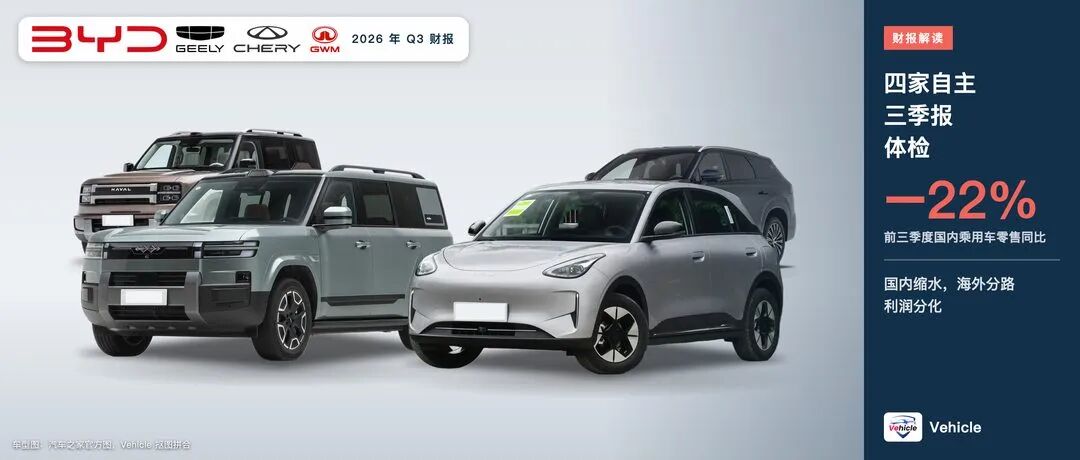
Looking across these four independent brands, Vehicle's assessment is this: the health of Chinese automakers now mainly depends on where they sell overseas and at what price they sell domestically; looking only at total sales volume would lead to the wrong conclusion.
The domestic market is likely to fall back below 2020 levels this year, and all four are using overseas markets to compensate, but their methods differ and so do the hurdles they must clear in 2027.
Below, drawing on the four companies' quarterly reports, production and sales bulletins, model retail sales and guide prices, we break down the first three quarters of China's four major independent automakers by profit, sales structure, overseas markets, price bands, health and trends.
01 Profit
Three Rising, Great Wall Falling · Net Profit & Per-Vehicle Profit
First, profit. In the third quarter, BYD's net profit attributable to shareholders was 10.02 billion yuan, up 28.1% year on year;
Geely's was 4.84 billion yuan, up 28.0%, with core profit excluding items such as exchange gains and losses at 5.21 billion yuan, up 32%;
Chery disclosed only the first three quarters; subtracting the first half from the nine-month figure gives third-quarter net profit attributable to shareholders of about 5.40 billion yuan, up roughly 16%;
Great Wall's was 1.36 billion yuan, down 40.8%, and only 980 million yuan after non-recurring items.
Extended to the first three quarters from January to September, the picture is less pretty.
BYD's net profit attributable to shareholders in the first three quarters was 22.35 billion yuan, down 4.2% year on year, and revenue of 566.3 billion yuan was almost flat with last year;
Geely's was 13.93 billion yuan, up 7%, with core profit of 14.90 billion yuan, up 41%;
Chery's was 13.96 billion yuan, down 2.8%; Great Wall's was 3.83 billion yuan, down 55.7%.
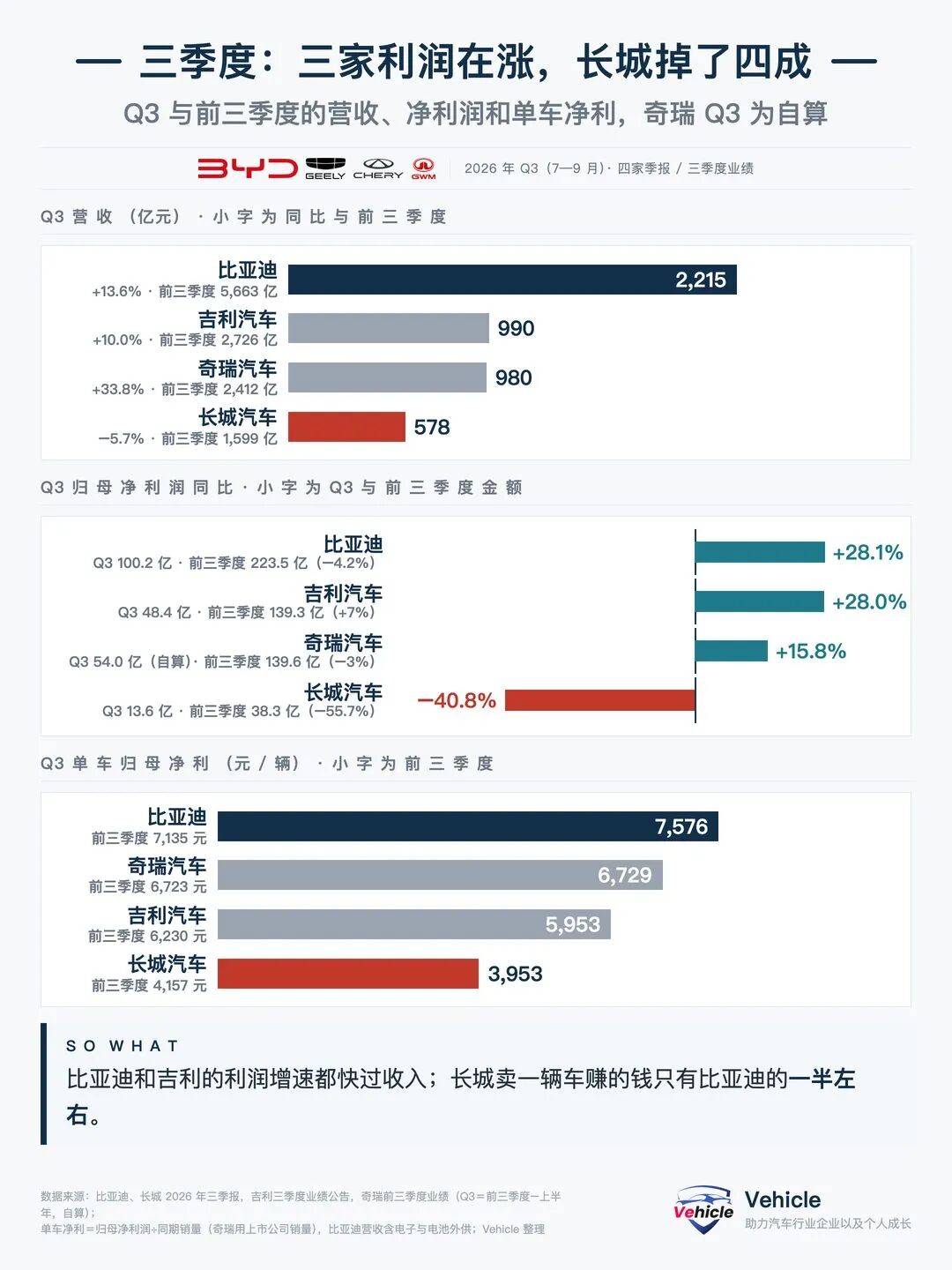
The four companies' Q3 revenue, year-on-year net profit attributable to shareholders and net profit per vehicle; small text refers to the first three quarters. Source: the four companies' 2026 third-quarter reports / earnings announcements; Chery Q3 and net profit per vehicle are calculated by Vehicle.
In a nutshell
Q3 net profit attributable to shareholders: BYD 10.02 billion, Chery about 5.40 billion, Geely 4.84 billion, Great Wall 1.36 billion (41%)
Overseas share from January to September: Chery Group 70.3%, Great Wall 51.7%, BYD 42.7%, Geely 35.7%
Q3 domestic retail sales fell across the board, with Great Wall down 27.6% the most and Chery down 8.9% the least
BYD sold 180,000 fewer vehicles in the 100,000–150,000 yuan band in Q3; Geely Xingyuan sold 116,000 in Q3; Great Wall's models above 150,000 yuan accounted for 69%
The EU hybrid quota takes effect on December 1, and the new energy vehicle export tax rebate will drop to 9% in April 2027
China Passenger Car Association: domestic retail sales in 2026 will be about 18.5 million vehicles, with growth of about 2% in 2027
Per-vehicle profit is more intuitive.
Based on a rough calculation of net profit attributable to shareholders divided by sales volume in the same period, in the third quarter BYD earned 7,576 yuan per vehicle sold, Chery's listed company 6,729 yuan, Geely 5,953 yuan and Great Wall 3,953 yuan;
for the first three quarters, the figures were 7,135 yuan, 6,723 yuan, 6,230 yuan and 4,157 yuan respectively.
Great Wall earns only a little more than half as much per vehicle as BYD.
BYD: Q3 sales volume was 1.323 million vehicles, up 18.8% year on year, including 548,000 overseas.
The gross margin of its automotive business was about 21.5%, down 1.5 percentage points quarter on quarter;
exchange gains and losses swung financial expenses by more than 10 billion yuan over the year, and profit was still below the market expectation of 12.1 billion yuan.
Geely: the average selling price in the first three quarters was 112,000 yuan, up 12%, and core profit per vehicle rose 37%.
Zeekr's revenue share rose from 17.7% last year to 31.3%, and Geely's profit is shifting toward higher-priced vehicles.
Chery: the gross margin in the first three quarters was 16.17%, up 2.46 percentage points, gross profit grew 32%, and R&D investment was 11 billion yuan, up 40%.
Profit growth could not keep pace with gross profit because of exchange gains and losses: this year's exchange loss was 3.17 billion yuan, compared with a gain of nearly 3 billion yuan in the same period last year.
Great Wall's problems are more specific.
For the vehicle scrappage tax subsidy in Russia, about 3 billion yuan was recognized in the same period last year, but only 470 million yuan was recognized in the first half of this year, and about 1.9 billion yuan had not yet arrived because of delays in government approval;
the company attributed the profit decline to "continued pressure from competition in the domestic auto market, delayed recovery of subsidy income under overseas tax policies, and exchange rate fluctuations."
The three companies' profits are rising, relying on overseas markets and high-priced vehicles; Great Wall's profit is falling, half because of the domestic market and half because of Russia.
02 Domestic and Overseas
70%, 50%, 40% · Domestic vs Overseas
Breaking down sales volume, the domestic and overseas structures of the four companies are already completely different.
Chery Group: sold 849,000 vehicles in Q3, exported 607,000, accounting for 71.5%;
from January to September, cumulative sales were 2.207 million vehicles, exports 1.551 million, accounting for 70.3%, with exports up 65.6% year on year.
Domestic sales from January to September were only 656,000 vehicles, down about 40% from last year.
Great Wall: 345,000 vehicles in Q3, 187,000 overseas, accounting for 54.3%, with overseas up 37.9% year on year, and 158,000 domestically, down 28.0%;
from January to September, 920,000 vehicles, 476,000 overseas, accounting for 51.7%.
BYD: 1.323 million vehicles in Q3, 548,000 overseas, accounting for 41.5%;
from January to September, 3.132 million vehicles, down 3.9% year on year, 1.338 million overseas, up 91.9%, accounting for 42.7%, already exceeding last year's full-year total.
Geely: 813,000 vehicles in Q3, 323,000 exported, up 189%, accounting for 39.8%;
from January to September, 2.236 million vehicles, 798,000 exported, up 169%, accounting for 35.7%.
Based on a rough calculation of wholesale minus exports, Geely's domestic sales in Q3 fell by about 25%.
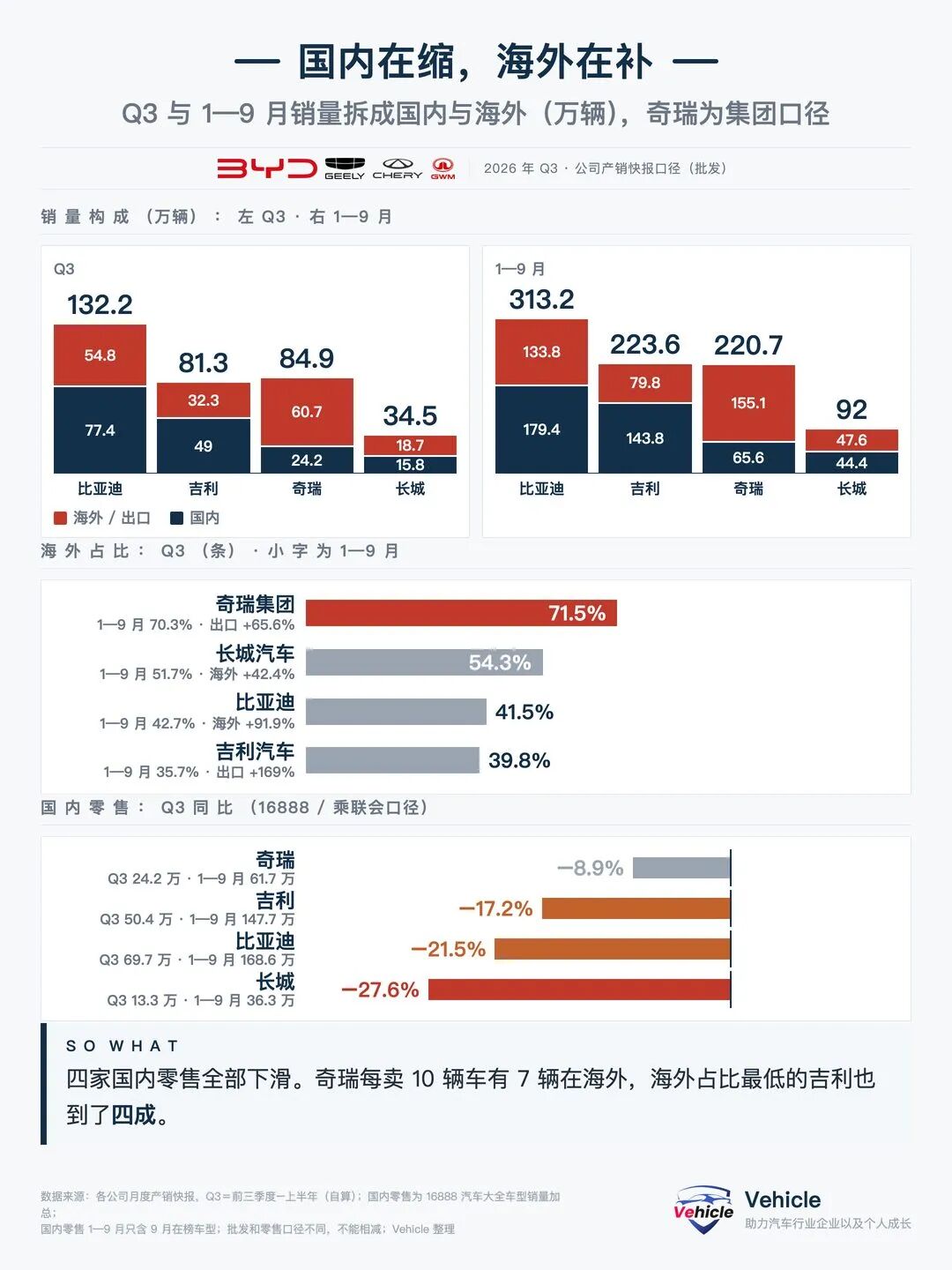
The domestic and overseas composition of the four companies' Q3 and January–September sales volumes, as well as year-on-year domestic retail sales. Source: each company's production and sales bulletin (Q3 is self-calculated), 16888 Auto Encyclopedia
For the domestic part, terminal retail sales are more accurate.
The model retail data from 16888 Auto Encyclopedia uses the same methodology as the China Passenger Car Association. We added up all listed models of the four companies: in Q3, BYD's domestic retail sales were 697,000 vehicles, down 21.5% year on year, and 1.686 million from January to September;
Geely's Q3 was 504,000 vehicles, down 17.2%, and 1.477 million from January to September;
Chery's Q3 was 242,000 vehicles, down 8.9%, and 617,000 from January to September;
Great Wall's Q3 was 133,000 vehicles, down 27.6%, and 363,000 from January to September.
Domestic retail sales of all four fell, basically in sync with the 21.7% decline in national passenger car retail sales in the first three quarters.
Chery fell the least because its domestic base was already small and two new models, the QQ3 and Zhijie V9, added volume.
A 20% domestic decline is the common situation of all four; the difference lies in how much overseas markets compensate: Chery compensates the most and Geely the least.
03 Overseas Map
Where the Four Are Betting Differs · Export Destinations
Overseas sales are likewise several hundred thousand vehicles, but where they are sold makes a big difference to profit and risk. The China Passenger Car Association and AutoNet publish automakers' export destinations every month; we take the most recent August to look at the structure.
BYD: exported 142,000 vehicles in August, with the EU, the UK and the European Free Trade Association accounting for 38% combined, Central and South America 14%, Southeast Asia 13%, and the CIS only 11%.
By country, the largest export destination from January to August was Brazil with 209,000 vehicles, followed by Australia with 81,000, the UK with 67,000 and Belgium with 67,000.
BYD sold 284,000 vehicles in Europe from January to September, up 134.6%.
Chery: the top ten export regions in August totaled 199,000 vehicles, with the EU, the UK and the European Free Trade Association accounting for 27%, the CIS 26%, Central and South America 14%, and the Middle East 13%.
Chery sold 234,000 vehicles in 24 European countries from January to August, up 193%, and in September it ranked first in brand sales in the UK for the second consecutive month, with the JAECOO 7 the best-selling model across all vehicle types in the UK.
Geely: Geely Holding exported 107,000 vehicles in August, with the CIS accounting for 27%, the EU, the UK and the European Free Trade Association 17%, Central and South America 15%, Africa 14%, and Southeast Asia 13%—the most scattered distribution among the four.
Goldman Sachs data show that in the first half, the EU accounted for only 10% of Geely's overseas retail sales.
Great Wall: Great Wall disclosed terminal retail sales in 17 countries, totaling 36,000 vehicles in August, with Russia accounting for 40%, Brazil 27%, Australia 13%, South Africa 7%, and the EU almost zero.
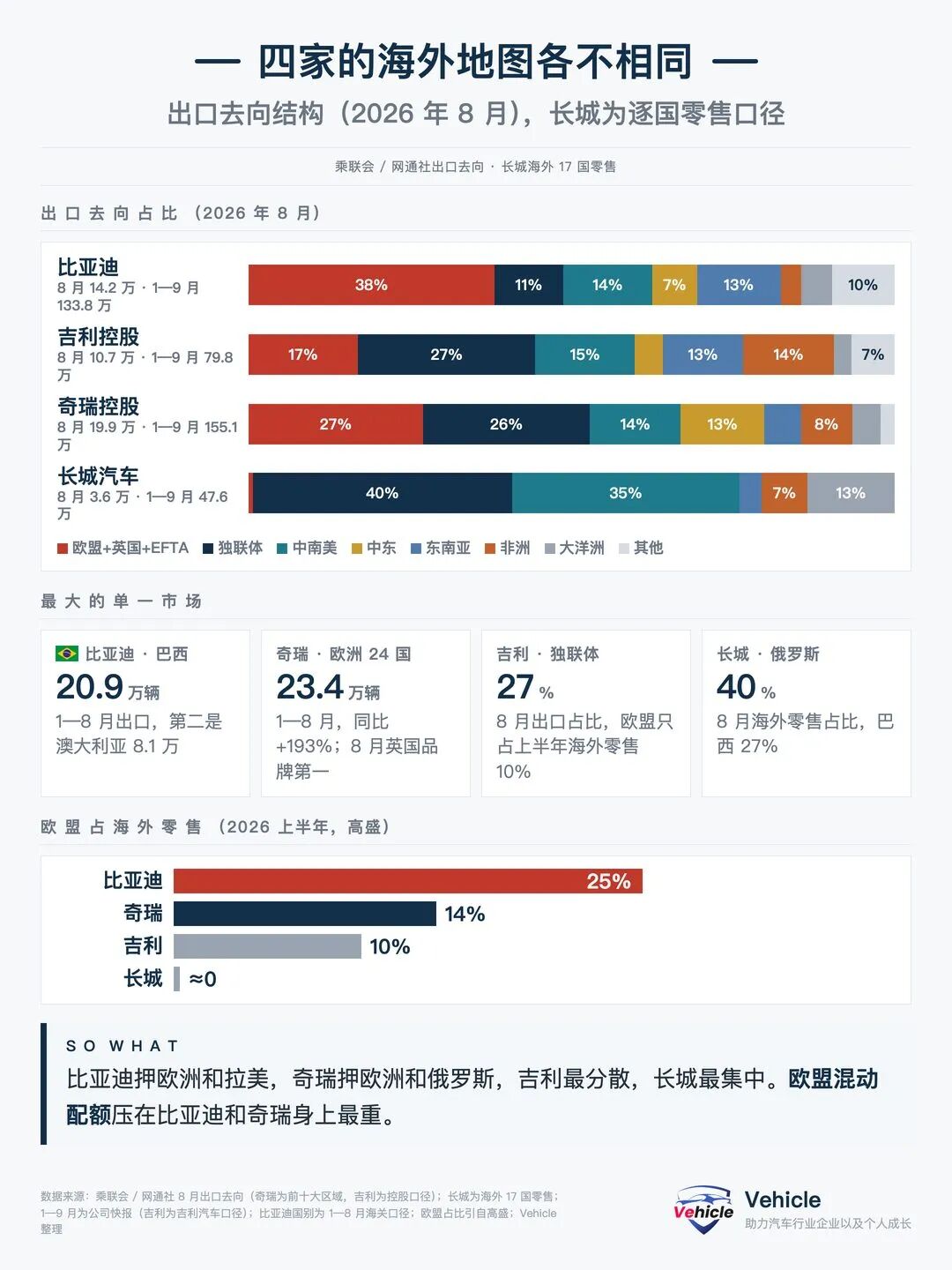
The export destination structure and largest single market of the four companies in August 2026; small text refers to total overseas sales from January to September. Source: China Passenger Car Association / AutoNet, Great Wall overseas retail, Goldman Sachs
This map determines who will suffer more in 2027.
Starting December 1, the EU will set an annual quota for hybrids of 350,000 vehicles per year, shared by China, Japan and South Korea; vehicles exceeding the quota will not be able to enter at the port;
JPMorgan data show that 52% of BYD's vehicles exported to the EU this year are plug-in hybrids.
Great Wall's risk is concentrated in Russia: the scrappage tax rises every year, subsidy arrival depends on approval, and the ruble exchange rate directly hits the income statement.
The benefit of Geely's diversification is that problems in any one market cannot hurt the foundation, but the cost is that no market is deep enough.
Its "123456" goal is to sell 2 million vehicles overseas in 2 to 3 years, with pan-Europe, ASEAN, Latin America and Africa, Eastern Europe, and Central Asia and the Middle East each taking 600,000 to 200,000 vehicles in sequence.
BYD is betting on Europe and Latin America, Chery on Europe and Russia; Geely is the most diversified and Great Wall the most concentrated; the EU hybrid quota weighs most heavily on BYD and Chery.
04 BYD's Price Bands
The Domestic Center of Gravity Is Moving Up · Price-Band Mix
For the four sections of price bands, we classify each model into six price bands based on the midpoint of the official guide price, and then look at how many were sold in Q3 and from January to September.
BYD's changes are most concentrated in the 100,000–150,000 yuan range.
In this price band, 270,000 vehicles were sold in Q3, 180,000 fewer than 450,000 in the same period last year, a decline of 40%, with the share falling from about half to 38.8%;
from January to September, cumulative sales were 691,000 vehicles, accounting for 41.0%.
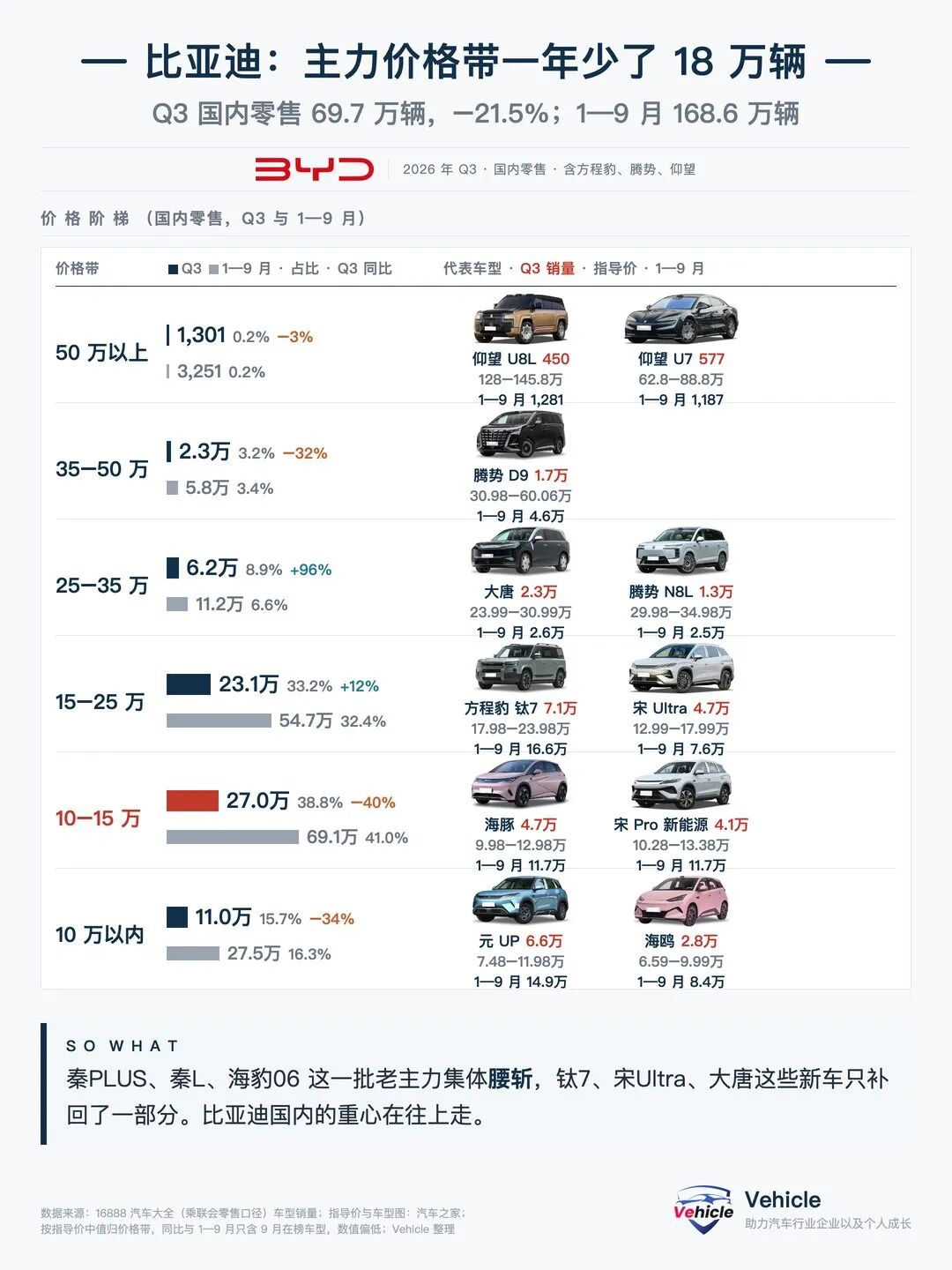
The price-band distribution and representative models of BYD (including Fangchengbao, Denza and Yangwang) domestic retail sales in Q3 and January–September. Source: 16888 Auto Encyclopedia, Autohome, compiled by Vehicle
What fell were the old mainstays. The Qin PLUS sold 33,000 vehicles in Q3, compared with 106,000 in the same period last year;
the Qin L sold 17,000, compared with 77,000 last year; the Seal 06 sold 36,000, compared with 73,000 last year.
The Dolphin and Song Pro New Energy basically held their ground, selling 47,000 and 41,000 vehicles respectively in Q3.
What filled the gap was at higher price points.
In the 150,000–250,000 yuan range, 231,000 vehicles were sold in Q3, up 12%, and 547,000 from January to September, led by the Fangchengbao Tai 7, with 71,000 in Q3 and 166,000 from January to September, plus the newly launched Song Ultra, with 47,000 in Q3;
in the 250,000–350,000 yuan range, 62,000 vehicles were sold in Q3, nearly doubling, driven by the Datang and Denza N8L.
The three brands Fangchengbao, Denza and Yangwang sold a total of 410,000 vehicles from January to September, up 75%.
The below-100,000 yuan segment is also shrinking. The Yuan UP sold 66,000 in Q3, more than last year, while the Seagull sold only 28,000, compared with 71,000 in the same period last year, and the entire price band fell 34%.
BYD is using new cars to push its domestic center of gravity above 150,000 yuan; new cars have only made up part of the share relinquished by old models.
05 Geely's price bands
Growing at both ends, shrinking in the middle · Price-band mix
Geely's price bands are dumbbell-shaped.
Below 100,000 yuan, 188,000 vehicles were sold in Q3, accounting for 37.3%, and 540,000 from January to September, accounting for 36.6%, the heaviest among the four at this price point.
Supporting this end is the Xingyuan, with 116,000 in Q3 and 310,000 from January to September; a single model accounts for nearly a quarter of Geely's domestic retail sales.
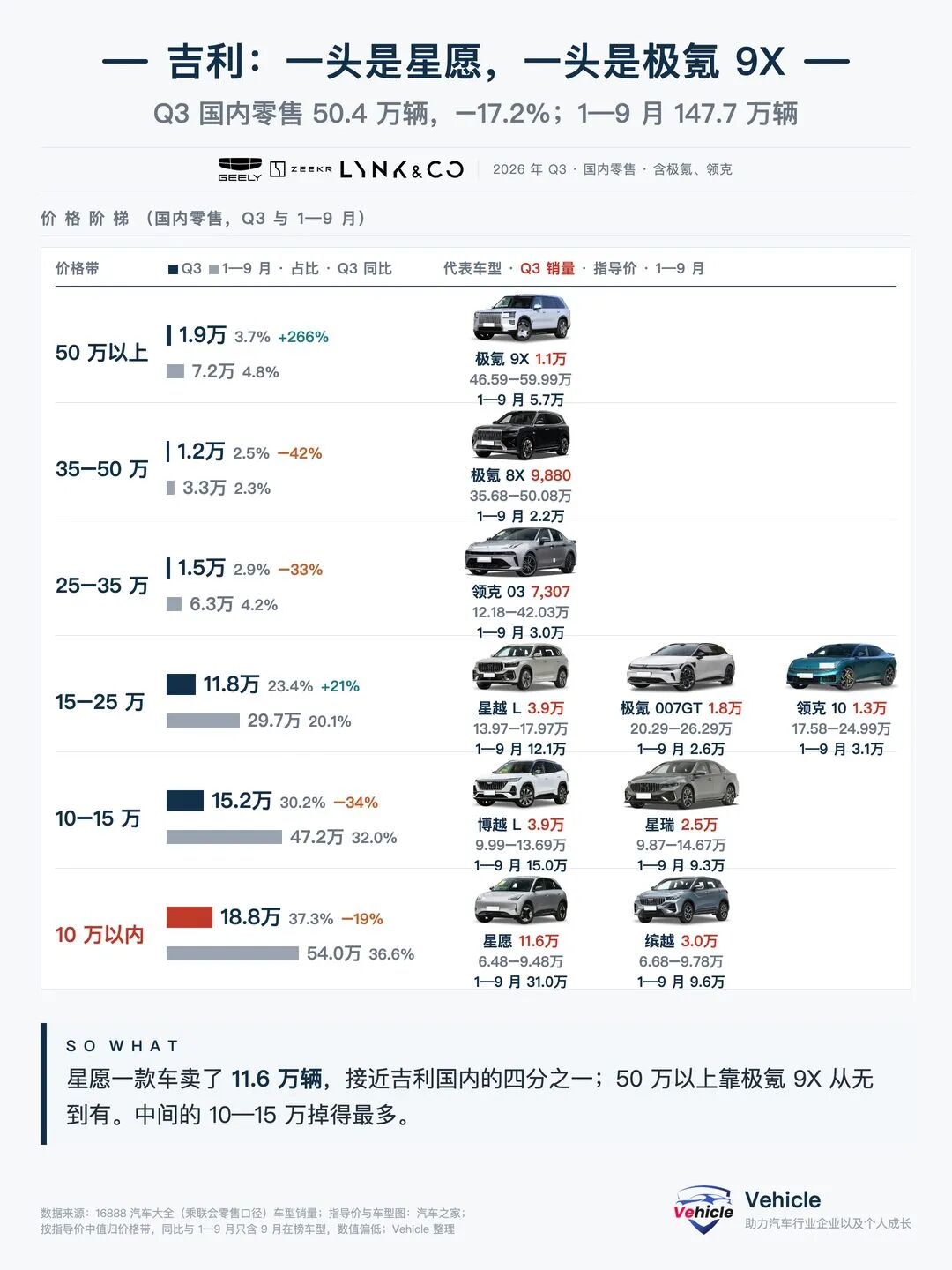
The price-band distribution and representative models of Geely (including Zeekr and Lynk & Co) domestic retail sales in Q3 and January–September. Source: 16888 Auto Encyclopedia, Autohome, compiled by Vehicle
The other end is Zeekr.
In the third quarter, 19,000 vehicles were sold in the above-500,000-yuan segment, up 266%, of which the Zeekr 9X accounted for 11,000, versus almost zero in the same period last year;
in the 150,000-to-250,000-yuan segment, 118,000 vehicles were sold in the third quarter, up 21%, with the Xingyue L, Zeekr 007GT, and Lynk & Co 10 as the mainstays.
From January to September, Zeekr sold 288,000 vehicles globally, up 101%, and its share of revenue rose to more than 30%.
What is shrinking is the middle.
In the 100,000-to-150,000-yuan segment, 152,000 vehicles were sold in the third quarter, down 34%; the Boyue L sold 39,000 in the third quarter, versus 73,000 in the same period last year.
This price range is exactly where the BYD Dolphin, Song Pro, and various new models from all brands are most densely concentrated.
After the earnings announcement, Gui Shengyue said this year's operating environment was the "most severe" in recent years and that he was "not satisfied" with the performance.
Geely's full-year target of 3.45 million vehicles was 64.8% completed in the first three quarters.
Geely is using the Xingyuan to defend the entry-level price range and Zeekr to raise the average price, while in the most fiercely contested 100,000-to-150,000-yuan range it is instead ceding share.
06 Chery's price bands
Smallest domestic base, largest overseas · Price-band mix
Chery's domestic retail sales in the third quarter were 242,000 vehicles, and 617,000 from January to September, more than only Great Wall among the four.
In terms of structure, the 100,000-to-150,000-yuan segment sold 109,000 vehicles in the third quarter, accounting for 45.0%, and 288,000 from January to September, accounting for 46.7%. The Tiggo 8, Arrizo 8, Exeed, and Jetour models in this price range underpin half of Chery's domestic sales.
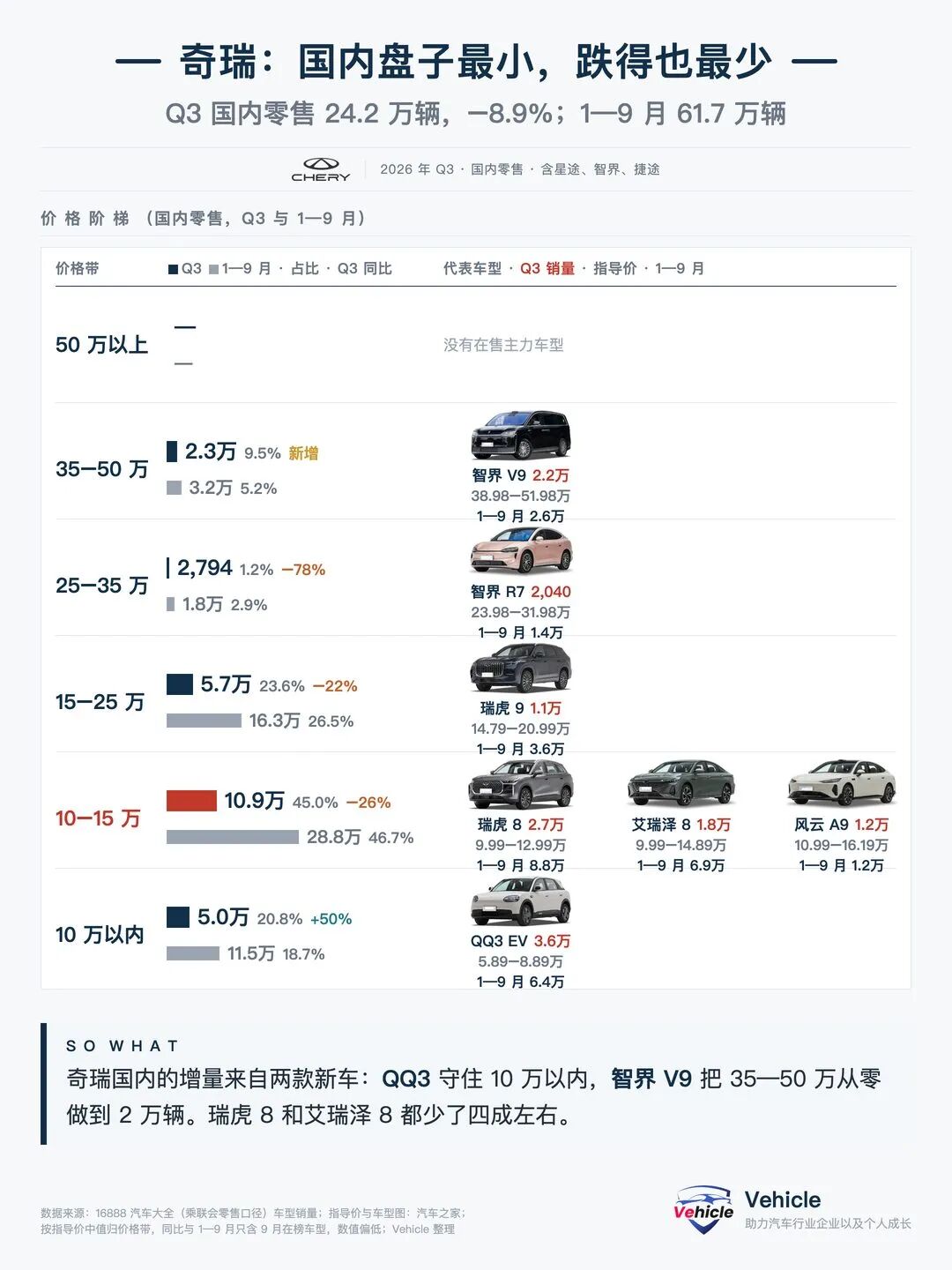
Price-band distribution and representative models of Chery (including Exeed, Luxeed, and Jetour) domestic retail sales in Q3 and January–September. Source: 16888 Auto Encyclopedia, Autohome, compiled by Vehicle
Old models are falling. The Tiggo 8 sold 27,000 in the third quarter, versus 46,000 in the same period last year;
the Arrizo 8 sold 18,000 in the third quarter, versus 37,000 last year.
New models are filling the gap: the QQ3 EV sold 36,000 in the third quarter, increasing sales below 100,000 yuan by 50% year on year;
the Luxeed V9, developed with Huawei, sold 22,000 in the third quarter and 26,000 from January to September, building Chery's presence in the 350,000-to-500,000-yuan range from zero.
Chery's domestic decline was the smallest because it had long since shifted its focus overseas.
In the first half, Chery's overseas revenue was 99 billion yuan, accounting for 69% of total revenue, while domestic revenue fell by more than 40% year on year.
Third-quarter revenue grew by about 34%, mainly also from exports.
Yin Tongyue recently said at the World Intelligent Connected Vehicles Conference that when Chinese automakers go global, they should "not engage in price wars" and "must use local supply chains to take root."
Chery revitalized Nissan's old Barcelona plant in Spain and acquired the Rosslyn plant in South Africa, aiming for a localization rate of 40% by 2028.
Chery's domestic business is stopping the decline with new models, while its profits and growth are bet on overseas markets. Its health depends on how quickly its overseas plants can absorb exports.
07 Great Wall's price bands
Above 150,000 yuan accounts for 70% · Price-band mix
Great Wall has the highest price structure among the four.
In the 150,000-to-250,000-yuan segment, it sold 59,000 vehicles in the third quarter, accounting for 44.3%, and 129,000 from January to September, accounting for 35.6%;
adding together everything above 150,000 yuan, it accounted for 69% in the third quarter.
Below 100,000 yuan, only the Ora Good Cat remains, with 3,139 units in the third quarter, down 73% year on year.
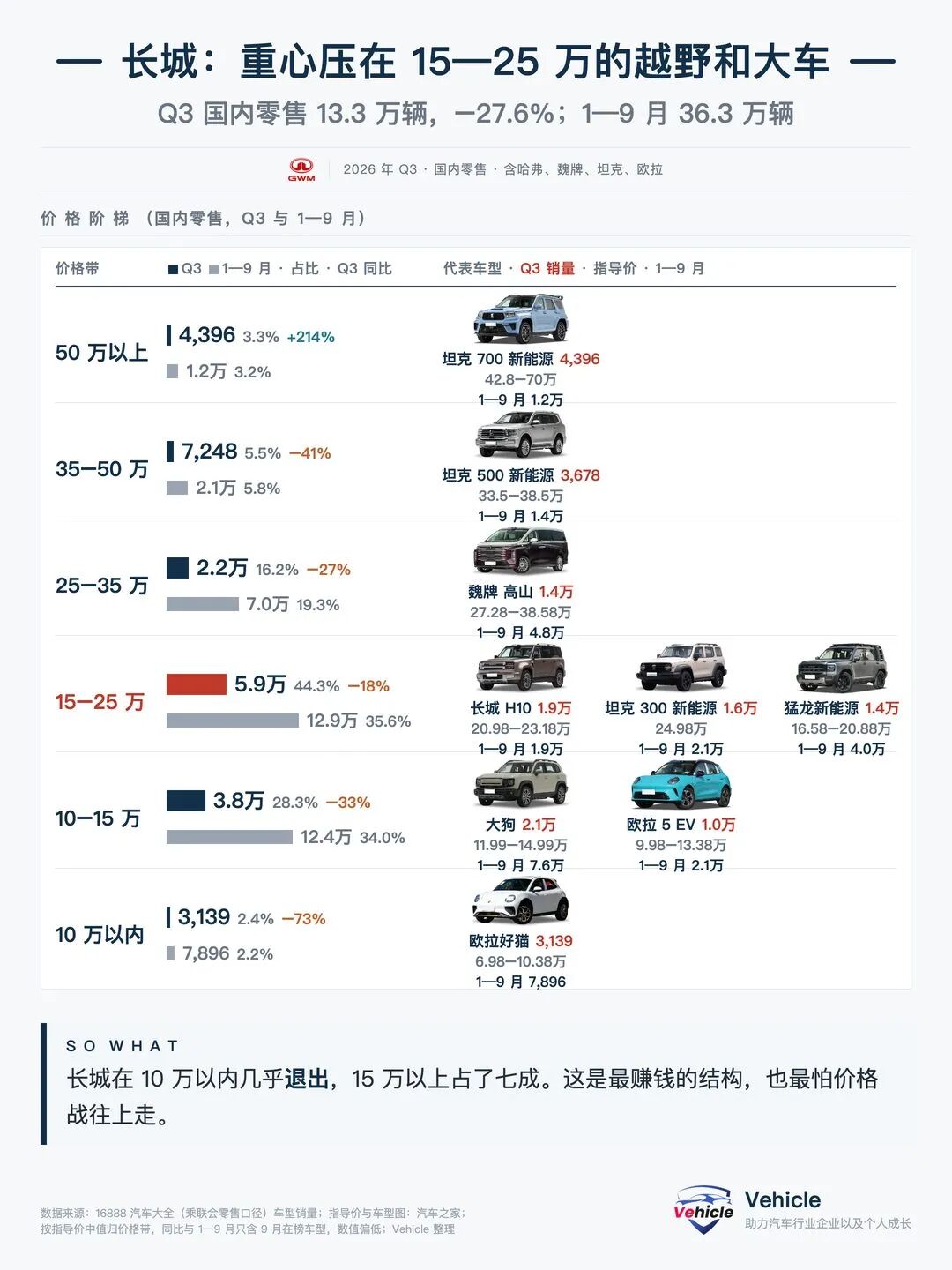
Price-band distribution and representative models of Great Wall (including Haval, WEY, Tank, and Ora) domestic retail sales in Q3 and January–September. Source: 16888 Auto Encyclopedia, Autohome, compiled by Vehicle
Great Wall's new models in the third quarter were the Great Wall H10, with 19,000 units in the third quarter, the Tank 300 New Energy with 16,000, the Haval Menglong New Energy with 14,000, and the WEY Alpine with 14,000.
The old mainstay Haval Big Dog sold 21,000 in the third quarter, versus 41,000 in the same period last year, almost halving;
the Tank brand sold 143,000 from January to September, down 13.5%.
This structure yields high per-vehicle revenue, about 168,000 yuan in the third quarter, more than 40,000 yuan higher than Geely and Chery, yet per-vehicle profit is the lowest.
The first reason is that domestic sales are shrinking, so fixed costs cannot be spread;
the second is that Great Wall's overseas profit is concentrated in Russia, and if subsidies do not arrive, a piece of profit is missing.
Great Wall's employee stock ownership assessment target this year is a net profit of 10 billion yuan, but only 3.83 billion yuan was completed in the first three quarters.
Great Wall has the highest product prices but the lowest profit margin; neither domestic scale nor Russian subsidies have connected.
08 Health check
Look beyond profit to cash and risk · Cash, inventory, FX
Looking only at the income statement misses several things. We put the four companies' cash, turnover, and risk points in one table.
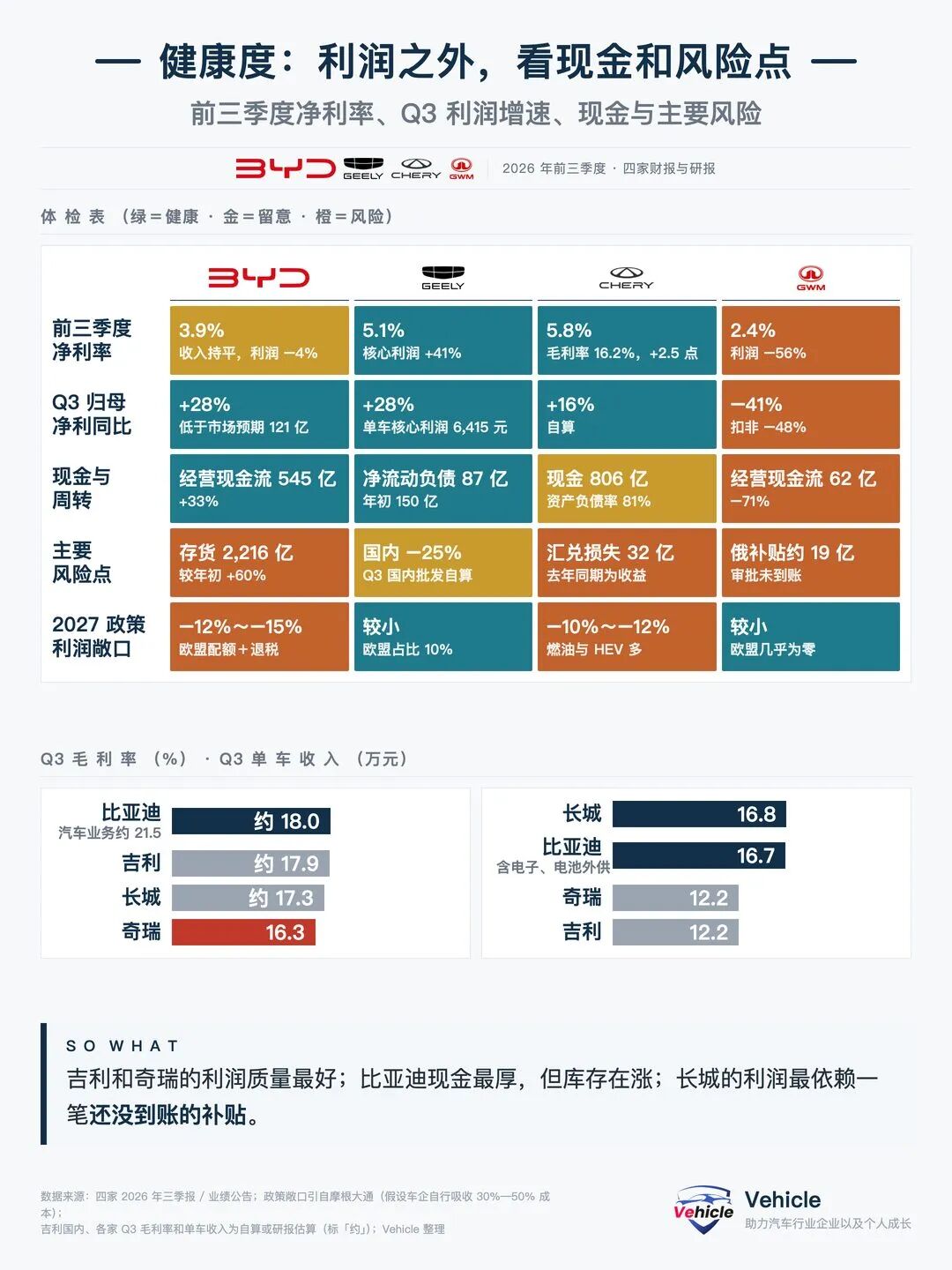
The four companies' net margins in the first three quarters, Q3 profit growth, cash and main risks, 2027 policy exposure, as well as Q3 gross margins and per-vehicle revenue. Source: the four companies' third-quarter reports, JPMorgan; some figures are self-calculated by Vehicle or estimated in research reports
BYD: operating cash flow in the first three quarters was 54.5 billion yuan, up 33%, the thickest cash among the four.
The risk is on the other side of the balance sheet: inventory was 221.6 billion yuan, up 60% from the beginning of the year, and notes payable were up 2.5 times from the beginning of the year, with overseas plants and new models both consuming cash.
Net margin in the first three quarters was 3.9%.
Geely: net margin in the first three quarters was 5.1%, core profit grew 41%, and the gap by which current liabilities exceeded current assets fell from 15 billion yuan at the beginning of the year to 8.7 billion yuan, showing balance-sheet improvement.
Its risk is domestic: third-quarter domestic wholesale fell by about a quarter, and the full-year target still has a gap of 1.21 million vehicles.
Chery: net margin in the first three quarters was 5.8%, the highest among the four, with cash of 80.6 billion yuan.
The asset-liability ratio of 81% is on the high side, overseas revenue accounts for 70%, and foreign exchange alone consumed more than 3 billion yuan in a year.
Great Wall: net margin in the first three quarters was 2.4%, operating cash flow was 6.2 billion yuan, down 71%.
Whether about 1.9 billion yuan in Russian subsidies can arrive before the end of the year is the biggest variable for Great Wall's profit this year; Citi believes the probability of receipt is low.
Gross margins are actually quite close among the four, all between 16% and 18% in the third quarter; the difference lies below gross profit: foreign exchange, subsidies, R&D investment, and selling expenses.
In 2027, another policy cost will be added.
JPMorgan estimates that, assuming automakers absorb 30% to 50% of the cost themselves, EU quotas plus a cut in export tax rebates will reduce BYD's 2027 profit by 12% to 15%, Chery's by 10% to 12%, with smaller impact on Geely and Great Wall.
Among the four, Geely and Chery have the best profit quality, BYD has the thickest cash but rising inventory, and Great Wall's profit depends most on a subsidy that has not yet arrived.
09 What comes next
Q4 gap and 2027 · Q4 targets & 2027
First, look at how much needs to be sold in the fourth quarter. The full-year target minus the first three quarters is the fourth-quarter gap.
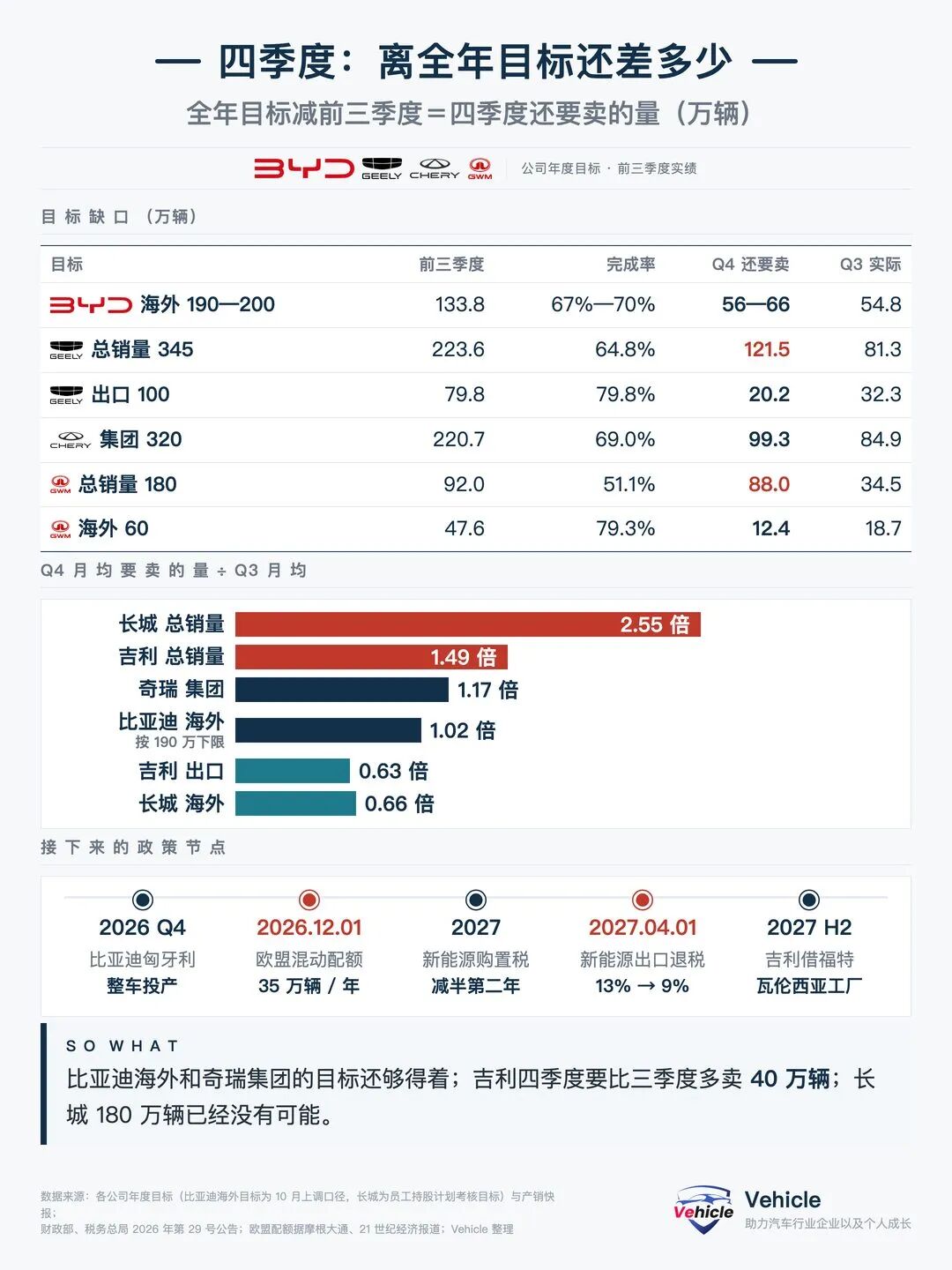
The four companies' annual targets, first-three-quarter completion, Q4 gaps, and upcoming policy nodes. Source: each company's annual targets and production and sales bulletins, self-calculated by Vehicle
BYD: overseas target is 1.9 million to 2 million vehicles, with 1.338 million in the first three quarters, leaving 560,000 to 660,000 in the fourth quarter, or 190,000 to 220,000 per month on average. The third-quarter monthly average was 183,000, and September already reached 181,000, so the lower bound is within reach.
Based on a rough estimate of 9 billion to 11 billion yuan in fourth-quarter profit, BYD's full-year net profit attributable to shareholders is 31 billion to 33.5 billion yuan, basically flat with last year's 32.6 billion yuan.
The Hungarian plant will start production in the fourth quarter and is key to hedging EU quotas next year.
Geely: against the target of 3.45 million vehicles, it needs to sell 1.215 million in the fourth quarter, 400,000 more than in the third quarter.
We estimate Geely's full-year sales at around 3.1 million, up about 10% from last year.
The export target is 1 million vehicles; only 200,000 are needed in the fourth quarter, while 320,000 were already sold in the third quarter, so it will substantially exceed the target.
In the second half of 2027, with production starting at Ford's Valencia plant, Geely will finally have its own capacity in Europe.
Chery: against the group target of 3.2 million vehicles, it needs to sell 993,000 in the fourth quarter, 17% more than in the third quarter; last year's fourth quarter was 798,000.
We estimate full-year sales at 3.05 million to 3.15 million.
Chery's pressure is next year: more than 60% of its overseas sales are fuel vehicles and ordinary hybrids, and both the export tax rebate cut and EU quotas will hit it.
Great Wall: against the assessment target of 1.8 million vehicles, it needs to sell 880,000 in the fourth quarter, 2.5 times the third quarter, which is already impossible;
we estimate full-year sales at around 1.3 million. The overseas target of 600,000 requires only 124,000 in the fourth quarter, which can be completed.
Great Wall's only remaining highlights this year are two: whether Russian subsidies arrive, and whether new models such as the H10 and Alpine can stop the domestic decline.
In the fourth quarter, BYD and Chery are still pushing toward targets, while Geely's and Great Wall's total-volume targets will both be missed. In 2027, all four will first have to get through the policy hurdle.
10 China's auto market
Domestic bottoming, exports facing hurdles · China market outlook
Put the four back into the industry context.
According to CAAM data, automobile sales in the first three quarters were 23.271 million, down 4.5%, of which domestic sales were 15.066 million, down 22.4%, and exports were 8.205 million, up 65.8%, with the export share rising from 20.3% last year to 35.3%.
The CPCA's retail data is more direct: from January to September, domestic passenger car retail sales were 13.334 million, down 21.7%, and October is expected to be down nearly 30%.
Cui Dongshu expects full-year retail sales this year to be only about 18.5 million, about 5.2 million fewer than 2025's 23.74 million and even lower than the 2020 trough of 19.29 million.
His explanation is that several factors have overlapped: oil prices, memory and raw material price increases brought by AI, diminishing effects of trade-ins, and demand pull-forward at the end of last year.
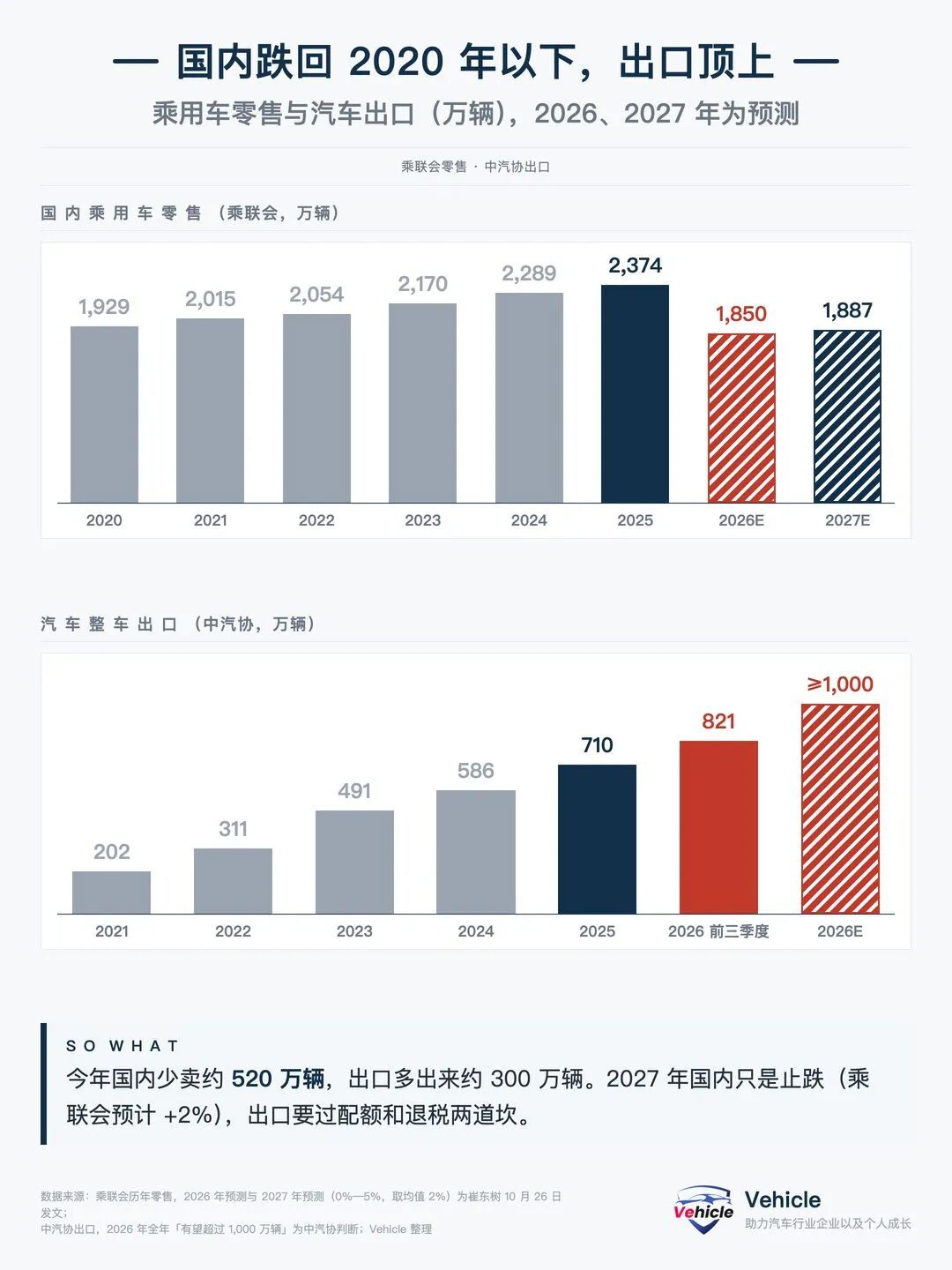
Domestic passenger car retail sales from 2020 to 2027 and automobile exports from 2021 to 2026; 2026 and 2027 are forecasts. Source: CPCA, CAAM, Cui Dongshu's article on October 26
For the domestic market in 2027, the CPCA's judgment is retail growth of 0% to 5%, averaging 2%, or around 18.9 million vehicles, a "weak recovery after bottoming."
Support comes from the second year of the halved purchase tax, the Year of the Horse Spring Festival, and falling oil and lithium carbonate prices.
CAAM expects exports to exceed 10 million vehicles this year—about 3 million more than last year—largely offsetting the decline in domestic sales.
Exports will face two hurdles next year.
First, the EU's hybrid quota, set at 350,000 vehicles per year starting December 1; JPMorgan expects the EU to import about 800,000 hybrid vehicles from China this year.
Second, the new energy vehicle export tax rebate will be cut from 13% to 9% starting April 1, 2027, which, according to estimates by Deloitte and brokers, will consume about 4% of the free-on-board price.
In the months before the rebate cut, there will be a rush of exports, after which growth will fall.
We estimate that China's automobile export growth in 2027 will fall from more than 60% this year to 10%–20%, with more incremental growth coming from local production at overseas plants and the share of complete vehicle exports declining.
In China's auto market in 2027, the domestic market will most likely only stop falling, and exports will still grow but at a notably slower pace; automakers will have to find incremental growth from overseas plants.
11 Reference for Chinese auto industry players
Overseas, price bands, hit models, plants, cash · So what
When looking overseas, do not look only at totals. With the same 40% overseas share, selling to Europe, Latin America, or Russia means completely different profits and risks.
BYD's and Chery's European businesses earn more, but quotas weigh most heavily on them; Great Wall's Russian business is stable but constrained by geopolitical subsidies.
When planning overseas operations, calculating profit and policy exposure by region is more useful than ranking by number of countries.
The domestic price bands are diverging at both ends. BYD is pushing above 150,000 yuan, Geely is defending below 100,000 yuan and lifting Zeekr, and the 100,000-to-150,000-yuan range has become the most crowded place, where old models can lose half their sales in a year.
When making products in this price range, replacement cycles and pricing both need to be faster than before.
The lifespan of hit models has shortened. The Qin PLUS, Qin L, Seal 06, Boyue L, Tiggo 8, and Haval Big Dog all fell by 40% to 70% within a year.
New models such as the Ti 7, Xingyuan, QQ3, and H10 are also ramping up quickly.
For parts suppliers, the risk of betting on a single model is much greater than two or three years ago.
Overseas plants need to be earlier. The EU exempts only local production; simple assembly via third countries is counted as Chinese origin;
export tax rebates may continue to be cut.
BYD's Hungary plant, Chery's Spain plant, and Geely's use of Ford's Spain plant are all racing against time, and the window for suppliers to go overseas with them is only in the next year or two.
Look at three numbers below the income statement: operating cash flow, inventory, and foreign exchange.
This year, three of the four had profits affected by foreign exchange by several billion yuan, BYD's inventory rose 60% in a year, and Great Wall's subsidy is sitting on the books.
The larger the overseas business, the more these three numbers need to be watched monthly.
12 Final notes
Watch these nodes next
Looking at the four together, my impression from the third quarter of 2026 is this: Chinese independent brands have overall become companies with half their business in China and half overseas. Domestically, they compete on price bands and replacement speed; overseas, they compete on regional layout and local production capacity.
BYD has the largest scale and the thickest cash, and is moving upward from the domestic price war;
Geely has the best profit quality, started overseas late, and has the most scattered layout;
Chery went overseas earliest, with overseas revenue accounting for 70%, and next year will face the most direct policy impact;
Great Wall has the highest prices, but scale and subsidies have not connected.
As for next year, the domestic price war will continue, overseas rules will increase, and who is healthier in 2027 will depend on whose overseas plants start first and whose domestic new models gain traction first.
This article is based on public disclosures and media reports from BYD, Geely, Chery, and Great Wall, and includes forward-looking statements by management and the author's judgments. It is for reference only and does not constitute any investment advice.
*Reproduction and excerpting without permission are strictly prohibited-
-
![]()
Is Honda Going to Reinvent the Assembly Line?
-
![]()
BMW Completes 1 Million Autonomous Vehicle Transfers Without Ever Touching a Public Road: Does This "Counterintuitive" Case Burst the Industry's Biggest Bubble?
-
October New EV Delivery Rankings: The End of the "Wei-Xiao-Li" Era as Leapmotor, Xpeng, and Xiaomi Take the Spotlight
-
![]()
You Can Now Create "Photorealistic" Worlds and Characters — Complete with Voice Interaction
-
![]()
Ultrafast Nonlinear Optics Technology No. 106: Deep-Ultraviolet Ultra-Broadband Transient Absorption
-
![]()
What Kind of New AITO M8 Did 1.5 Billion Yuan in R&D Investment Create?
-
![]()
Tesla's Latest Move: The "Price Cut" Is All About the Math
-
![]()
Top Four Independent Automakers in Q3 2026: Domestic Shrinkage, Divergent Overseas Paths, Diverging Profits