Volkswagen: Would Rather "Court Death" Than "Wait for Death"
 11/02 2026
 558
Introduction
For an automotive giant selling 9 million vehicles a year, the biggest risk is not change itself.
"We have no time to waste. We must act quickly and decisively."
On October 29, in Wolfsburg, Germany, Volkswagen Group, as usual, presented its third-quarter financial report to the world. Volkswagen CFO Arno Antlitz made this statement during the third-quarter earnings conference call jointly livestreamed by investors, analysts, and media—and his tone was anything but polite.
The reason: Volkswagen Group's performance in the first three quarters was far from ideal.
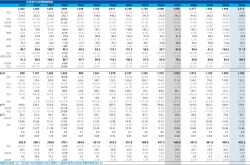
Data shows that in the first three quarters, Volkswagen Group's revenue was 233.378 billion euros, down 2.2% year-on-year; operating profit was only 71 million euros, a year-on-year plunge of 98.7%; and the after-tax loss was directly 2.72 billion euros, turning from profit to loss.
What does 71 million euros mean? It means that for an industrial giant delivering 9 million vehicles a year and employing more than 600,000 people, after nine months of work, the money earned was not even enough to buy two buildings at its Wolfsburg headquarters.
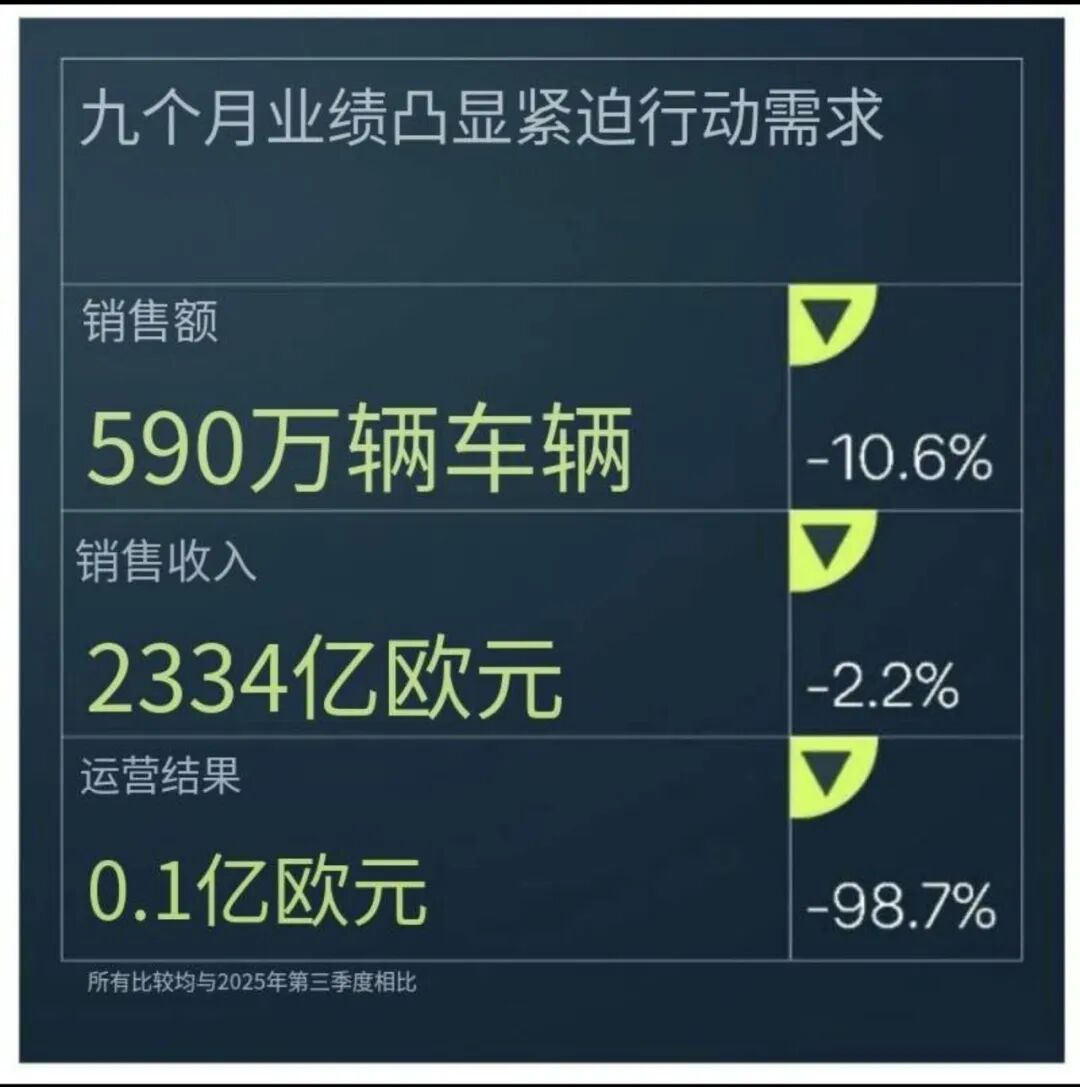
Not only that, but if the income statement is broken down, there is a special charge of 8.7 billion euros, of which 6.4 billion euros is goodwill impairment for Porsche, and 1 billion euros is directly written off against assets in the China region. In other words, Volkswagen itself admits that its two former most profitable cash cows—the Porsche brand and the Chinese market—are no longer so profitable.
Beyond the financial report, sales are also unimpressive.
According to data published by Volkswagen Group, in the first three quarters of 2026, Volkswagen Group delivered 6.011 million vehicles worldwide, down 9% year-on-year; in the third quarter alone, global deliveries were 1.885 million vehicles, down 14.3% year-on-year. Apart from a few markets such as Europe and South America that barely maintained positive growth, almost all regions were receding—and the sharpest decline was precisely in China.
It was this collapse in financial data and sales that led Antlitz to say the sentence later repeatedly quoted: "The group no longer has any buffer time and must quickly implement reform measures." Clearly, what Volkswagen Group needs is no longer patching things up, but a top-down self-rescue that is decisive to the point of almost brutal.
01 Winter in Wolfsburg
Turn the clock back three months. On July 9, 2026, the Volkswagen Supervisory Board held a day-long meeting in Wolfsburg.
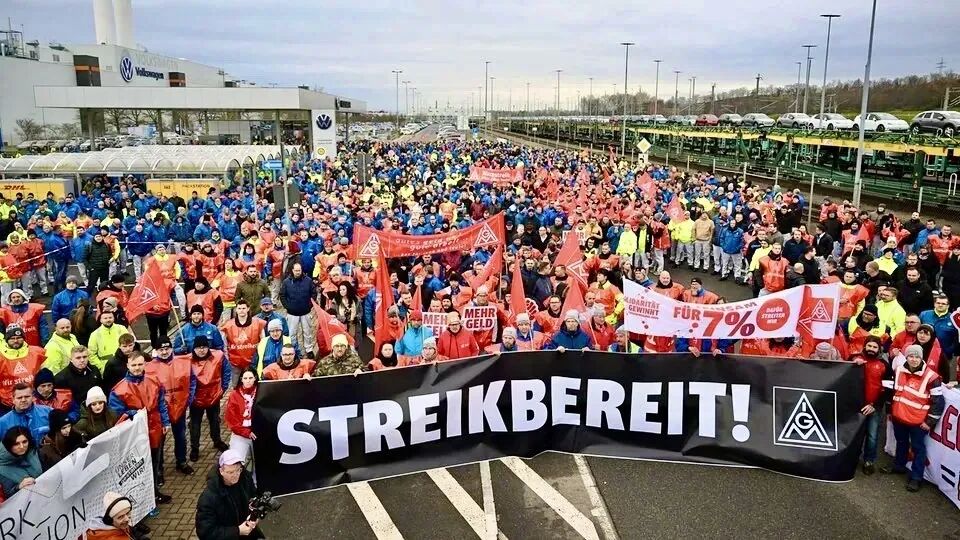
Outside the meeting room, IG Metall (the German Metalworkers' Union) organized joint protests covering all Volkswagen plant areas across Germany, with slogans reading "Vereint für unsere Zukunft kämpfen" (United to fight for our future). What the union was opposing was precisely the board's discussions about plant closures and layoffs.
This contest was laid bare in September by a 147-page internal document. According to exposure by the German magazine WirtschaftsWoche, the Volkswagen management board had unanimously approved a plan: the Emden and Zwickau plants will cease production in 2031, the Hanover commercial vehicle plant will be shut down in 2032, and the Neckarsulm plant has also been included on the list. This is the first systematic closure of Volkswagen's domestic German vehicle assembly plants in its post-war history.
Plant closures often mean layoffs, and this is the "combo skill" of economic downturn and automotive reform.
Subsequently, Volkswagen announced the "Future Plan," stating that by 2030 it would cut up to 100,000 jobs globally, including about 50,000 management positions; by 2035 it would cut its model lineup in half and reduce capacity by about 1 million vehicles. On September 30, Volkswagen and IG Metall laid their cards on the table in Hanover, announcing that multiple collective wage agreements would be terminated at the end of the year and negotiations would restart.
In response, Christiane Benner, deputy chair of IG Metall and a member of Volkswagen's supervisory board, publicly criticized Audi CEO Döllner for attending a Trump campaign rally as "violating the company's code of conduct," and asked: last year alone, U.S. tariffs consumed about 1.2 billion euros of Audi's profit, and now capital is being poured into North America again—who will be responsible for German workers' jobs?
The Lower Saxony state government also stated that Volkswagen is the state government's "own child" in which it holds a 20% stake, and that they oppose treating plant closures as the future solution.
And in the same week that Volkswagen was confronting its own workers, policy at a higher level in Europe was also being loosened. European Parliament legislative tracking documents show that in mid-October, German Chancellor Merz and French President Macron reached an agreement: to lower the EU's red line of 100% zero emissions for new cars by 2035 to 90%.
This means that after 2035, fuel vehicles and hybrid vehicles can still be sold in Europe. German Chancellor Merz even said directly that the internal combustion engine ban "has become history." However, the German newspaper Handelsblatt sharply commented that this move is short-term pain relief.
As for why Germany and France joined forces to withdraw from the 2035 combustion engine ban, the reason is all too obvious.
Both Germany and France are home to traditional established giants. For European legacy automakers represented by Volkswagen, per-vehicle profitability of electric vehicles is far lower than that of fuel vehicles, while the cost of maintaining three technical routes—internal combustion engines, hybrids, and pure electric—is crushing them, and policy happens to provide a buffer zone so that everyone's base of fuel vehicles will not collapse because of the 2035 combustion engine ban.
02 Electrification Results Cannot Keep Up with the Collapse of Fuel Vehicles
"In China, for China." Volkswagen has shouted this slogan for nearly a decade. At its peak, the Chinese market could contribute more than 40% of Volkswagen's global sales in a single year, and it was the confidence that gave it the courage to burn money on electrification globally. But by 2026, this confidence of Volkswagen is being lost at a visibly rapid pace.
According to data published by Volkswagen Group (China), Volkswagen delivered 1.3788 million vehicles in China in the first three quarters, down 30.2% year-on-year, nearly 600,000 fewer than the same period last year. In the third quarter alone, only 405,800 vehicles were delivered in China, compared with 660,300 in the same period last year—250,000 vehicles evaporated in a single quarter, a decline of 38.5%.
On the fuel vehicle side, Volkswagen's base is loosening. The classic sedans that FAW-Volkswagen and SAIC Volkswagen once relied on for volume have continued to have their share cut under the two-sided attack of domestic brands' 100,000-yuan-class hybrids and pure electric vehicles.
On the new energy side, the ID. series managed to hold on for a while in earlier years thanks to the ID.3, but while the ID.3 performed reasonably well in the European market, in China it has long been "praised but not bought." Per-vehicle profitability is under pressure, MEB production line scheduling priority continues to shift toward new CMP models, and there are currently no plans for a model replacement.
As for Volkswagen's electrification performance, to use the private words of a joint venture automaker executive: Volkswagen does not lack electrification in China; rather, its product cadence, cost structure, and intelligent level of electrification are all half a beat slow.
And the turning point occurred in the past two weeks.
On October 20, Volkswagen's first fully locally developed new energy vehicle platform, CMP, officially entered mass production in Hefei; on October 28, Volkswagen China released its locally self-developed integrated technology matrix VEGA (Weaving Girl Star), integrating the CMP/CSP vehicle platform, CEA electronic and electrical architecture, and Hyper Sense 8 advanced intelligent driving solution into a complete system.
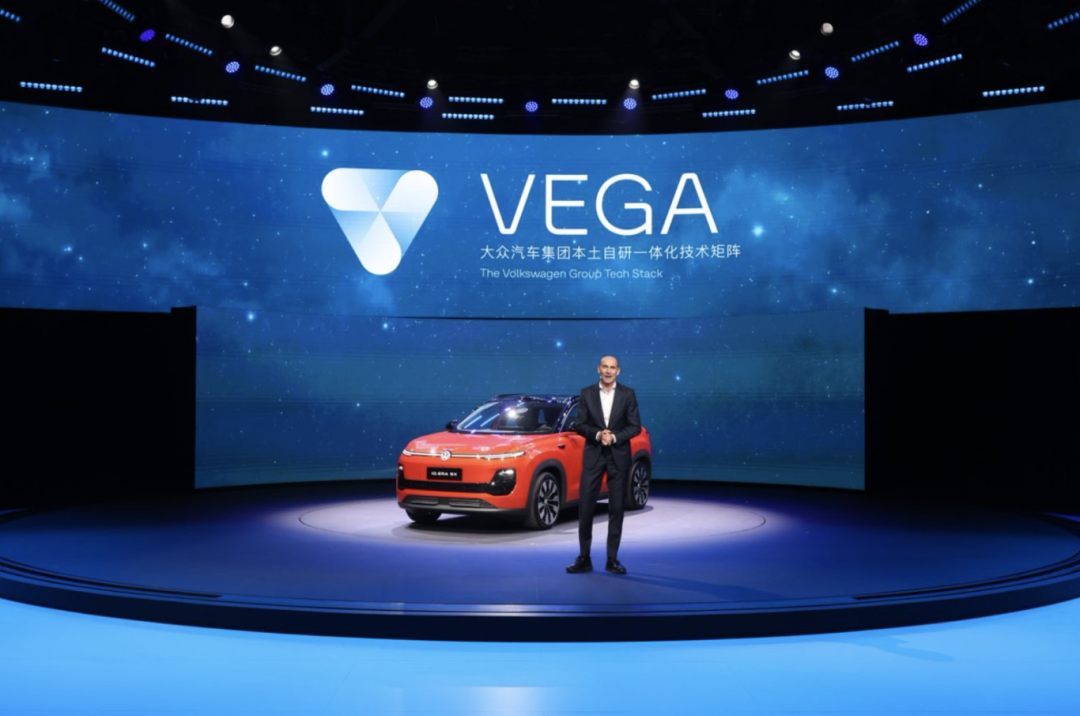
On the same day, Volkswagen China CEO Ralf Brandstätter announced: ID.AURA T6 locked orders exceeded 38,000 units, ID.ERA 5S exceeded 31,000 units, and Jetta M6 exceeded 12,000 units, with total locked orders for the three new models exceeding 81,000 units. In a year when the overall share of joint venture new energy vehicles has fallen to single digits, this is a rare set of impressive data.
In an interview with the German newspaper Handelsblatt at the end of October, Brandstätter, the head of Volkswagen China, said bluntly: "Der Gesamtmarkt in China ist im freien Fall," meaning the overall Chinese auto market is in free fall. He also mentioned that if Volkswagen's deliveries in China continue to decline, the group will increase overseas exports to hedge losses.
And this is exactly what Volkswagen is plotting next: exporting the CMP platform and CEA architecture self-developed in China to South America to serve Global South markets; within 2026, Chinese-made Volkswagen and Jetta models will be exported to seven major overseas markets including sub-Saharan Africa, Egypt, and Vietnam.
What was once a story of imports to China is expected to become a story of made in China, sold globally.
03 U.S. Plant Construction and the "Future Plan"
If the Chinese market is set aside, Volkswagen's situation in other markets is actually not that bad—at least not as bad as in China.
In the European market, Volkswagen's deliveries in the first three quarters increased 1.7% year-on-year, and deliveries in South America increased 4.3%; European pure electric orders surged 39%, and the group's order backlog is about 1.1 million vehicles.
Strangely, the market is not that bad, yet profit is almost zero.
The reason, apart from impairments in the China region and at Porsche, is the tariff knife hanging overhead.
For example, its deliveries in North America fell 4% in the first three quarters, but this was mainly due to tariffs: Audi's U.S. sales rely entirely on imports from Europe and Mexico, and its volume mainstay Q5 does not comply with USMCA rules, with U.S. sales falling 16% in the first nine months of this year.
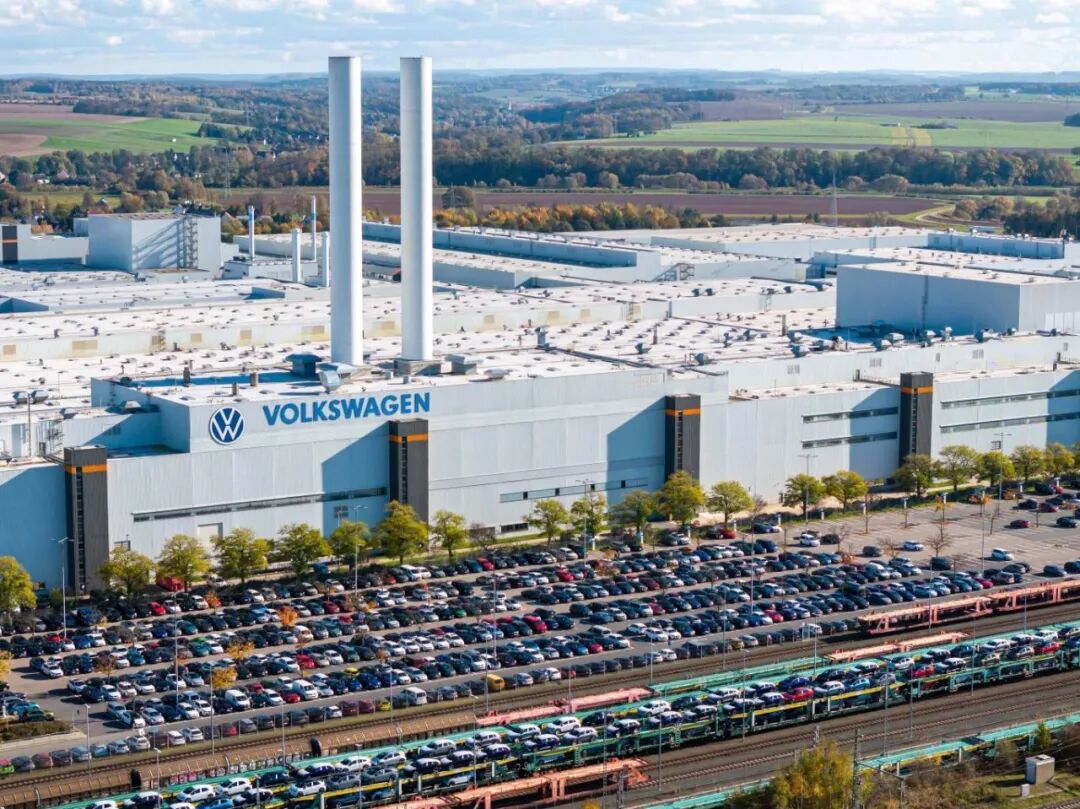
Thus came the news around October 25 that global media chased: Volkswagen will build a new plant in Macon, Georgia, for Audi with an annual capacity of 200,000 vehicles, producing the Q7, Q8, and Q9; at the same time, it will expand the Scout Motors plant in Blythewood, South Carolina, adding 25,000 vehicles of annual capacity.
Trump plans to personally "officially announce" this matter at a campaign rally in Perry, Georgia, on Saturday evening U.S. Eastern Time.
This is a most typical exchange: Volkswagen promises to spend money building plants and creating jobs in key swing states, while the United States continues to negotiate with Volkswagen a mechanism of capacity-for-tariff relief. For Volkswagen, the new plant will not begin production for several years, but the bargaining chip of tariff relief takes effect from the moment of signing—Volkswagen needs this piece of paper too much.
And back to Wolfsburg mentioned at the beginning, Antlitz used a very heavy phrase on the third-quarter earnings call: "must act quickly and decisively." Behind this sentence is the complete skeleton of Volkswagen's "Future Plan": up to 100,000 job cuts, halving the model lineup, terminating collective agreements, shutting down four German plants, and reducing the complexity of R&D and procurement in one go.
Volkswagen Group even lowered its full-year operating return on sales guidance to a maximum of 1%—a company that once consistently exceeded 8% is drawing this helpless bottom line for itself.
For a long time, regarding the electrification transformation of traditional automakers, there has been a saying in the outside world: transformation is courting death, not transforming is waiting for death. For Volkswagen, this financial report in the autumn of 2026 has already blocked the road of waiting for death.
Thus we have seen the most contradictory and also most resolute set of moves by this company in nearly ninety years: closing plants and cutting jobs in Germany, changing leadership and localizing in China, betting on swing states in the United States, loosening internal combustion engine restrictions in Europe while continuing to bet on pure electric and intelligent driving.
It is negotiating with its own union to terminate collective contracts, while sending an executive with a China background to the position of president of Audi China, while paying the price of 6.4 billion euros in impairment for Porsche's brand premium, while preparing to sell cars made in Hefei globally.
The last time Volkswagen did this was thirty years ago in the eras of Piëch and Winterkorn, betting its fortune again and again. They promoted the platform strategy, acquired luxury brands, and forced Volkswagen—this European people's carmaker—into the world's number one in sales.
Admittedly, history does not simply repeat itself, but in the genes of this old Wolfsburg factory, there seem to have never been the three words "sit and wait." This time, it would rather choose the harder, more painful, and more uncertain road, because it knows clearly that for an automotive giant selling 9 million vehicles a year, the biggest risk is not change itself.
Editor: Li Sijia Editor: Wang Yue

THE END
-
![]()
Computing Power Is No Longer the Ceiling for AI Agents—the Ecosystem Wall Is
-
![]()
BYD: Trading Price for Volume at Home, and Its Overseas "Savior" Is Starting to Falter Too?
-
![]()
The Vanished "Golden September and Silver October"
-
![]()
Tesla Changes Its Car-Buying Policies Nine Times a Year—Only "Honest People" Buy Teslas
-
![]()
Volkswagen: Would Rather "Court Death" Than "Wait for Death"
-
![]()
Is Honda Going to Reinvent the Assembly Line?
-
![]()
BMW Completes 1 Million Autonomous Vehicle Transfers Without Ever Touching a Public Road: Does This "Counterintuitive" Case Burst the Industry's Biggest Bubble?
-
October New EV Delivery Rankings: The End of the "Wei-Xiao-Li" Era as Leapmotor, Xpeng, and Xiaomi Take the Spotlight