"Domestic Cars" in the European Market: Are They Replicating the American Story of Japanese Cars?
 11/02 2026
 386
Produced by | Shitianhao Observer
Author | Chen Cong
October 16, 2026, Zaragoza, Spain.
A month ago, the production line at the Figueruelas plant was still undergoing final debugging. On this day, the first Leapmotor B10 rolled off the assembly line on schedule, and founder Zhu Jiangming stepped out of the car. This 43-year-old Stellantis plant is expected to add 450 to 600 jobs and a night shift. Local media are calling it the "Leapmotor effect."
In the same week, the China Association of Automobile Manufacturers released its report card for the first three quarters. Domestic auto sales fell 22.4%; the industry profit margin from January to August was 3.6%, with complete vehicles below 2%; exports reached 8.205 million units, up 65.8% year on year, and are on track to exceed 10 million units for the first time for the full year.
For readers who have followed along, this is not the end of the story—it is the beginning of the acceptance inspection.
Previously, on July 6, the editor wrote in "Leveraging China's Supply Chain Advantages, Volkswagen and BYD Lead the Race for Overseas Markets" about the first wave of going global; on August 4, "No Internet-Famous Boss, Yet Monthly Sales Topped 100,000 in the First Month! Who Did Leapmotor Slap in the Face?" brought the protagonist of this story onto the stage; and on September 8, "The 45.3% European Tariff Forces New Energy Going Global to Take Big Steps Toward Localization" pushed the narrative toward naturalization. Three reports in three months, and the market remembered the 45.3% tariff, 2.5 million units of idle capacity, and the three naturalization methods: borrowing factories, buying lines, and building plants.
Now it is time to check the report card: which line has changed, and which has not.
I. Promises Fulfilled, but the Exam Questions Have Changed
1. The Debugging Line Started on Time
First, check the progress bar of naturalization.
When the production line was still being debugged in early September, the general expectation was that KD assembly would start in the fourth quarter, and JPMorgan's annual outlook released on September 29 also predicted on that basis. However, the B10 that rolled off the line on October 16 skipped this stage entirely, with the four major processes of stamping, welding, painting, and final assembly running through in one go. At the roll-off ceremony, Leapmotor International CEO Danilo said that the second local model, the B05, is expected to start production in the first half of next year; Zhu Jiangming had previously said during the Paris auto show that it would be in the first quarter. The battery plant about 30 kilometers away, with an investment of about 25 million euros, took only seven months from receiving the keys to the first battery rolling off the line. The technical standards and core process parameters remain in Leapmotor's hands. In Zhu Jiangming's words, "the soul and heart are in China, and the body is in Europe."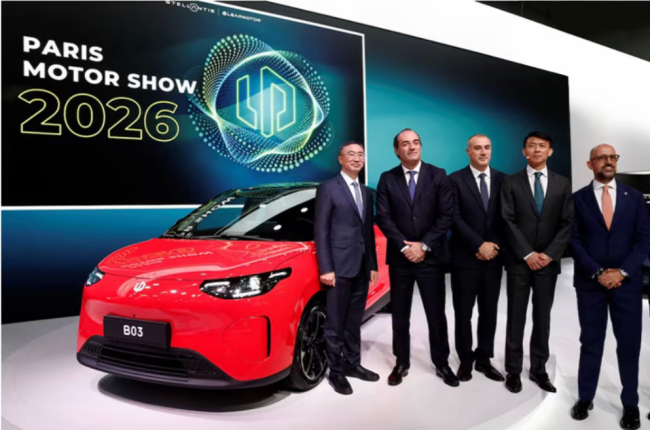
(Image source: Leapmotor)
The biggest suspense of the factory-borrowing model was whether Europeans could keep up with Chinese speed. That hurdle has been cleared.
2. The Acceptance Standard Has Shifted from Rolling Off the Line to Gross Profit
But this is also where the naturalization exam questions have changed.
Rolling off the line is news; gross profit is the ledger. Leapmotor's interim report released on August 24 shows that in the first half of the year the consolidated gross profit margin was 11.7%, down 2.4 percentage points year on year; in the first quarter it was only 9.4%, with a single-quarter loss of 390 million yuan. On the earnings call at the end of August, the company lowered its full-year net profit target from 5 billion yuan to about 3 billion yuan. Management also admitted that local parts procurement costs in Spain are significantly higher than in China, and that local production currently offers limited improvement to gross profit.
The employment figures obtained on the ground in Zaragoza by the Huxiu Auto Team in October make this thin margin even more detailed. The comprehensive labor cost for blue-collar workers on the battery line is about 2,660 euros per month, including wages, social security, and union welfare allocation—equivalent to about 20,700 yuan, 2.6 times the 8,000 yuan monthly salary on Chinese production lines. Converted by local cola purchasing power, the real purchasing power of Spanish workers is about two-thirds that of their domestic counterparts, while the company's cost is more than double. This is the scissors gap one must face when living in Europe.
More intuitive is flexibility. The production line, which Leapmotor and Stellantis invested 200 million US dollars to renovate, will be subject to the ERTE agreement covering the full year in 2026, allowing up to 35 working days of shutdown. At present, there are about 600 production positions for the B10, operating on a one-shift basis.
Borrowing a factory saves the money for building one, but it cannot save the money for continued operations within the scissors gap. The cost dilution from capacity ramp-up can only be calculated clearly after the second and third shifts are up and running.
3. There Is Another Ledger Beyond the Production Line
A deeper layer of uncertainty lies beyond the production line.
Stellantis confirmed to the Huxiu Auto Team that the capacity allocation rule within Zaragoza is first come for the larger volume, and Leapmotor must queue with Opel and Peugeot on the same production line. In its own new five-year strategy, the group has made clear that by 2030 it will cut more than 800,000 units of annual capacity in Europe, through renovation and alliances, and Zaragoza is precisely a vehicle for the alliance path. Former Leapmotor International CEO Xin Tianshu was promoted in July to head Stellantis China and Asia-Pacific, and the binding is deepening, with Leapmotor simultaneously helping the other side digest its legacy burden. The other side of the coin is that once Stellantis completes its electrification transition via Leapmotor's platform, the Opel all-electric SUV and the B10 will slide from complementarity to direct competition.
II. What Has Not Changed Is Still Rising; What Has Changed Is the Quality
The baseline has not changed; what has changed is the quality behind the numbers.
1. Exports Have Moved from Impact to Certainty
Data released by the China Association of Automobile Manufacturers on October 20 show exports of 8.205 million units in the first nine months, up 65.8% year on year. The previous wording of "impacting 10 million units" can now be changed to "will break 10 million units." Cui Dongshu, secretary-general of the China Passenger Car Association, gave a forecast of 11.5 million to 12 million units in an interview with media on October 12.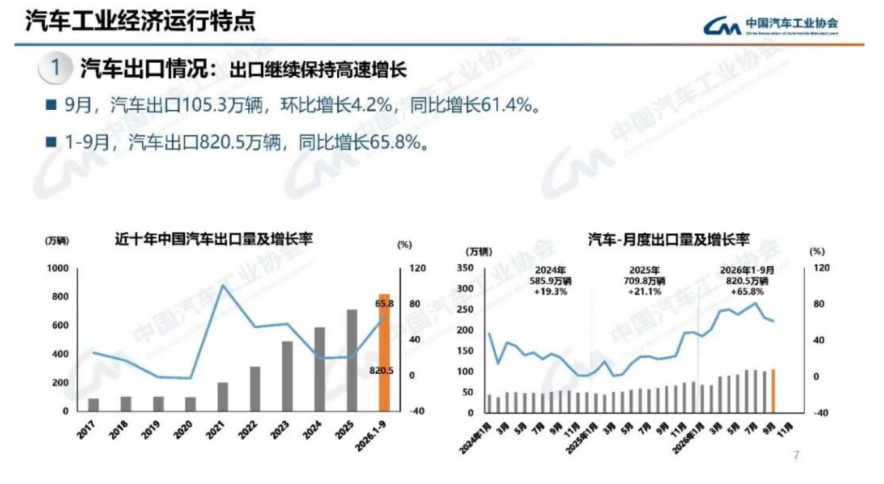
(Image source: China Association of Automobile Manufacturers)
September data released by the General Administration of Customs on October 18 hint at a quality issue. That month, electric vehicle exports were nearly 705,000 units, with export value of 13.17 billion US dollars, with both volume and price doubling year on year. The Ministry of Finance announced on October 12 that from April 2027 the tax rebate rate will be lowered from 13% to 9%. The market generally expects a window for rush exports in the first quarter of next year, and the full-year export rhythm will be rearranged.
Export momentum is real, and so is the expectation of front-loaded volume.
2. Share Ramp-Up Is Still Accelerating
The improvement on the European side is more substantial. Data released by the European Automobile Manufacturers' Association on October 22 show that in September European new car registrations were 1.36 million units, up 10.2% year on year, with pure electric sales surging 60%. Chinese brands sold a total of 182,500 vehicles in Europe in September, up 113.9% year on year, with an overall share of 13.6%, compared with only 7% in the same period last year. BYD registered nearly 50,000 vehicles that month, setting records in both ranking and sales; Leapmotor grew 324% year on year; and Chery's Jaecoo 7 became the first Chinese car ever to enter the top ten of Europe's model sales ranking.
III. What Has Worsened Is the Other Three Lines
1. The Domestic Market Has Moved from Contraction to Bleeding
The first deteriorating line is domestic.
The decline itself is no longer new; what is new is who is falling. According to China Association of Automobile Manufacturers data, in the first three quarters the domestic auto market fell 22.4%, and domestic sales of new energy vehicles fell more than 10% year on year. Caixin reported on October 24 that BYD's total sales in the first three quarters were about 3.075 million units, down about 4% year on year, with domestic sales falling more than 30% to about 1.69 million units. New energy retail penetration has reached 67%, yet sales themselves are declining, with both fuel and electric segments weakening at the same time.
Dealers are falling before automakers. Data from the China Auto Dealers Chamber of Commerce show that in the first half of the year more than 1,800 authorized dealer stores closed or withdrew from the network—about 10 per day on average. Under the China Automobile Dealers Association's figures, the average gross profit margin on new cars was negative 21.4%, and nearly 80% of dealers had inverted prices. The industry profit margin has fallen for three consecutive years: 4.5% in 2024, 4.1% in 2025, 3.8% in the first half of this year, and further to 3.6% from January to August. The net profit attributable to shareholders of listed companies in the automotive manufacturing industry fell 25.74% year on year.
2. Another Hand Has Appeared to Siphon Off Profits
The second deteriorating line is policy, and it happened in the same week.
On October 12, the Ministry of Finance and the State Taxation Administration issued Announcement No. 29 of 2026, lowering the VAT export tax rebate rate for new energy vehicles from 13% to 9% starting April 1, 2027. Some industry figures estimate that based on an average export price of 135,000 yuan, the tax rebate per vehicle will be reduced by about 5,400 yuan. If 6 million vehicles are exported in 2027, the impact on industry profits will be about 30 billion to 40 billion yuan. On the same day, the Ministry of Commerce announced that China and Europe had reached substantive consensus in consultations on hybrid vehicle trade, arranging export volume upward on the basis of 302,000 units in 2025. One hand is closing the door, while the other is opening a window.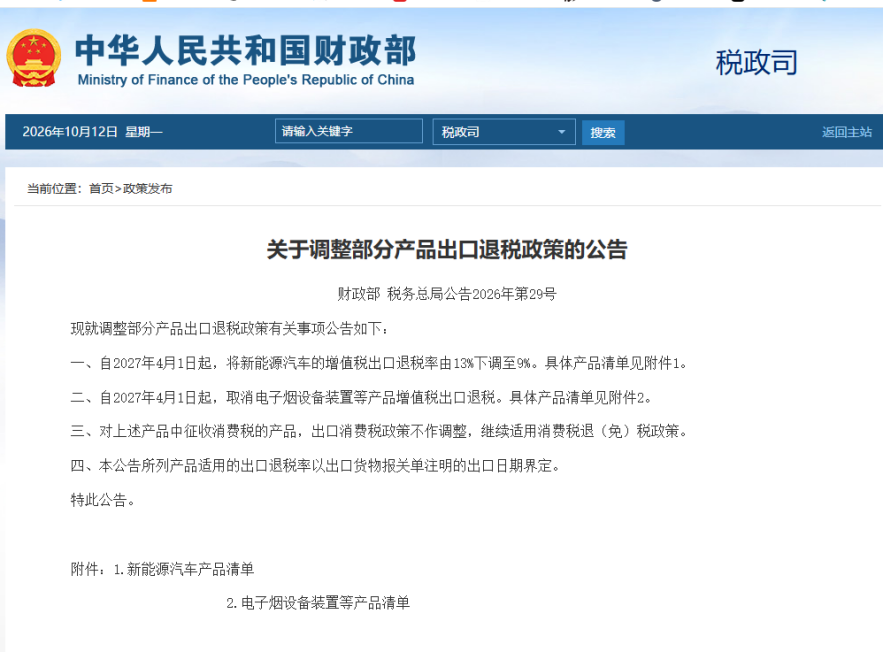
(Image source: Ministry of Finance)
The threshold itself is also getting more expensive. According to Commission Implementing Regulation (EU) 2024/2754, Leapmotor, as a cooperating non-sampled company, is subject to an additional 20.7% duty rate; combined with the 10% basic tariff, the overall tax burden is about 30.7%. Moreover, for the B10 to be recognized as Spanish-origin, local value-added must pass the 40% rules-of-origin threshold, and the relevant draft also plans to raise it to 70%. The admission ticket not only has to be bought with money, but also renewed every year.
3. The Ticket Has Already Been Refunded Once
The third deteriorating line is valuation, and the tuition has long been paid.
NIO entered Norway, Germany, and the Netherlands with a direct-sales model, with initial investment in a single country of 200 to 300 million yuan. Li Bin later admitted that he did not expect building a battery swap station in Europe to take ten months or even a year, and the related business has shifted to a dealer model. Great Wall's Tula plant in Russia has accumulated investment of more than 5 billion yuan, and Haval has a 14% market share in Russia, first among foreign brands, but in the first four months of 2026 it lost about 30,000 yuan net on every vehicle sold. The sticking point is the localization score of 1,805 points, which falls short of the 3,701-point threshold for the full scrappage subsidy; the subsidy is halved, and costs cannot be covered. The money spent buys an admission ticket, not profit.
The capital market's response is equally direct. In the first half of this year, all 13 mainstream automakers listed in Hong Kong fell, with BAIC Motor down 59.6% and Seres down 56.7%, while the A-share complete vehicle sector fell about 26% cumulatively. On September 29, JPMorgan downgraded BYD, Geely, Leapmotor, and XPeng, and gave top picks to Chery, Sinotruk, and GAC. The story has stopped selling tickets; only profit visibility matters now.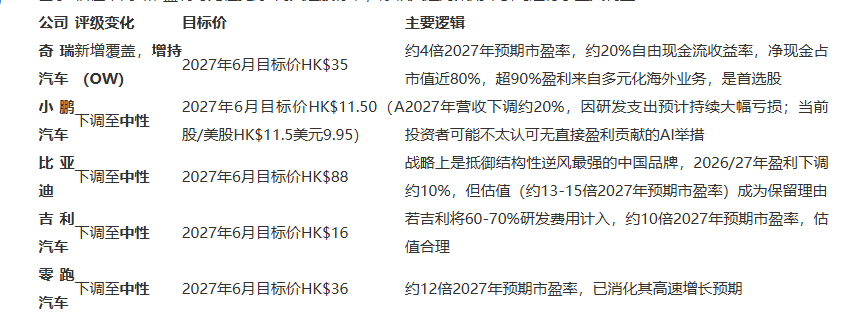
(Image source: JPMorgan)
IV. Putting the Report Card into a Fifty-Year Perspective
1. Penetration Is a Matter of Time
This report card also has a longer time scale.
A macro chart report released by UBS in October overlays today's China versus the EU and Japan versus the United States fifty years ago on the same chart. Japanese brands' share of US imports rose from 3% in 1964 to 64% in 1980. In 1981, voluntary export restraints took effect, equivalent to about a 21% tariff. Japanese automakers responded by building plants directly in the United States; from 1982 to 1989, direct investment in the United States increased eightfold, and in 1990 the Japanese share in the United States rose another 15 percentage points. Chinese brands' share of EU imports rose from less than 3% in 2015 to about 25% in 2025, and the curves almost overlap. The report's conclusion is simple: when manufacturing efficiency and product definition capability form a generational gap, penetration is only a matter of time; barriers cannot stop it—they only accelerate localization.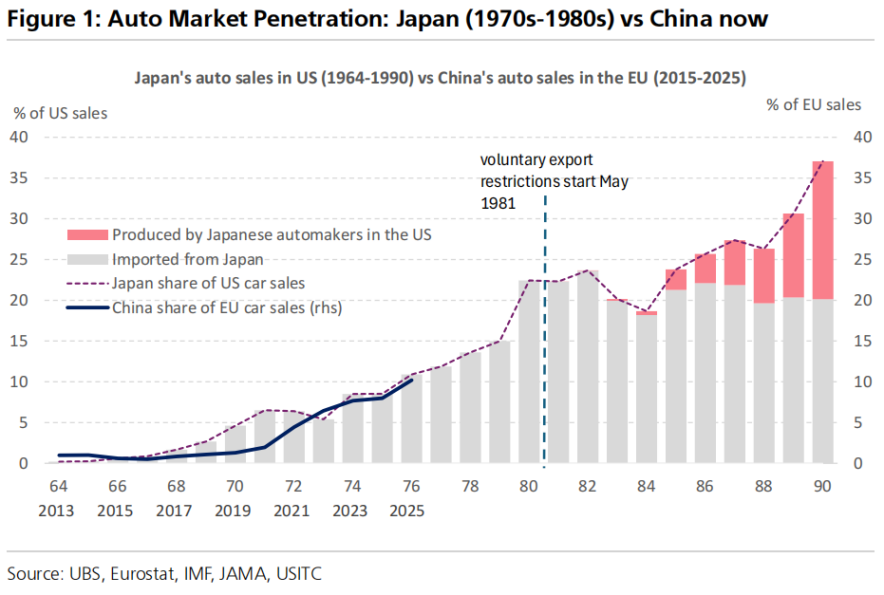
(Image source: UBS)
But the report also highlights two key differences. Europe's response has been far quicker than America's was back then, and Chinese automakers wield a broader toolkit than Japan did—deploying global production, technology exports, and capital investment all at once. On this report card, the 2027 tax rebate cut and tariffs are merely the opening move; what lies ahead is a marathon measured in decades. The profit problem is not cyclical—it is structural.
2. Will the money return, and will the war end?
Lai Yizhe, head of Asia automotive research at JPMorgan, said at the annual outlook meeting in late November 2025 that the profit from a single vehicle sold overseas roughly equals that of two to four vehicles sold domestically. Leapmotor's books offer a supporting footnote: according to brokerage estimates, its overseas business gross margin remains at 18% to 20%, well above the 11.7% consolidated gross margin in the first half of the year, with an overseas sales target of 350,000 to 400,000 vehicles for 2027. The asset-light approach holds on the channel side as well. About 90% of Leapmotor's European outlets rely on Stellantis's existing channels, and estimates put the construction cost per store at roughly 65% lower than building an independent network. Zhu Jiangming disclosed that actual orders for the B10 in Europe alone exceeded 8,000 units in September.
But before any dividends, two filters must be passed. Stellantis owns 51% of the joint venture's equity, and combined with the net profit impact of the tax rebate cut, JPMorgan estimates the hit at between 6% and 18%. If the money flows back home to subsidize price cuts and fight for market share, going global merely extends the price war, and the distorted structure of 10 million exports at a 2% profit margin becomes entrenched. If the money stays overseas to build local supply chains and after-sales systems, then—as Chen Shihua remarked at the supply chain conference on October 20—upgrading from trade going global to operations going global will allow overseas profits to generate cash independently and force inefficient domestic capacity to exit.
3. The clearing has begun, but half a beat slow
The exit has already started. In September, the Ministry of Industry and Information Technology and eight other departments jointly issued a work plan for stable growth in the automotive industry, and a capacity warning mechanism has been written into the 15th Five-Year Plan for the automotive industry currently under formulation. In October, Hozon New Energy entered bankruptcy reorganization, the production qualifications of eight marginal automakers were frozen, and the number of automakers with sales records shrank from more than 80 to 42. Clearing has moved from statistics to concrete cases.
But the pace of clearing lags behind the deterioration of profits, and the window is closing fast.
In Zaragoza on October 16, the old plant added a night shift, and the new car wore a new badge. The preview written into the report a month earlier was delivered on time.
On this midterm report card, the sales column earns full marks; the profit column has only just begun the exam. Fifty years ago, Japanese automakers spent twenty years turning an import shock into local roots. Today's Chinese automakers have been handed the same exam paper—except that Europe's examiners are far stricter than America's were back then, and the time allowed to answer may not necessarily be more.
The story of naturalization has been told; now it's time to settle accounts. The direction of the tide hasn't changed; what has changed is that more and more people on the shore are waiting to collect rent.
END
-
![]()
Tech Stocks Plunge: Is Faith in AI Still There? New Energy Weekly Summary
-
![]()
After the Hundred-Billion-Yuan Financing Closed, DeepSeek Unveiled Its Super-Agent Architecture
-
![]()
October New Energy Vehicle Sales Revealed: Leapmotor Up 51% Year-on-Year, While NIO, Li Auto and Harmony Intelligent Mobility All Decline
-
![]()
Apple Chooses Qwen—and There's More to It Than Meets the Eye
-
![]()
The Battle Against DJI: How Ying Shi Lost 100 Billion Yuan in Market Value
-
![]()
Modern China's Predicament: Hard to Break Through by Merely Changing the General Manager
-
![]()
Cutting Corners or Compliance? iPhone Duo Teardown Reveals China-US Structural Differences — Apple Says Component Variations Are Normal
-
![]()
Leapmotor Retains the Crown as Xpeng and Xiaomi Break 50,000: The New Forces Sales Landscape Gets Another Shake-Up