October New Forces Sales Ranking: Leapmotor Breaks 100,000, XPeng and Xiaomi Both Break 50,000, Multiple Companies See Year-on-Year and Month-on-Month Declines | Mingjing Pro
 11/02 2026
 488

Although this year's "Silver October" was still not as robust as in previous years—with many companies seeing both year-on-year and month-on-month declines—there were still plenty of bright spots. Among the new forces, Leapmotor continued to lead with over 100,000 sales; XPeng and Xiaomi both exceeded 50,000 units. HarmonyOS Smart Mobility, NIO, and Li Auto all saw both year-on-year and month-on-month declines, with Li Auto falling back below 30,000 units.
Among traditional automakers' new energy brands, long-time leader Galaxy has resumed rapid growth; SAIC MG, having completed its new energy transformation, saw global sales directly exceed 85,000 units in October, becoming second only to Geely Galaxy among traditional automakers' new energy brands. Its domestic sales, driven by the twin hits MG4 and MG07, also surged again to exceed 31,000 units—a truly impressive performance. Fangchengbao continued to maintain high-speed growth, and Hyper Aion BU also returned above 40,000 units.
Some are happy, some are worried. Many brands have launched products in succession, yet monthly sales have stagnated. In today's market, automakers without exports find it very difficult to achieve major breakthroughs—except for brands like Xiaomi and Huawei.
01 New Forces: Xiaomi and XPeng Both Break 50,000+
In October, Leapmotor remained firmly in first place. October deliveries reached 106,127 units, up 51% year-on-year, marking four consecutive months of monthly sales above 100,000. In Leapmotor's sales this year, the A series and overseas markets are the two major growth pillars. On October 16, Leapmotor B10 started mass production at its Zaragoza plant in Spain, achieving localized production and sales in the European market and elsewhere. From January to October this year, Leapmotor's cumulative deliveries reached 772,666 units, up 65.88% year-on-year, already completing 77.27% of its full-year sales target of 1 million. To achieve the target, Leapmotor needs average monthly sales of 113,700 units in the remaining two months; with a final year-end push, this goal is still within reach. Next year, with the launch of its second brand, Leapmotor will more aggressively capture the market above 200,000 yuan.

XPeng's October deliveries were 50,237 units, up 19.57% year-on-year and 21.77% month-on-month, setting a new monthly delivery record. Among them, overseas market deliveries were 13,326 units, up 166% year-on-year, setting a new monthly overseas delivery record and accounting for 26.5% of total sales. In November, XPeng's sales may hit a new high again, because the third model in the MONA series, the L05, launched at the end of the month, with 5,000 quasi-stock vehicles sold out within 3 minutes after launch; nationwide large-scale deliveries of the model began on November 1. In addition, although the L03 has been on the market for 3 months, order growth still exceeds deliveries.
Xiaomi's October deliveries directly exceeded 50,000 units, setting a new brand record. There are two core reasons: first, the two pure electric models SU7 and YU7 continue to maintain stable output; second, the newly added N70 and N90 extended-range production capacity continued and deliveries were on a larger scale. From this point of view, all four models launched by Xiaomi are hit products. From January to October this year, Xiaomi's cumulative deliveries exceeded 330,000 units. To complete its full-year target of 550,000 units, it needs to sell about 110,000 units per month going forward. Although Xiaomi has indeed seen fierce growth since deliveries of the Pengcheng series began, this target seems somewhat difficult to achieve.
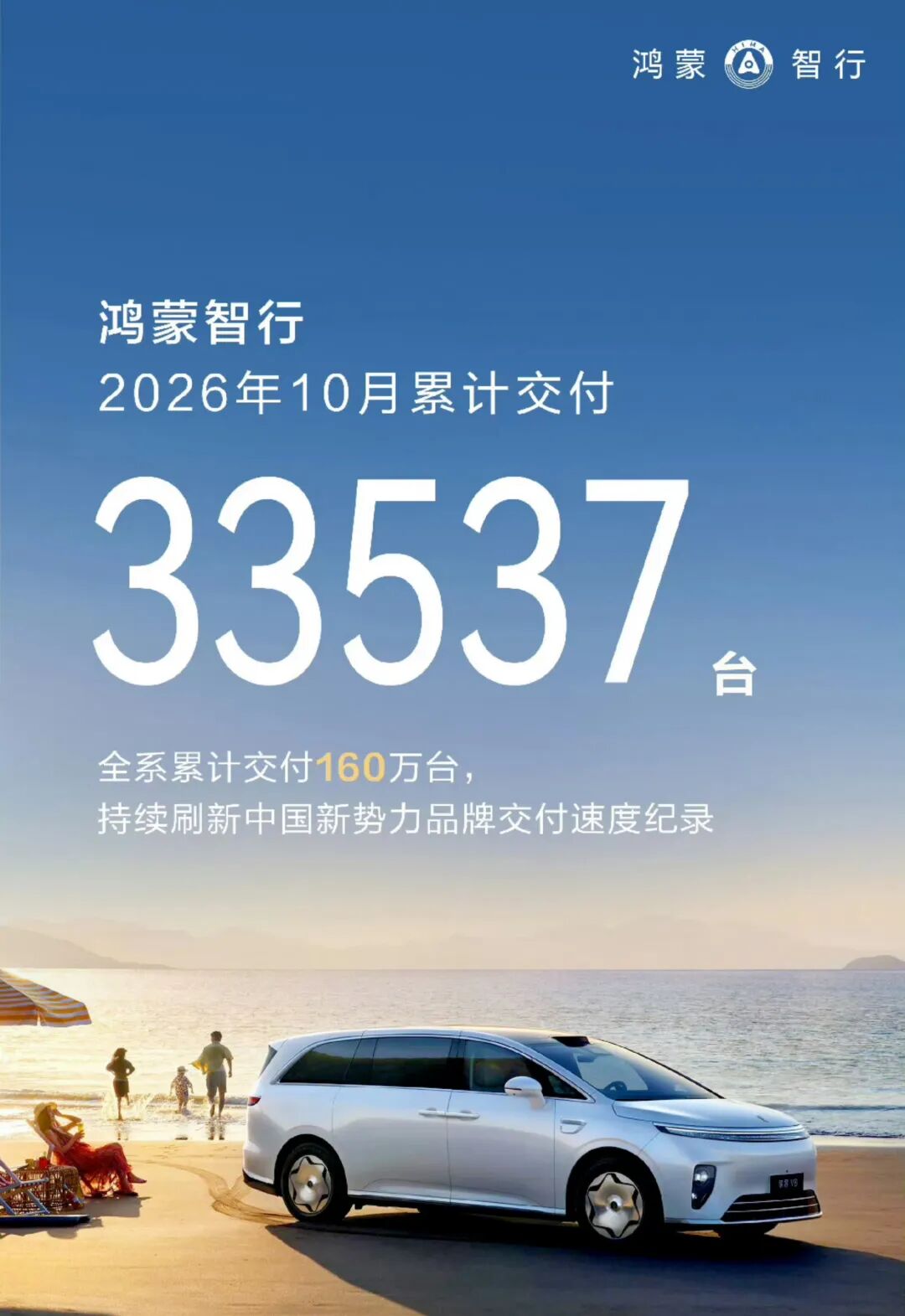
HarmonyOS Smart Mobility's total October deliveries were 33,537 units, down 50.84% year-on-year. HarmonyOS Smart Mobility has not yet released separate sales data for its five major brands, so it is impossible to compare sales changes among the brands horizontally. However, based on September insurance registration data, the key reason for its sales decline may be the split last month involving AITO. The upcoming new M8 may boost AITO's sales this month. Luxeed G9 also began large-scale sales in October, and its month-on-month sales should also have grown; subsequently, Luxeed will also launch the V8 targeting the family MPV market. In addition, the average transaction price of the entire HarmonyOS Smart Mobility lineup exceeds 400,000 yuan, proving that its several brands have firmly established themselves in the high-end camp.
NIO Inc.'s October sales were 34,246 units, down 15.23% year-on-year and 8.45% month-on-month. Among them, NIO brand deliveries were 18,125 units, up 4.52% year-on-year; Onvo was 8,383 units, down 51.10% year-on-year; Firefly was 7,327 units, up 30.89% year-on-year. It can be seen that the main reason for the sales decline is that in the same period last year, Onvo saw a surge in orders with deliveries of the L90, while this year L90 sales have fallen to around 3,000 units, and sales of the newly launched L80 have also fallen back to around 3,000 units. By contrast, sales of the two models ES9 and ES9, priced above 400,000 yuan, have remained relatively stable at high levels; Firefly has also secured a firm foothold in the high-end small car market. From January to October this year, a total of 334,547 new vehicles were delivered, up 38.5% year-on-year, setting a historical high.
Li Auto's October deliveries were 29,025 units, down 8.63% year-on-year and 8.78% month-on-month. The reason for the sales decline is that its main sales driver, the i6, is at a transition point between old and new models; meanwhile, the new-generation Li Auto MEGA delivered more than 3,000 units in a single month and ranked first in the MPV market above 500,000 yuan for two consecutive months. From January to October this year, Li Auto's cumulative deliveries were 322,461 units, down 1.96% year-on-year. At the end of October, the new i6 was officially launched, with more than 12 upgrades including the Lianshan battery and the Mahe M100 chip while keeping the price unchanged, and the ordering page was directly overwhelmed on the launch night. With large-scale deliveries of the new i6, Li Auto's sales are expected to rise significantly in November.
In addition, second-tier new forces such as Polestones, Skyworth, and 212 have all stopped publishing sales figures.
02
Traditional Automakers' New Brands: Fangchengbao and Hyper Aion BU Surge
Among traditional automakers' new brands, Geely Galaxy remains firmly in first place, with October sales of 153,385 units, up 20% year-on-year and 18% month-on-month. This is mainly due to the Xingyuan stabilizing the base and the recently launched TT, Battleship 700, and new E5 all beginning large-scale volume ramp-ups. Among them, Galaxy TT delivered more than 10,000 units within 30 days of launch. From January to October this year, Geely Galaxy's cumulative sales were 1,030,569 units, up 3% year-on-year. In the next two months, Galaxy sales are highly likely to hit a new high, aiming for monthly sales of 160,000+. The MG brand ranks second only to Geely Galaxy, with global sales exceeding 85,000 units in October; domestic sales exceeded 31,000 units, nearly doubling year-on-year.

Fangchengbao and Aion BU are two companies in the 40,000-unit range. Among them, Fangchengbao's October sales were 43,872 units, up 41.3% year-on-year and 1.6% month-on-month. At present, Fangchengbao's sales pillars are still the Tai 7 and Tai 3 models, and its first sedan, the Equation SS, began large-scale deliveries in October and became a sales growth point; according to Fangchengbao general manager Xiong Tianbo, production capacity is currently the constraint on Fangchengbao's sales, and in November it will go all out to increase production and speed. In addition, in November Fangchengbao will also launch a new model, the Tai 9; with an increasingly rich product matrix, Fangchengbao will challenge the 50,000-unit mark within the year.
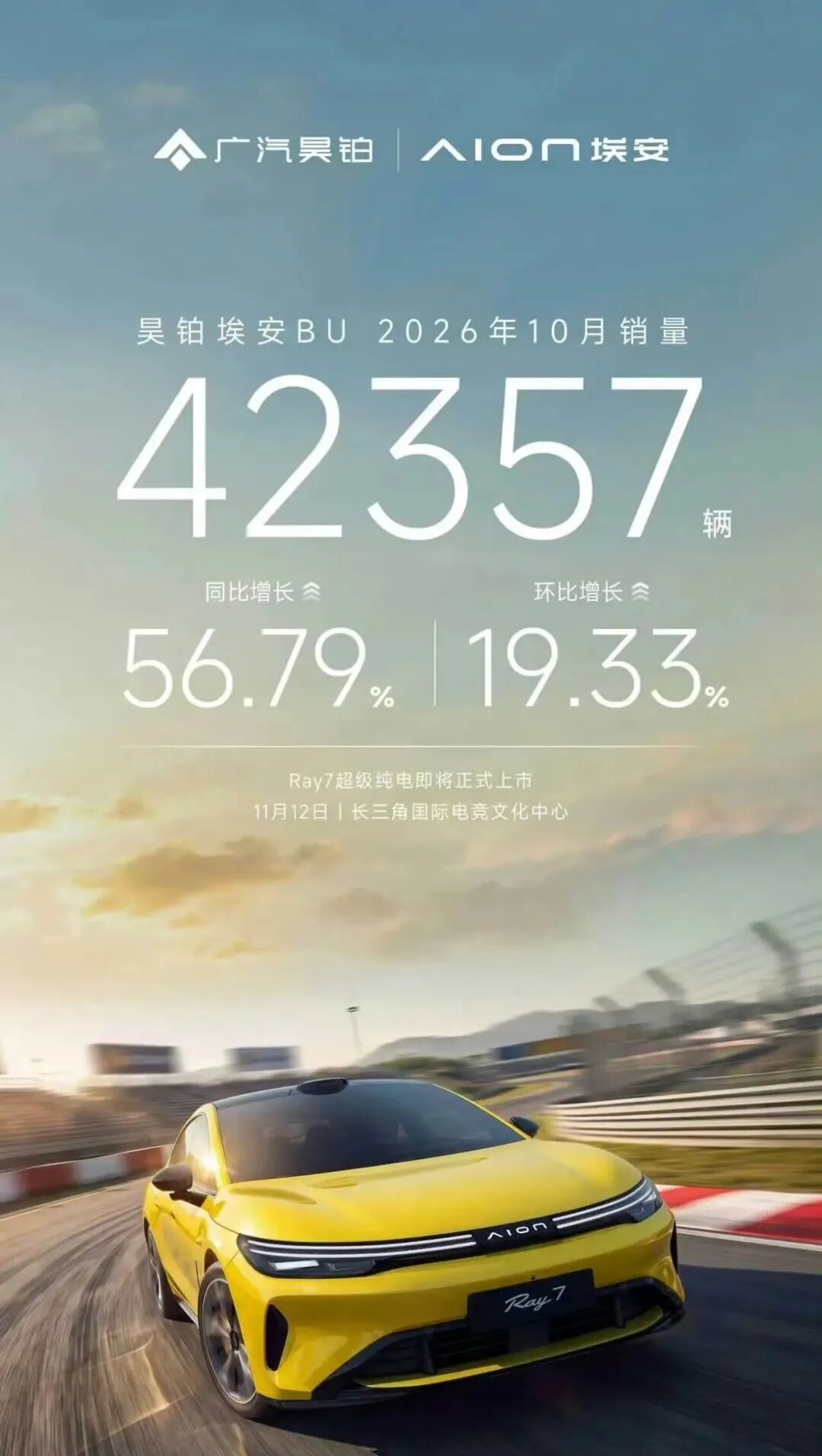
Hyper Aion BU's sales also returned above 40,000 units. In October, Hyper Aion BU sales were 42,357 units, up 56.79% year-on-year and 19.33% month-on-month, achieving positive growth against the trend for eight consecutive months. Among them, Aion is the absolute sales mainstay, while Hyper's monthly sales have fallen to fewer than 1,000 units. While i60 sales steadily exceed 10,000 units, the first model of Aion's all-new Ray series, the Ray7, will launch on November 12; whether Aion's sales can return to 50,000+ depends on this car.
Deepal and Zeekr are two companies in the 30,000-40,000-unit range. Deepal's October sales were 32,602 units, down 11.4% year-on-year and up 8.01% month-on-month. Among them, Deepal S05 monthly sales were 19,793 units; Deepal S07 was 6,062 units. From the sales structure, Deepal's sales currently rely heavily on the S05 and S07, with the two models together contributing nearly 80% of sales. In October, Deepal launched the 2027 L06 and L06 Chase Wind Edition. To achieve a breakthrough in sales, Deepal still needs to diversify its product lineup as soon as possible while continuing to accelerate overseas market expansion.
Zeekr's October sales were 32,483 units, up 51.6% year-on-year and down 12.72% month-on-month, with Zeekr 7X monthly sales exceeding 10,000 for four consecutive months. Although Zeekr did not have many all-new products this year, it is in a state of rising volume and price, with an average customer transaction price of nearly 370,000 yuan. From January to October, it delivered a total of 320,887 units, up 94.4% year-on-year, having already exceeded its full-year sales target of 300,000 units ahead of schedule. Within the year, the Zeekr 7X and Zeekr 009 Grand will also be refreshed. Based on current sales estimates, Zeekr's sales this year may exceed 380,000 units.
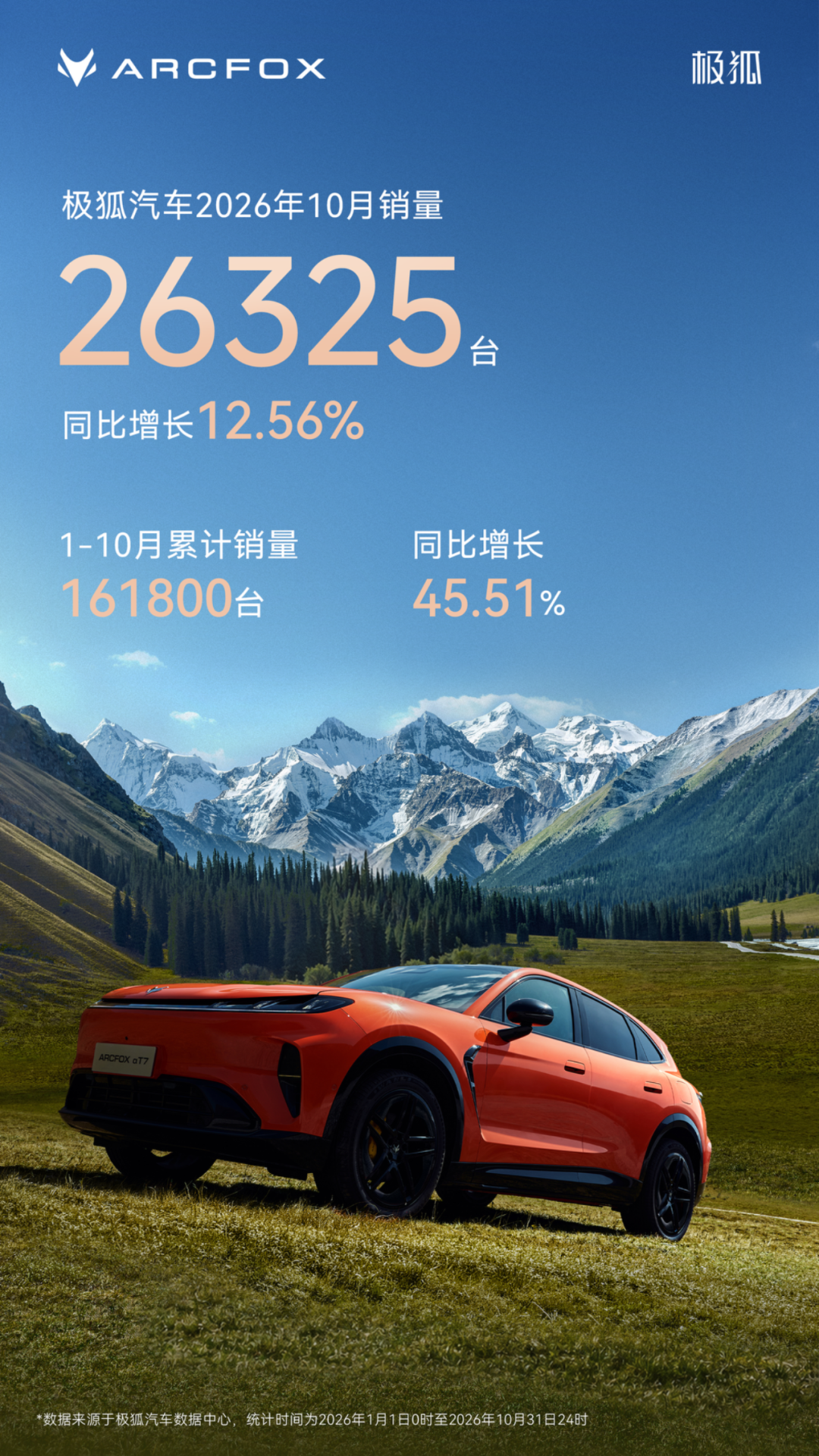
Arcfox's October sales were 26,325 units, up 12.56% year-on-year; from January to October this year, Arcfox's cumulative sales were 161,800 units, up 45.51% year-on-year. After the successive hot sales of products such as the Beta T1 and Beta S3 launched in the past two years, Arcfox's sales have grown rapidly. The recently launched Alpha T7 received more than 30,000 locked orders within 1 hour of launch; with large-scale deliveries of this product beginning in November, Arcfox's sales will rise another step. Another significance of this car for Arcfox is that it is another upward move by the brand into the 150,000-200,000 yuan market.
Apart from these, all other sales were below 20,000 units. Denza's October sales were 15,152 units, up 49.5% year-on-year and down 16.74% month-on-month. In the sales mix, the D9 is no longer the sole sales support; together with the N8L and Z9GT, it underpins Denza's base.
Voyah's October deliveries were 13,030 units, down year-on-year and basically flat month-on-month. This year is a major product year for Voyah, having successively launched all-new products such as the Taishan X8, Zhuiguang S, and Dreamer 9, but the overall market declined, so subsequent strategy adjustments are still needed. Fortunately, the proportion of Voyah's high-end products has increased, which is beneficial for elevating the brand. Voyah has a good market reputation, and there are opportunities for a breakout later.
In addition, Yipai Technology's October sales were 11,841 units, with cumulative sales from January to October of 178,674 units. Among them, overseas markets continued their growth momentum, with cumulative exports up 36% year-on-year.

Finally, IM Motors and Avatr: since entering 2026, both have had monthly sales below 10,000 units. Among them, IM Motors sold a cumulative 68,000 units from January to October, up 21.2% year-on-year. Based on its previously cumulative sales, IM Motors' October sales were about 8,000 units. IM Motors' product strategy this year has been to cascade steer-by-wire chassis technology, previously available on high-end models, down to the entire lineup as standard equipment; the new L6 and LS6 equipped with this technology have also received favorable reviews. In November, the IM LS8 NEO pure electric, equipped with a full steer-by-wire chassis + CATL large battery, will also be officially launched. This may push it back above 10,000 units.
Avatr's October deliveries were 7,056 units, down 13.77% month-on-month. Judging from sales in September-October, Avatr's major model this year, the Avatr 07L, seems not to have driven the brand back to its baseline of 10,000 monthly sales. At the end of October, Avatr 07L also added a Max pure electric version, and drew attention because it canceled the launch event and used an internal pricing short video. Subsequently, Avatr will also launch the flagship Avatr T09; whether it will be launched and delivered within the year is not yet clear.
In addition, the Yijing brand created by Dongfeng and Huawei also began large-scale deliveries on October 18. The car was officially launched on September 24, priced at 279,800-359,800 yuan, and received 9,157 locked orders within 24 hours of launch. Since the start of large-scale deliveries, Yijing X9 delivered 3,612 units in two weeks, with an average transaction price of 340,000 yuan. Next, it remains to be seen whether the reputation after delivery can translate into sustained sales growth.
-
![]()
AI Cannot Cure the CEO's Serious Illness
-
![]()
In the Era of Stock Competition, Why Quality Competition Must Look at Both "How Well It's Built" and "How Long It Lasts"
-
![]()
Kuaishou: The Perennial Runner-Up — Can Kling AI Become Its Second Growth Curve?
-
![]()
Over 6,000 Yuan Profit per Car—Is Geely's Per-Vehicle Profit Inflated?
-
![]()
Kling 4.0 Hands-On Test: Creating an Exhibition Walkthrough Video with Zero On-Camera Talent — How Far Is AI from Delivering a "One-Stop Finished Video"?
-
![]()
AI Code Refactoring in Practice: Assess First, Then Tackle Technical Debt
-
![]()
Fold 5 Times and It Leaks — ¥8,000 Repair Bill: Who Set Up Apple's Foldable Screen Scam?
-
![]()
Xiaomi Spends 1.7 Billion Yuan to De-CATL-ize: Is Lei Jun Content to Be a "Worker" for the Ning King?