Chinese Consumers No Longer Underwrite German Auto Workers
 11/18 2026
 418
Introduction
German media: The workers laid off by German companies were, in effect, sustained by China.
From parts suppliers to automakers, companies all along the German auto industry's supply chain are racing to downsize and cut jobs.
Citing weak demand for combustion-engine vehicles, Schaeffler recently announced it would cut 3,460 jobs and shut down five European plants, affecting more than 2,600 positions at four German factories. The group also said its core workforce in Germany will shrink by 18% by 2028.
Volkswagen Group has launched the largest restructuring in its history, with layoffs expected to reach 100,000 over the coming years. A week ago, as profitability deteriorated, the company scrapped investment plans for German plants, including its Wolfsburg headquarters.
After four months of negotiations, Mercedes-Benz and the union still failed to reach an agreement on cutting labor costs. Management has decided to suspend all investment in Germany and stated bluntly that "closing domestic German factories may be considered further in the future."
Yet in China, these same German automakers present a completely different posture.
"100% in China, for China." On November 11—the same day Volkswagen Group canceled its German factory investment plan—Mercedes-Benz pivoted to a new strategy. Ola Källenius, Chairman of the Board of Management of Mercedes-Benz Group, said China remains the core of Mercedes-Benz's transformation plan, and the new all-electric Mercedes-Benz E-Class will be produced in China next year.
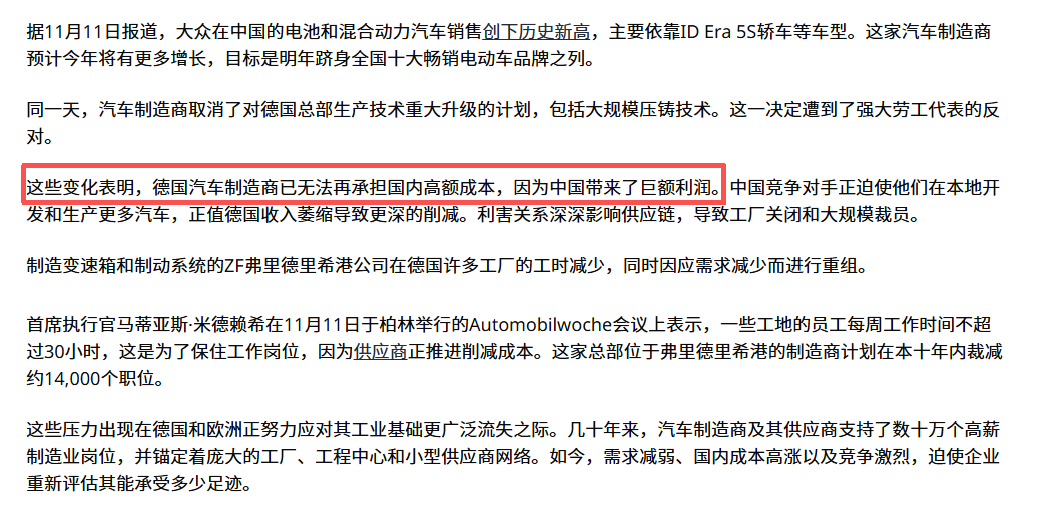
Buoyed by models such as the ID.ERA 5S, Volkswagen's pure electric and hybrid sales in China hit a record high, with next year's goal being to rank among China's top ten best-selling electric vehicle brands.
Laying off workers, closing factories and cutting costs and benefits at home while devoting more attention to the Chinese market has caused considerable resentment in the German auto industry, which believes the Chinese market has taken away Germany's opportunities.
Interestingly, Germany's Handelsblatt and the U.S. Bloomberg gave the same rebuttal.
"The German auto industry laments the 'China shock' loudly, and within the next few years, hundreds of thousands of jobs will be at risk of disappearing, but the cruel reality is that many of these jobs still exist entirely thanks to China. Over the past decade, they earned billions of dollars in profits from trade with China, and the government also provided subsidies..."
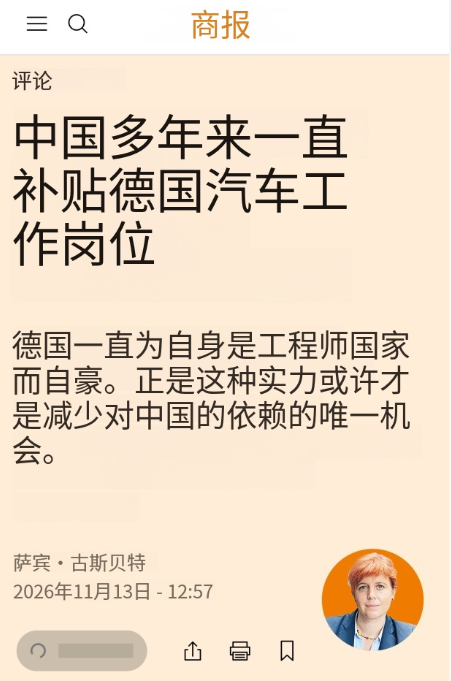
Bloomberg put it more directly: German automakers can no longer bear high costs at home, while the Chinese market previously brought them huge profits.
Both reports point to the same content: over the past decade or so, the Chinese market contributed huge profits to German automakers, not only feeding executives and shareholders but also supporting tens of thousands of German workers. The core reason German automakers are now forced to lay off workers is that after the collapse of profits in the Chinese market, companies can no longer afford high domestic costs.
Rewind to 2016. Despite 6.4 billion euros in special items related to the "dieselgate" scandal, Volkswagen Group's profit before tax and after tax that year still reached 7.3 billion euros and 5.4 billion euros, respectively.
Based on this financial situation, the group's Management and Supervisory Boards recommended raising the dividend per ordinary share to 2 euros (0.11 euros in 2015) and the dividend per preferred share to 2.06 euros (0.17 euros in 2015).
"The reason Volkswagen Group's performance improved in 2016 was mainly because of its huge advantage in the Chinese market," Der Spiegel commented.
At the time, the financial report did not break down turnover by region, but Zhang Pijie, then director and general manager of FAW-Volkswagen, said FAW-Volkswagen's sales revenue in 2016 exceeded 300 billion yuan (about 41.3 billion euros), with tax payments alone approaching 50 billion yuan (about 6.9 billion euros).
In 2017, Volkswagen Group's global sales and operating profit hit new records. German employees not only received pay raises, but bonuses also rose from 2,905 euros the previous year to 4,100 euros.
As Handelsblatt put it, the huge profits German automakers earned in China over the past decade not only made financial reports look exceptionally good but also supported, to a considerable extent, Germany's high domestic production costs and jobs.
When sales in the Chinese market decline, German automakers that once relied on Chinese profits find it difficult to sustain high domestic labor costs.
As a German domestic media outlet, Handelsblatt showed no mercy, saying that high profits made German auto executives and shareholders lower their guard and ignore warnings about over-reliance on China; the huge profits earned were not used for future planning and technological upgrading, but were instead spent on how to make cars appear more environmentally friendly in emissions tests.
Amid this complacency, the major customer that once brought generous profits became the strongest competitor.
Bloomberg further pointed out that after losing the generous profits from the Chinese market, German automakers must, on the one hand, cut costs at home. On the other hand, the rise of Chinese independent brands is forcing them to increase local R&D and production layout in China. The pressure of shrinking profits is transmitted along the entire supply chain, leading to factory closures and large-scale layoffs.
What should alert Germany even more is the shift in the center of gravity of competition. While Europe is still working hard to protect the existing interests of the traditional auto industry, China has already begun competing for the initiative in the next round of technological competition, including artificial intelligence, rare earth-related technologies, and export controls on key technologies.
Reforms should be completed during high growth, but it is precisely during high-growth periods that the motivation for reform is lacking. The Chinese market gave German automakers ample time and even contributed huge profits, yet over the decade, the entire industry let opportunities slip through its fingers.
The dividend masked the system's accumulated weaknesses, and prosperity dissolved the sense of urgency for transformation. The old path of relying on external market profits to underpin a high-cost domestic model is no longer sustainable.
But judging from recent market feedback on BBA's new models such as the all-electric Mercedes-Benz GLC, BMW iX3, Audi E7X, as well as FAW-Volkswagen ID.AURA T6 and Jetta M6, German automakers are gradually finding their rhythm again.
However, finding the rhythm again does not mean recreating the glory of the old days.
German cars once extracted excessive profits from the Chinese market through high premiums, nourishing high domestic labor costs and driving up executive pay. Now, independent brands are reclaiming pricing power with faster iteration, lower prices, and products that better understand local needs, and Chinese consumers are no longer willing to pay for premiums.
The era of high profits and high pay that German workers miss can no longer return.
Editor: Du Yuxin Editor: He Zengrong

THE END
-
Why Do OPPO and vivo Shun Going Public While Transsion, After Breaking Its Issue Price on Day One, Keeps Climbing?
-
![]()
Huawei's Starlight Rises as Honor's Star Fades
-
![]()
Share Link Won't Open: Tracing a URL Parameter Placement Bug
-
![]()
BAIC Group | October Terminal Sales: Product Mix Across Four Brands and 31 Models
-
![]()
Mercedes-Benz China Retail Sales in October: 28,820 Units — How Did Beijing Benz and smart Perform?
-
![]()
Tesla Invests €3 Billion to Upgrade German Factory, Sells Robotaxi — but You Still Pay Monthly to Drive
-
![]()
ARCFOX Slashes Huawei Smart Driving Threshold to the 150,000 Yuan Mark
-
![]()
The Korean Car Conundrum: Boxed In by the Supply Chain, Outmatched in Overseas Markets