Huawei's Starlight Rises as Honor's Star Fades
 11/18 2026
 545
Author | Wuzi
Six years after going independent, Honor and Huawei are now going head-to-head.
Huawei has officially announced that it will hold a new product launch event on November 20, 2026, to unveil a brand-new sub-brand called "OSTA Starlight," aimed at young consumers and focused on the mid-to-high-end market.
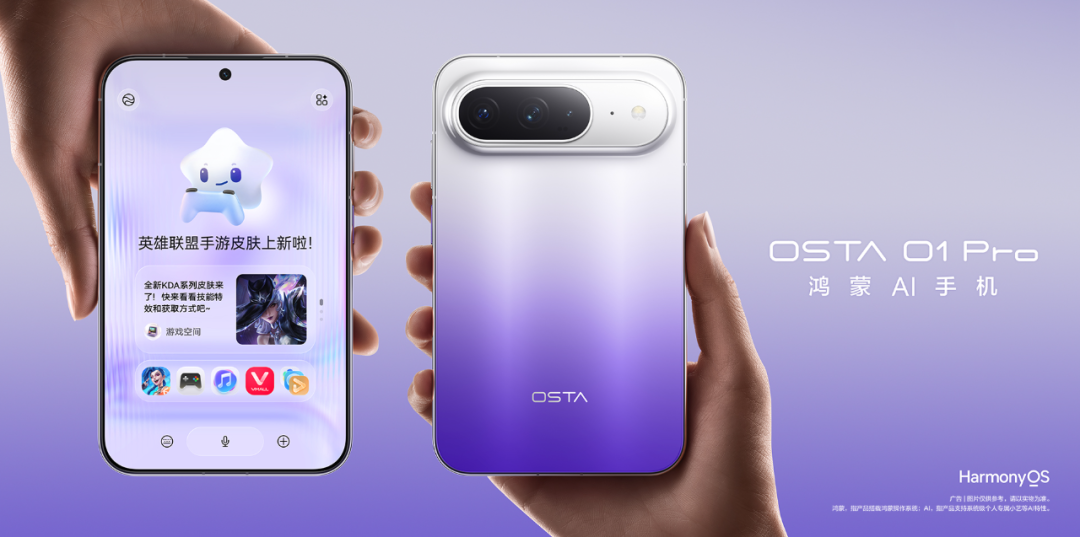
Image source: Huawei
The first Starlight model, the OSTA O1 Pro, is now open for reservations on official channels. It features a wide bar design, an exclusive AI companion called "Little Starlight," and comes in three colors—Starlight Black, Nebula White, and Starlight Purple—across four versions: 12GB+256GB, 12GB+512GB, 16GB+512GB, and 16GB+1TB.
Information disclosed by the China National Intellectual Property Administration shows that Huawei has registered the Starlight trademark, covering product categories such as smartphones, laptops, and tablets. From this perspective, the Starlight brand may not be limited to the phone business in the future but will expand across multiple categories.
Huawei's launch of the Starlight brand is likely to make Honor very nervous, because Starlight is targeting precisely the mid-to-high-end and young consumer base that Honor relies on for survival. Especially considering that the smartphone industry has now entered the stock era, Starlight leveraging Huawei's technology to capture the mid-to-high-end market will bring enormous downward pressure on Honor.
From the "chosen one" that took over the market Huawei ceded six years ago to now seeing its valuation continuously shrink, Honor is experiencing the most severe pain since going independent. Facing an aggressive Huawei, Honor must not only defend its smartphone base in the stock-game competition but also piece together a new story that the secondary market will buy into before capital patience runs out.
01
Behind the birth of Starlight, where does Honor's pressure come from?
In the early days of independence, Honor phones once traced a "smile curve." In the first half of 2021, Honor's smartphone market share dropped as low as 3%. With supply chain rebuilding and orderly new product iterations, two years later Honor's smartphone market share jumped to 17.1%, ranking first in China's Android phone market by shipments.

Image source: Honor
However, it should be noted that Honor's rapid shipment growth was not entirely based on products being competitive. At that time, constrained by sanctions, Huawei phones were stalled, and independent Honor to some extent became a "Huawei substitute." Consumers chose Honor because they could not buy Huawei; channels were willing to sell Honor because Huawei had no stock to sell.
In August 2023, with the launch of the Huawei Mate 60 Pro equipped with Kirin chips, Huawei phones made a strong comeback, and Honor's market influence began to narrow.
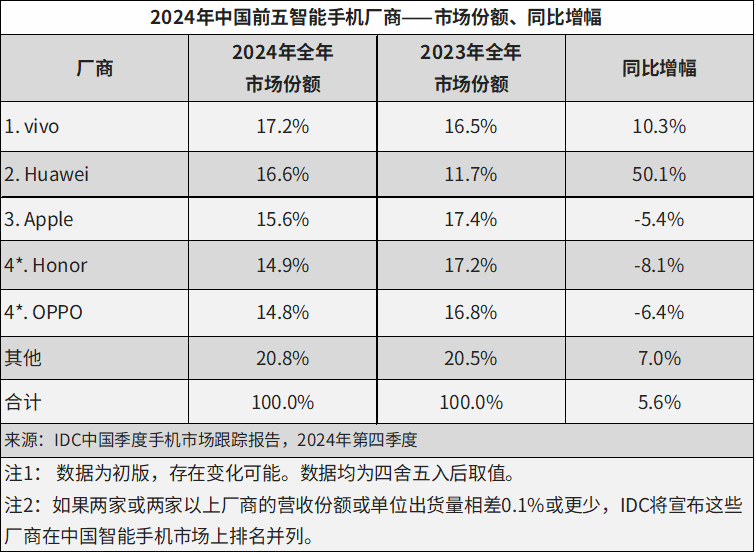
Image source: IDC
IDC data shows that in China's 2024 phone market, Huawei's shipments grew 50.1% year-on-year, ranking second, only behind vivo. During the same period, Honor's shipments fell 8.1% year-on-year, tying for fourth with OPPO.
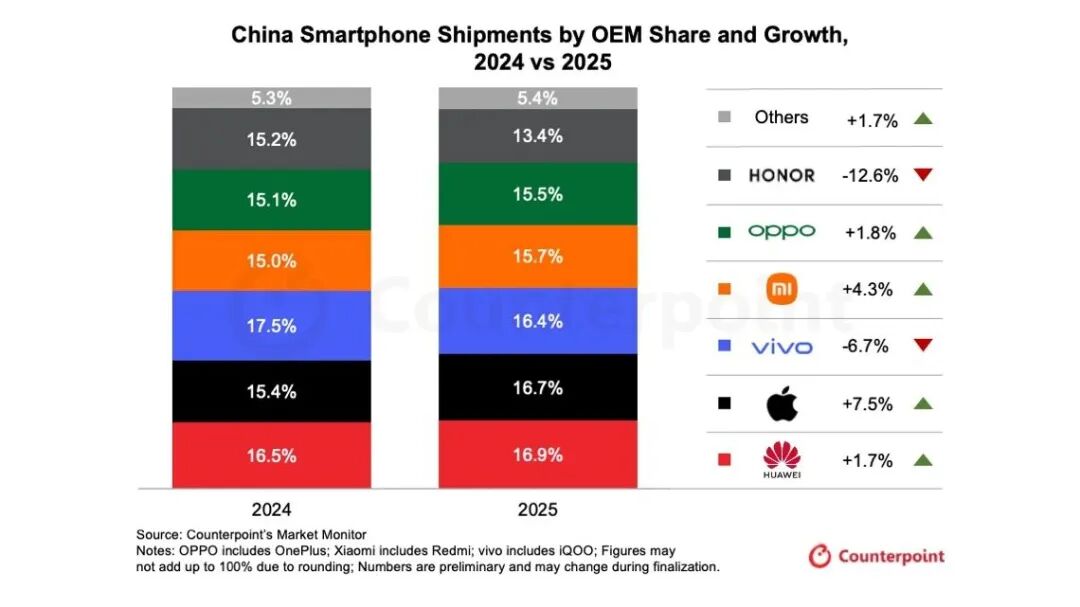
Image source: Counterpoint Research
In 2025, Huawei's phone shipments returned to first place, while Honor fell out of the TOP 5 list. Counterpoint Research data shows that during that year, Honor's phone shipments fell 12.6% year-on-year, the largest decline among leading manufacturers.
It should be noted that Honor is not entirely without improvement. In Q3 2026, Honor's phone shipments edged up 0.9% quarter-on-quarter, making it the only top manufacturer with positive quarter-on-quarter growth; in October it even ranked first in China's Android market with a 12.04% share. But this is a rebound from a low base and relies heavily on an ocean of models and mid-range volume sales, failing to fundamentally rewrite the underlying trend of a sharp year-on-year decline.
Facing an aggressive Huawei, Honor has not sat idle but is actively deploying AI technology, attempting to open up growth space by creating differentiated experiences. In March 2025, Honor released the Alpha Strategy, planning to invest $10 billion over the next five years to transform into an AI terminal ecosystem company.
Guided by the Alpha Strategy, Honor successively built products such as the Magic8, Magic9, and Magic V6 series and launched AI services including the YOYO agent family, YOYO Tasks, and AI call assistant.
Unfortunately, because it is difficult to break through the barriers of the mobile internet ecosystem and create a significant gap with other products, Honor phones have not secured a firm foothold through AI technology. IDC data shows that in China's phone market from Q1 to Q3 2026, Honor's phone shipments fell 2%, 9.5%, and 24.2% year-on-year, ranking fifth, sixth, and sixth, respectively.
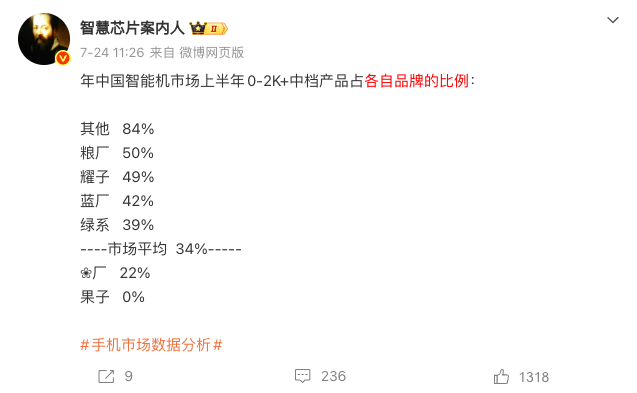
Image source: Smart Chip Insider
More importantly, Honor has not achieved a high-end transformation. According to digital blogger "Smart Chip Insider," in the first half of 2026, products priced at 0-2000 yuan accounted for 49% of Honor's phone sales, only 1 percentage point lower than Xiaomi, which is known for cost-effectiveness. In the first three quarters of this year, in China's high-end phone market above 6000 yuan, Honor's market share was only 1.5%.
Against this backdrop, compared with Huawei's phone comeback three years ago, the birth of Starlight may bring a greater negative impact on Honor. Because in the past few years, Huawei focused on the flagship phone market, which was somewhat misaligned with Honor's base. By contrast, Starlight targets young consumers and focuses on the mid-to-high-end market, striking directly at Honor's core territory.
For Honor, competing with Starlight is not a symmetric contest. This is not only because Starlight can inherit Huawei's mature technology but also because Huawei has more abundant cash flow and values HarmonyOS ecosystem installations more than short-term returns. After Starlight's launch, it may seize market space from Honor and other smartphone manufacturers through aggressive pricing strategies.
02
Valuation shrinks by 30%, Honor's IPO struggles
Because the receiving capital has exit demands, after independence, in parallel with capturing the smartphone market, Honor's other major strategic direction is to push toward the capital market.
In November 2023, Honor's board of directors announced that "to achieve the company's next-stage strategic development, it will continuously optimize its shareholding structure, attract diversified capital, and promote the company's listing on the capital market through an initial public offering." Subsequently, Honor successively completed shareholding reform and optimized its equity structure to prepare for the IPO sprint.
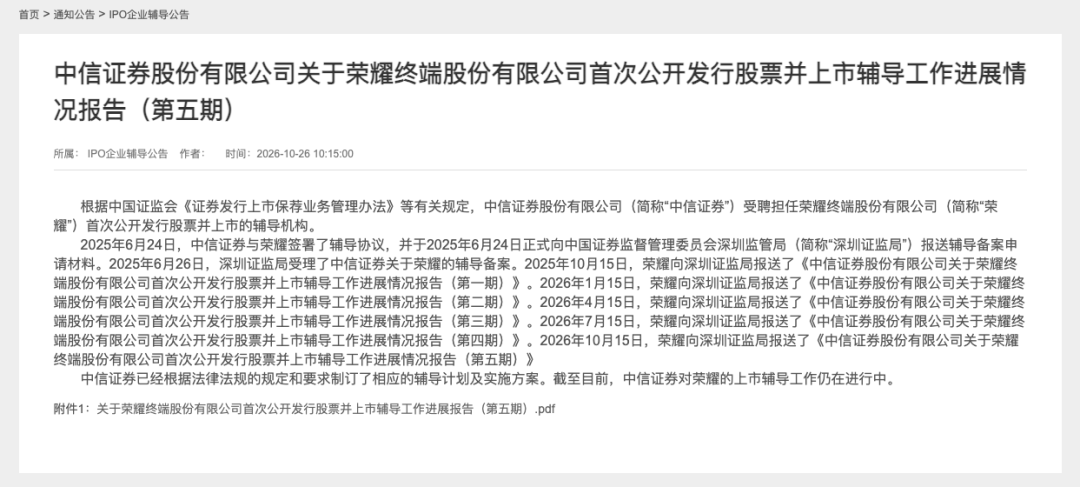
Image source: CITIC Securities
In June 2025, Honor completed listing coaching filing with the Shenzhen Regulatory Bureau, with CITIC Securities as the coaching institution. It originally planned three phases totaling nine months, with coaching acceptance completed by March 2026 at the latest. However, in October 2026, Honor submitted the fifth phase coaching progress report to the Shenzhen Regulatory Bureau. As of now, CITIC Securities' listing coaching work for Honor is still ongoing.
The reason Honor's IPO journey has yet to see a key leap is largely because the phone market environment has deteriorated and the company's room for imagination is narrowing.
As mentioned earlier, with Huawei's strong comeback, Honor's market influence has been declining. Since 2026, memory prices have soared rapidly, beginning to erode Honor's profits.
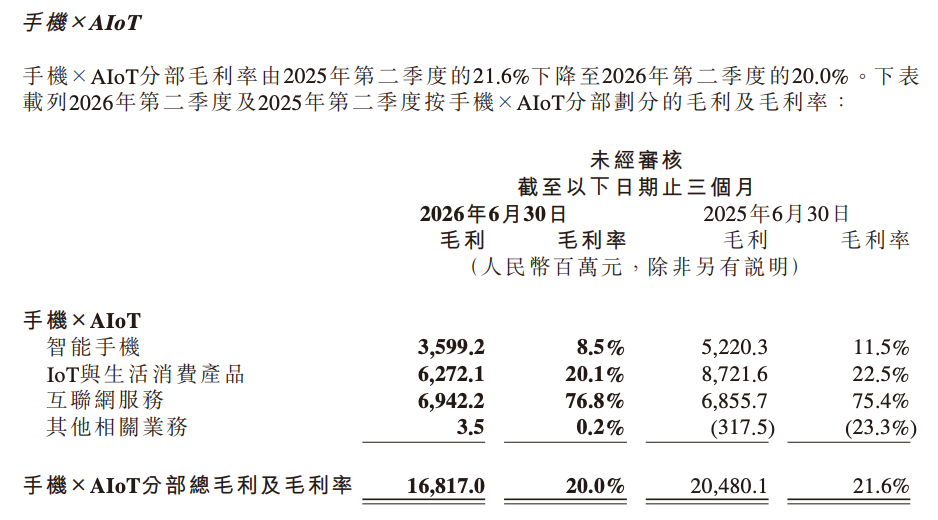
Image source: Xiaomi 2026 Q2 financial report
Take Xiaomi, whose product structure is similar to Honor's, as an example. In Q2 2026, Xiaomi's phone business gross margin was 8.5%, down 3 percentage points year-on-year. Fortunately, Xiaomi has diversified businesses such as IoT, internet, and smart cars that can offset the pressure of rising memory prices for phones. By contrast, Honor is highly dependent on the mid-range smartphone business and finds it difficult to defend profits.
Due to the lack of a solid base and considerable growth potential, Honor's valuation has been declining all the way. According to Caixin, in November 2020, when Shenzhen state-owned capital acquired Honor from Huawei, the transaction price was about $40 billion (about 260 billion yuan at the exchange rate then).
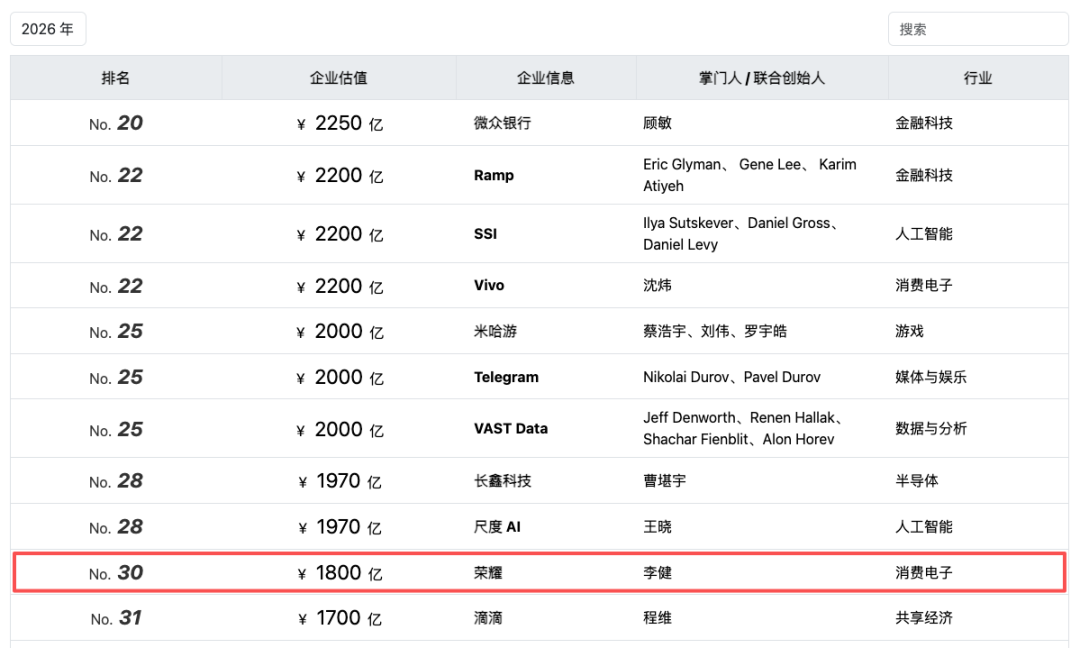
Image source: Hurun Research Institute
In October 2024, Honor completed its Pre-IPO financing round at a valuation of 200 billion yuan. In June 2026, the "2026 Global Unicorn List" released by the Hurun Research Institute showed Honor's valuation at 180 billion yuan. In just six years, Honor's valuation shrank by about 30%.
Facing a continuously postponed listing timetable and accumulating uncertainty, Honor employees have begun to "vote with their feet" internally.
According to TMTPost, Honor had previously conducted four internal share allotments, and many employees invested. However, within one year of the shareholding reform, Honor did not complete its IPO as hoped. Moreover, to meet listing requirements, in April 2026 Honor also canceled regular dividends.
As early as the beginning of the shareholding reform, Honor's senior management stated that if the IPO progressed below expectations, it would consider opening an exit channel. In May 2026, Honor officially opened an employee reduction and exit channel, allowing employees to withdraw shares at the original price. With both realization paths—listing expectations and dividend returns—narrowing simultaneously, many employees chose to "refund."
Admittedly, opening share withdrawal does not mean Honor's IPO plan has failed, but employees choosing to withdraw shares still indicates to some extent that Honor is becoming less "sexy." With internal employees lacking confidence in the company, it is difficult for Honor to persuade the capital market to give it a higher valuation.
03
Betting on robots and 3D printers, Honor seeks a breakthrough through diversification
Given the growing competitive pressure in the smartphone industry, Honor is actively deploying diversified businesses to open up broader growth space.

Image source: Honor
Guided by the Alpha Strategy, Honor has built the consumer-grade humanoid robot Lightning D1 and the robot phone Robot Phone. In addition, according to digital blogger "Dingjiao Digital," Honor is actively expanding multiple product lines toward pan-technology. "This year it is making robot vacuums, and next year it will have self-developed 3D printers."
Judging from the development trends of the tech industry, whether humanoid robots, AI phones, or 3D printers, all have broad prospects. For example, data from the National Bureau of Statistics shows that in the first half of 2026, China's output of 3D printing equipment grew 48.5% year-on-year, ranking first in growth among major industrial products.
However, as BBK founder and investor Duan Yongping said, "Very few companies can do 'diversification' well, especially those that diversify for the sake of diversification." This is not only because a company's energy and capabilities are limited but also because professional players have already built relatively deep competitive barriers in vertical tracks.
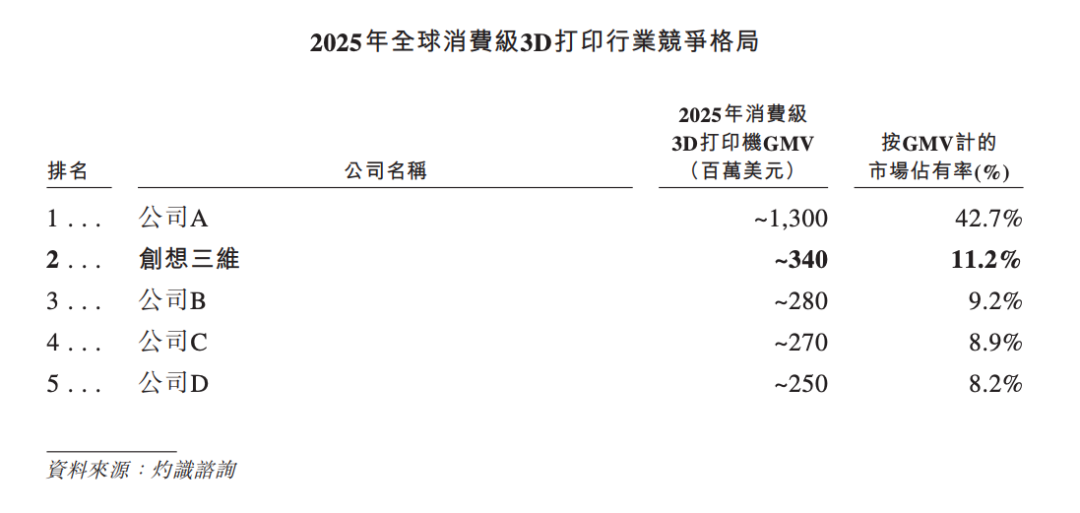
Image source: Creality prospectus
Take 3D printers as an example again. Data disclosed by China Insights Consultancy shows that in the 2025 global consumer-grade 3D printing market, Bambu Lab and Creality had GMVs of $1.3 billion and $340 million, with market shares of 42.7% and 11.2%, respectively, totaling 53.9%, indicating the industry has entered an oligopoly era.
Consumer-grade 3D printing relies heavily on software ecosystems and community operations. Players such as Bambu Lab and Creality have established extremely high competitive barriers through ecosystem communities and multi-color high-speed printing, thus achieving clear leading advantages in the market. For Honor, building a high-performance 3D printer is not difficult; the real challenge lies in how to build a thriving ecosystem.
Ultimately, diversification can indeed improve a company's risk resistance. Xiaomi's ecosystem chain and Midea's multi-category expansion are both positive examples.
However, the underlying logic of Honor's diversification layout is completely different from these companies. Xiaomi's ecosystem chain adopts an asset-light model of "investment + channels" and complements its steadily rising main business. Honor, by contrast, is exploring diversification while its main business is losing blood and before it has completed an IPO financing. Both are pursuing diversification strategies, but one is using profits to trial and error, while the other is making a cash gamble.
On the surface, Honor's current predicament stems from a three-pronged attack: loss of its smartphone base, delayed IPO, and blocked cross-sector expansion. But tracing it to the root, these three problems are actually different facets of the same coin—six years after independence, Honor has never walked out of the shadow of being a "Huawei substitute."
A more dangerous chain reaction is quietly unfolding. Unlike conventional tech companies, the dozens of agents and distributors that jointly took over Honor back then serve as both shipment channels and behind-the-scenes shareholders. In the past, high IPO premium expectations acted as a strong adhesive holding the vast offline channel system together. Now, with valuations shrinking, original-price share withdrawal opening up, and channel-flattening reforms advancing, the loosening of capital ties can easily backfire on Honor's offline stock-pushing capability—the very lifeline it relies on for survival.
From a business perspective, although Honor has done many things right over the past six years, it has yet to build a deep competitive moat. AI phones are now an industry standard, humanoid robots are being pursued by many companies, and robot vacuums and 3D printing have long been dominated by major players. Honor has proven that it can keep up with trends, but it has never managed to find its own irreplaceability.
In business history, the truly cycle-resistant diversification has always been the natural spillover of underlying technologies and ecosystem momentum. A hastily assembled "pan-tech" portfolio—created to fill gaps in the core business and cater to secondary-market narratives—not only cannot support a hundred-billion valuation, but may also accelerate the dilution of the company's already limited strategic focus.
As Huawei's "Starmap" closes off the escape route for "stand-ins," the window left for Honor to prove its value is gradually shutting.
Discussion Topic
Are you optimistic about Huawei Starmap? Will it bring pressure to Honor?
This article is original content from Farsight. Reproduction is prohibited without authorization.
-
![]()
Baidu's Q3 Report: Advertising Stalls as AI Takes the Wheel
-
![]()
JD.com: Retail Stops the Bleeding While Overseas Burns Cash — When Will the "Thrashing" End?
-
![]()
Great report! But without Jensen Huang, Nvidia just doesn't feel the same!
-
![]()
LCoS and the Screen Door Effect: Why Do Our Eyes "Catch" the Pixel Gaps?
-
![]()
Cybertruck Failed to Keep Musk, the Car Builder
-
![]()
Chips Are Scarce, Yet TSMC Has Started "Vetting Customers' Finances"?
-
After "Taking Down" Jensen Huang, the United States Officially Shows Its Hand: A Comprehensive Blockade on China's AI Computing Power
-
![]()
Huawei's AI Phone Has Arrived!