MIIT Begins Scrutiny of Automakers' Payment Terms
 11/18 2026
 505
On November 16, the China Association of Automobile Manufacturers (CAAM) issued the "Notice on Conducting Survey and Assessment of Supplier Payment Conditions of Automotive Enterprises," launching a survey and assessment of supplier payment conditions for 17 key automotive enterprises. These 17 cover the major domestic passenger carmakers: FAW, SAIC, Dongfeng, Changan, GAC, BAIC, Chery, JAC, Great Wall, Geely, BYD, Seres, Li Auto, NIO, XPeng, Xiaomi, and Leapmotor. On the same day, a relevant official from the Ministry of Industry and Information Technology (MIIT) responded that assessment results will be published once a year, and companies with large accounts payable, deliberate lengthening of payment terms, or numerous complaints will be jointly summoned for talks and urged to rectify.
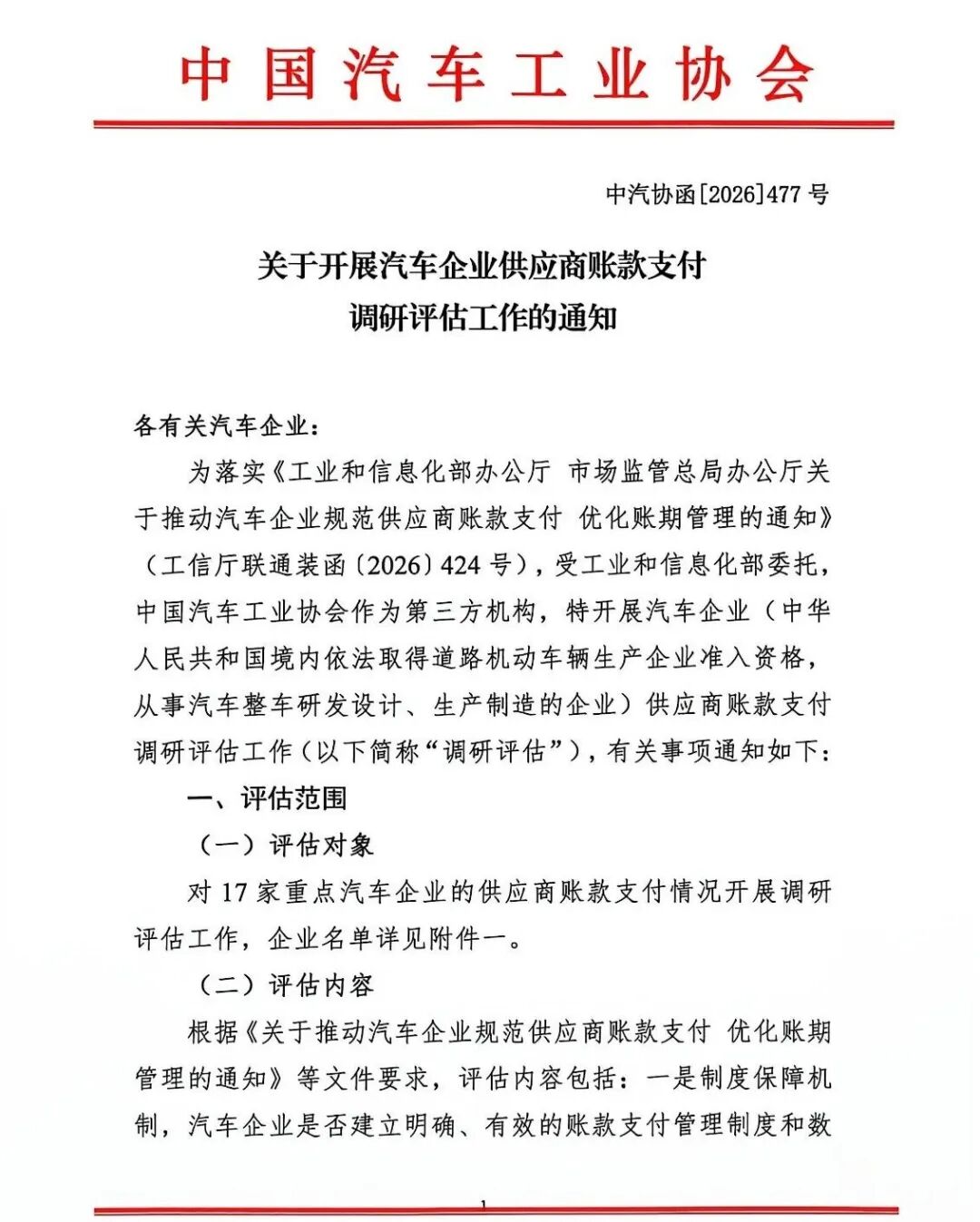
The assessment breaks the payment-term commitment into four verifiable checkpoints. The first is institutional: automakers must have payment management systems and digital systems, and supply contracts signed with suppliers must have a validity period of no less than one year. The second governs small and medium-sized suppliers: payment terms must not exceed 60 days, and payment methods must be entirely cash, or cash plus bank acceptance bills. The third governs non-SME suppliers: payment terms are likewise capped at 60 days, and the proportion of cash and bank acceptance bill payments must be no less than 80%. The fourth closes the loophole on price negotiations: contracts must clearly specify how payments are made during negotiation periods. For continuous supply, advance payment shall reference the most recently effective contract unit price, at a proportion no less than 90%; for non-continuous supply, advance payment shall reference the industry average price or development designated unit price, at a proportion no less than 70%, with final pricing settled by refunding excess or supplementing shortfalls.
The working mechanism is more noteworthy than the assessment content. Surveys are conducted annually in four steps: enterprise reporting, special task force verification, expert review, and public release. Automakers must submit the previous year's report by January 31 each year and the first-half report by July 31. The accounting scope covers accepted and qualified purchase orders, not accounts payable under financial reporting standards. CAAM randomly selects no fewer than 15 suppliers from each enterprise's supplier list each year for document verification and on-site surveys, checking contracts, acceptance certificates, reconciliation records, invoices, and payment vouchers. Enterprises may not conceal information or provide false information. In other words, the figures automakers report must be verified with their suppliers.
This mechanism did not come out of nowhere; it follows up on a commitment made a year and a half ago. On June 1, 2025, the revised "Regulations on Ensuring Payments to Small and Medium-sized Enterprises" took effect, requiring large enterprises purchasing from SMEs to pay within 60 days of delivery. Within the following two days, nearly 20 automakers publicly committed to payment terms not exceeding 60 days. BYD issued a statement at 1:28 a.m. on June 11, unifying supplier payment terms to within 60 days. The reason automakers acted collectively was that payment terms had long ceased to be merely a payment arrangement in the industry and had become a competitive weapon.
The industry has long had an unwritten rule of "3-month payment terms plus 6-month acceptance bills." The longer the payment terms, the more cash automakers hold, and the more ammunition they have for price wars. Data publicly disclosed by a BYD brand executive in June 2025 showed that, calculated by average turnover days of accounts payable and notes payable, BYD stood at 127 days, Geely at 127 days, Great Wall at 163 days, and SAIC at 164 days. Beyond being squeezed on prices, suppliers also had to front capital. With tens of thousands of parts per vehicle, in a pyramid-shaped supply system, risk ultimately falls on the small and medium-sized enterprises at the very bottom.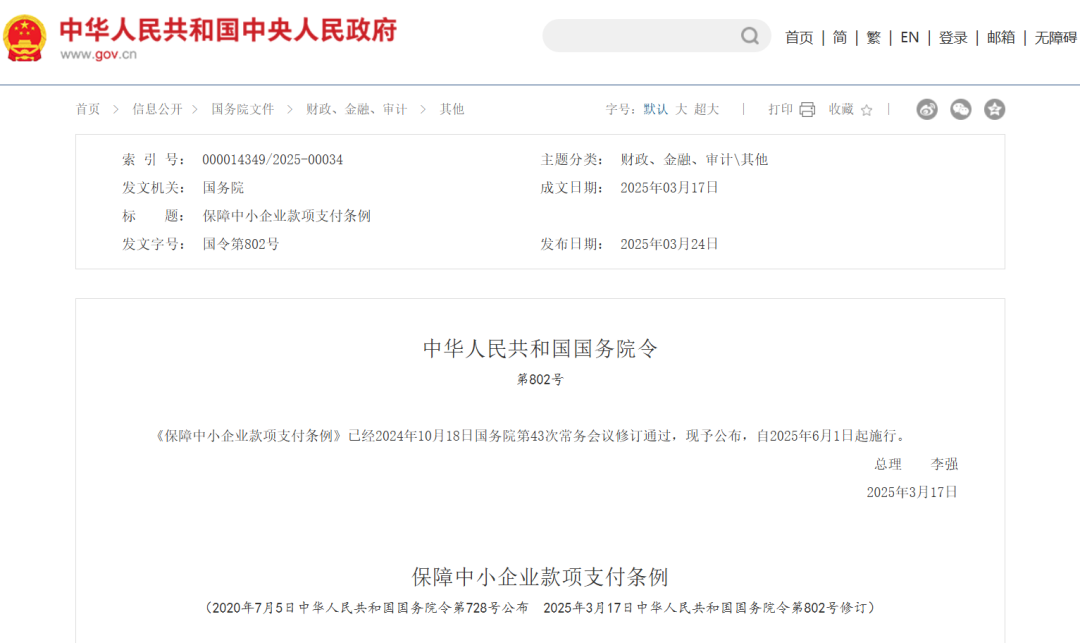
Making a commitment is easy; what is hard is the accounting basis. A CAAM survey in February this year showed that key automakers had an average payment term of about 54 days, roughly 10 days shorter year-on-year, but the starting point for calculating payment terms varied from company to company, and some enterprises still effectively extended payment terms through disguised means. With different starting points, the same sum of money can differ by a noticeable margin in book days. This is also why on September 7, MIIT and the State Administration for Market Regulation issued the "Notice on Promoting Automotive Enterprises to Standardize Supplier Payment and Optimize Payment Term Management," which explicitly codified payment term starting points, acceptance time limits, payment methods, and advance payments during negotiation periods clause by clause. This CAAM notice then turns those clauses into a verification checklist. Stacked together, the three documents form a line: the regulations set the bottom line, the ministry documents set the rules, and the association assessment serves as referee.
For automakers, the cost of tightening payment terms is real cash flow. Pressing accounts payable turnover days from 160 days to 60 days is equivalent to fronting more than three months of payments on the same scale of procurement, money that suppliers had been advancing on automakers' behalf. In the year and a half since the commitments were made, leading automakers have gradually translated their commitments onto financial statements, but the margin between the 54-day industry average and the 60-day red line is not large. Details such as advance payments during negotiation periods and the proportion of acceptance bills are precisely aimed at operating room beyond the financial statements.
The first acceptance checkpoint is January 31, 2027. On that date, the 17 automakers will each submit their 2026 payment reports, the first annual answer sheet under the assessment mechanism. After that, at least 15 suppliers on each enterprise's supplier list will receive verification calls. For suppliers, payment terms used to be an account they could only complain about privately. From this notice onward, the acceptance certificates and reconciliation records in their hands have become the source documents for the scorecard.
-
![]()
Share Link Won't Open: Tracing a URL Parameter Placement Bug
-
![]()
BAIC Group | October Terminal Sales: Product Mix Across Four Brands and 31 Models
-
![]()
Mercedes-Benz China Retail Sales in October: 28,820 Units — How Did Beijing Benz and smart Perform?
-
![]()
Tesla Invests €3 Billion to Upgrade German Factory, Sells Robotaxi — but You Still Pay Monthly to Drive
-
![]()
ARCFOX Slashes Huawei Smart Driving Threshold to the 150,000 Yuan Mark
-
![]()
The Korean Car Conundrum: Boxed In by the Supply Chain, Outmatched in Overseas Markets
-
Has Apple Really Cured the "Rogue App" Epidemic Among Domestic Apps?
-
![]()
AI Short Dramas: A Successful Capital Relocation?