BAIC to Sell Off All Its Self-Operated Battery Swap Stations
 11/19 2026
 368
On the evening of November 17, BAIC Motor announced that its wholly-owned subsidiary, BAIC Powertrain, intends to publicly list and auction on the Beijing Equity Exchange an asset package related to 112 battery swap stations, encompassing inventory, fixed assets, construction in progress, and intangible assets. The appraised value of these assets is approximately 278 million yuan (excluding tax), and the listing price will be no lower than this amount. The intended transferee remains unclear.
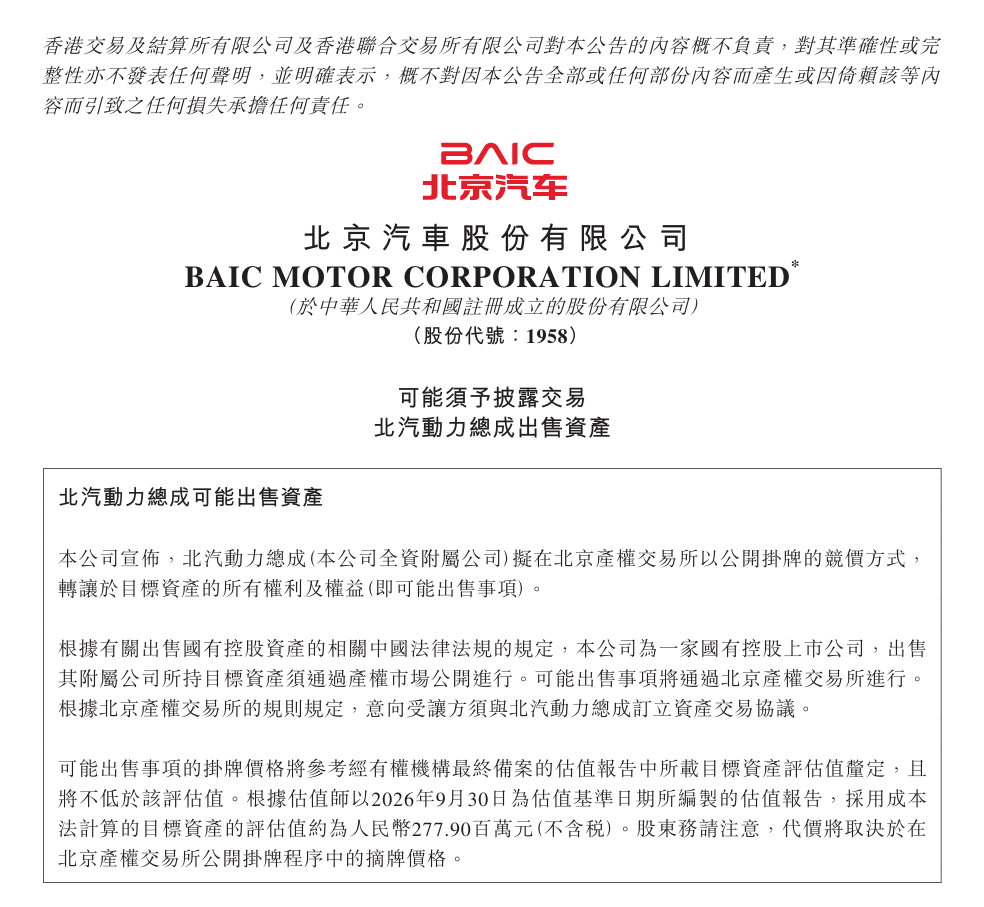
The key point is not the amount, but the identity of the seller. BAIC was the earliest domestic automaker to turn battery swapping into commercial operations: at the end of 2015, it delivered its first batch of 200 EU220 battery-swap taxis; in 2016, it partnered with Sinopec and Aulton New Energy to build the first 10 charging and battery swap stations; in 2017, it released the "Optimus Prime Plan," proposing to invest 10 billion yuan and build 3,000 solar-storage battery swap stations by 2022. At its peak in 2019, it operated 13,000 battery-swap taxis and had built 148 stations across 15 cities; by the first quarter of 2021, it had reached 255 stations in 19 cities. That year, 10,000 EU5 fast-swap taxis were delivered, with battery swapping completed in 90 seconds. It held more than 300 patents and 6 national and international standards, and billed itself as the country's largest battery-swap vehicle service provider.
But this route stopped at the B-end. The economics of battery swapping were fully validated in taxis: high vehicle standardization, intensive operations, and energy replenishment efficiency directly translated into driver income. The step from taxis to private users was never taken. Network density in the private market was insufficient, battery asset operations were not an automaker's strength, and ordinary consumers rarely placed an order simply because a car supported battery swapping. The Optimus Prime target of 3,000 stations was far from fulfilled. The 112 stations listed this time are the remaining family assets from ten years of accumulation.
The quality of the assets can be read from two numbers: book value of 274 million yuan, appraised value of 278 million yuan—an appreciation of just 1.54%. If sold within the year at the appraised value, BAIC Motor's comprehensive profit for 2026 would increase by only about 3.52 million yuan. These stations are essentially being sold at replacement cost, with no premium obtained for operating value.
There is another detail: 40 of them were purchased only in March last year for about 129 million yuan from the group's related party, Blue Park Energy, and now they are being transferred as a whole. This cash recovery is not superfluous for BAIC Motor at present. In the first three quarters of this year, the company's net loss attributable to shareholders was 3.09 billion yuan, with the decline in the joint venture business being the main reason.
No premium can be obtained because what the buyer is buying is bricks and steel frames, not the business running on the stations. The business could not be built up, and the root lies in the self-built battery swap network route itself: of the two automakers that went the furthest, NIO relied on more than 20 billion yuan in investment and more than 40 co-builders to support over 4,000 stations, and has so far not earned back its investment through the network itself; Geely worked on it for ten years, with E-E Connectivity reaching more than 470 stations at its peak and now falling back to 389. In September this year, it signed with NIO to merge its operating battery swap business into NIO Power's operations, retaining only equity and battery-swap model development. For a self-built network to stand, three things matter: money to build stations, vehicle traffic running on the stations, and models the stations can accommodate. For BAIC back then, none of the three came together.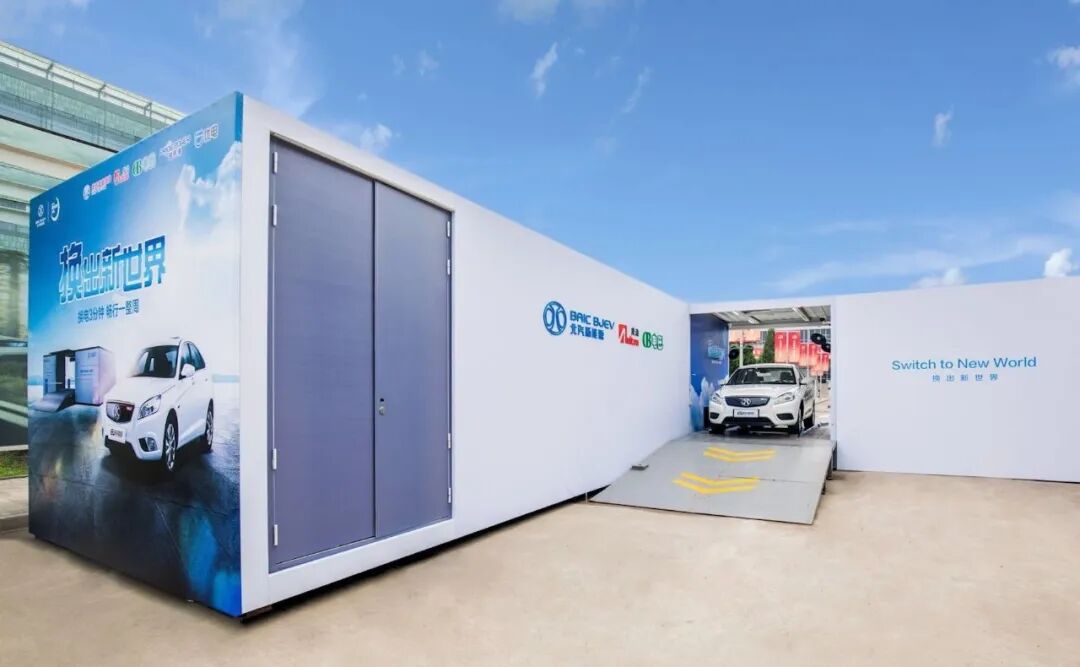
First, money. The construction cost of a passenger car battery swap station is around 1.5 million yuan, not including site rent, power capacity expansion, and circulating batteries. Behind NIO is more than 20 billion yuan of cumulative investment over ten years, and last year CATL injected another 2.5 billion yuan into its energy business. BAIC did not have this scale. Optimus Prime called for 3,000 stations, but only more than 100 were actually built.
Next, vehicle traffic. Break-even for a battery swap station requires a single station to serve dozens to hundreds of swaps per day. If a brand sells tens of thousands of vehicles a year, spread across one city and one district, it cannot support this traffic. BAIC's self-operated stations served only its own taxis and ride-hailing cars. The EU5 fast-swap version had long been withdrawn from the main product line. As the stock of vehicles decreased, utilization declined monotonically, and in the end they could only be monetized at the price of steel frames.
The amount of vehicle traffic ultimately hinges on models. BAIC's self-operated stations used their own battery standards and could only swap BAIC vehicles; CATL's Choco-Swap uses standard battery blocks, covering multi-brand models from A0-class to C-class with No. 20, No. 25, and No. 26, and vehicles from FAW, Changan, Chery, and GAC can all use them. At present, in the passenger car battery swap market, NIO accounts for 61.73% and CATL 17.06%, with the two together accounting for nearly 80%, and the standard positioning is basically settled.
This also explains what BAIC is doing while selling stations. In April this year, BAIC Group signed a comprehensive battery swap strategic cooperation agreement with CATL; on October 22, it signed another million-vehicle-level agreement; a few days ago, the Arcfox T1 battery-swap version went on sale, equipped with a 54 kWh Choco-SEB battery, 99-second battery swapping, starting at 52,000 yuan. The division of labor is clear: Arcfox handles complete vehicles, CATL handles batteries, standards, and networks, and BAIC opens dealer stores to participate in joint station construction and operation. BAIC's role has retreated from an operator holding assets and building networks to an automaker building battery-swap vehicles and providing channels.
So selling stations does not mean being bearish on battery swapping. BAIC has not left this business; it has only changed the way it participates: the 112 self-operated stations are put on the shelf at book price, while the battery-swap models it is vigorously promoting have all joined CATL's Choco-Swap ecosystem. It no longer builds networks itself, but sells cars on the large networks laid out by others. Starting from the goals of 10 billion yuan and 3,000 stations, nine years later, the way of participating in battery swapping has changed, and so has its position. As for who will ultimately take over these 112 stations, the announcement says the intended transferee is not yet clear, and the answer will have to wait until the delisting date.
-
![]()
Three Gates for AI Automated Testing: Verifying Code Correctness
-
![]()
XPeng's Q3 2026: Service-Fee Tide Recedes as Cars and Overseas Sales Take Over
-
![]()
Waymo Suspended from California Highways: Why Halt Operations Without Any Casualties, and Where Is Tesla's Cybercab?
-
![]()
Breaking: U.S. Moves to Block Global Computing Power, Bars China from Overseas GPU Rentals
-
![]()
Between Jing and Jie: Has AITO Landed in an "Intermediate State"?
-
![]()
Apple's 18 New Products: All-Star Lineup for Next Year, With First AI Glasses Finally Making Their Debut
-
![]()
MIIT Approves 6G Ministry-Province Collaborative Pilot in 8 Provinces and Municipalities: A Comparative Analysis of Regional Industrial Advantages
-
Anthropic Goes Public, but Its Values May Determine How Far It Can Go