Waymo Suspended from California Highways: Why Halt Operations Without Any Casualties, and Where Is Tesla's Cybercab?
 11/19 2026
 557
Silicon Valley's autonomous driving sector has made headlines once again: Waymo has confirmed the suspension of its driverless passenger service on highways across the United States. The move was triggered by a restriction order from the California Department of Motor Vehicles (DMV) effective November 11, which prohibits Waymo from operating or testing driverless vehicles on any highway in California on the grounds of an "imminent danger to public safety." Notably, this order was not disclosed by the media until six days later.
In fact, neither of the two triggering incidents resulted in a collision or casualty. The reason California took action against Waymo this time most likely comes down to failed remediation: the same type of error recurred after a recall and software update, and "no accident" was no longer an acceptable excuse.
On the same day, Tesla registered 200 Cybercabs at once in Texas. In our previous article "Waymo vs Tesla: Where the Robotaxi Battle Stands, and Will Automakers Become Foxconn?", we also noted that Tesla's Robotaxi count in Texas had caught up with Waymo's. So how is Tesla's Cybercab faring?
This article clarifies the ins and outs of the matter and also shares how Tesla's Cybercab is doing.
What Happened: Two Incidents, One Prohibition Order
On November 5, three Waymo driverless vehicles on Highway 101 near Burlingame, south of San Francisco, entered a closed construction zone. The following day, a Waymo on Highway 280 in San Francisco attempted to overtake a California Highway Patrol vehicle that was weaving to slow traffic, and the video circulated widely online.
The DMV order set no deadline, and the condition for lifting it is that Waymo provide evidence that its vehicles can recognize and respond to construction zones and emergency vehicles. Waymo expanded the restriction nationwide the same day, suspending all highway passenger service in the San Francisco Bay Area, Los Angeles, Phoenix, Miami, and Austin, while testing with safety drivers continues as usual. Regular road service in 15 cities is unaffected, with weekly orders still above 500,000.
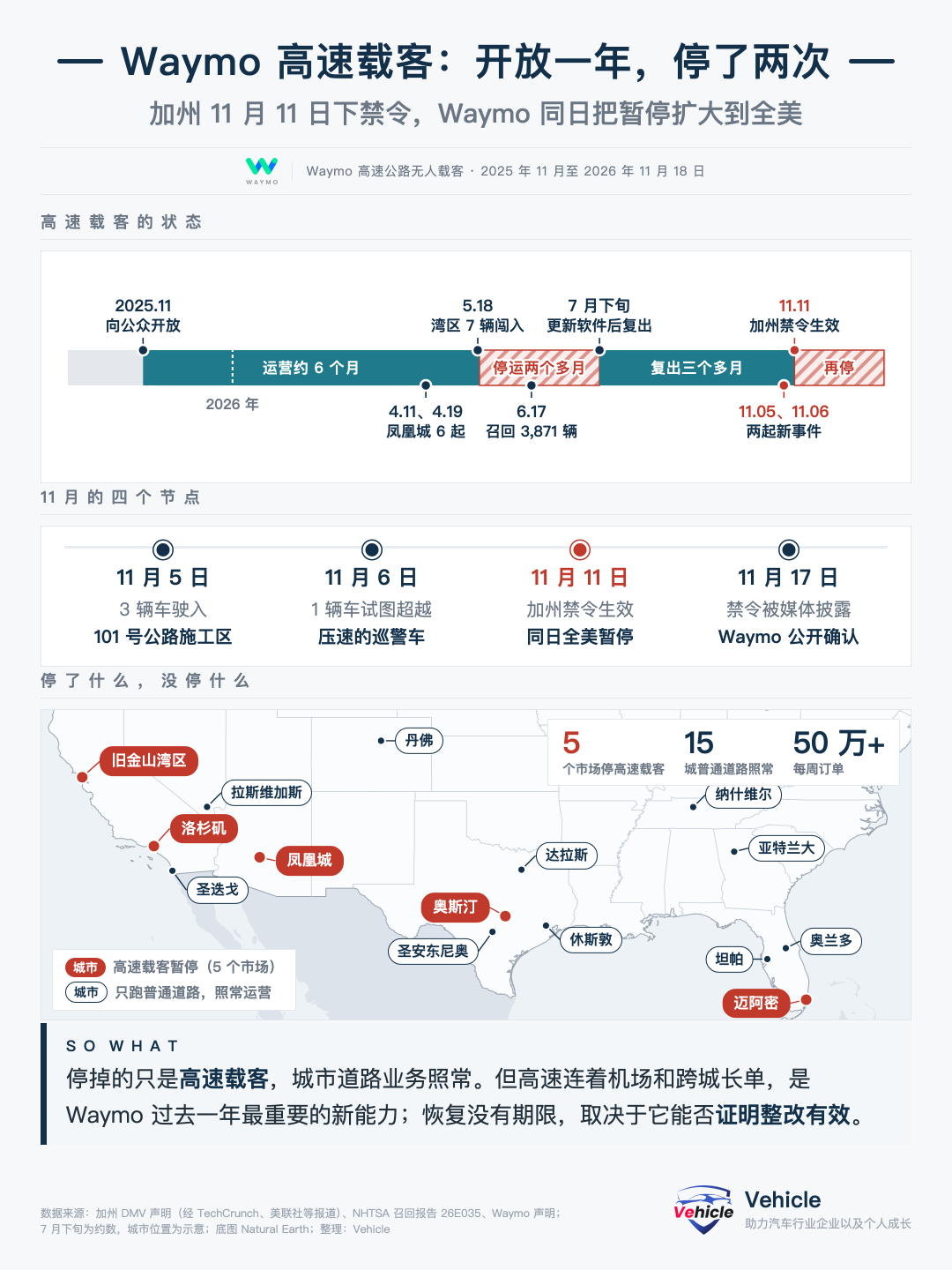
Source: California DMV statement, NHTSA recall report 26E035, Waymo statement; late July figures are approximate, city locations are illustrative
The losses are concentrated in long-distance orders: highway passenger service only launched last November, and cross-peninsula trips in the Bay Area that originally took more than 45 minutes and airport orders all depended on it. Waymo's city business has not stopped; what has stopped is its most important new capability of the past year.
Why: Halt Operations Even Without Casualties
Two key phrases stand out in the DMV statement: "repeatedly," and "despite prior restrictions and remediation."
Repeated violations: In April this year, Waymo vehicles in Phoenix failed six times to recognize closed ramp signs and entered construction zones; on May 18, seven vehicles in the Bay Area passed between cones and entered a lane under construction. Highway service was immediately suspended, and on June 17 Waymo filed a recall with the National Highway Traffic Safety Administration (NHTSA), covering all 3,871 vehicles with driverless highway capability, and returned to service after a software update in late July. More than three months later, the same thing happened again.
The root cause lies in decision-making: The defect stated in the recall document is that the system "improperly prioritized avoiding other highway hazards, and/or failed to recognize construction zones." The problem is not only whether it saw them, but also which risk to avoid first when several risks appear simultaneously. Construction zones are temporary and do not match the map, and on highways the reaction time left for the system and remote assistance is very short, with unprotected workers standing nearby. A patrol vehicle slowing traffic requires the system to understand the intent of law enforcement vehicles.
Expansion accelerating: Waymo's fleet grew from more than 2,000 vehicles to more than 4,000 in a year, and both highway mileage and low-probability scenarios are amplifying.
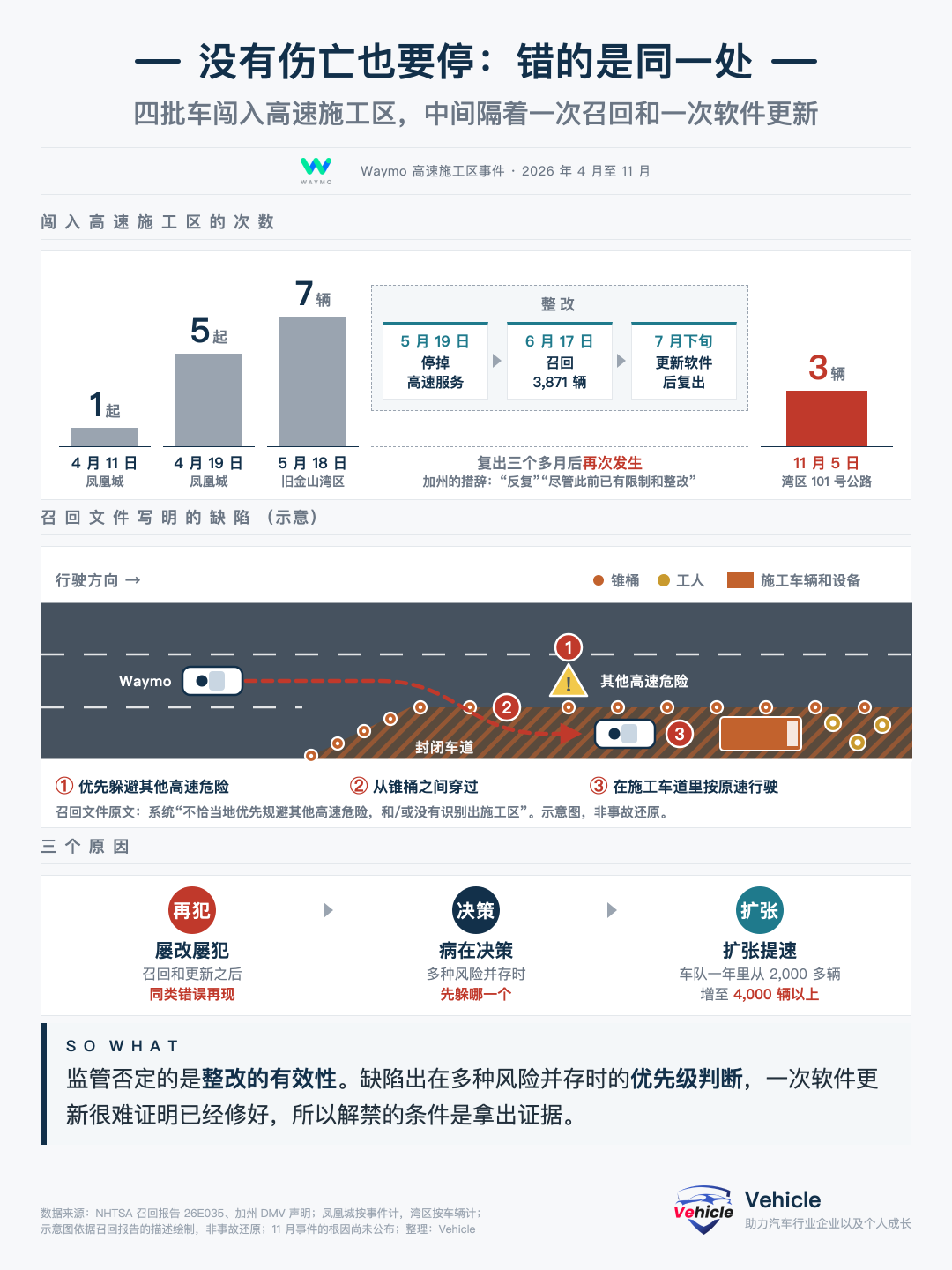
Source: NHTSA recall report 26E035, California DMV statement; the schematic is drawn based on the description in the recall document and is not an accident reconstruction
Waymo voluntarily expanded the suspension nationwide, and this article infers there are two considerations. The same software runs everywhere, and other states and NHTSA will sooner or later ask the same questions; the industry also remembers the cost of falling out with regulators, as Cruise's driverless operating permit was suspended by California in 2023 and GM stopped funding it at the end of the following year. According to Waymo's published data, its accidents involving serious injuries are 95% fewer than those of human drivers. What is being questioned this time is its ability to find and fix problems, and that is the precondition for regulators to allow it to expand.
Cybercab: Vehicles Pile Up Fast, but Highways Are Not Yet on the Table
Cybercab went into production at the Texas factory in the second quarter of this year and began carrying passengers in Austin on September 3, with no steering wheel or pedals in the vehicle. As of November 17, Tesla had registered 1,507 Robotaxis in Texas, 186 more than Waymo's 1,321, of which 773 were Cybercabs, accounting for 51%.
Production capacity: The Texas factory has an annual capacity of more than 125,000 vehicles. Musk said Cybertruck production will end around the middle of next year to free up the line for it; the head of the Berlin factory said on November 16 that about $3.3 billion will be invested to produce Cybercab from 2029, with a target maximum annual output of 1 million vehicles.
Operations: Driverless service covers 8 cities in Texas and Florida and has operated around the clock since mid-November, but Cybercab passenger service is still only in Austin; more than 50 vehicles have already arrived in Dallas, where service was originally scheduled to open in November, but as of the 18th no opening has been seen.
Sales: The personal version began invitation-based ordering on November 13, at $29,990 plus a $299 monthly subscription fee, with deliveries expected in December, and it can only drive within service areas in Texas.
Shortcomings: Tesla's driverless vehicles do not go on highways. In the latest NHTSA data, none of its 43 driverless accident reports occurred on a highway, and the median speed was only 1 mile per hour. Cybercab had 8 reports in total, 4 in driverless mode, all at speeds not exceeding 5 miles per hour; the other 4 came from test vehicles with safety drivers, including a collision at 53 miles per hour on a Philadelphia highway. In September, NHTSA also launched a review of whether this vehicle without a steering wheel complies with federal safety standards, and JPMorgan noted that if it can only rely on exemptions, the annual deployment cap is 2,500 vehicles.
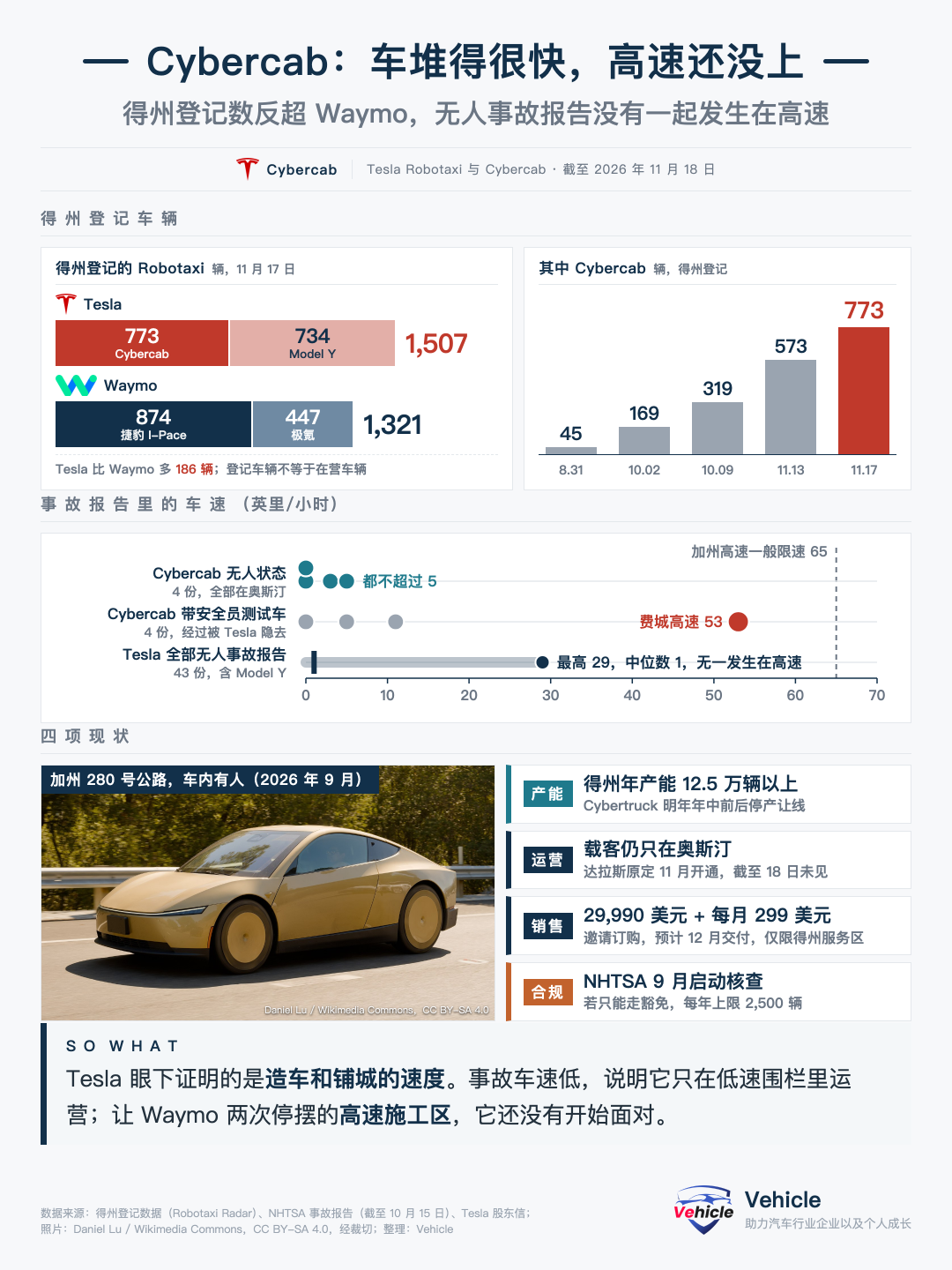
Source: Texas registration data (Robotaxi Radar), NHTSA accident reports, Tesla shareholder letter; registered vehicles are not equal to operating vehicles
What Tesla has proven at the moment is the speed of building vehicles and expanding across cities. The highway construction zones that twice halted Waymo are something it has not yet begun to face.
Final Thoughts
For Waymo, this is a contraction of its operating scope. Its city business and safety record have not been overturned, but its expansion pace and long-distance order revenue will be discounted. For Tesla, this is an exam paper published in advance; highways and construction zones will sooner or later enter its operating scope.
What is quite interesting is that the first ODD opened by intelligent driving or autonomous driving in China's auto industry was highways, and then urban areas, which is the opposite of companies in Europe and the United States. In fact, highway scenarios are relatively simple but highly damaging, and the accidents exposed in the past were basically all on highways.
References and images*
-
![]()
Three Gates for AI Automated Testing: Verifying Code Correctness
-
![]()
XPeng's Q3 2026: Service-Fee Tide Recedes as Cars and Overseas Sales Take Over
-
![]()
Waymo Suspended from California Highways: Why Halt Operations Without Any Casualties, and Where Is Tesla's Cybercab?
-
![]()
Breaking: U.S. Moves to Block Global Computing Power, Bars China from Overseas GPU Rentals
-
![]()
Between Jing and Jie: Has AITO Landed in an "Intermediate State"?
-
![]()
Apple's 18 New Products: All-Star Lineup for Next Year, With First AI Glasses Finally Making Their Debut
-
![]()
MIIT Approves 6G Ministry-Province Collaborative Pilot in 8 Provinces and Municipalities: A Comparative Analysis of Regional Industrial Advantages
-
Anthropic Goes Public, but Its Values May Determine How Far It Can Go