XPeng's Q3 2026: Service-Fee Tide Recedes as Cars and Overseas Sales Take Over
 11/19 2026
 512
XPeng's Q3 earnings report is out.
Last quarter, our headline for XPeng was "cars lose, services earn": Volkswagen's technology service fees propped up nearly half of gross profit, and automotive gross margin stayed at 12.1%.
This quarter, XPeng's financial statements have shifted direction.
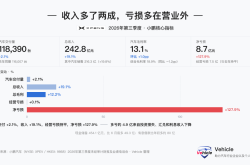
Revenue of 24.28 billion yuan and deliveries of 118,390 units — both single-quarter highs; automotive gross margin back to 13.1%, while overall gross margin instead fell to 18.9%; net loss of 870 million yuan, narrower than last quarter but more than double the same period last year.
So what does XPeng's financial report reveal this 2026 third quarter? This article breaks it down in three parts: revenue and finance, products and technology, risks and opportunities.
Third-quarter revenue and finance
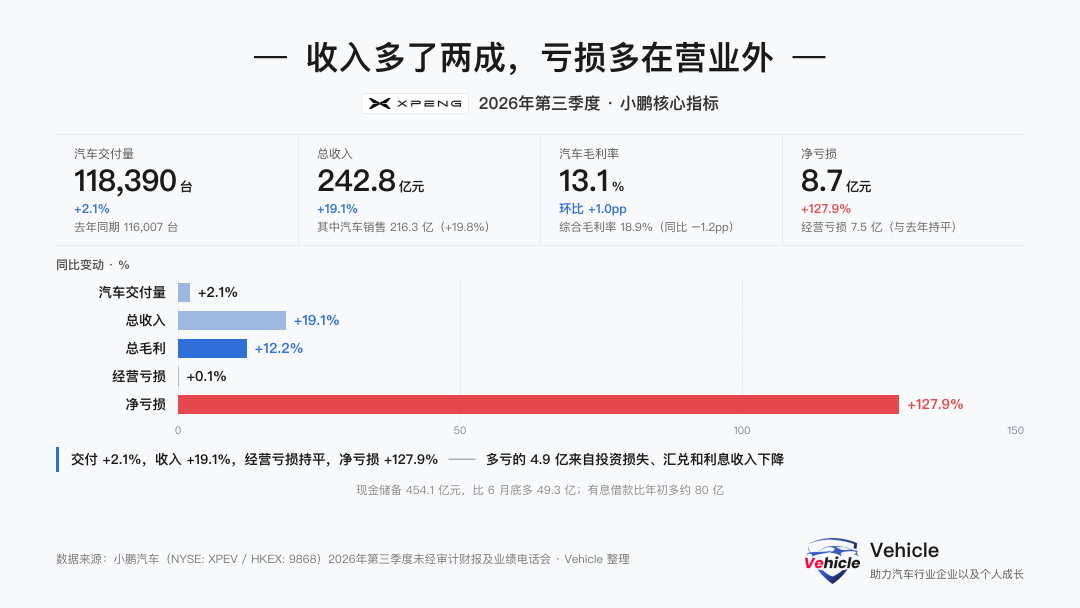
Core indicators and year-on-year changes for Q3 2026
Deliveries of 118,390 units, +2.1% year-on-year, +14.6% quarter-on-quarter; 50,237 units in October, surpassing 50,000 for the first time.
Revenue of 24.28 billion yuan, +19.1% year-on-year, of which vehicle sales were 21.63 billion yuan, +19.8% year-on-year. Deliveries rose only 2% while revenue rose by a fifth, mainly because vehicle average selling price increased.
Gross margin: automotive gross margin 13.1%, +1.0 percentage point quarter-on-quarter; services and other gross margin dropped from 75.1% to 67.1%, dragging overall gross margin down 1.8 percentage points quarter-on-quarter.
Loss: operating loss of 750 million yuan, almost the same as the same period last year. The extra 490 million yuan in net loss came from non-operating items: a 200 million yuan loss on long-term investments, a 120 million yuan foreign exchange loss, and lower interest income.
Cash of 45.41 billion yuan, 4.9 billion more than the end of June; but interest-bearing borrowings were 8 billion more than at the start of the year, and cash minus borrowings fell by about 10.3 billion yuan over nine months.
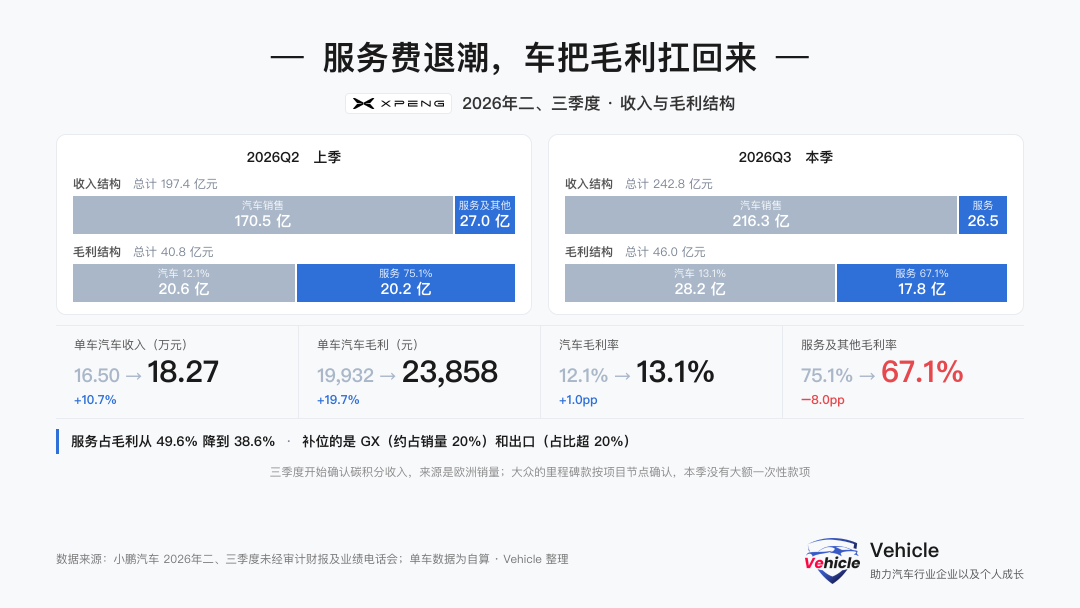
Q2 and Q3 revenue and gross profit structure, and per-vehicle economics
Services' share of total gross profit fell from 49.6% last quarter to 38.6%, as Volkswagen's milestone payment did not arrive this quarter. Cars filled the gap: by our rough calculation, per-vehicle gross profit was 23,858 yuan, about 3,900 yuan more than last quarter. Vice President of Finance Wu Jiaming gave two reasons:
First, the GX starting at 279,800 yuan accounted for nearly 20% of sales,
Second, the export share rose above 20%, and export gross margin is more than double that of domestic.
By this rough calculation, XPeng's domestic vehicle gross margin is around 10%, and overseas around 20%.
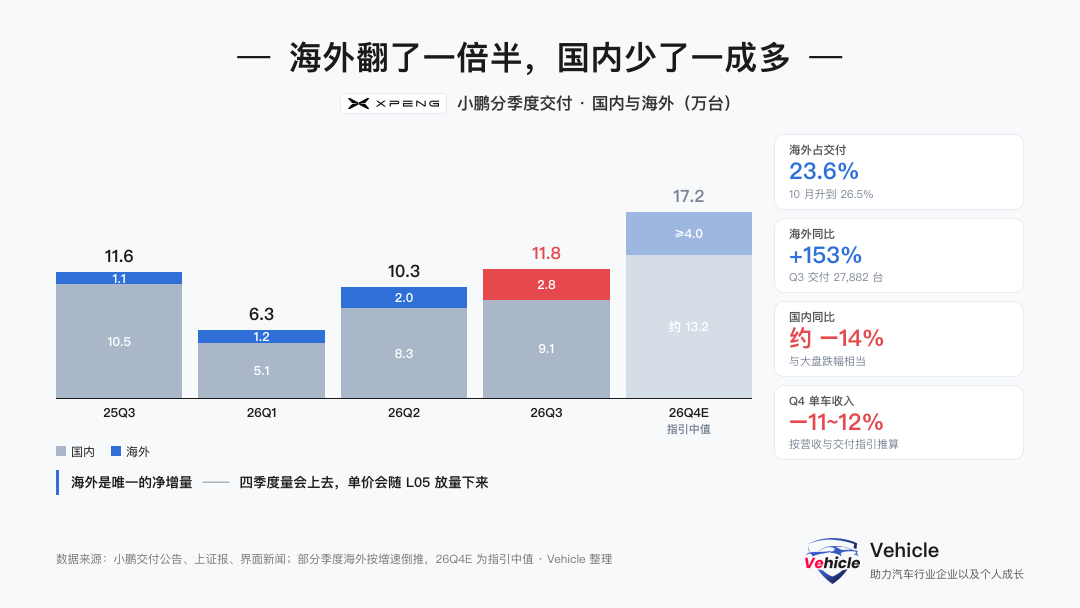
Domestic and overseas deliveries by quarter
Third-quarter overseas deliveries were 27,882 units, +153% year-on-year; domestic was about 90,500 units, down about 14% year-on-year, roughly in line with the market decline.
XPeng's guidance for the fourth quarter is vehicle sales of 169,000 to 174,000 units; volume will rise, but based on the revenue guidance, per-vehicle revenue will be 11% to 12% lower than in the third quarter, as L05 volume pulls down the average price.
The conclusion for finance this quarter is: vehicle revenue is improving, but the improving part is mainly overseas.
Products and technology
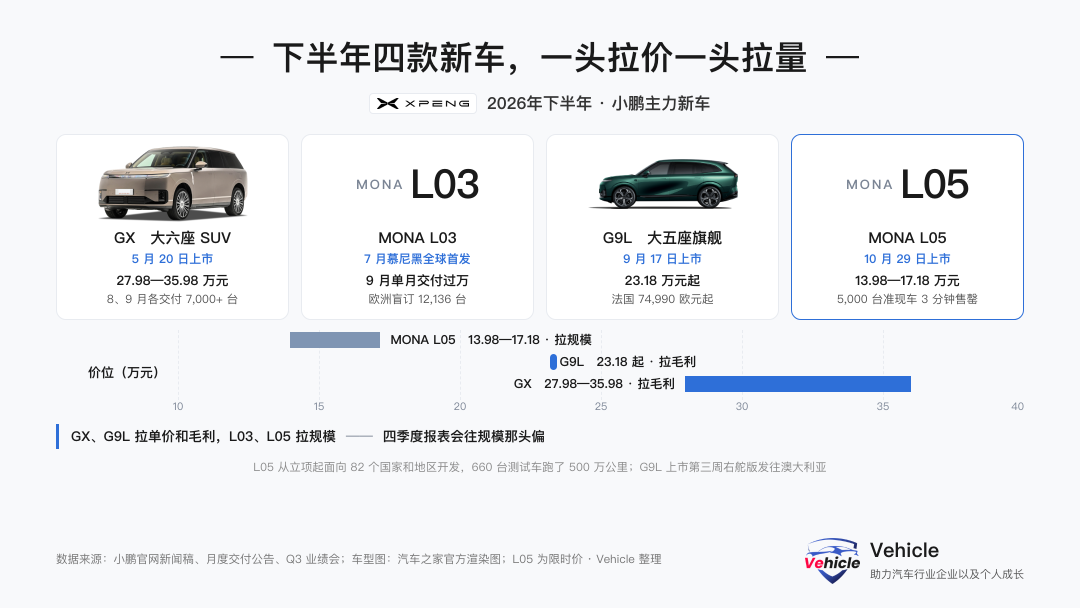
Four main new models and price ranges in the second half of 2026
XPeng's new cars in the second half of this year are scheduled monthly.
In May the GX launched, starting at 279,800 yuan, delivering over 7,000 units each in August and September;
In July the MONA L03 had its global premiere in Munich, delivering over 10,000 units in September alone;
In September the G9L launched, with a limited-time starting price of 231,800 yuan, entering France in October at a starting price of 74,990 euros;
On October 29 the MONA L05 launched, with a limited-time starting price of 139,800 yuan, and 5,000 near-stock vehicles sold out in 3 minutes.
The four cars split into two ends. The GX and G9L are responsible for raising average price and gross margin, while the L03 and L05 are responsible for scale.
Another change is synchronous global vehicle development.
Since project inception, the L05 has targeted 82 countries and regions, developed for left- and right-hand drive simultaneously, with 660 test vehicles running 5 million kilometers in 25 countries;
The G9L meets more than 3,000 regulatory access requirements in 64 countries and regions; in the third week after its domestic launch, the right-hand-drive version was shipped to Australia.
He Xiaopeng's standard for evaluating new cars also changed this year: he watches deliveries in the 3rd and 6th months after SOP, and the GX delivering over 7,000 units per month for three consecutive months is the result submitted against this standard.
Behind these cars is the same intelligent driving system. The second-generation VLA removed the "language translation" step, generating driving actions directly from visual signals. To make it run on the vehicle, XPeng rewrote the compiler and software stack for the Turing chip, running models with tens of billions of parameters on the 2,250 TOPS Ultra models, while common industry vehicle-side models are basically in the tens of millions. Next year XPeng will also bring NGP to Europe, and intelligent driving will become one of the selling points of overseas models.
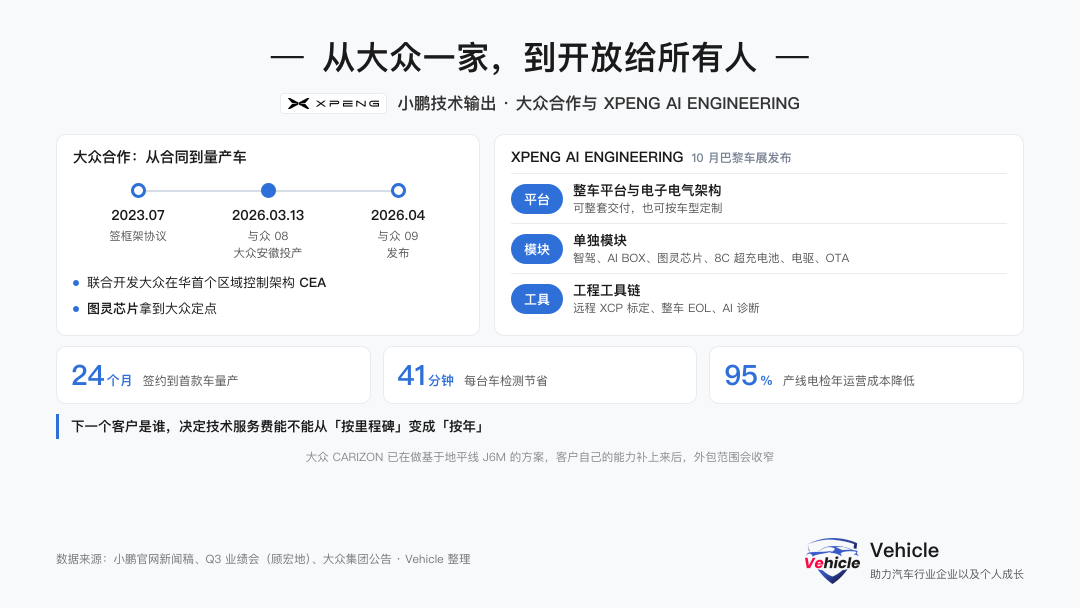
XPeng technology export: Volkswagen cooperation and XPENG AI ENGINEERING
On the technology front, following the Volkswagen export.
At the Paris Motor Show in October, XPeng packaged this capability into an independent business, XPENG AI ENGINEERING. It is divided into three parts:
Whole-vehicle platform and electrical/electronic architecture
Individual modules (intelligent driving, AI BOX, Turing chip, 8C ultra-fast charging battery, electric drive, OTA)
Engineering toolchain; XPeng's data shows this toolchain saves 41 minutes of inspection time per vehicle and reduces annual operating costs of production-line electrical inspection by 95%
On technology cooperation, President Gu Hongdi said he personally leads this area, that new cooperation with Volkswagen is under discussion and will begin producing results next year; the customer base has also expanded from automakers to Robotaxi, Robovan and robotics.
However, the ceiling for cooperation should also be recognized. Volkswagen's CARIZON is already working on a solution based on Horizon J6M, and is also developing its own high-level chip; as customers' own capabilities improve, the scope for outsourcing will narrow. As a technology supplier, XPeng has one more selling point than other suppliers: its own cars use this system, and there is already a proof of concept.
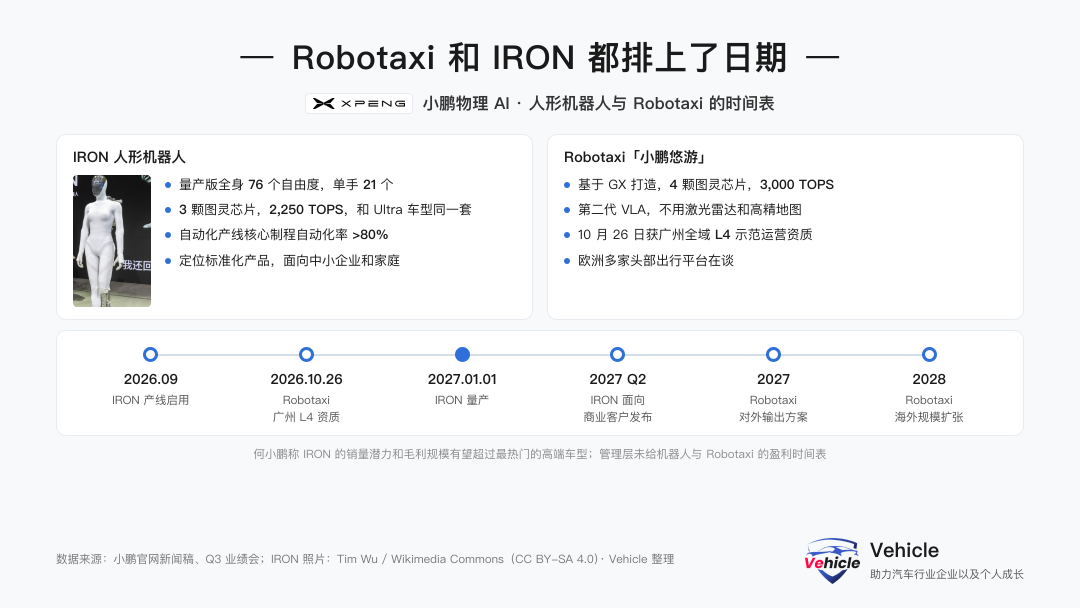
Timeline for humanoid robot IRON and Robotaxi
In addition, XPeng's same set of intelligent technology is also used in Robotaxi and robots. Robotaxi "XPeng Youyou" is built on the GX, with 4 Turing chips, 3,000 TOPS, running the second-generation VLA, without lidar or high-precision maps; on October 26 it obtained Guangzhou's citywide L4 demonstration operation qualification, will export the overall solution in 2027, and begin scale expansion overseas in 2028.
The production version of the humanoid robot IRON has 76 degrees of freedom across the body and 21 per hand, 3 Turing chips, 2,250 TOPS, the same set as the Ultra models; its automated production line was activated in September, with core process automation rate exceeding 80%; mass production on January 1, 2027, entering XPeng stores in the first quarter for reception and explanation, and released to commercial customers in the second quarter. He Xiaopeng's judgment on it is aggressive: its sales potential and gross profit scale are expected to exceed the hottest high-end models.
He Xiaopeng positions the robot as a standardized product, first targeting small and medium-sized enterprises, eventually entering homes, and not doing customization for large customers. He said at the earnings call that many robots sold today end up in warehouses, and XPeng will differentiate itself through four things: the hardware body, scaled manufacturing and sales, real data such as tactile pressure and temperature, and on-device and cloud computing power. The first two are the automaker's traditional strengths.
Chips, models and supply chains are shared among cars, Robotaxi and robots, spreading R&D costs; but all three lines are currently spending money, and management has not given a profitability timetable.
Products and technology this quarter are both moving outward: cars are sold overseas, technology is sold to other automakers, and robots will not show results until the first half of 2027.
Risks and opportunities
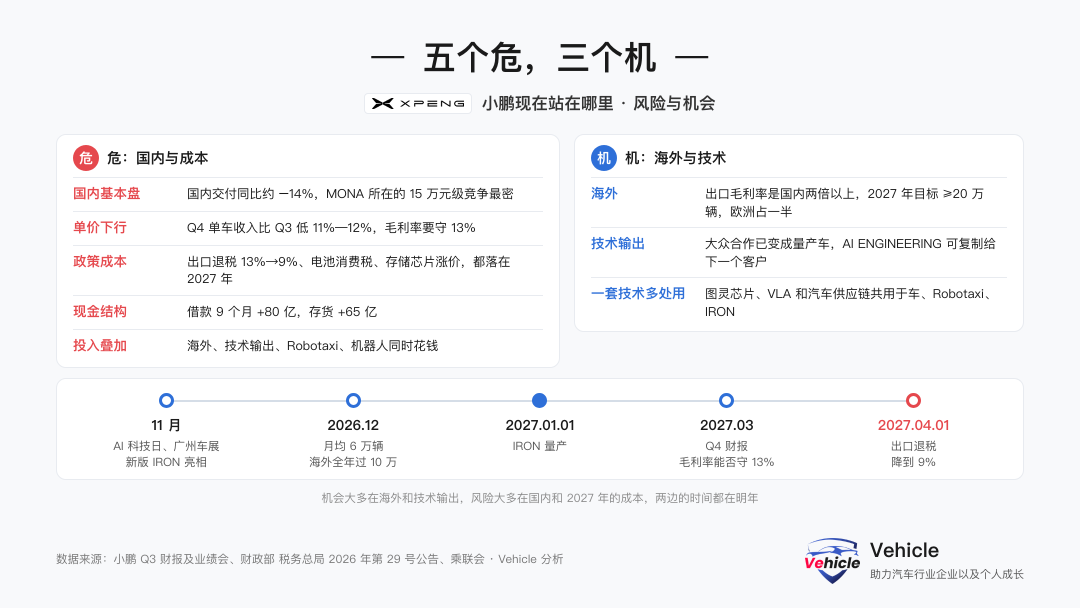
XPeng's five risks, three opportunities and key upcoming dates
Risk: The domestic base. Third-quarter domestic deliveries fell about 14% year-on-year. The MONA series around 150,000 yuan is in the most competitive domestic price range; Leapmotor made money here through scale in the first half, with a gross margin of 11.7%.
Risk: Declining average price. Fourth-quarter per-vehicle revenue will fall by more than 10%, and whether automotive gross margin can hold at 13% depends on how much overseas and GX can offset L05 dilution.
Risk: Policy costs. From April 1, 2027, the export tax rebate for new energy vehicles will drop from 13% to 9%, reducing the rebate by 4,000 yuan per 100,000 yuan of FOB price; the battery consumption tax has already been levied, and complete vehicle exports cannot refund the consumption tax already paid on battery packs; combined with rising memory chip prices, all three cost items land in 2027.
Risk: Cash structure. Borrowings increased by 8 billion yuan over nine months, inventory increased by 6.5 billion yuan, and part of the expansion is being supported by borrowing.
Risk: Overlapping investment. Overseas channels doubling, building a technology export team, running Robotaxi operations, and building robot production lines, four things spending money at the same time, while the automotive business is not yet profitable.
Opportunity: Overseas. Export gross margin is more than double domestic, with a target of at least 200,000 units in 2027, more than half in Europe. According to management, each additional overseas vehicle sold contributes several times more to profit than a domestic one; this is XPeng's fastest path to reducing losses.
Opportunity: Technology export. Cooperation with Volkswagen has already become production vehicles, and AI ENGINEERING can be replicated for the next customer.
Opportunity: One set of technology used in multiple places. If IRON is delivered on time in the second quarter of 2027, XPeng will be one of the earliest automakers to mass-produce humanoid robots on automotive-grade production lines.
XPeng is healthier this quarter than last quarter: the service fee tide receded, vehicle gross margin came back, and overseas gross margin came back even more. But it is still not profitable; domestic vehicle sales have only about 10% gross margin, part of the high overseas gross margin comes from tax rebates, and money for robots and Robotaxi has already been spent.
Overall, most of XPeng's opportunities are overseas and in technology export, while most of its risks are domestic and in 2027 costs; both sides' timelines are next year.
What do you think of XPeng? Welcome to leave a comment for discussion.
*Unauthorized reproduction and excerpting are strictly prohibited-
-
![]()
Three Gates for AI Automated Testing: Verifying Code Correctness
-
![]()
XPeng's Q3 2026: Service-Fee Tide Recedes as Cars and Overseas Sales Take Over
-
![]()
Waymo Suspended from California Highways: Why Halt Operations Without Any Casualties, and Where Is Tesla's Cybercab?
-
![]()
Breaking: U.S. Moves to Block Global Computing Power, Bars China from Overseas GPU Rentals
-
![]()
Between Jing and Jie: Has AITO Landed in an "Intermediate State"?
-
![]()
Apple's 18 New Products: All-Star Lineup for Next Year, With First AI Glasses Finally Making Their Debut
-
![]()
MIIT Approves 6G Ministry-Province Collaborative Pilot in 8 Provinces and Municipalities: A Comparative Analysis of Regional Industrial Advantages
-
Anthropic Goes Public, but Its Values May Determine How Far It Can Go