Too "Involutionary"—Even a Foot-Washing Basin Gets Into the Car?
 11/24 2026
 350
Bizarre patents are no longer a novelty in the automotive industry.
Competition among automakers is no longer limited to building cars.
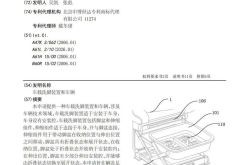
The China National Intellectual Property Administration recently published Deepal Automobile's invention patent application for a "Vehicle-Mounted Foot-Washing Device and Vehicle" (application publication number CN122873858A). The device is foldable and retractable, stows under the front seats, connects to the vehicle's water supply and drainage pipelines, and supports constant-temperature foot soaking and foot massage while parked—turning the "in-car foot bath" from netizens' imagination from a meme and a joke into a technically feasible solution on patent drawings.
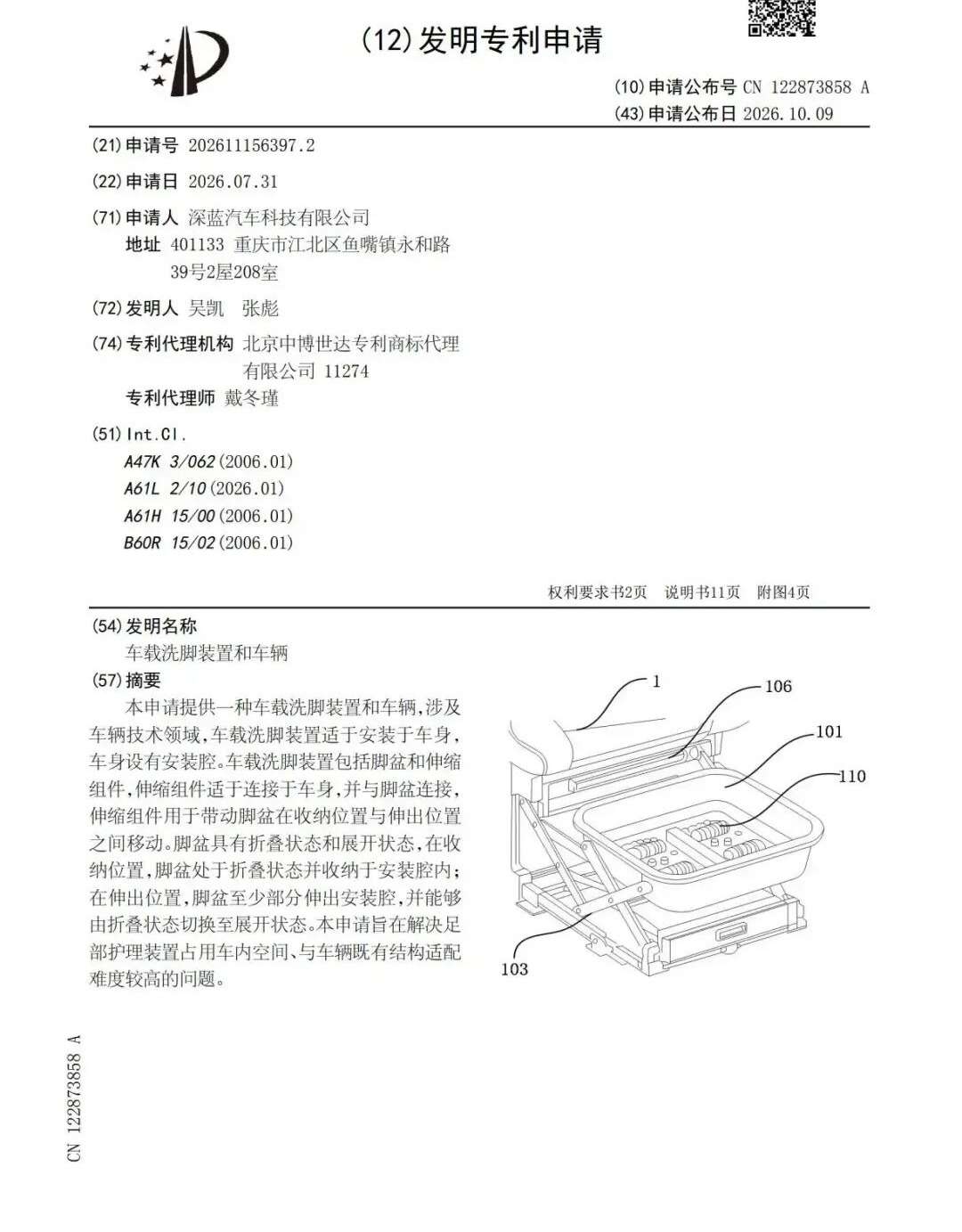
Image source: Official website of the China National Intellectual Property Administration
In fact, such bizarre patents are no longer a novelty in the automotive industry. Some automakers have previously filed patent applications for in-car toilets, in-car showers, and the like. As gaps in core capabilities such as the electric drive system and intelligent driving gradually narrow, automakers' competitive focus is shifting from basic vehicle performance to the creation of diverse lifestyle scenarios within the cockpit.
From Parameter Competition to Scenario Expansion
In the early development of the new energy vehicle industry, the competitive logic was simple and direct: "involution" over range and "involution" over 0-100 km/h acceleration. Using hardcore parameters to establish product gaps was the industry's common approach. However, with the maturity of the supply chain and the rapid popularization of electrification technology, leading technical solutions continue to trickle down, and the gaps in range, acceleration, and even basic electric drive capabilities are constantly being erased. The room for widening gaps solely through on-paper parameters is becoming increasingly narrow.
The cockpit combination of "refrigerator, color TV, and large sofa," first popularized by Li Auto, turned from a differentiated selling point into a routine configuration for family new energy vehicles in just a few years. As hardware lists become homogenized, automakers' competitive focus is no longer fixated on competing over performance indicators, but has instead begun to seek new incremental windows in more segmented and even niche lifestyle scenarios. The in-car foot-washing device patent published by Deepal Automobile is a highly representative product of this round of scenario-based "involution."
Prior to this, the NIO ES9 had already been mass-produced with second-row mechanical foot massage, implementing cockpit relaxation needs with a dry massage solution; Deepal's solution goes further. The patent shows that the foot basin can be connected to the vehicle body pipelines via quick-connect fittings and features designs such as heating, drainage, and disinfection. However, it currently remains at the patent application publication stage, and mass-production installation has not been confirmed.
Layouts for in-car water systems and bathroom-related scenarios are not isolated cases either. Chang Jing, founder of Polestone Auto, previously revealed that the Polestone 01 had planned emergency toilet components and outdoor shower kits, targeting outdoor scenarios such as camping and fishing.
In April this year, Seres' utility model patent for a "Vehicle-Mounted Toilet and Vehicle" was officially authorized, with authorization announcement number CN224104011U and authorization date April 10, 2026. The entire structure adopts a slide-rail hidden design, stored under the seat, and can be pulled out for emergency use when needed. The specific model to be equipped with this patent has not yet been confirmed.
The IM LS9 offers a simple shower kit that can be hung on the tailgate, including an approximately 10-liter heatable water tank. It is an optional configuration, and its core usage scenarios are outdoor foot rinsing and cleaning of the vehicle body/feet after wading. Behind this series of product designs, the product positioning of automobiles is being continuously restructured. A car is no longer merely a means of transportation taking people from point A to point B, but is evolving toward a movable, expandable living space.
This shift from parameter competition to scenario expansion is essentially a switch in the industry's competitive logic: after electrification has achieved basic popularization, automakers are no longer competing over "whether the car drives well," but over "how else one can live in the car." Of course, such novel scenario patents also bring considerable controversy. Since many designs remain at the patent or optional kit stage, if they are truly mass-produced in the future, they will still face realistic questions regarding usage frequency, hygiene, cost, and safety. But it is undeniable that cockpit scenarioization has become an important track for brands to build differentiated perceptions in the second half of the new energy era.
Traffic Gimmick, or Long-Term Value?
The underlying driver behind this wave of emerging novel cockpit functions is the continuously declining marginal returns of core hardware parameters. Today, long range, urban NOA, and high-speed intelligent driving are gradually becoming basic capabilities of mainstream models. Relying solely on stacking hardware and refreshing parameters can no longer build a solid product moat, nor can it easily sway consumers' car-purchasing decisions.
Under this situation, low-frequency niche scenario functions have become automakers' choice to create differentiated labels and gain communication volume at relatively lower cost. A patent or special configuration with topicality can quickly capture attention and stand out amid massive product information; even if most users rarely use it, as long as it can form a unique brand memory point, it has value at the marketing level.
Of course, patent publication does not equal mass-production implementation. Automakers lay out a large number of invention patents every year, many of which are defensive patents, technical reserves, or early conceptual exploration. For a design to move from drawings to actual vehicle installation, it must cross a series of realistic thresholds such as cost control, automotive-grade reliability, after-sales maintenance, and hygiene and safety. Many eye-catching cockpit ideas ultimately stop at patent documents or exhibition cars and are difficult to achieve scaled installation.
What needs to be distinguished is that automakers' exploration of niche scenarios is a rational choice in response to homogenized competition, but scenario innovation can easily slide into a new round of ineffective hardware stacking. Deng Chenghao, chairman of Deepal Automobile, publicly disclosed at the 2026 World New Energy Vehicle Congress that the actual usage rates of many internet-famous cockpit configurations have long been low. For example, the actual usage rate of in-car refrigerators is only about 5%, and the annual usage of rear-seat entertainment screens and in-car karaoke generally does not exceed 10 times.
When viewing cockpit scenarios, it is necessary to differentiate needs by layer, distinguishing high-frequency rigid demand, low-frequency emergency use, and topical functions. Emergency toileting and outdoor water and electricity support in long-distance travel and camping scenarios have clear and stable demand support; while solutions such as in-car foot soaking are naturally niche choices due to limitations in in-car space, hygiene conditions, and usage scenarios.
In an environment where price wars and configuration wars continue to compress profits, bizarre functions probably bring only short-term traffic dividends and cannot build a long-term brand moat. At present, leading new forces are generally still in the loss-climbing stage, and every investment in low-reuse functions essentially dilutes already limited R&D resources. Tilting resources toward high-frequency rigid-demand scenarios, rather than stacking bizarre configurations for short-term communication volume, is a more pragmatic competitive strategy in the price war cycle.
Moving from a means of transportation to a mobile living space is a long-term and clear evolution direction for the automotive industry. However, this transformation is far from a simple superposition of hardware and functions. The destination of technological innovation is not to show off cutting-edge capabilities, but to accumulate sustainable user value and form a positive business loop. When patent noise and hot spots take turns on stage, only innovations based on real needs and able to continuously benefit users can withstand the test of time.
-
![]()
P/S and O/E: Two Fundamentally Different Naming Systems Describing the Same Polarization State
-
![]()
Too "Involutionary"—Even a Foot-Washing Basin Gets Into the Car?
-
![]()
November Auto Market: Penetration Rate Spikes as Retail Contracts — How to Make Sense of It?
-
![]()
Nissan in China: Seeking the Next Round of Growth
-
![]()
Musk Delivers on His Promise! Tesla FSD V15 Makes a Blockbuster Debut: Stock Surges Over 11% Overnight
-
![]()
Outpaced by Chinese Brands, Japanese Automakers Opt for Their Quietest Strategy Yet
-
![]()
BBA Charges into the Heartland of NIO, XPeng, and Li Auto
-
![]()
Tencent WorkBuddy, Winning "Major Contracts" in Quick Succession!