Lotus Tech: AR Glasses Split into Two Camps: Lightweight AI HUD and AR Large-Screen Viewing/Spatial Computing Glasses
 09/15 2026
 471
471
It is widely recognized that China stands as one of the most vibrant and cutting-edge regions globally in terms of brand, technology, and product releases within the smart glasses market. The term "dense" aptly describes the high frequency and innovative nature of these launches. In 2026, smart glasses were included as the sole new category in the national subsidy catalog, propelling the consumer electronics sector to new heights of market enthusiasm. According to Lotus Tech (RUNTO) data, in the first half of 2026, China's smart glasses market achieved a total sales volume of 909,000 units across online and offline channels, marking an 85.5% year-on-year increase. Sales revenue reached 1.88 billion yuan, up 98.7% from the previous year.
Against this backdrop, the smart glasses industry has transitioned from rapid initial growth to a phase of in-depth development, with the trajectory of product evolution becoming increasingly distinct.
Lotus Tech (RUNTO) previously posited in the article "Lightweight Breakthrough for Smart Glasses: The Subtraction Era Begins in 2026" that lightweight design represents the prevailing consensus in the current smart glasses industry, with subtraction design emerging as the preferred product direction.
Moreover, the development trends within certain niche categories of the smart glasses sector are gradually coming into focus.
Lotus Tech (RUNTO) classifies smart glasses into three main types: AR glasses (with display + audio), audio glasses (without display + with audio), and camera glasses (without display + with camera). The subsequent analysis in this article will concentrate on AR glasses.
Relevant Data
According to Lotus Tech (RUNTO) data, China's online smart glasses market experienced a certain pullback in July this year due to promotional and seasonal factors.
Monitoring retail sales on the three major mainstream e-commerce platforms—JD.com, Tmall, and Douyin—revealed a 15.3% year-on-year decrease and a 20.9% month-on-month decline. Retail revenue decreased by 25.8% year-on-year and 43.0% month-on-month.
Among the three major niche categories, AR glasses emerged as the sole growth pillar in the industry, while audio glasses and camera glasses both witnessed embarrassing declines that month.
Recently, the International Consumer Electronics Show (IFA2026) concluded in Berlin, featuring numerous Chinese manufacturers showcasing their products on-site, including Thunderbird, INMO, XREAL, Rokid, iFLYTEK, Lawaken, Qianwen, XGIMI, Hisense Vidda, Yiwen, Bleedup, HTC, and others.
Through in-depth on-site research, Lotus Tech (RUNTO) concluded that consumer-grade AR smart glasses have abandoned the idealized path of "relying on a single device to achieve full-scene spatial AR," and the sector is now dividing into two distinct product camps: lightweight daily AI HUD and AR large-screen viewing/spatial computing glasses (heavy-duty AR).
I. Lightweight Daily AI HUD Emerges as the Primary Growth Driver in the Overall AR Market
Many manufacturers now deliberately use the term "AI HUD glasses" to distinguish themselves from heavy-duty AR glasses, emphasizing lightweight design and lifestyle applications while tempering users' overly high expectations for AR's "virtual-real overlay" capabilities.
Generally speaking, AI HUD focuses on daily intelligent assistance, prioritizing practical functions and ultimate portability to precisely fit high-frequency scenarios such as commuting and office work. With advantages of lightweight design, low power consumption, and high practicality, it aims to become the mainstream choice in the mass consumer market.
According to Lotus Tech (RUNTO) research, the global consumer-grade AR smart glasses market will maintain steady growth in 2026, with significant product structure differentiation. It is also predicted that lightweight AI HUD products will contribute over 70% of shipments.
Meanwhile, AR large-screen/spatial computing products cater to the high-end immersive experience market, supporting 6DoF spatial positioning and virtual-real fusion. Although the market size is relatively niche, they continue to lead the iteration direction of advanced optical and display technologies.
II. During IFA, New Products from Both Product Routes Were Intensively Launched
From a global supply perspective, Chinese brands, with their mature supply chains and rapid product iteration capabilities, firmly occupy the leading position in consumer-grade AR smart glasses innovation. They were also the core force at this IFA exhibition, with multiple customized new products for overseas markets being concentrically launched. Moreover, product positioning is precisely segmented, clearly corresponding to the two core consumption scenarios of daily intelligent assistance and high-end private immersive experiences. The differentiated development pattern in the sector has fully taken shape.
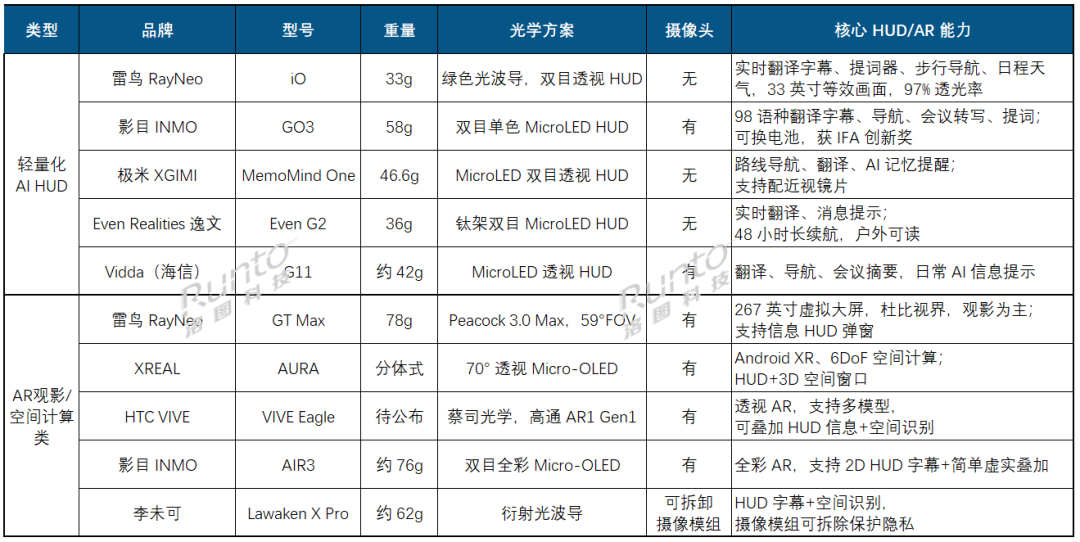
2026 IFA Lightweight AI HUD and AR Large-Screen Viewing/Spatial Computing Glasses Product Display List
Source: Lotus Tech (RUNTO) Statistics
Thunderbird Innovation introduced two heavyweight flagship new products, achieving a comprehensive layout in both sectors. Among them, the RayNeo iO all-weather AI glasses feature a normalized frame glasses appearance, support customized prescription lenses, and are core-equipped with an AI memory assistant and active event reminder functions, focusing on solving users' pain points of frequently taking out their phones to check information and creating a seamless personal intelligent assistant. Another product, the RayNeo GT Max, is the world's first Dolby Vision-certified AR large-screen glasses, equipped with a 59° large field-of-view optical solution and a B&O professionally tuned quad-speaker system, delivering an ultra-high-definition immersive viewing experience for high-end entertainment consumption scenarios.
The INMO INMO GO3 weighs only 58g and is equipped with a binocular Micro-LED high-definition HUD display, highlighting its lightweight hardware advantages. Its functions cover 98 languages for real-time two-way translation, intelligent meeting transcription summaries, pedestrian real-view navigation, and other high-frequency essential functions. It can connect to mainstream general-purpose large models and supports offline translation in 9 languages, making it a popular mass-market AI HUD product that received high attention from overseas media and distributors at this exhibition.
Products belonging to the AR viewing/spatial computing glasses category include: XREAL showcased the AURA, characterized by a split-body design, equipped with the Android XR system, 70° see-through Micro-OLED, and 6DoF tracking, targeting spatial computing.
Lawaken's Lawaken X Pro weighs approximately 62g and includes a magnetically detachable camera module, balancing privacy and weight reduction.
In addition, iFLYTEK focused on the pain points of noisy business scenarios and showcased AI glasses equipped with its self-developed lip motion recognition noise reduction technology, distinguishing human voices from environmental noise, thereby improving the accuracy of interpretation and recording transcription in complex scenarios.
Besides core hardware new products, the industry's ecological layout is also accelerating. Rokid showcased two product lines, covering AR entertainment glasses with displays and screenless lightweight audio AI glasses, while officially launching the AIUI Studio intelligent agent development platform to enhance the global software ecosystem.
The joint booth of Meta and CUPRA presented a cutting-edge AI glasses concept demo, demonstrating the device's visual recognition, real-time parsing, and explanation functions for physical objects, clearly showcasing the long-term development potential of smart glasses as an all-domain visual interaction gateway for the physical world.
III. Overseas Channel Deployment Accelerates, and Compliance Becomes a Threshold for Large-Scale Global Expansion
From a market commercialization perspective, Lotus Tech (RUNTO) believes that the global deployment process of domestic AR glasses has significantly accelerated. The new models showcased at this IFA generally have terminal pricing concentrated in the 300-500 euro mass consumer range, completely breaking the early industry's 10,000-yuan-level high-price barrier and achieving a breakthrough in price band democratization.
Meanwhile, mainstream manufacturers such as Thunderbird, INMO, and Rokid all announced on their booths the progress of cooperation with mainstream retail channels in Europe and America, such as Amazon and BestBuy, indicating that domestic AR glasses have completely moved beyond the "technology exhibit" stage and officially entered the mass consumer retail market in Europe and America.
At the same time, the industry should also be mindful of the risks associated with going global. Europe has the world's most stringent personal data security regulatory system, and the core functions of current mainstream AI glasses, such as all-weather camera, voice recording, and scene memory retention, all involve the collection and storage of user personal data, facing high privacy compliance review pressure.
Therefore, data compliance and localization adaptation will become the core thresholds for domestic AR smart glasses to achieve large-scale global expansion.
IV. Industry Outlook: Structural Bottlenecks Persist, and Scenario Exploration Determines the Medium- to Long-Term Growth Ceiling
Overall, this IFA2026 exhibition fully confirms that the AR smart glasses industry has fully entered a refined, scenario-based, and differentiated landing and iteration cycle, completely abandoning the past "one-size-fits-all" general-purpose AR device development approach and turning towards a segmented product layout based on users' real needs.
However, certain structural bottlenecks remain. Functions such as all-weather intelligent perception and AI computing reasoning will significantly increase device power consumption, but users have rigid demands for lightweight design and long battery life. Even for AI HUD products, it is necessary to consider how to balance wearing experience and battery life while retaining high-end AI intelligence capabilities.
Secondly, there is a scarcity of mass high-frequency application scenarios. Currently, the core landing scenarios of products are highly concentrated in three areas: business meetings, cross-border travel translation, and commuting audio-visual entertainment. Daily high-frequency scenarios for ordinary consumers have not been fully explored, and the perceived value of products for mass users is weak, which may restrict the expansion of the industry's user base.
For detailed market information, please refer to "Monthly Tracking of China's Smart Glasses Retail Market" and "Quarterly Report on Global Smart Glasses Market Analysis" produced by Lotus Tech (RUNTO).
-
![]()
Is It Harder for Automakers to Profit as Car Sales Increase?
-
![]()
After Returning Operating Rights to Seres, How Far Can AITO Progress Post-Huawei's Exit?
-
![]()
Why Build 'Space Towers' When Phones Can Connect Directly to Satellites?
-
![]()
31 Provinces’ Computing Power Integrated into the Grid: Huoshi Industrial Intelligence Unveils Five Regional Competition Trends
-
![]()
Lotus Tech: AR Glasses Split into Two Camps: Lightweight AI HUD and AR Large-Screen Viewing/Spatial Computing Glasses
-
![]()
How Did AI Customer Service, Which Transfers Calls to Human Operators After 660 Seconds, Turn into a ‘Talking Wall’?
-
![]()
Xiaomi Xuanjie O3 Debuts, Qualcomm Reveals Next-Gen Snapdragon Platform, Paving the Way for the Agentic AI Era
-
![]()
Will New Energy Vehicle Prices Climb Following the Introduction of the Battery Tax?