Revenue of 200 Million, Then Another 200 Million Invested! Transight Optoelectronics Takes a Bold Bet on Ultra-Precision Optics Pilot Production
 09/28 2026
 536
536
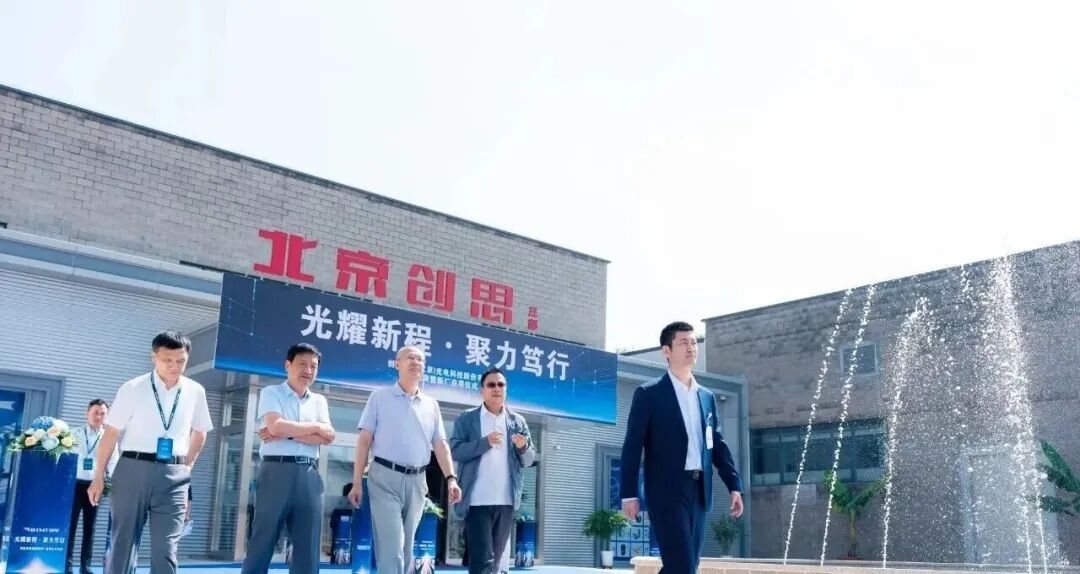
Recently, Transight Optoelectronics (Beijing) Co., Ltd. (hereinafter referred to as "Transight Optoelectronics") held an unveiling ceremony and commenced operations at its new factory, with the simultaneous commissioning of its ultra-precision optical component pilot production base.
The pilot production base has a total investment of 200 million yuan, covers a building area of 5,800 square meters, and plans to deploy five pilot production lines, covering key areas of ultra-precision optical components and equipment.
It is understood that Transight Optoelectronics has grown from a micro-enterprise with an annual revenue of just one million yuan to a high-tech precision optics enterprise with revenue exceeding 200 million yuan. Why is it bold enough to invest 200 million yuan in building a pilot production base? Why is the pilot production base so important?
Pilot production is a critical link in the commercialization of scientific and technological achievements. Ultra-precision optical components face high customer validation thresholds and significant challenges in mass production. There is a substantial engineering gap between laboratory samples and stable mass delivery, and the pilot production base focuses on stable mass supply and precision enhancement, precisely addressing the barriers on both sides of this gap.
At the policy level, the Ministry of Industry and Information Technology's "Guidelines for the Construction of Manufacturing Industry Pilot Platforms (2025 Edition)" clearly state that pilot platforms should focus on transforming and upgrading traditional industries and fostering the growth of emerging industries, accelerating the conversion of industrial scientific and technological innovations into practical productivity. To date, China has established over 2,400 pilot platforms, with key platforms undertaking 25,000 pilot service projects.
From an industry ecosystem perspective, pilot production capabilities in the ultra-precision optics field are becoming a key variable in industrial chain competition. The Optoelectronic Pioneer Institute was the first in China to propose the "1+N" flexible engineering platform model. Its 6-inch compound semiconductor optoelectronic chip pilot platform commenced operations in 2023 and has served multiple photonic chip and sensing enterprises. The northwest region's first 8-inch silicon photonics pilot line officially commenced operations in November 2025 and is now in the operational phase. The Tianfu Xinglong Lake Laboratory's micro-nano manufacturing pilot platform, an accredited platform in Chengdu, focuses on micro-nano manufacturing processes, providing services such as pilot batch production of ultraviolet optical coatings and industrialization of micro-optical components and semiconductor products. These cases demonstrate that pilot platforms are becoming infrastructure connecting technological breakthroughs with industrial scale-up.
In the ultra-precision optics field, the global high-end market has long been dominated by a few companies such as Carl Zeiss and Nikon, with even higher concentration in the semiconductor ultra-precision optics sector. Research by Academician Zhang Xuejun's team at the Changchun Institute of Optics, Fine Mechanics and Physics points out that sub-nanometer surface shape precision control, batch consistency, and automation and intelligence are the core development directions of current optical manufacturing, considered one of the key bottlenecks restricting industrial upgrading.
What pilot platforms aim to solve is the transformation of laboratory process capabilities into repeatable, controllable, and deliverable engineering capabilities, including process window solidification, statistical process control, equipment repeatability verification, and multi-batch small-volume verification. For enterprises in the ultra-precision optics field, the value of the pilot production stage lies in addressing systemic capability issues related to stable mass supply.
From an industry trend perspective, the evolution of ultra-precision optics pilot production capabilities is showing three noteworthy directions.
First, precision control is approaching the "atomic level." As major equipment such as extreme ultraviolet lithography and laser fusion places increasingly stringent demands on the surface shape precision of optical components, traditional manual shaping processes are approaching their physical limits. Deterministic processing technologies such as ion beam shaping and magnetorheological polishing are seen as breakthrough paths. The pilot production stage needs to undertake the task of validating these technologies' transition from the laboratory to stable mass production.
Second, platform forms are evolving from "single-point services" to "networked collaboration." The Optoelectronic Pioneer Institute's "1+N" model represents an early form of this trend. Its further proposal to construct a trinity platform architecture integrating "compound semiconductors + silicon photonics + heterogeneous integration" points to a higher level of networked collaboration. Multiple regions are also promoting the systematic upgrading of pilot platforms from "having" to "excelling" and from "points" to "networks," covering the entire chain from material growth and chip fabrication to packaging and testing.
Third, the coupling of capital and pilot production is accelerating. Significant substitution opportunities are attracting industrial capital, local special funds, and pilot platforms to form synergies.
Therefore, for Transight Optoelectronics to transition from an optical component manufacturer to a provider of industrial infrastructure, the real test lies in whether its pilot production capabilities can find a balance between process maturity and mass production economics, as well as whether it can form an effective collaborative innovation ecosystem with upstream and downstream partners.
Transight Optoelectronics' bold bet of 200 million yuan on pilot production reflects the weight of pilot production capabilities in current industrial chain competition. We look forward to seeing how the market will respond.
-
![]()
Changsha Computing Power Firm Lands Another Order Worth Nearly 900 Million Yuan
-
![]()
Jiemei Technology’s Restructuring Plan Greenlit: Set to Acquire Afos Technology for 915 Million RMB
-
![]()
Revenue of 200 Million, Then Another 200 Million Invested! Transight Optoelectronics Takes a Bold Bet on Ultra-Precision Optics Pilot Production
-
![]()
What is the True Value of Zhipu's $3 Billion ARR Amid the 'Data Leak' Controversy?
-
![]()
Monthly Report | China's Online Notebook Computer Market in August 2026: Sales Volume Drops 21%, Apple and Xiaomi Buck the Trend to Gain Market Share; Average Price Rises 12%, Share of Models Priced O
-
【Focus】Low-drag disc brake assembly reduces energy loss and holds great potential in new energy vehicles
-
![]()
Lying Flat in a Car: Is There a 4.4-Fold Increase in the Risk of Severe Injury During a Collision?
-
![]()
Honor Magic9 Pro Max Review: Imaging Gets More Exciting, Agent System Impresses