Circular Aperture, Square Aperture, Double Slit: Three Optical Fingerprints of Diffraction and Interference
 10/10 2026
 410
410
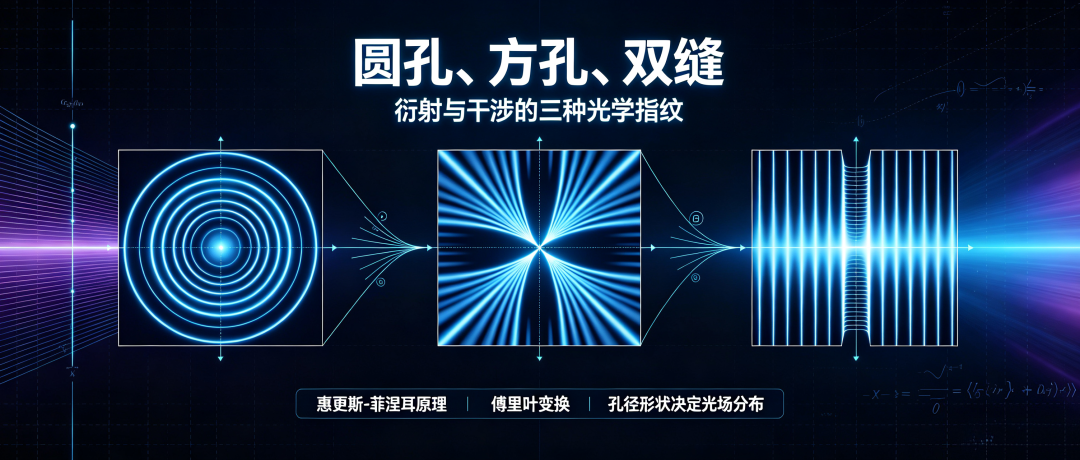
Abstract: When light passes through apertures of different shapes, it produces distinct diffraction and interference patterns, which can be considered as unique optical fingerprints for each aperture.
Circular apertures generate Airy disks, square apertures form cross-shaped stripes, and double slits produce evenly spaced bright and dark stripes. Although these three manifestations differ greatly, they all follow the Huygens-Fresnel principle, with only the boundary conditions varying.
Mastering these three fundamental patterns is the starting point for understanding classical diffraction and interference phenomena.
Core Insight: Light passing through apertures of different shapes leaves entirely different "diffraction fingerprints"—Airy disks for circular apertures, cross-shaped stripes for square apertures, and evenly spaced alternating bright and dark stripes for double slits.
Behind these three patterns lie three differentiated expressions of the same physical principle under different boundary conditions, serving as the foundational basis for understanding most fundamental diffraction and interference phenomena.
When a beam of parallel light vertically strikes a small aperture, what appears on the screen is never a simple shadow of the aperture.
A circular aperture diffuses into concentric rings, a square aperture stretches into a regular cross pattern, and double slits generate uniformly alternating bright and dark stripes.
With the same incident light, merely changing the aperture shape results in vastly different imaging effects.
These unique light and shadow patterns are the optical fingerprints left by the interaction of light with the aperture.
This article visually dissects the underlying logic of these three classical patterns to clarify the essential differences between diffraction and interference.
Simulation Tools and Physical Principles: The Unified Underlying Logic of Diffraction

The core of simulating all diffraction and interference phenomena lies in solving the Huygens-Fresnel principle: every point on a wavefront is treated as a new secondary wavelet source, and by superimposing the vibrational effects of all wavelets at the observation plane, the complete light field distribution is reconstructed.
Under the commonly used Fraunhofer far-field diffraction conditions, diffraction patterns can be rapidly solved through two-dimensional Fourier transforms. The geometric shape function of the aperture, after Fourier transformation, becomes the light field distribution form (morphology) at the observation plane.
Mainstream simulation tools such as MATLAB, Python, and COMSOL all rely on this principle to achieve pattern simulation.
In short, the aperture shape directly determines the foundational framework of the diffraction pattern.
Circular Aperture Diffraction: Airy Disk, the Physical Limit of Optical Resolution
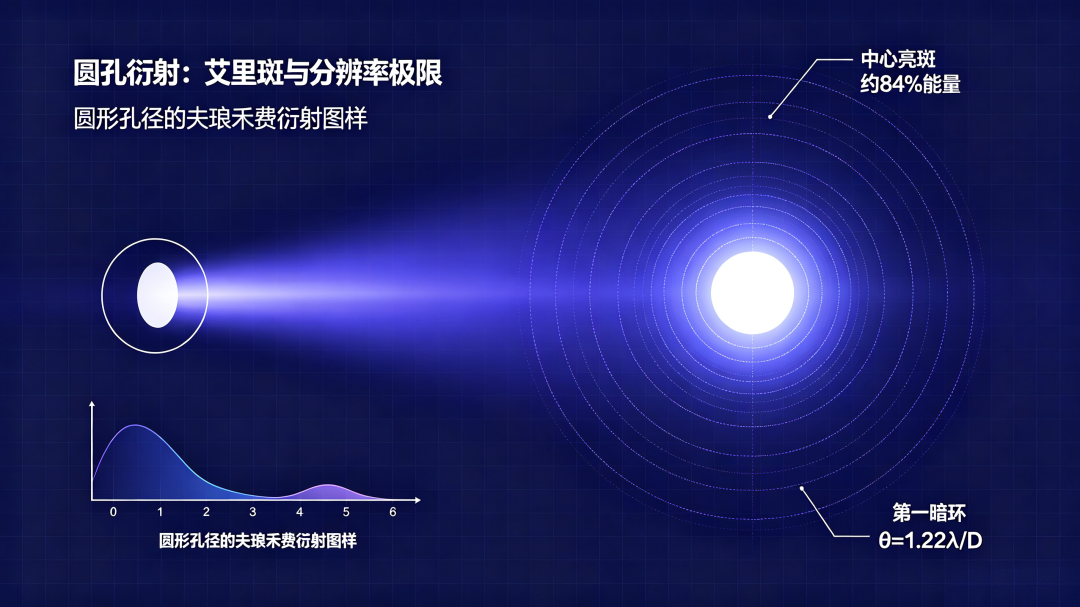
When parallel light passes through a circular aperture, a regular circular spot does not appear on the screen; instead, a classic structure of a central bright spot surrounded by multiple concentric bright and dark rings forms—this is the Airy disk.
As the most fundamental diffraction pattern, the central bright spot of the Airy disk concentrates approximately 84% of the incident light energy (derived from optical general theory and the integral of the first-order Bessel function J), making it the core region of energy concentration. The angular radius of its first dark ring follows the classic formula: θ = 1.22λ/D (where λ is the light wavelength and D is the circular aperture diameter).
This formula directly defines the diffraction-limited resolution of an optical system: the critical angle at which the Airy disks of two adjacent imaging points can just be distinguished is the system's limiting resolution angle.
Circular aperture diffraction exhibits perfect isotropy, with the brightness of the spot decaying outward in a Bessel function pattern.
All optical systems with circular apertures, including lens apertures, imaging lenses, and the human eye's pupil, produce Airy disks, which serve as the unbreakable physical foundation of optical imaging.
Square Aperture Diffraction: The Cross-Shaped Optical Signature
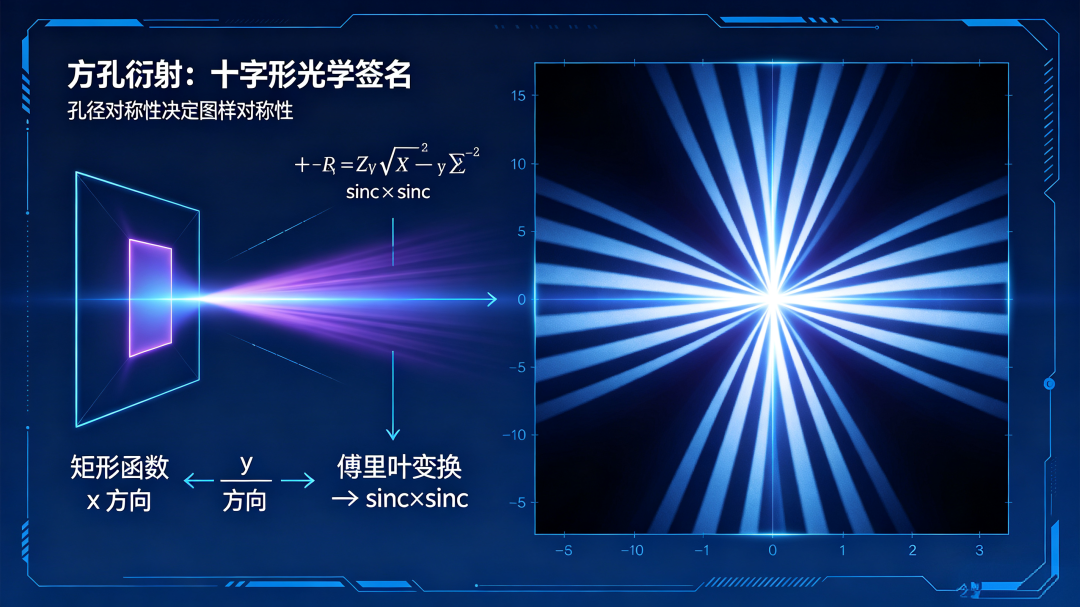
Replacing a circular aperture with a square one drastically changes the diffraction pattern, completely breaking the isotropic characteristic.
The Fraunhofer diffraction of a square aperture forms a cross-shaped symmetric pattern with a bright center extending horizontally and vertically. The bright and dark stripes are clear in the horizontal and vertical directions, while the diagonal regions are dim with no distinct patterns.
The origin of the cross-shaped pattern stems from the coupled logic of mathematics and optics: the shape function of a square aperture can be decomposed into the product of two independent one-dimensional rectangular functions in the x and y directions, and its corresponding Fourier transform is the superposition of two orthogonal sinc functions.
This precisely explains why square aperture diffraction only generates stripes in the horizontal and vertical directions.
Square aperture diffraction serves as the most intuitive teaching case: the geometric symmetry of the aperture directly encodes the morphological symmetry of the diffraction pattern.
Double-Slit Interference: Evenly Spaced Stripes Modulated by a Diffraction Envelope
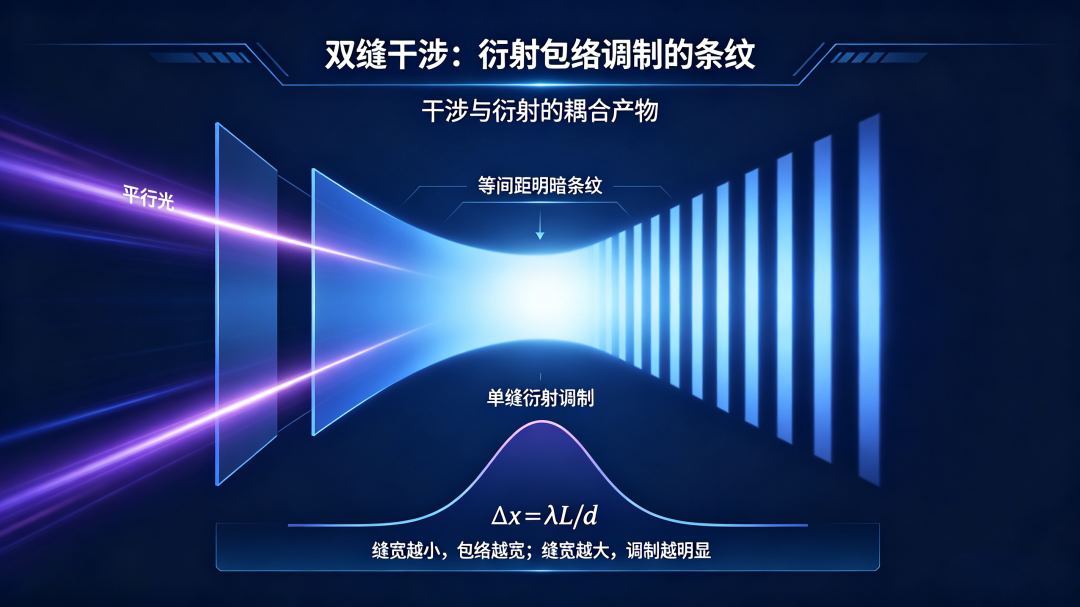
The double-slit experiment is a classic benchmark in interference optics, but strictly speaking, the double-slit pattern is essentially a coupled product of interference and diffraction rather than a single interference effect.
Double-slit interference generates evenly spaced alternating bright and dark stripes, with the stripe spacing precisely calculable by the formula Δx = λL/d (where L is the observation distance and d is the double-slit spacing).
Notably, the brightness of the double-slit interference stripes is not uniformly constant but is modulated by the diffraction envelope of a single slit: the overall pattern is brightest in the center and gradually decays toward the sides.
When the slit width is extremely small, the diffraction envelope covers a wide area, and the interference stripes approach uniform brightness; as the slit width increases, the diffraction modulation effect becomes prominent, and the brightness differences between the stripes widen, eventually degenerating into a double-slit diffraction pattern.
This characteristic of "evenly spaced but varying brightness" is the core foundation for understanding grating diffraction and precision interference testing.
Comparison of Three Patterns: How Apertures "Carve" Light Field Morphology
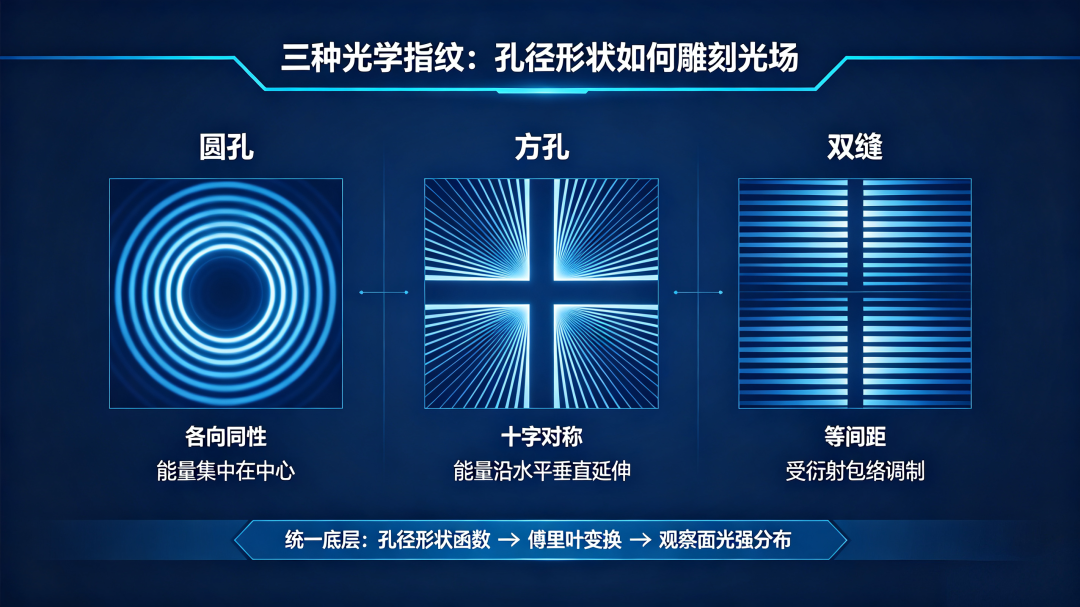
The three classical apertures correspond to three entirely different optical fingerprints, with significant differences in appearance but a highly unified underlying logic:
Circular Aperture Diffraction: Perfectly isotropic, presenting concentric ring Airy disks with highly concentrated energy at the center, defining the resolution limit of optical imaging;
Square Aperture Diffraction: Orthogonally symmetric cross-shaped stripes, with energy extending horizontally and vertically, intuitively demonstrating the regulatory effect of aperture symmetry on the light field;
Double-Slit Interference/Diffraction: One-dimensional evenly spaced alternating bright and dark stripes, with overall brightness modulated by a diffraction envelope, serving as a typical model of coupled interference and diffraction effects.
From a physical perspective, all patterns are the light field outputs after the Fourier transform of the aperture shape function. The aperture boundary conditions are the sole variable determining the light field distribution, which is also the core principle of optical simulation and design.
Conclusion: The Airy disk locks in the resolution limit of optical imaging, the cross-shaped stripes reveal the coupling relationship between aperture symmetry and light field distribution, and the double-slit stripes establish the core cognitive foundation of modern interference optics.
These three classical patterns are not just dry formula derivations in textbooks but the most authentic and essential optical signatures left by the interaction of light with apertures.
Understanding these three fundamental diffraction fingerprints is the key prerequisite for entering the fields of optical imaging, precision optical path design, and AR optical simulation.
Interactive Topic: What Picture quality (image quality) and efficiency issues caused by diffraction and interference effects have you encountered during the design, debugging, and practical testing of AR optical systems? Feel free to share your practical experience in the comments.",
-
![]()
The Rise of AI Travel in a New Era | WeTides
-
![]()
Huawei Mate 90 Pro Max Review: Stellar Imaging, HarmonyOS Ecosystem Excels
-
![]()
The Enigma of the $1.2 Billion Loan and the Flagship Price Surge: Why is OPPO Raising Funds Amid an Industry Slump?
-
![]()
A Puzzle Behind $1.2 Billion Loan and Flagship Price Hike: What Is OPPO Preparing for During Industry Adjustment Period?
-
![]()
BYD’s 8T8R Millimeter-Wave Radar Chip Delegates Perception and Computation to Central Brain
-
![]()
Did the 'Golden September' Phenomenon Fail to Materialize? Auto Market Experiences Sales Dip Amidst High Base, Yet 'Not Cold'
-
![]()
Circular Aperture, Square Aperture, Double Slit: Three Optical Fingerprints of Diffraction and Interference
-
![]()
Post-90s Tsinghua PhD Raises 300 Million Yuan for AI Video Startup