Q3 Net Profit Plunges 87.44%: Why Is Phenix Optics' Revenue Growth Not Translating into Profit?
 11/02 2026
 432
On October 31, Phenix Optics released its third-quarter report. For the first three quarters of 2026, the company reported total operating revenue of 1.267 billion yuan, up 8.38% year-on-year, with third-quarter revenue reaching 480 million yuan, up 17.58% year-on-year.
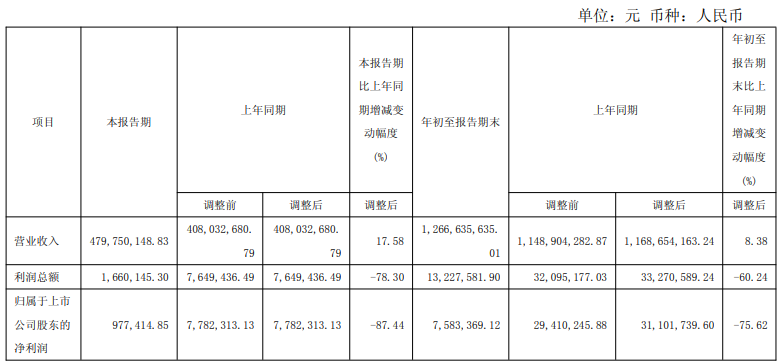
Yet over the same period, net profit attributable to the parent company amounted to just 7.5834 million yuan, down 75.62% year-on-year, while quarterly net profit attributable to the parent came in at 977,400 yuan—a plunge of 87.44%. This widening scissors gap between revenue and profit points to a profit structure squeezed by three forces at once: cost pressure, competitive repricing, and the fading of one-off gains.
Breaking it down, the optical business generated 503 million yuan in revenue in the first half of 2026, up 8.87% year-on-year, with a focus on segments including automotive, security, infrared, medical, and machine vision. The intelligent controller business brought in 272 million yuan, up 2.38% year-on-year, accounting for roughly 34.5% of first-half revenue.
The profit slowdown can be traced along three lines. The first is structural pressure on gross margin. The overall gross margin for the first three quarters stood at 16.39%—a low absolute level—with sharp divergence across segments. The intelligent controller business saw its gross margin drop to 12.56% in the first half, which the company explicitly attributed mainly to rising raw material costs. With intelligent controllers making up about 34.5% of first-half revenue, the collapse in this segment's gross margin significantly dragged down the overall profit center.
The optical business was likewise unable to shield itself from industry-wide price repricing: competition in automotive lenses is fierce, and the security lens market continues to face pressure from intensifying competition and shifts in product mix. That Phenix Optics' comprehensive gross margin sits at just over 16% is hardly surprising given this intensity of competition—but it also means the company has yet to find a way to fully offset price declines through a higher share of high-value-added products.
The second line is the fading of a high base of one-off gains, which directly explains why the decline in net profit attributable to the parent far exceeded that of non-recurring net profit. In the first half of 2025, the company sold equity in a new energy subsidiary and Shanghai real estate, generating non-recurring gains; no comparable gains materialized in the same period of 2026. Investment income for the first three quarters swung from +7.19 million yuan in the prior-year period to -3.2813 million yuan, with this item alone accounting for a year-on-year swing of more than 10 million yuan.
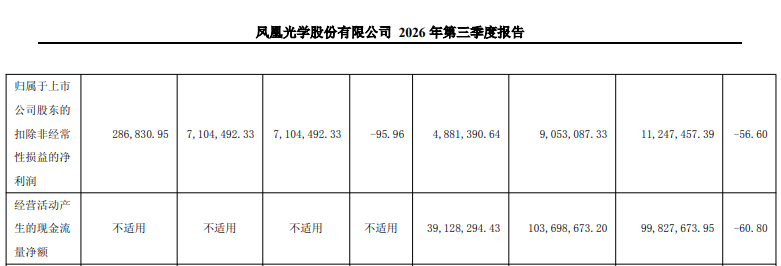
In the first three quarters, net profit attributable to the parent fell 75.62%, while non-recurring net profit fell 56.60%. A considerable part of the gap between the two stems from the disappearance of the non-recurring gain base. Non-recurring net profit of 4.8814 million yuan was itself declining, indicating that the core profit center is indeed moving down—but in the "cliff drop" of net profit attributable to the parent, one-off factors played an underestimated role.
The third line is the jump in financial expenses, whose marginal impact on the income statement rivals a few tenths of a percentage point of gross margin. Financial expenses for the first three quarters reached 24.3718 million yuan, up 71.57% year-on-year. In its semi-annual report, the company explicitly attributed this to exchange losses and an increase in unrecognized financing costs; in the first half alone, financial expenses grew at a year-on-year rate of 84.31%.
Even more alarming than the income statement are the signals from the balance sheet. The third-quarter report shows that accounts receivable continued to grow from the beginning of the period—and faster than revenue. Among credit impairment losses in the first three quarters, bad debt losses on accounts receivable came to about 5.64 million yuan, with asset impairment provisions totaling 7.2573 million yuan. In its explanation of performance changes, the company also cited "increased impairment losses due to growth in accounts receivable and inventory buildup" as one of the reasons for the decline in total profit.
Revenue growth accompanied by simultaneous expansion of accounts receivable suggests that the cash conversion efficiency of incremental revenue is declining. Over the same period, operating cash flow per share was 0.14 yuan, down 60.8% year-on-year, and net cash flow from operating activities was 39.1283 million yuan, down 60.80% year-on-year—corroborating this judgment. For Phenix Optics, weak headline profit, further eroded by receivables and impairments, leaves an extremely thin safety cushion.
The core question posed by Phenix Optics' third-quarter report is this: at what cost is revenue growing, and how much of the profit decline is one-off versus structural? Demand in the automotive and security segments of the optical base remains supported, but price competition and cost pressure are systematically lowering the profit content per unit of revenue. In the intelligent controller business, during a cycle of rising raw material costs, the pace of gross margin recovery will directly determine whether overall profitability can stabilize.
Emerging directions such as LiDAR, medical endoscopes, and machine vision offer clues for medium-term structural upgrading. Before that, however, distinguishing the slow downward drift of the core profit center from the base-effect plunge in net profit attributable to the parent—and tracking the improvement in accounts receivable turnover and operating cash flow—deserves to sit at the top of the watch list, more so than revenue growth itself.
-
![]()
AI Office Track Head-to-Head: After the Battle for Entry Points, the Renewal Period Is the Real Test
-
![]()
Why Is the Eyebox Always "Bright in the Center, Dark at the Edges"? — The Polarization Multiplexing Solution
-
![]()
Why Can't the Smartest Coding Assistant Reply to Your Messages Instantly?
-
![]()
Half of Domestic Tokens Used to Make Wish-Fulfillment Dramas? Large Models Face a Compute Bloat Bubble
-
![]()
Apple Picks Qwen — and There's More to It Than Meets the Eye
-
No Blackening, No Fanning—Xiaomi Auto's Goal of Delivering 550,000 Vehicles This Year Is Easier Said Than Done
-
![]()
Automakers' KPI Collapse
-
![]()
The All-New Xiaomi SU7 Ultra Laps the 'Ring Undisguised — Can Chinese Performance Cars Earn a 'Seat at the Table'?