Ultrafast Nonlinear Optical Technology Series, Part 108: Multi-Pass Cells Generate Terawatt-Class Sub-Two-Cycle Pulses
 11/23 2026
 557
Millijoule-class few-cycle pulses at kHz repetition rates are an important driving scheme for laser plasma acceleration (LPA). The combination of ytterbium-doped lasers and multi-pass cells (MPCs) offers significant scalability advantages in terms of average power. Distributing the post-compression process across multiple MPC stages can reduce the accumulated nonlinear phase per stage, thereby ensuring good spatiotemporal quality under the high compression factors required to reach the few-cycle pulse regime. In this work, a two-stage gas-filled multi-pass cell was used to compress a kHz repetition-rate commercial Yb:YAG laser to 6.2 fs, with a pulse energy of 12.5 mJ and an effective peak power of 1.4 TW [1].
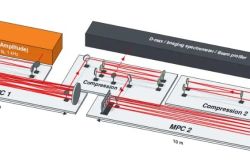
The experimental setup is shown in Fig. 1. The front-end ytterbium-doped laser (MAGMA25, Amplitude) delivers an output of 18 mJ, 400 fs, 1 kHz. To achieve sub-two-cycle pulse output, the compression factor C must reach at least 60. According to the empirical formula C = 0.59B + 1, the total introduced B-integral needs to exceed 100. The first-stage MPC adopts a near-concentric Herriott structure consisting of two 3-inch concave mirrors with a radius of curvature R = 2 m, coated with high-reflectivity (99.95%) dielectric films, and separated by 3.85 m. The cavity is filled with 140 mbar argon, the beam completes 29 single passes (N = 30, k = N − 2), and then 9 chirped mirrors provide 1800 fs of dispersion compensation. A relatively long cavity length is used to control the ionization risk at the focus and to reduce the energy fluence on the mirrors.
The second stage is an array-type multi-pass cell about 10 m long, filled with 500 mbar helium, completing 9 single passes; each mirror has a curvature of 5 m and is used only once. The first mirror is a dielectric mirror, and the rest are enhanced silver mirrors with a reflectivity of about 98.5%, to accommodate the broadband spectrum and to keep the mirror energy fluence below 50 mJ/cm². After the output beam is expanded to about 25 mm, final compression is completed in a vacuum chamber below 10 mbar using a fused silica wedge and chirped mirrors (Ultrafast Innovations) providing 120 fs of dispersion compensation.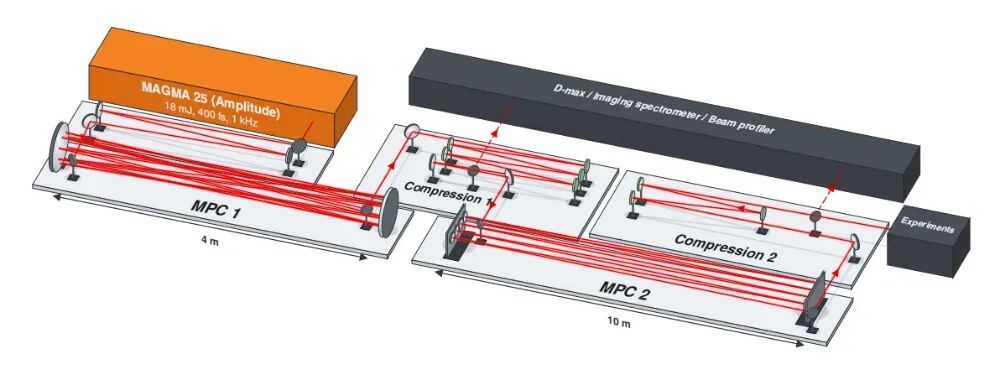
Fig. 1. Schematic diagram of the experimental setup [1]
The pulse measurement results are shown in Fig. 2. The d-max reconstruction yields a pulse width of 6.2 fs, corresponding to 1.8 optical cycles at 1030 nm, with an overall compression factor of about 65; the output pulse energy is 12.5 mJ, corresponding to an average power of 12.5 W (transmission efficiency of about 69%). Normalizing the reconstructed temporal waveform by the output energy yields an effective peak power of 1.4 TW, with the energy distribution outside the main peak having been taken into account.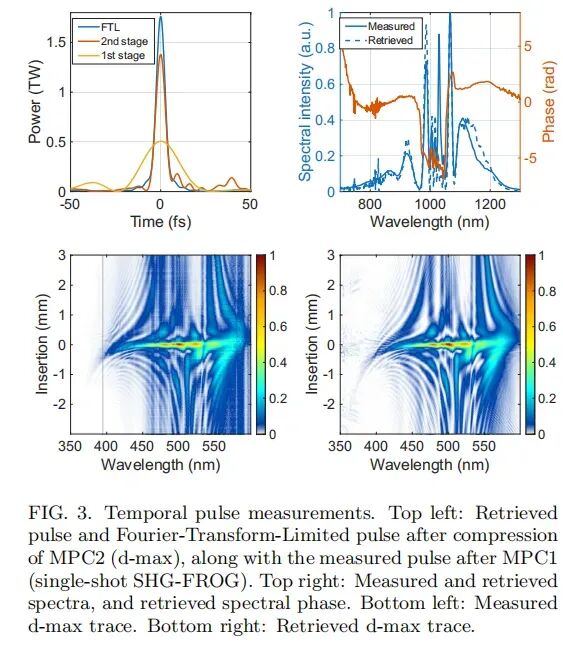
Fig. 2. Output temporal waveform, spectral phase, and d-max curve [1]
The spatially resolved spectral measurement results are shown in Fig. 3, indicating that the integrated spectra in the horizontal and vertical directions are similar. The V parameter used to evaluate spatial-spectral uniformity is above 95% within the beam region corresponding to half-peak intensity, and above 90% within the main beam region in both directions, indicating that good spatial-spectral uniformity is still maintained after substantial broadening.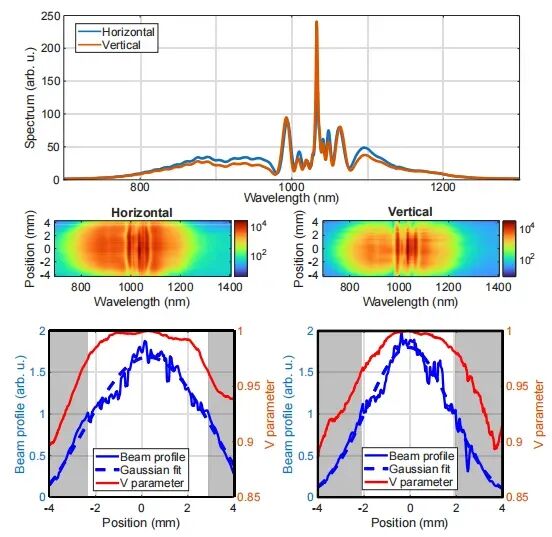 Fig. 3. Measurement results of output spectral uniformity [1]
The focusing results are shown in Fig. 4. Using an off-axis parabolic mirror with a focal length of 10 cm, the focal spot 1/e intensity diameter measured with an attenuated beam is 5.8 μm × 5.4 μm, with 83.4% of the energy contained within the elliptical range. Combining the focal spot distribution with the peak power, the authors estimate that the full-energy focusing intensity reaches 1.2 × 10²⁰ W/cm², with a normalized vector potential a₀ of about 3, meeting the conditions for driving laser plasma acceleration. Beam stabilization systems are configured before both cavity stages, and the focal pointing root-mean-square fluctuation during 18 minutes of monitoring is 0.18 μm, about 3% of the focal spot diameter.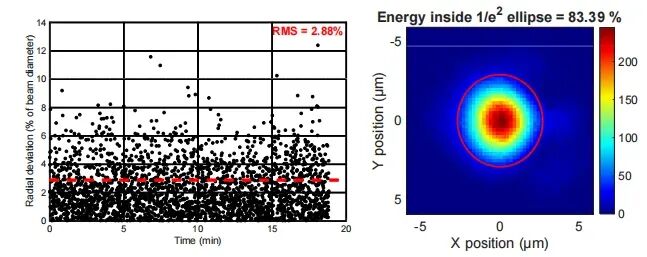 Fig. 4. Focal pointing stability and focal intensity distribution [1]
In summary, this work simultaneously achieves multi-millijoule energy, sub-two-cycle pulse width, and terawatt-class peak power at kilohertz repetition rate, and verifies the spatial-spectral uniformity and focusing capability, providing a feasible post-compression route for strong-field and laser plasma acceleration experiments driven by commercial ytterbium-doped lasers. If the energy is to be further scaled, the laser can be shaped into an L-G mode with a more uniform energy density distribution; if the average power is to be scaled by increasing the repetition rate, substrate materials with higher thermal conductivity are needed, and active cooling of the mirror substrates is required.
Reference [1] KOLTALO V, KAUR J, DANIAULT L, et al. Sub-2-Cycle, Terawatt Pulses via Double-Stage Multi-Pass Cell Compression of an Yb Laser. arXiv:2609.04989v1, 2026. DOI: 10.48550/arXiv.2609.04989.
-
![]()
After a Bloodbath, Nvidia Wipes Out 18 Trillion Yuan in Value—Is the AI Feast Coming to an End?
-
![]()
Weekly Stock Review | Profit Margin 1.4%: When 'Golden September and Silver October' Becomes 'Golden September, Silver Losses'
-
![]()
Ultrafast Nonlinear Optical Technology Series, Part 108: Multi-Pass Cells Generate Terawatt-Class Sub-Two-Cycle Pulses
-
![]()
Why Do Voyah and Luxeed Still Need This "Birth Certificate" in 2026?
-
![]()
Mary Barra's Exit Looms as General Motors Hunts for a Successor
-
![]()
First-Tier Joint Ventures Launch Counteroffensive—What About Second-Tier Players?
-
![]()
A New Wave of Overseas Cars with a Full "Chinese Flavor" Is About to Debut at the Guangzhou Auto Show
-
![]()
Low Prices No Longer the Whole Story: Joint Venture EVs Are Finally Catching Up