iFlytek Executives Forgo 20 Million Yuan in Pay? Company Responds to High-Salary Controversy
 11/02 2026
 368
iFlytek has been in the spotlight lately — from a September scandal involving the former head of its PR department to its 1024 Developer Conference.
Now the company is making headlines again.
This time, the buzz is over a topic that matters to many shareholders and netizens alike: executive compensation.
Two executives took home 7.1 million yuan in a single year — yet the company explains that each of them actually gave up more than 20 million yuan. iFlytek's response to the compensation controversy quickly drew widespread attention.
According to a Sina Tech report on October 29, investors pressed the company on the rationale for executive pay raises and whether compensation matches performance. The company explained that Chairman Liu Qingfeng and President Wu Xiaoru, taking into account the company's stage of development and hoping to reward top-tier A-class employees more generously, voluntarily reduced their annual salaries as calculated under the existing formula.
In 2025, the pre-tax compensation the two actually received was 4.1 million yuan and 3 million yuan, respectively.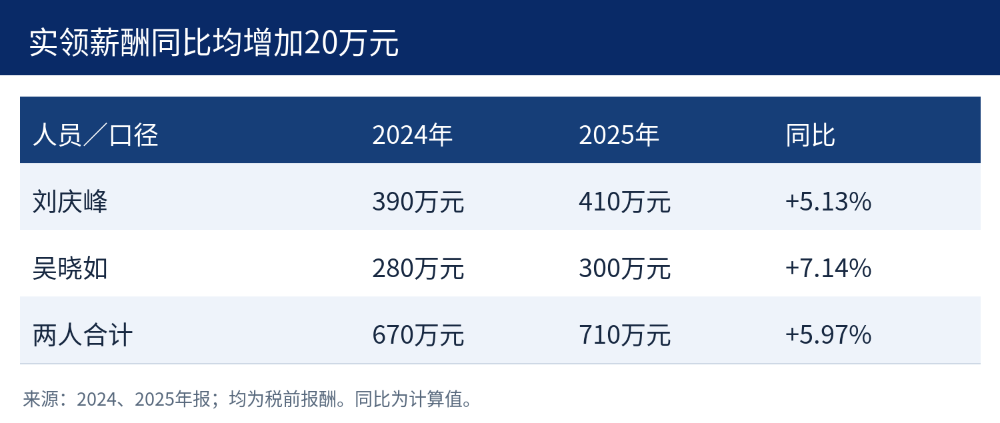
In 2024, Liu Qingfeng received 3.9 million yuan and Wu Xiaoru 2.8 million yuan. In 2025, each received 200,000 yuan more — increases of roughly 5.13% and 7.14%, respectively. The company's claim of "taking less" refers to a reduction relative to the formula-calculated amount; actual pay still rose year on year. Only by clarifying this distinction does the discussion become meaningful.
What netizens see is annual pay in the millions; what shareholders care about is the return management has delivered to the company. High pay has its rationale. Running a listed company means deciding R&D directions, allocating funds, and organizing teams — and the cost of misjudgment can be steep. Compensation rules should therefore also make management bear the business results. Higher pay demands results; when problems arise, there should be a price to pay.
Where does executive compensation come from?
Page 68 of the 2025 annual report sets out the annual salary calculation for the chairman and president: base annual salary of 16.7878 million yuan, performance annual salary of 11.1691 million yuan, totaling 27.9569 million yuan. The former is calculated at 2% of audited net profit for the year, and the latter at 4% of the difference between net profit for the year and net profit attributable to the parent for the previous year.
The annual report lists these figures according to the position formula, and the company further stated in its response that each of the two gave up more than 20 million yuan. The "combined 27.9569 million yuan for the two" appearing in reports can easily cause misreading. This article presents the annual report calculation, the company explanation, and individual actual receipts separately to avoid conflating them into one number.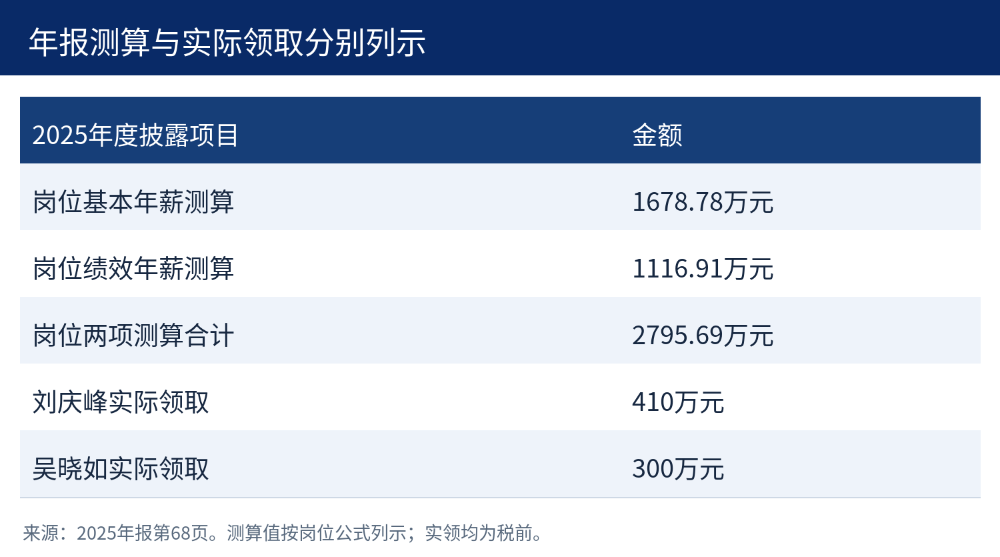
As for the actual amount received, the annual report already gives a clear answer: Liu Qingfeng 4.1 million yuan, Wu Xiaoru 3 million yuan. The calculation difference reflects the voluntary reduction the company describes; when evaluating the compensation burden, the actually disclosed compensation should be used as the basis. The system revised in May 2026 brings new changes.
Under Article 12, the base annual salary is the higher of 2% of net profit and 1 million yuan; the base performance amount is the higher of 4% of profit increment and 1 million yuan; the performance annual salary is then the higher of the base annual salary and the base performance amount. This means that, looking only at the formula, the lower limit for the two combined is 2 million yuan per person.
The system also sets constraints such as assessment deductions, and how much is ultimately paid still depends on implementation. The calculation in the 2025 annual report predates this revision, and the two sets of rules should be understood separately. The actual compensation received for the full year of 2026 will still need to wait for subsequent annual disclosure.
Last year's performance was decent
The operational improvement in 2025 provided the basis for the pay increase. That year, iFlytek's revenue was 27.105 billion yuan, up 16.12% year on year; net profit attributable to the parent was 839 million yuan, up 49.85% year on year; non-recurring adjusted net profit attributable to the parent was 264 million yuan, up 40.47% year on year; net operating cash flow was 3.208 billion yuan, up 28.57% year on year. Revenue, profit, and operating cash flow all grew.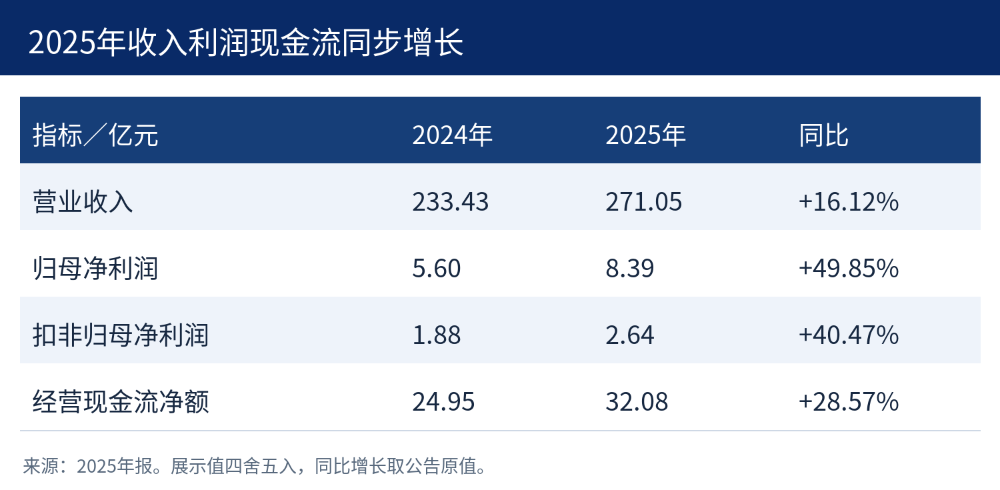
The combined actual compensation of the two executives rose from 6.7 million yuan to 7.1 million yuan, an increase of about 5.97%, lower than that year's profit growth. For the single year of 2025, operating performance can support this modest salary increase. Whether pay is reasonable still requires a comprehensive judgment based on position responsibilities, personal contributions, and long-term returns.
iFlytek's business relies on applying speech, language, and large-model technology to learning machines, office equipment, and industry products and services in education, healthcare, and other sectors. Only when the technology can be built, customers are willing to buy, and the business can continue to collect payments will R&D investment gradually turn into corporate value. It is worth noting that in 2025 non-recurring adjusted net profit was only about 31.5% of net profit attributable to the parent. The non-recurring indicator excludes non-recurring gains and losses, which helps observe the sustainability of profitability, but it cannot be directly equated with the profit of a single main business.
When designing bonuses, including such indicators in assessment is more convincing than focusing only on net profit attributable to the parent.
This year's third-quarter report performance
The latest third-quarter report adds new context to this compensation discussion. In the first three quarters of 2026, iFlytek's revenue was 18.187 billion yuan, up 7.05% year on year; net profit attributable to the parent was 21.8872 million yuan, turning from loss to profit year on year; non-recurring adjusted net profit attributable to the parent was a loss of 763 million yuan, compared with a loss of about 338 million yuan in the same period last year. After excluding non-recurring gains and losses, profit pressure remains evident.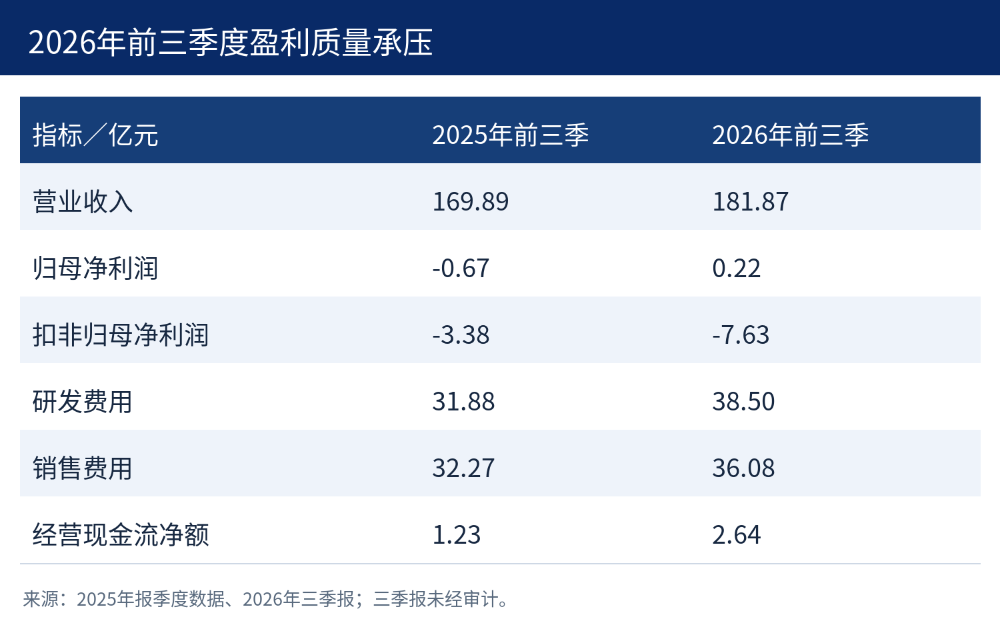
The third-quarter report shows that in the first three quarters, non-recurring gains and losses contributed about 785 million yuan to net profit attributable to the parent, including government subsidies included under that scope and fair value changes and disposal gains or losses related to financial assets. These items are included in current profit, and their sustainability needs to be observed separately. Rising investment is also squeezing profits.
In the first three quarters, R&D expenses were 3.850 billion yuan, compared with 3.188 billion yuan in the same period last year; selling expenses rose from 3.227 billion yuan to 3.608 billion yuan — both growing faster than revenue. The company also disclosed that third-quarter R&D investment exceeded 1.7 billion yuan, an increase of nearly 400 million yuan year on year. R&D investment and R&D expenses in the income statement are different calibers. There are still bright spots on the business side.
According to company disclosure, third-quarter revenue from smart education and smart healthcare both grew by more than 20%; the company actively contracted its smart city business, and overall revenue from government-side business fell 2.39%. Concentrating resources on advantageous businesses is expected to improve investment efficiency, and the effect should continue to be seen in profit and cash collection.
In the first three quarters, net operating cash flow was 264 million yuan, an increase over the same period last year. At the same time, cash paid for the purchase and construction of fixed assets, intangible assets, and other long-term assets was 3.478 billion yuan. Sustained investment requires funding support, and management's future achievements should also be reflected in collection quality and capital use efficiency.
High pay must stand the test of performance
AI competition requires patience. Investment in key technologies often occurs first, and commercial returns can only be seen afterward. If excellent managers can make correct judgments and lead teams to form product advantages, the company should provide competitive compensation. Shareholders also have reason to require that bonuses follow results. Short-term profits can withstand investment pressure, but long-term operations must show progress.
Whether projects have customer renewals, whether products can form stable gross margins, and how much cash investment can bring after several years should all enter the assessment.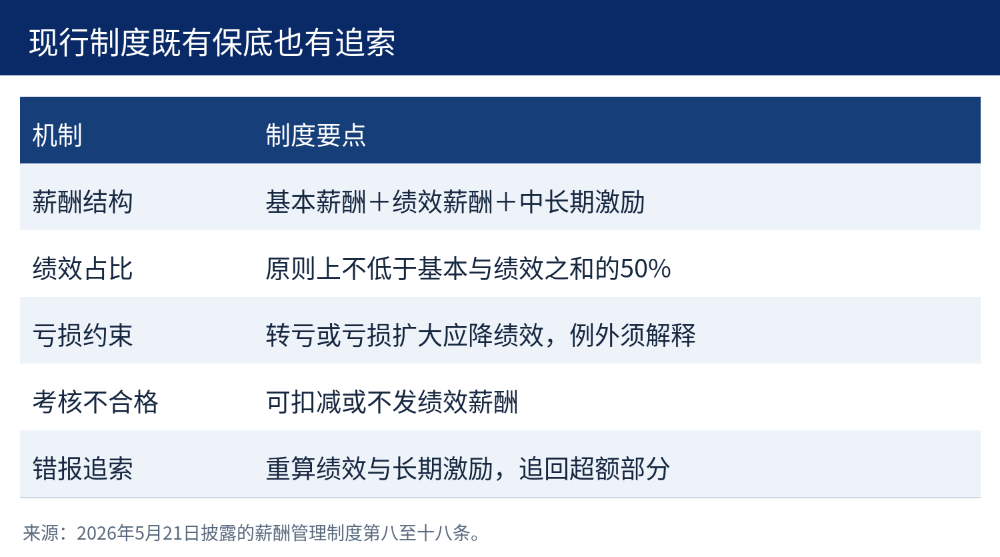
iFlytek's new system has already written in constraints: when the company turns from profit to loss or losses expand, average performance pay for executives should decline accordingly, and exceptions must explain the reasons; if assessment fails, performance pay may be deducted or suspended; after financial misstatements are retroactively restated, reassessment should be conducted and excess incentives recovered. When related violations cause losses, there are also payment-stop and clawback arrangements.
What is worth watching next is how these clauses connect with the guaranteed minimum formula. The minimum guarantees performance of duties, while performance rewards results. The clearer the boundary between the two, the easier it is for compensation to gain recognition. On specific assessment, I am more in favor of increasing the weight of non-recurring adjusted profit, operating cash flow, and long-term product returns.
For businesses that need years of cultivation, assessment can be staged, and part of the bonus deferred until results are realized. This is this article's suggestion for system implementation. Evaluating 2025 compensation should be against 2025 achievements; the operating pressure in 2026 should be reflected in the assessment of the corresponding year.
Executives of listed companies should receive incentives commensurate with their responsibilities. Truly weighty high pay relies on continuously creating value and also on bearing consequences. Only when rewards and penalties are implemented in practice can management's returns align with shareholders' expectations. Data caliber note: compensation is pre-tax pay; existing shareholding market value, dividends, and wages are different calibers.
Actual compensation received for the full year of 2026 is still pending annual disclosure; this article uses the disclosed 2025 compensation. Financial tables are original redrawn images, and amounts are rounded. What do you think about the topic of iFlytek executive compensation? We look forward to your civilized and rational comments in the comment section.
Statement: This article is only an analysis of financial hot topics. Data and materials are cited from public queries, company announcements, and Tonghuashun iFinD. Views are for reference only and do not constitute any investment or consumption advice. #FinancialHotTopics #InDepthInterpretation #BusinessFinance #InvestmentBankingCircle #ListedCompanies #PrimaryMarket #IPO #AI #iFlytek
-
![]()
AI Office Track Head-to-Head: After the Battle for Entry Points, the Renewal Period Is the Real Test
-
![]()
Why Is the Eyebox Always "Bright in the Center, Dark at the Edges"? — The Polarization Multiplexing Solution
-
![]()
Why Can't the Smartest Coding Assistant Reply to Your Messages Instantly?
-
![]()
Half of Domestic Tokens Used to Make Wish-Fulfillment Dramas? Large Models Face a Compute Bloat Bubble
-
![]()
Apple Picks Qwen — and There's More to It Than Meets the Eye
-
No Blackening, No Fanning—Xiaomi Auto's Goal of Delivering 550,000 Vehicles This Year Is Easier Said Than Done
-
![]()
Automakers' KPI Collapse
-
![]()
The All-New Xiaomi SU7 Ultra Laps the 'Ring Undisguised — Can Chinese Performance Cars Earn a 'Seat at the Table'?