115 Fortune Global 500 Companies Head to Shenzhen: What Follow-Through Should Be Watched for in APEC Business Opportunities?
 11/16 2026
 322

Author | Jing Yu. For more financial insights, follow BT Finance Data Connect. Main text: 2,143 words; estimated reading time: 9 minutes.
If a parts factory in Shenzhen meets a representative of a multinational company at the summit, the most valuable takeaway after the event may well be an email from the other side's procurement team: please quote according to this specification, send samples to this address, and we will confirm test results next month. Only with that in hand can the factory decide whether to invest engineers' time and allocate sample production capacity. A business card opens a contact; an inquiry with specifications and dates is what gives both sides the basis to discuss a deal.
According to information released by the China Council for the Promotion of International Trade on November 15, the 2026 APEC CEO Summit will be held on November 17–18 at the Qianhai International Conference Center in Shenzhen. More than 2,000 political and business representatives are expected to attend, including companies from 115 Fortune Global 500 firms. All 21 APEC economies will be represented, and companies from another 13 non-regional economies will also take part. The number of participating U.S. companies ranks first among foreign economies, accounting for nearly 20%. As of the morning of November 16, the CEO Summit had not yet opened. For foreign trade enterprises, the value of this participation information lies in narrowing the search for potential customers and partners—and then seeing who is willing to move conversations forward into concrete projects.
01 When Companies Show Up, the First Thing Saved Is the Time Spent Finding Partners
The topics announced for the summit include connectivity, artificial intelligence, the digital economy, sustainable development, and development opportunities in the Guangdong-Hong Kong-Macao Greater Bay Area. These topics can help companies determine where to look for partners. Manufacturers of industrial parts can focus on procurement and delivery needs. Those in cross-border warehousing and distribution can focus on which market the other party plans to serve and whether it needs to supplement warehousing and distribution capabilities. R&D service providers can assess whether the other party lacks engineering validation, software interfaces, or a local implementation team. What is specifically needed still has to be worked out item by item with the relevant team after the event.
Representatives of large companies attending the event sometimes handle regional business or strategic cooperation, while the actual ordering party may be a factory in some location, a regional procurement center, or another legal entity. When following up, suppliers can first confirm who the next point of contact is. If the other party is willing to refer them to the procurement team, they should also ask whether the team is looking for alternative suppliers for existing products or requesting quotes for a new project that has not yet been finalized. The former may involve checking delivery windows, batch consistency, and backup capacity; the latter often requires first clarifying drawings, development cycles, and testing standards. Both types of projects may present opportunities, but the resources worth investing are different.
The role of business associations can be measured by the same yardstick. For an organized matchmaking event, the most valuable follow-up is to leave both sides with confirmable handlers, clear needs, and a time for the next communication. A small or medium-sized enterprise that did not attend the summit can also look for business entry points based on the public agenda and follow-up activities released by business associations. If specific procurement entities and requirement descriptions can be identified, it is easier to find the right people than by inquiring one by one from the list of attendees.
02 Before a Trial Order, Clarify Sampling and Payment Terms First
Take a hypothetical parts procurement as an example. The buyer says at the meeting that it needs a second supplier, and the first expense may fall on the supplier's side: engineers studying drawings, preparing materials for samples, and arranging testing. Whether to proceed first depends on whether the buyer has given clear specifications, testing methods, sample quantities, and feedback dates, as well as how sample and mold costs will be borne. When specifications are still subject to change and order volume is uncertain, suppliers can first quote based on small-batch verification and then list production price conditions separately, so as not to dilute current costs with a large order that has not yet materialized.
After samples pass, the next step is to confirm who places the purchase order. A framework agreement can set out the scope of cooperation, but actual scheduling still requires executable delivery instructions. Items to verify include procurement quantity, delivery location, acceptance milestones, payment currency, and payment terms. Cross-border R&D is similar: after a cooperation document, there must still be a scope of work, delivery standards for prototypes or software, and arrangements for ownership of results and costs. Only after these issues are clarified can both sides judge how many people to allocate and how much cash to tie up in the next stage.
Only after the first order can it be further verified whether this is a sustainable customer relationship. If the buyer completes testing, actually purchases, and continues to place orders after using up the first batch, then it is possible to observe whether the supplier can deliver stably and whether the quote can cover rework, cross-border after-sales, and turnover costs. Conversely, if the payment collection cycle is longer than the stocking cycle, even if a new customer brings several purchase orders, the enterprise may have to advance more funds for raw materials at the same time. To judge medium- and long-term orders, procurement records should be looked at together with actual receipts.
03 Logistics Convenience Should Be Calculated Based on an Actual Route
Qianhai already has cases for reference. The Shenzhen Qianhai Authority has publicly introduced that the multi-country consolidation model of the Qianhai Comprehensive Bonded Zone can redistribute and consolidate goods from different sources according to actual transport arrangements, and then transfer them using sea, land, air, and rail resources. Shenzhen Customs introduced at another public briefing that for goods participating in a specific "direct lifting from shipside" model, the time from unloading to pickup has been shortened from 4–6 hours to less than 8 minutes. These are practices and data for specific operational steps already disclosed before the summit. Enterprises can use them to judge where the channel can still be optimized; the door-to-door time for the entire shipment still needs to be calculated separately.
For example, if a customer needs several batches of parts each month, the supplier can compare quotes for direct delivery and consolidation via Qianhai. If small-batch shipments can be consolidated, trunk line costs may decrease. If consolidation requires waiting for enough cargo volume, waiting time, warehousing, and short-haul costs must also be included. What enterprises really need to record is when similar goods are delivered to the warehouse, when they are released, whether they catch the cut-off, and on what date they are signed for by the customer. Only when data is tied to verifiable routes and goods can logistics convenience have a chance to turn into quotable delivery times.
The summit plans to release the "2026 APEC CEO Summit Shenzhen Initiative." Public initiatives can help enterprises understand the directions of concern to the business community. Specific customs clearance arrangements depend on the scope of application, implementation time, and operating conditions subsequently announced by the competent authorities. If logistics service providers plan to quote to customers, they can first check currently available services and then update commitments based on arrangements that have already taken effect.
04 Four Types of Evidence Worth Tracking After the Event
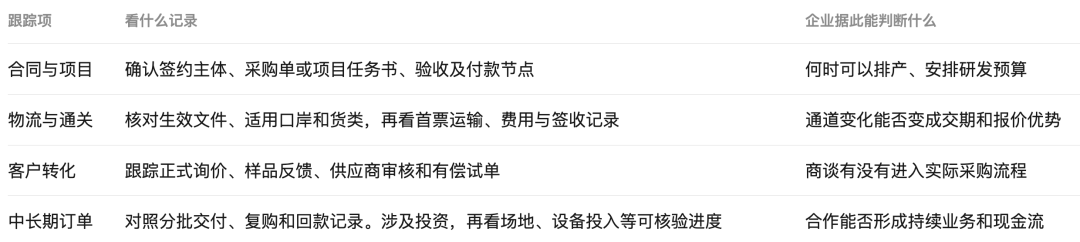
The concentrated visit of multinational companies to Shenzhen gives suppliers more opportunities to connect with procurement, R&D, and service teams. What can first be verified after the event is usually whether the other party has scheduled the next business meeting, sent a complete inquiry, or confirmed a batch of trial orders with delivery dates. Looking further ahead, whether the goods have been accepted, whether the money has arrived, and whether the next batch will still be purchased. These things say more about how far the business opportunity has progressed than counting how many large companies were met on site.
This article is an original article by BT Finance. Without permission, it may not be used, copied, disseminated, or adapted. If it constitutes infringement, legal liability will be pursued.
-
Pragmatic Thunderbird's Calculated Bet
-
![]()
Raking in a Whopping 40.4 Billion Yuan in the First Three Quarters! Industrial Fulian's Performance Soars—So Why Has Its Market Value Evaporated by Nearly a Trillion?
-
![]()
115 Fortune Global 500 Companies Head to Shenzhen: What Follow-Through Should Be Watched for in APEC Business Opportunities?
-
![]()
Volkswagen's Crash Course in Car Making
-
The Second Round of the AI Office Battle Begins
-
![]()
Why Does Correcting One Aberration Often Make Another Worse?
-
![]()
BYD Puts a 5-Million-Yuan Bounty on the Table — and Exposes a Hidden Industry Chain
-
![]()
Chopsticks Catch a Spacecraft! Musk Wins Another Bet—Whose Face Does This Slap Wake Up?