AI Smartphones Embrace Doubao Trend: Can Honor Blaze a New Trail?
 12/25 2025
 721
721

Do AI smartphones demand excellence in both software and hardware? Could Honor emerge as the hardware solution?
Author | Andrew
Editor | Gu Nian
Mobile phone manufacturers that have endured numerous market share fluctuations often exude a legendary charm, their successes and failures readily serving as business case studies both within and beyond the industry.
At a time when many perceive China's smartphone landscape as having consolidated into a 'Hua-Mi-V' (Huawei, Xiaomi, Vivo) triumvirate, scrutinizing Honor's position becomes particularly pertinent. As a brand spun off from an ICT giant, Honor's five-year independent journey has resembled a rollercoaster. It rebounded from a mere 3% market share to lead the industry, only to plummet out of the top five by the end of 2024. While it regained a top-five spot in the third quarter of 2025, it still fell short of the top three.
Summarizing Honor's 2025, the appointment of a new CEO and the unveiling of the Alpha Strategy saw the company inundate the market with new products while making significant strides in organization, marketing, strategy, and new industry ventures. The results were promising, with IDC data revealing Honor shedding its 'Others' label in the third quarter.
However, this merely addressed the issue of domestic survival. Rising from a fall proved more challenging than anticipated, with new hurdles emerging. Against a backdrop of stagnating innovation and a consolidated market landscape in the smartphone industry, Doubao's foray into AI smartphones has introduced considerable uncertainty.
"One wave recedes, another surges": AI and overseas markets were once seen as Honor's breakthrough opportunities. Yet, whether Honor's bet on AI robotic smartphones can drive growth—and how its new overseas expansion narrative will unfold—remains uncertain.
01 Do AI Smartphones Necessitate Hardware Breakthroughs?
Driving smartphone sales growth through innovative product offerings is a standard strategy for manufacturers.
Currently, the domestic smartphone market is enthralled by the model intelligence perception brought about by Doubao's mobile assistant, as ByteDance redefines AI smartphones through large model-enabled agent scheduling.
Software-level system AI Agent capabilities have sparked operational changes and constructed an AI experience ecosystem, more readily stirring consumer desire to upgrade. Consequently, ZTE Nubia M153's initial 30,000-unit stock swiftly sold out, commanding a premium in the secondary market.
In contrast to Doubao's software breakthroughs, AI smartphones have witnessed far fewer hardware-level transformations. Since the iPhone 4 comprehensively defined smartphones through its bezels, buttons, body, and cameras over a decade ago, manufacturers have introduced straight-screen, curved-screen, and foldable models without bringing fresh design or manufacturing inspiration to the industry.
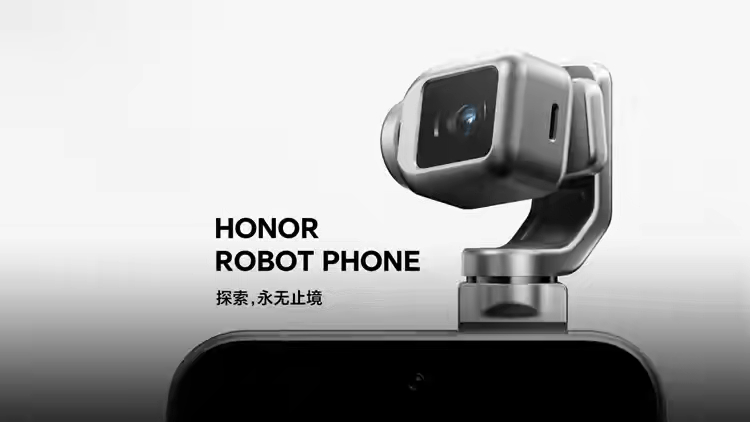
Against this backdrop, Honor proposes a robotic smartphone (a product integrating embodied intelligence) as a new form factor. According to CEO Li Jian's disclosure in Wuzhen, this product, set to launch next year, will integrate three core capabilities: AI smartphone, embodied intelligence, and high-definition videography (camera), becoming Honor's key move in a new sector.
Li Jian stated that from iPhones to AI Phones to Robot Phones, Honor pursues not merely hardware upgrades but intelligent evolution in crafting smart devices. Reportedly, Honor's Robot Phone may feature an AI superbrain capable of perceiving everything anytime, anywhere, along with robotic-level mobility.
Without detailed parameters or specifications revealed, the outside world cannot yet assess its technical capabilities. However, considering Honor's accumulated expertise in device design and AI algorithms (MagicOS system), it may possess inherent genetic advantages for this hardware-innovating product.
Additionally, Honor's robot once set an industry record with a 4m/s running speed, indicating potential in the embodied intelligence sector and making its realization in a new intelligent life form plausible. If so, Honor's smartphone innovation could rival Doubao's contributions to mobile products.
Thus, Honor's integration of portable computing with robotic embodied interaction fills an innovation gap in consumer AI smartphone hardware.
In other words, hardware innovation can propel smartphones into the next era, but the pace of technological innovation across the supply chain remains sluggish. Manufacturers have overinvested strategically and resource-wise in incremental 'squeeze toothpaste' micro-innovations, neglecting the evolutionary path and patterns of smartphone hardware itself.
The new energy vehicle industry has been far more aggressive, achieving collective progress in powertrains, intelligence, and even styling and appearance.
Of course, nothing is certain until the product launches. Behind the gloss, uncertainties abound. With competition intensifying, rivals like Vivo have already entered the embodied intelligence space. Whether the Robot Phone can translate into practical functions for users remains unknown.
ByteDance's recent plans to collaborate with Lenovo and Transsion essentially aim to achieve software-hardware synergy and strengthen AI implementation capabilities. Thus, Honor's Robot Phone must navigate numerous competitive realities in its product definition.
Consumer electronics innovation rarely succeeds through isolated breakthroughs; it usually requires simultaneous advancement in underlying technology and end-user experience. For Honor's robotic smartphone to truly drive growth, it must overcome triple barriers: hardware innovation, underlying technology, and scenario implementation. After all, no smartphone manufacturer wants to fall into the 'hot concept, cold market' trap.
02 A Challenging 2025
Despite a vivid blueprint for its new narrative, Honor faces an uphill battle to deliver the expected 2025 performance.
This year, Honor has adopted a high-frequency product launch strategy, introducing models like the Honor Play 60, Power, X60 GT in the first half, and accelerating iterations in the second half with the Magic V5, X70, Magic V Flip2, Magic8, and Honor 500 series, covering all price segments from budget to flagship to premium foldables.
Among them, the Honor 400 series emerged as an annual hit, with global activations exceeding 3 million units, driven by precise offline distribution and top-tier endorsements, becoming a key performance driver. The Honor 500 series also reportedly performed strongly.
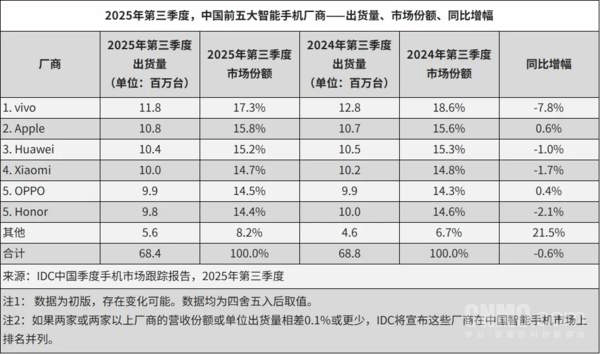
However, the success of blockbusters cannot mask broader growth challenges. IDC data shows Honor re-entering China's top five in Q3 2025, tied with OPPO at 14.4% market share, though still down 2.1% year-on-year. The final three months' performance remains uncertain, but reclaiming a top-three spot will be arduous.
In the mid-to-low-end market, Honor once built a reputation with features like an 8,000mAh battery but now faces fierce competition from OV's Reno series, Huawei's Nova series, and Xiaomi's digital series in the 2-4k price range, requiring sustained competitiveness in new releases.
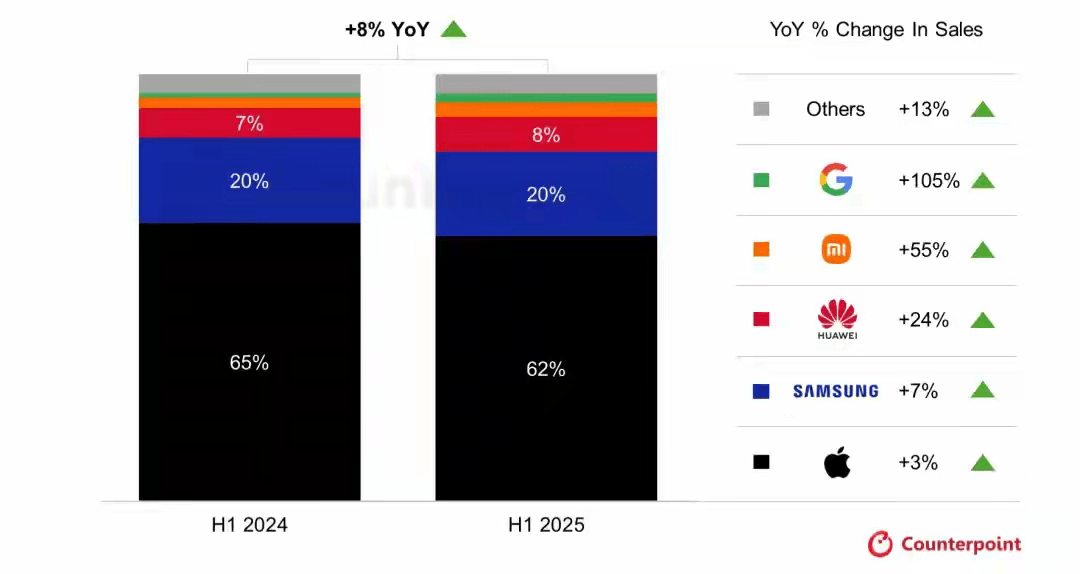
In the premium segment, the Magic 8 series, powered by the fifth-gen Snapdragon 8 Supreme chip and MagicOS 10, targets flagship status but struggles to disrupt China's entrenched Huawei-Apple duopoly. Counterpoint data shows Honor excluded from the domestic premium top four in 2024 and absent from global premium sales rankings in H1 2025.
In the smartphone industry, blockbuster models generate momentum and sales volume, contributing incremental growth and brand influence. However, long-term ecosystem accumulation matters more than short-term hits. While Honor's products have strengths, its pressures may stem from the industry's increasingly consolidated competitive landscape.
Some argue that China's smartphone market has stabilized under 'Hua-Mi-V' leadership, requiring more than just blockbusters for other brands to break through—they need comprehensive support in brand perception, technological barriers, and channel systems. Moreover, following the sales pattern of mobile products, even viral blockbusters typically plateau and phase out after their initial sales surge. Honor must still achieve systematic growth.
03 Two Markets, Two Strategies
Looking ahead, "defending the domestic base while expanding overseas" will be a critical topic for most mainstream manufacturers.
The domestic market has long been mired in stock competition, focusing on refined product specifications, channel margins, and brand marketing. Headstart advantages have created insurmountable gaps for fallen manufacturers attempting a comeback, with costs and benefits potentially diverging in the short term.
With Doubao's entry, whether ByteDance can replicate its automotive 'AITO' success in smartphones and reshape the industry remains unclear. Regardless, manufacturers can no longer ignore the impact of large model companies on traditional smartphones—they must either collaborate or confront them directly.
Given sluggish domestic growth, Honor shifted its focus overseas years ago. By December last year, overseas sales exceeded 50%, achieving scalable profitability in multiple regions.
According to Honor's EMT management team's New Year address last year, Honor became Western Europe's top large foldable vendor in 2024, surpassing Samsung for the first time, while capturing over 20% in Malaysia and 54.9% in Hong Kong. In September, Honor reported a 75% sales surge for the Magic V5 in Europe, boosting its market share to 34%.
Overseas markets, particularly in Europe and Southeast Asia, still offer growth potential, with consumers more receptive to AI features and foldables. Honor can leverage its domestic expertise in channel management and product refinement to expand overseas, where foldables remain a promising premium market entry point.
The crux lies in balancing domestic rivalry while fending off Samsung and Apple's global dominance, as these two brands firmly hold the top two global positions.
The strategy is clear: long-term investment in localized channel development and after-sales systems is essential, given significant regional variations in user needs and consumption habits, testing manufacturers' localization capabilities.
Honor's new narrative reflects a broader smartphone industry transition amid intensifying stock competition, with all manufacturers seeking new growth engines.
While the robotic smartphone exploration is commendable, it must avoid the 'concept over substance' trap. Overseas expansion, though directionally correct, demands unwavering commitment to long-termism. Ultimately, reclaiming a domestic top-three spot hinges on building software-hardware synergistic core competitiveness.
-
![]()
CHN Energy Teams Up with Chery, Further Strengthening Green Power Alliance Between Power Generation and Auto Companies
-
![]()
Insights from the Chengdu Motor Show: Overseas Brands Step Up Their Game
-
![]()
Chengdu Auto Show: Some Brands Opt Out, While Others Go All-In with 'Pavilion Dominance'
-
![]()
8.2 Billion Yuan Invested to Launch a New Entity: Dongfeng Peugeot Citroen Automobile Reboots After Years of Inactivity
-
![]()
Why Are Once-Prominent 'Honored Guests' Now Mostly Missing from the Chengdu Motor Show?
-
Kuaigo’s ‘Inverted’ Valuation vs. Kling: Who Has Misjudged the Pricing?
-
![]()
Harbor Weekly Review | Dreame's 200,000-Yuan Smartphone: A Symbolic Gesture with Limited Impact
-
![]()
Harbor Weekly Review | Dreame’s 200,000-Yuan Smartphone: A Symbolic Gesture Lacking Substance