AI-Powered DingTalk: The Fusion of Software and Hardware
 12/25 2025
 741
741
Author: Wu Kunyan
Editor: Wu Xianzhi
In the tech realm, naming often embodies ambitions and strategic visions.
From the 'fern' in August, symbolizing rootedness and resilience, to the 'Magnolia' in December, representing the origin of angiosperms and the commencement of diverse reproduction, DingTalk CEO Wu Zhao drew inspiration from the history of plant evolution to set the tone for DingTalk AI Version 1.1. The previously industry-anticipated theme of 'integrated software and hardware' remains intact. However, DingTalk's new hardware offerings diverge from personal devices like phones or tablets. Instead, they are tailored exclusively for enterprise organizations—introducing DingTalk Real.
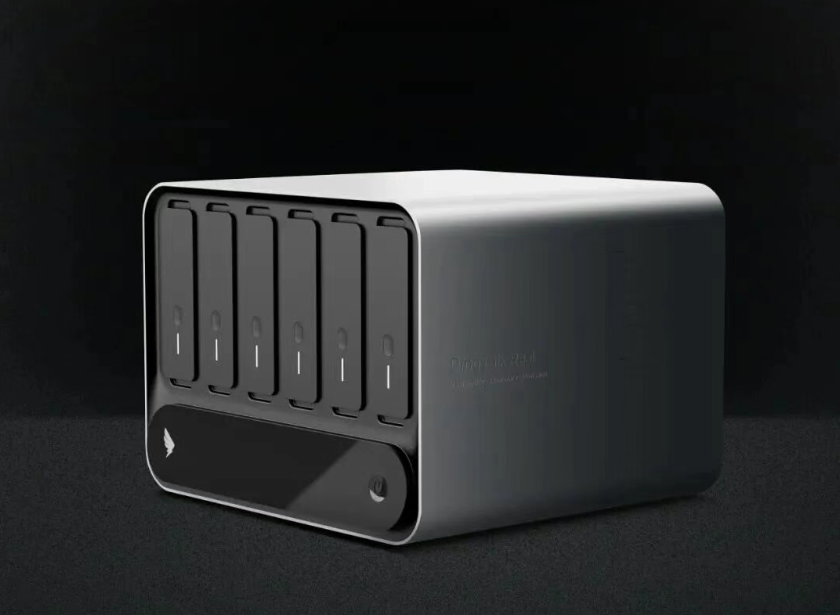
Teased as the 'next big thing' during the previous launch event, DingTalk Real is positioned as the physical embodiment and execution terminal for enterprise customers to deploy and harness Agent capabilities.
Against this backdrop, following Microsoft's release of Copilot in 2023, the 'assistant'-style product format swiftly emerged as one of the mainstream paradigms for AI-to-B applications. In this model, AI is seamlessly integrated into Office, email, spreadsheets, and CRM systems, functioning as intelligent plugins to optimize the efficiency of individual knowledge workers within enterprises.
Moreover, vertical SaaS applications like Salesforce Einstein and MaaS solutions emphasizing token consumption underscore the ease of accessing AI capabilities from the cloud. These implementation forms significantly lower the barrier to understanding for enterprises and maximize the reuse of existing software systems, facilitating the rapid evolution of large model capabilities through deployment.
The unveiling of DingTalk Real and its underlying Agent OS signals DingTalk's divergence from the norm. This strategic decision is driven by differentiated market considerations and strategic judgments tailored to DingTalk's mainstream customer base.
Hardware = Data Sovereignty + Security Compliance?
The dilemma of whether to migrate to the cloud or build private IDCs has persisted for enterprise organizations since the advent of cloud computing.
Cost negotiations often arise, with customers perceiving the cloud as expensive and cloud providers finding it unprofitable to reduce prices for scale. However, in China's business environment, data security and compliance may be more pertinent factors.
While OpenAI and Microsoft aggressively promote cloud-based solutions, DingTalk adopts a 'countercurrent' approach by developing hardware. This places enterprises at a crossroads regarding AI adoption.
For a significant number of enterprises, such as financial institutions, large manufacturing companies, and pharmaceutical firms, data sovereignty is not a choice but a survival imperative. They harbor a natural skepticism towards 'cloud-based AI,' encompassing concerns over data ownership, Agent execution transparency, and the ability to promptly rectify AI deviations. This mindset permeates their selection of model services.
From this vantage point, DingTalk's emphasis on 'integrated software and hardware' to create a physically 'controllable' execution terminal for Agent services aligns with 'mainstream customer needs.' DingTalk's core market comprises large manufacturing enterprises and government agencies. Under this customer structure, simply replicating the 'cloud-based Copilot + SaaS plugin' approach is impractical.
Examining the product form of DingTalk Real, it essentially serves as a 'legal pass' for AI Agents within enterprise private domains. Its three 'Reals' (real identity, real data, real-time) underscore the execution of Agents in a controlled hardware environment.
Compared to intangible cloud-based AI, physical entities offer enhanced controllability and security. A prime example is the 'emergency power-off' switch highlighted by Wu Zhao for DingTalk Real. While seemingly rudimentary, this design addresses the security concerns of large organizations and government clients on a psychological level.
It sends a resounding message to business owners: AI is not a wild horse; humans retain ultimate physical control. This 'integrated software and hardware' strategy is a pragmatic choice tailored to China's local compliance environment.
After delving into DingTalk's hardware investment rationale, another system-level innovation worthy of attention at this launch event is the unveiling of Agent OS and the general-purpose task processing Agent 'Wukong.'
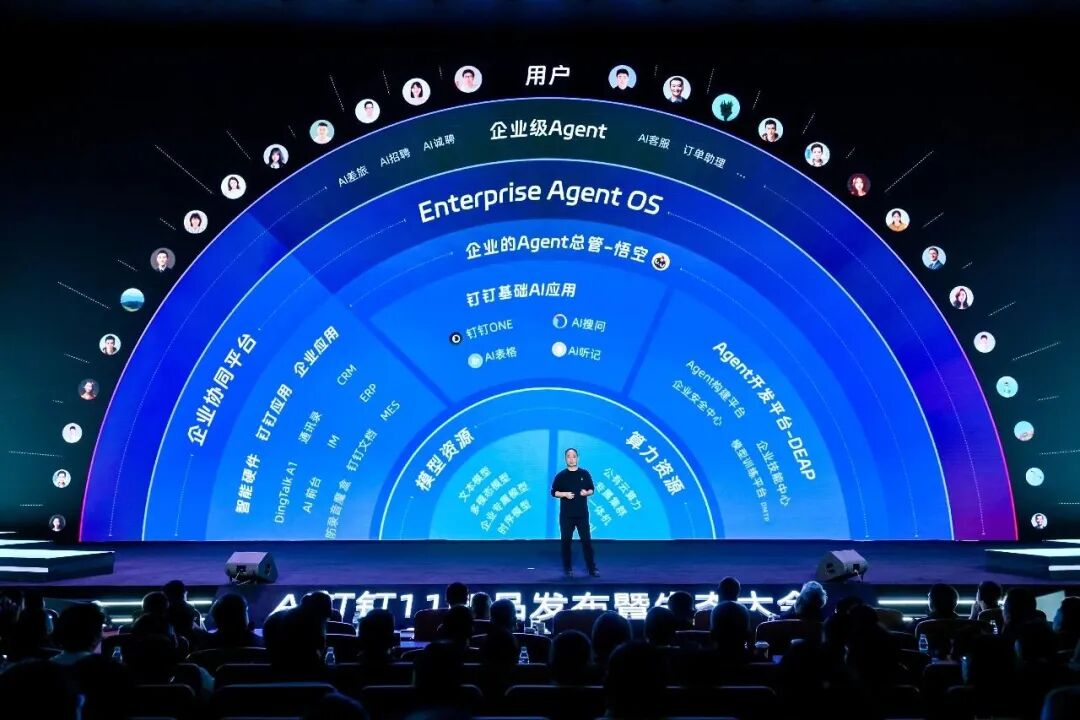
Officially dubbed as the 'world's first intelligent operating system for AI work,' it delegates human operational permissions to Agents through MCP (Model Context Protocol). For instance, conversational AI can assist in drafting a business trip request, while DingTalk's Agent can directly access travel interfaces to compare prices, book tickets, and complete approvals within the OA system.
MCP is not a novelty in the industry, nor is the invocation of Agent and model capabilities exclusive to DingTalk. The challenge lies in the ineffectiveness of traditional monitoring in such Agent workflows. For example, many steps' invocation processes and intermediate input-output states elude capture by traditional logs or tracking tools, resulting in 'black box execution.' Until the reasoning process and intermediate decision chains can be fully audited, hallucination black boxes remain a significant obstacle to AI implementation on the enterprise side—MCP is no exception.
In traditional code development, input A invariably yields output B. The advent of Vibe Coding has revolutionized this logic. Martin Fowler, author of 'Refactoring' and software engineer, cautions that AI is leading us into a 'probabilistic fog' replete with uncertainty. Many organizations running multi-Agent systems may encounter systemic failures due to an Agent receiving incorrect data from a preceding step.
Grasping this premise elucidates why DingTalk dares to propose Agent OS—hardware deployment ensures physical controllability of AI and related data, empowering enterprises to grant Agents broader permissions and enabling them to penetrate organizational processes beyond superficial content or code generation.
Judging by DingTalk's open invocation of basic atomic capabilities like scheduling, approvals, and note-taking through Wukong, even with a physical carrier, DingTalk's foray into organizational processes through AI remains cautious. However, one certainty is that DingTalk's strategic path has become sufficiently clear since Wu Zhao's return.
The 'Certainty' Game
In 2023, Alibaba envisioned AI permeating all industries. Unlike the consumer (to C) market, where AI can subtly infiltrate user dialogues like gentle rain, the business (to B) market is far more unforgiving.
Enterprise organizations do not invest in 'intelligence'; they invest in 'low-cost, certain outcomes.' Consider an extreme example: in industrial manufacturing, parts per million (PPM) is a critical metric for gauging product quality, representing the number of defects per million units. High-precision scenarios and demands have long made accurate modeling the cornerstone of industrial intelligence, with large models applied solely to process optimization, such as inspections.
Following this rationale, the vertical-scenario Agents integrated into DingTalk's Agent OS, such as 'AI Print' and 'AI Travel,' are marketed not on the basis of capability strength or intelligence but on 'error-free' performance.
Take AI Print as an illustration. In design and printing, a minor hallucination in text layout can result in significant waste losses. While AI is prone to errors, DingTalk's strategy is to augment the underlying model with 'relevant human processing support.'
The underlying logic of AI Travel and AI Recruitment is relatively straightforward. The former merely requires identifying and comparing flight and hotel prices and obtaining booking authorization to automate reservations and subsequent reimbursement processes. The latter involves structured information 'input-output,' where enterprise customer requirements are dissected into tokens, and Agents scour the web for resumes and complete subsequent processes like scheduling confirmations based on permissions.
Overall, DingTalk refines Agent capabilities into highly segmented scenarios, embedding them atomically into specific business workflows to replace previously time-consuming and laborious processes. This organizational process optimization shares parallels with DingTalk's initial foray into collaboration through conventional OA systems—simplicity reigns supreme as long as tasks are accomplished flawlessly, easing the burden on bosses.
DingTalk, which originated as a top-down management tool, is now embarking on a similar journey in the AI-to-B landscape.
At the launch event, Wu Zhao declared, 'The 1.0 version in August marked the first step for AI DingTalk. Today, we can proudly announce that DingTalk has undergone a complete transformation into an AI operating system.' While the ultimate outcome remains uncertain, as DingTalk Real continues to penetrate the market and more enterprise business processes operate on DingTalk's Agent protocols, migration costs will become unsustainable.

It is imperative to acknowledge the real-world challenges in realizing this vision.
The success of an operating system hinges on developers, and the evolution of Agent OS necessitates DingTalk to retrace its PaaS journey. Under a token-based rather than subscription-based business model, cultivating a vibrant platform ecosystem for third-party developers poses a formidable challenge. Another obstacle stems from the cost perspective: integrated software and hardware entail heavier supply chain management and capital investment for DingTalk, while for enterprise users, they present an upfront cost barrier.
Globally, DingTalk's path exudes distinct 'local characteristics.' Rather than focusing on knowledge workers, it prioritizes integrating AI into processes from highly decentralized, complex, and high-risk business scenarios. Agents capable of ensuring commercial delivery may emerge as the efficient and trustworthy digital employees that DingTalk's client enterprises seek.
Therefore, we must transcend a technical lens to observe the transformations in AI DingTalk Version 1.1—it offers a pragmatic, localized implementation template for the Chinese market. In the AI-to-B battleground, the ultimate victor may not be the one with the highest large model benchmark scores but the one who can ensure AI operates steadily in factories, government offices, and business travel processes.
-
![]()
Wu Yongming: Have No Fear, Capex Will Yield Returns in Three Years
-
![]()
After Cursor and OpenRouter Were Acquired, Has the Wave of AI Mergers and Acquisitions Arrived?
-
![]()
Revenue of 11.6 Billion and Loss of 200 Million: Can iFLYTEK Overcome the AI Profitability Dilemma?
-
![]()
CHN Energy Teams Up with Chery, Further Strengthening Green Power Alliance Between Power Generation and Auto Companies
-
![]()
Insights from the Chengdu Motor Show: Overseas Brands Step Up Their Game
-
![]()
Chengdu Auto Show: Some Brands Opt Out, While Others Go All-In with 'Pavilion Dominance'
-
![]()
8.2 Billion Yuan Invested to Launch a New Entity: Dongfeng Peugeot Citroen Automobile Reboots After Years of Inactivity
-
![]()
Why Are Once-Prominent 'Honored Guests' Now Mostly Missing from the Chengdu Motor Show?