Doubao AI Phone Takes on Super Apps, Sparking the 'Battle for Mobile Entry Points'
 12/26 2025
 502
502
'Siege' on AI Phones
Investor Network Lead | Xie Yingjie
Recently, ByteDance and Nubia collaboratively launched a phone dubbed the 'Nubia M153 Doubao Phone Assistant Technology Preview Version,' with a strong emphasis on AI capabilities.
The subtle undercurrents within the entire mobile internet landscape have suddenly risen to the surface: WeChat, Taobao, and Meituan almost simultaneously restricted Doubao phone users from logging in via verification codes, citing 'security reviews' as the pretext. On the surface, this appears to be a technical justification, but at its core, it represents a collective move by the gatekeepers of traffic.
Before this new innovation could even leave the laboratory, the established order had already constructed barriers of 'incompatibility.' ByteDance, perhaps foreseeing this intense reaction, deliberately included the term 'Technology Preview Version' in the model name, aiming to assess market acceptance and the commercial viability of AI phones.
Doubao Phone Challenges Tech Titans
ByteDance and ZTE jointly introduced the nubia M153, which comes pre-installed with the Doubao phone assistant. Shortly after the initial batch hit the market, it was declared sold out, and a premium market (premium resale) quickly emerged on second-hand platforms. The core selling point of this engineering prototype lies in its ability to 'do the work for you': users simply issue a natural language command, and the Doubao assistant can automatically execute a series of operations across different apps, such as ordering food, booking tickets, comparing shopping prices, and organizing information across platforms.
In simpler terms, it integrates the Doubao large model into the system layer, unifying the four major entry points—voice, image, search, and recommendations—under AI control, rather than having them segmented by individual apps. A user can just say, 'Take my kid to the Forbidden City this weekend,' and the phone will automatically compare weather conditions, ticket availability, subway routes, and family-friendly restaurants, generating an itinerary complete with payment links, all without the need to switch between WeChat, Meituan, or Fliggy.
When AI becomes the primary mode of interaction, app icons will be relegated to the background, akin to command lines in the DOS era, and traffic entry points will shift accordingly—towards Doubao.
However, the underlying logic of the mobile internet is not rooted in technology but in 'who owns the users.' WeChat was the first to close the channel for Doubao phones to obtain SMS verification codes. Taobao subsequently blocked the risk control whitelist for Alipay on this device, and Meituan extended the review period for new device registrations for riders and users from two hours to forty-eight hours.
Currently, applications such as Taobao, Meituan, Alipay, and Pinduoduo cannot be logged into using the Doubao AI phone, displaying messages like 'Your device's login environment is abnormal.' Meanwhile, applications like WeChat and Amap are unable to perform AI operations on the Doubao AI phone, showing messages such as 'Cannot open due to relevant restrictions.'
Internet companies have all cited 'routine security upgrades' externally, but these upgrades were coincidentally timed around the Doubao launch event. Two days later, Doubao announced the discontinuation of the phone assistant's automatic operation capabilities for WeChat, changing relevant scenarios to only support manual execution by users, and stated that restricted accounts on the engineering prototype would gradually resume login. However, at the same time, permission disputes, multi-platform blockades, and regulatory signals began to emerge one after another.
The vigilance of the tech giants is not without reason. Questmobile data reveals that Chinese users have an average of 68 apps installed but open fewer than 12 daily, with the top three apps accounting for 38% of usage time. Once AI assistants break down user needs and fulfill them at the system layer, apps' 'desktop dominance' will be reduced to mere backend tools.
More critically, advertising budgets will follow the entry points. When brands discover that users no longer open Taobao to search for dresses but instead tell their phones, 'Find me a trench coat like a celebrity's,' the recommendation power shifts to the large model, and the commercial rules behind the model remain a gray area.
On December 5th, the Doubao phone assistant issued a statement saying it is actively seeking in-depth communication with various app vendors and has made standardized adjustments to AI phone operation capabilities in certain scenarios, including but not limited to: restricting scenarios for score-brushing and incentive-brushing; disabling the use of financial apps; and disabling AI usage capabilities in certain gaming scenarios.
The Greater Competition Lies in the Ecosystem
According to IDC data, in the third quarter of 2025, vivo, Apple, Huawei, Xiaomi, OPPO, and Honor were the top five smartphone vendors in China, with OPPO and Honor tied for fifth place. Nubia, a ZTE smartphone brand, did not make the list.
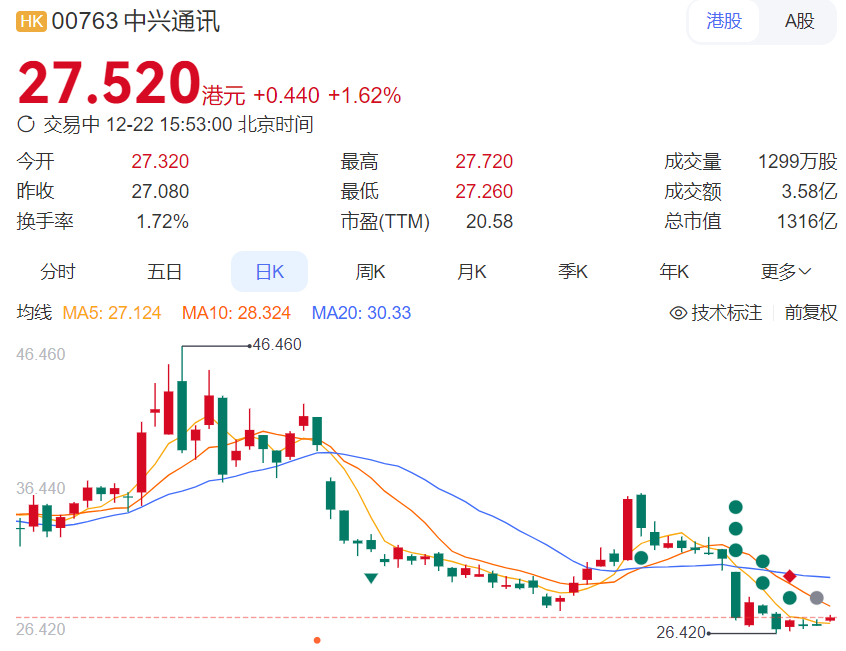
Capital market sentiment quickly shifted from enthusiastic to cautious. On December 1st, the day ByteDance and ZTE's cooperation was announced, ZTE Corporation (000063.SZ) hit its daily limit but then fell in subsequent trading days.
The initial transaction price for the Doubao phone was 4,089 yuan, only a 590 yuan premium over the official price of 3,499 yuan. Subsequently, market enthusiasm for this AI phone surged, and transaction prices skyrocketed. According to the latest transaction data from the Dewu App, the transaction price of the Doubao AI phone peaked at 6,529 yuan on December 11th before plummeting, falling to 4,899 yuan by December 20th, a 25% decline.
Returning to the consumer perspective, most still perceive 'AI phones' as smarter voice assistants. A young trial user in Shenzhen told the Investor Network that his most frequent use case is commuting and telling his phone to 'continue playing the unfinished documentary on Douyin to the car's infotainment system.' As for one-click coffee orders and movie ticket bookings, 'if WeChat can't log in and coupons can't be synced, I'll still go back to the group-buying page.' This statement reveals a harsh truth: AI can shorten paths but cannot bypass the sunk costs of account systems, membership balances, and social relationships.
Historical experience indicates that shifts in entry points often accompany hardware upgrade cycles: in the 3G era, touchscreens moved traffic from PCs to phones; in the 4G era, cameras shifted traffic from text to short videos; in the 5G and AI superposition (superimposed) period, voice and images may move traffic from apps to the system layer. However, each shift sees old giants using 'incompatibility' to buy buffer time, then using investments, acquisitions, and replication to pull innovation back onto their tracks.
In April 2025, the WeChat Security Center issued a notice advising users not to use third-party tools like 'AI management of chat records.' It also restricted the use of OPPO's 'AI One-Click Flash Note' within WeChat. Additionally, Bilibili does not allow AI assistants to automatically summarize videos on its platform; Meituan and Taobao have preemptively blocked all technical scraping and automated access in their user agreements.
Whether the Doubao phone can become an exception depends not on its 300,000 unit sales but on whether it can leverage differentiated experiences to attract 10 million sticky users within the six months of the tech giants' 'closure'—equivalent to the annual active buyers of a mid-sized e-commerce platform.
With high inventory levels and prolonged replacement cycles being a consensus in the phone industry, and even Apple lowering its sales expectations in China, the difficulty for a new brand to break through with an AI concept is evident.
From a broader perspective, regulators have already issued a yellow warning against 'platform self-preferencing.'
On November 15, 2025, the State Administration for Market Regulation released the 'Internet Platform Antitrust Compliance Guidelines (Draft for Comments).' One of the core highlights of this new regulation is further refining behaviors related to 'malicious incompatibility' and incorporating them into the typical risk scenario of 'platform differential treatment,' clarifying that unfair differential treatment by platforms in transaction conditions, access standards, traffic promotion, and algorithmic recommendations all fall under compliance risks.
If ByteDance chooses to file a formal complaint, WeChat, Taobao, and Meituan will need to justify the technical necessity; otherwise, they may face fines ranging from 1% to 10% of their annual revenue. However, litigation can drag on for up to two years, enough to slow down the golden lifecycle of a phone.
Currently, 'phone AI-ization' is becoming the main trend in industry development. According to IDC's insights into the top ten trends for the Chinese smartphone market in 2026, the shipment volume of next-generation AI phones in China is expected to reach 147 million units in 2026, accounting for more than half for the first time, reaching 53%.
The story remains undecided at this point. ByteDance has issued a 'dimensionality reduction strike' challenge to super apps with its AI phone, while the tech giants have responded most bluntly with 'incompatibility': traffic entry points are not a technical issue but a matter of commercial sovereignty. (Produced by Siwei Finance) ■
Source: Investor Network
-
![]()
Even a Titan Like Musk Has Faced Setbacks in Fulfilling Promises
-
![]()
AI Office: The End of the Racing Era, Context Becomes the Key to Success
-
![]()
Domestic Vehicle Chassis Revolution ②: The Steering Wheel Remains, But Mechanical Connections in the Steering System Are Decreasing
-
![]()
Exploring MiniMax Design: Can Video Editing Be as Simple as Speaking?
-
![]()
Why Can SenseTime Achieve Profitability While CloudWalk Still Faces Challenges, Despite Both Adopting Large Models?
-
![]()
Domestic Car Chassis Revolution Part 3: Suspension Systems Transform Vehicle Posture, from Vibration Absorption to Active Force
-
![]()
Hainan is Going on a Crazy Satellite-Building Spree
-
![]()
Optics Determines Success in the XR Era: Wafer Production Reaches Millions, Industry Giants Join the Fray!