Distinct Disparities Between Chinese and Foreign Robots: Deployment Scenarios Versus Full-Chain Technology
 01/07 2026
 485
485
Produced by Zhineng Technology
At CES 2026, Chinese and foreign robots presented markedly contrasting narratives:
● Overseas
Overseas contenders, exemplified by 1X's Neo household humanoid robot and Boston Dynamics' Atlas, prioritized complete machines and forward-looking visions. These overseas players emphasized, "We already have a clear understanding of the robot application scenarios," even if the progress is gradual.
Neo positions the 'home' as its ultimate application domain. With a price tag of $20,000, a subscription-based model, and the backing of OpenAI's advanced model, it signifies a transition from technical demonstration to actual product delivery. It focuses on being understated, dependable, and evolving steadily over the long haul, despite current constraints in cost and stability. Backed by Hyundai, Atlas showcases its 'top-tier capabilities' through live demonstrations, providing an industrial timeline for entering automotive manufacturing by 2028, with an aim to achieve a production rate of ten thousand units.
● China
The collective presence of Chinese robots at CES 2026 highlighted a comprehensive technological suite: from dexterous hands, sensors, LiDAR, and computing platforms to data acquisition systems, and encompassing complete machines such as humanoids, quadrupeds, wheeled-legged robots, and service robots. Nearly every critical component has a representative stepping up to 'bridge the gap,' covering a multitude of possibilities with a complete industrial chain.
Diverging from the previous perception of being merely 'cost-effective alternatives,' this round of Chinese companies places greater emphasis on product completeness, system synergy, and adaptability to real-world conditions. They have also notably evolved in their communication, articulating 'the problems I have solved' in a manner comprehensible to global users.
01
Logic Behind Overseas Robots
◎ The 1X Neo household humanoid robot distinctly anchors its product in the intricate yet highly imaginative realm of home use.
Its pricing, subscription model, limited delivery pace, and direct operation of a customized OpenAI advanced model demonstrate that the true challenge for humanoid robots lies in their ability to function reliably in long-term, unstructured environments and continuously evolve through software.
Neo deliberately eschews 'flashy tricks,' emphasizing low noise, safety, and the ability to perform repetitive tasks day after day. At this stage, European and American companies prioritize 'product responsibility' over 'technical showmanship.'
◎ Boston Dynamics' Atlas signifies the resurgence of top-tier engineering prowess in industrial settings.
The flawless execution of its live demonstrations, candid explanations of remote operation, and a clear timeline for deployment in Hyundai's automotive factories by 2028 indicate that the most certain value of humanoid robots in the near term still resides within highly controllable industrial systems.
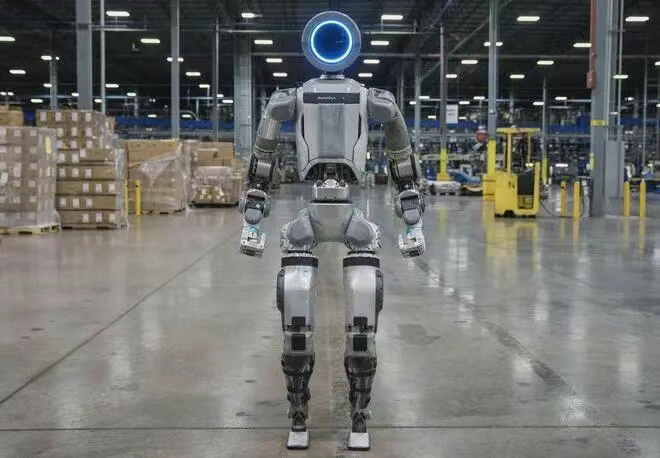
Atlas is an enterprise-level product tailored for manufacturing and logistics warehousing environments. Its design objective is to execute diverse tasks in unstructured real-world scenarios, with its core being exceptional physical performance and intelligent adaptability. Standing at 1.9 meters tall with an arm span of 2.3 meters, Atlas boasts up to 56 degrees of freedom, ensuring unparalleled flexibility.
Its maximum load capacity is 50 kilograms, and it can operate stably across a wide temperature range from -20°C to 40°C, with an IP67 rating for water and dust resistance.
The robot is equipped with a 4-hour endurance battery and can autonomously navigate to a charging station when depleted, replacing the battery within 3 minutes to achieve nearly uninterrupted 24/7 operation.
Atlas features a safety system based on advanced perception and decision-making algorithms, enabling seamless human-robot collaboration without physical barriers. When high-precision sensors detect personnel entering the work area, it automatically pauses or adjusts its movement trajectory, resuming only when it is safe to do so.
Hyundai plans to initially receive Atlas robots in 2026 for preliminary integration and testing at its robot application center, with scaled deployment scheduled to commence in 2028 at its electric vehicle manufacturing plant in Georgia, USA.
Initially, the robots will undertake repetitive, heavy-duty tasks such as parts sorting and handling, with future expansion into more complex assembly processes.
Boston Dynamics' newly forged strategic AI partnership with Google DeepMind aims to tackle the ultimate challenge of autonomous understanding and decision-making for robots in dynamic environments, with the objective of deeply integrating Google DeepMind's Gemini Robotics foundational model into the Atlas robot platform.
In the future, Atlas may only need to observe a human demonstration once or receive a natural language instruction to comprehend and execute a complex task never programmed before, generalizing and applying the experience to truly adapt to flexible production needs.
Mass production of the Atlas has commenced at the company's headquarters in Boston, USA, with all capacity orders for 2026 already sold out. The initial products are being delivered to Hyundai and Google DeepMind, with availability for more industry customers opening in early 2027.
There are actually not many overseas players; they slowly build robots with limited but clearly defined scenarios.
02
Chinese Robots
Author Lang Hanwei has crafted the following intriguing diagram. The array of robots is impressive:

◎ Zhiyuan Robotics showcased its versatile humanoid robot and complete machine solutions at CES 2026.
◎ Unitree Technology displayed a range of robot products at the exhibition, highlighting high-speed motion and stable control capabilities.
◎ Starry Robotics unveiled two humanoid robots, the Starry L7 and Q5, demonstrating bipedal walking and full-body coordinated control abilities.
◎ Fourier Intelligence showcased its new generation of full-size humanoid robot, the GR-3, at CES, focusing on interaction and companionship features.
◎ DeepRobotics introduced its wheeled-legged robot, the Lynx M20 Pro, designed for complex terrain and hazardous environment applications.
◎ Jingshi Technology showcased the BAOBAO, a dual-morphology robot capable of switching between humanoid and quadrupedal forms.
◎ VITA Power displayed and pre-sold its quadrupedal intelligent companion robot, the 'Big Head BoBo,' at CES.
◎ Keenon Robotics showcased its delivery robot, the T10, and multiple cleaning robots, catering to commercial service scenarios.
Chinese companies have occupied multiple sections of CES, nearly spanning the entire industrial chain.
Dexterous hands, joint modules, 3D vision, LiDAR, computing platforms, and data acquisition systems—these components, often considered 'behind-the-scenes' in the past, are now being prominently displayed alongside complete machine products.
The strengths of the Chinese robotics industry lie in the fact that while single-point technologies may not be the globally strongest, they possess a natural environment for system integration, cost control, and engineering speed. Chinese manufacturers are not fixated on whether the 'ultimate form is humanoid,' but instead continuously accumulate real-world operational data and commercial closures through various mature or semi-mature scenarios such as household cleaning, garden robots, commercial delivery, quadrupeds, and wheeled-legged robots.
◎ Zhaowei Electromechanical showcased multiple high-degree-of-freedom dexterous hand products at CES 2026, covering humanoid robot hand solutions ranging from 6 to 20 degrees of freedom.
◎ Inks exhibited a 20-degree-of-freedom dexterous hand and integrated joint modules at CES, targeting humanoid and embodied AI robot applications.
◎ RoboSense showcased its 'hand-eye coordination' solution based on its self-developed Active Camera, combining 3D vision with dexterous hands for complex manipulation tasks.
◎ Hesai Technology exhibited its JT series 3D LiDAR at CES 2026, primarily targeting lawn mowing, delivery, and service robot scenarios.
◎ Orbbec released and showcased multiple new 3D camera products, mainly used for fine perception in humanoid robots and outdoor AMRs.
◎ Black Sesame Technologies showcased its SesameX embodied AI computing platform at CES, serving as the computational foundation for robot perception and decision-making.
◎ Daimeng Robotics exhibited force/tactile feedback dexterous hands and remote operation data acquisition systems for robot training and learning.
The 'expression' of Chinese companies at CES is evolving. In 2026, Chinese robot manufacturers have begun to consciously discuss design philosophies, user experiences, and long-term upgrade strategies, even actively occupying forward-looking narrative positions such as 'embodied AI' and 'robot foundations.'
This external manifestation of industrial stage changes indicates that products have surpassed the threshold of 'usability' and now possess the confidence to discuss 'how to use them' and 'what they will evolve into in the future.' Chinese robots represent a natural overflow of years of manufacturing capabilities, supply chain collaboration, and scenario trial and error.
Summary
Overseas companies appear to be redefining the 'ultimate form' using AI and robots, while Chinese companies are advancing robots as an industry that can be rapidly engineered and scaled within complex market and manufacturing systems, employing multiple parallel routes to enhance the probability of success. We have confidence in Chinese robots!
-
![]()
Registered Capital Slashed to 372 Million Yuan! Yutong Optical Finalizes Industrial and Commercial Change Registration
-
![]()
Zhuque-3 Successfully Lands, and 'Time Traveler' Secures Another ¥100 Million in Funding: China's Commercial Space Industry Experiences a 'Dynamic August'
-
![]()
Autohome Faces a Shrinking Window of Opportunity
-
![]()
Even a Titan Like Musk Has Faced Setbacks in Fulfilling Promises
-
![]()
AI Office: The End of the Racing Era, Context Becomes the Key to Success
-
![]()
Domestic Vehicle Chassis Revolution ②: The Steering Wheel Remains, But Mechanical Connections in the Steering System Are Decreasing
-
![]()
Exploring MiniMax Design: Can Video Editing Be as Simple as Speaking?
-
![]()
Why Can SenseTime Achieve Profitability While CloudWalk Still Faces Challenges, Despite Both Adopting Large Models?