Unleashing Two "Game-Changers" at Year's Start, Zhang Yiming is Playing a Grand Chess Game
 02/15 2026
 892
892
Produced by Leida Finance, Text by Ding Yu, Edited by Meng Shuai
At the beginning of 2026, ByteDance has released a series of “game-changing” announcements.
In the field of large models, ByteDance recently launched the AI video generation model Seedance 2.0. During its internal testing phase, this model, capable of creating cinematic-quality videos from text or images, went viral on the internet due to its stunning performance.
At the hardware level, ByteDance reportedly has a self-developed chip team of over a thousand members, which has now formed four major product lines: AI chips, CPUs, VPUs, and DPUs.
In fact, amid the current AI boom, leading global tech companies are continuously increasing their investments, sparking an intense competition centered around AI.
In this battle without gunsmoke, ByteDance, as a significant player, is sparing no expense in budget allocation: In 2024, the company invested RMB 80 billion in AI; in 2025, its capital expenditure is expected to reach RMB 150-160 billion; and in 2026, ByteDance plans to invest another RMB 160 billion in AI business development.
Based on these rough estimates, ByteDance is expected to invest a staggering RMB 400 billion in AI over just three years, an investment scale comparable to the annual GDP of a mid-sized prefecture-level city.
Such a massive investment in AI has also made ByteDance highly favored in the capital markets. In November last year, Today Capital, led by “venture capital queen” Xu Xin, heavily invested USD 300 million to acquire shares in ByteDance, raising the company's valuation to USD 480 billion (approximately RMB 3.4 trillion).
Tianyancha data shows that Zhang Yiming founded ByteDance in 2012. As ByteDance's valuation reaches new heights, Zhang Yiming has also seen a substantial increase in his personal wealth.
In the 2025 Hurun China Rich List, released in October last year, Zhang Yiming ranked second with a wealth of RMB 470 billion, up 34% from the previous year.
Benchmarking First, Then Surpassing! Seedance 2.0 Takes the Global Stage by Storm
Many netizens' first impression of generative video AI may date back to Sora, released by OpenAI in February 2024.
With just a brief or detailed text prompt, or even a single static image, Sora can generate realistic, cinematic scenes featuring multiple characters, various types of actions, and detailed backgrounds, producing up to 1-minute-long 1080P high-definition videos.
Sora's emergence shattered people's imaginations at the time, leading many to dub 2024 as the “first year of AI video generation.”
More than half a year later, ByteDance's similar models finally made their debut. In September 2024, ByteDance released PixelDance and Seaweed, developed by its then AI Lab team and Seed team, respectively. However, these models arrived three months later than Kling AI, developed by ByteDance's rival, Kuaishou.
It wasn't until November 2024 that PixelDance and Seaweed were officially launched on ByteDance's video generation platform, Jimeng, and made available to platform users.
In 2025, as competition in the AI video model track (translation note: “sàidào,” meaning “track” or “arena”) intensified, products like OpenAI's Sora 2 and Google's Veo 3 entered the market.
Facing attacks from competitors, ByteDance refused to back down. In April of the same year, ByteDance merged its AI Lab team into the Seed team.
The following month, ByteDance integrated PixelDance and Seaweed to launch the video model Seedance 1.0 lite. This further integration of teams and products accelerated ByteDance's progress in large-scale video generation models.
In June, ByteDance released the Seedance 1.0 and Seedance 1.0 pro models, which supported text and image inputs to generate seamless multi-angle 1080P videos while significantly reducing generation time.
In December of the same year, Seedance 1.5 pro was officially released, introducing advanced features such as synchronized audio-visual output and multi-language, multi-person dialogue dubbing.
Just two months later, ByteDance's Seedance 2.0 took the internet by storm, both domestically and internationally, with its groundbreaking AI video generation capabilities.
Compared to previous versions, Seedance 2.0 significantly improved generation quality, offering higher usability in complex interactive and motion scenes, with notably enhanced physical accuracy, realism, and controllability, better meeting the demands of industrial-grade creative scenarios.
One netizen commented, “The lighting, camera movements, sound effects... Compared to this, Sora seems like a toy from the last era!”
Faced with the technological tsunami triggered by Seedance 2.0 globally, even tech mogul and world's richest man Elon Musk was deeply impressed, prompting him to repost and comment on Seedance 2.0-related posts on social media, marveling at the model's rapid development.
Seedance 2.0's stunning performance even left renowned director Jia Zhangke in awe: “Seedance 2.0 is truly impressive. I plan to use it to make a short film.”
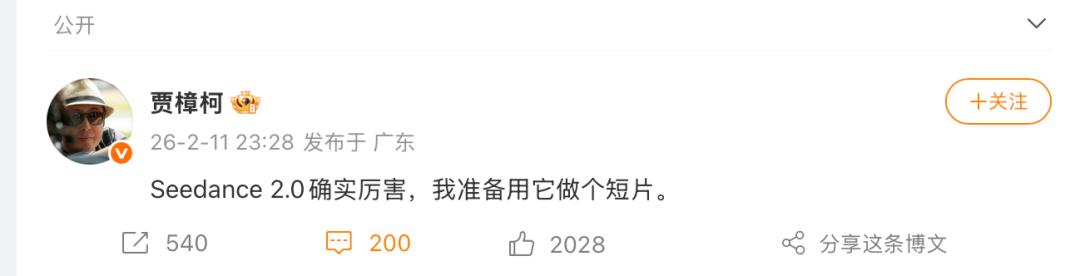
Interestingly, just over half a year earlier, at the “Green Onion Plan” Film Master Class, Jia Zhangke had stated that AI could not yet fully replace traditional filmmaking techniques.
Additionally, several U.S. directors who used Seedance 2.0 to create short films were equally astonished. Director Charles Collen wrote that he used Seedance 2.0 to produce a trailer for an unreleased live-action film adaptation of a video game in just 20 minutes, costing only USD 60.
Director Andrew Olek released a short film under 30 seconds long, depicting a boy in a wheelchair sliding into water in a forest. The video's fast-paced, thrilling sequence resembled an action scene from a movie. Olek said, “This is incredible! With just a text prompt, Seedance 2.0 handled everything!”
“The childhood era of AIGC is over,” said Feng Ji, producer of Black Myth: Wukong, adding, “I'm glad that today's Seedance 2.0 comes from China.” He described his initial experience with the model using words like “leading,” “versatile,” and “low-threshold.”
However, Feng Ji also expressed concerns. He pointed out that the production costs of general videos would no longer follow traditional logic in the film and television industry but would increasingly approach the marginal cost of computing power. The content field is bound to face unprecedented inflation, with traditional organizational structures and production processes being completely restructured.
Even more concerning to Feng Ji was the proliferation of fake videos and the resulting trust crisis. “This is the real reason I'm posting this—because realistic fake videos will become Extremely easy (translation note: “ Extremely easy ,” meaning “extremely easy”) to create, and existing intellectual property and censorship systems will face unprecedented challenges.”
Hollywood, meanwhile, has collectively resisted ByteDance. According to media reports, the Motion Picture Association (MPA), representing major studios such as Netflix, Paramount Pictures, Amazon MGM Studios, Sony Pictures Entertainment, Universal Pictures, Walt Disney Studios, and Warner Bros. Discovery, has strongly protested.
The MPA pointed out that within just one day of Seedance 2.0's launch, there were numerous cases of unauthorized use of American copyrighted works, demanding that ByteDance immediately suspend the service.
Charles Rivkin, chairman of the MPA, stated that ByteDance's actions disregarded copyright laws protecting creators' rights and threatened tens of thousands of U.S. film and television industry jobs.
In response to industry protests, ByteDance quickly reacted by announcing the suspension of the feature allowing users to upload images of real people and stating its commitment to respecting intellectual property and copyright protection. However, this move did not entirely alleviate Hollywood's concerns.
According to a copy of the letter obtained by Axios, The Walt Disney Company sent a letter to ByteDance on Friday local time, accusing the company of using Disney works without permission during the training and development of the Seedance 2.0 model and demanding that ByteDance “cease infringement and not repeat it.”
Establishing a Thousand-Strong Self-Developed Chip Team, Forming Four Major Product Lines
The impressive achievements of ByteDance's AI products, such as Seedance 2.0 and Doubao, are backed by robust computing hardware support.
According to Securities Times, ByteDance previously relied heavily on purchasing computing resources from third parties but has recently decided to fully invest in building its own AI data centers, taking complete control of infrastructure and hardware procurement.
In terms of financial investment, ByteDance has spared no expense. In 2024, its capital expenditure on AI reached RMB 80 billion, nearly matching the combined capital expenditures of Baidu, Alibaba, and Tencent (BAT), which totaled around RMB 100 billion.
In 2025, ByteDance's capital expenditure is expected to reach a staggering RMB 160 billion, with approximately RMB 90 billion allocated to AI computing power procurement—RMB 40 billion domestically and RMB 50 billion overseas (primarily in Southeast Asia)—to build a strong foundation for AI computing capabilities.
The remaining RMB 70 billion will be allocated to IDC infrastructure and bidding for network equipment such as optical modules and switches, with RMB 50 billion earmarked for domestic projects and RMB 20 billion for international projects, aiming to create a large-scale, independently controllable data center cluster.
Additionally, according to 36Kr's “Smart Emergence,” ByteDance plans to invest RMB 160 billion in AI in 2026, with up to RMB 85 billion allocated to the procurement and research and development of AI processors.
By the end of last year, ByteDance had stockpiled at least nearly 120,000 NVIDIA cards (A100, A800, H800), along with nearly a million NVIDIA H20, L20, and L40 chips.
Furthermore, ByteDance has also amassed a significant number of domestic AI chips, including Cambricon 5/6/9 series, Shengteng 910B/C, Haiguang, and Kunlun Core chips, ranging from tens of thousands to several thousand units.
At the same time, ByteDance aims to keep core chip technology in-house. According to “Smart Emergence,” ByteDance's chip team has quietly expanded to over a thousand members.
Sources revealed that ByteDance's AI chip and CPU teams are relatively large, with the AI chip team exceeding 500 members and the CPU team around 200.
On February 14, BlueWhale News learned from sources that ByteDance's chip R&D team will begin large-scale recruitment, covering cities such as Beijing, Shanghai, and Shenzhen, with positions including chip architecture and SoC design.
Meanwhile, “Smart Emergence” mentioned that ByteDance's chip team recently underwent structural adjustments: Wang Jian, the former head of the chip division and technical director of the “Data-Systems” department, no longer oversees this sector.
Instead, Shi Yunfeng, head of the AI chip and DPU teams, and Yu Hongbin, head of the CPU team, will report directly to Yang Zhenyuan, ByteDance's vice president and head of Volcano Engine business.
ByteDance's chip business began in 2020 and is currently divided into four main segments: AI chips, CPUs, VPUs, and DPUs.
Among them, AI chips are used for inference tasks in the Doubao large model; CPUs serve as server chips for general-purpose computing in data centers; VPUs (video processing units) are used for video decoding and content moderation; and DPUs (data processing units) are primarily used for network and storage optimization in data center networks, such as RDMA.
According to Reuters, after six years of secret preparation, ByteDance's AI chip for inference tasks (SeedChip) is expected to receive its first batch of chip samples by the end of March 2026. The company plans to produce at least 100,000 self-developed AI chips this year and gradually increase production to 350,000 units, with Samsung potentially serving as the foundry partner.
According to “Smart Emergence,” ByteDance's AI chips have already undergone three to four generations of secret iterations, and the company has also engaged with other foundry partners besides Samsung.
Analysts believe that if ByteDance successfully develops its own chips, it will not only effectively reduce the company's computing power costs and external dependencies but also promote deep hardware and software (translation note: “ hardware and software ,” meaning “software-hardware”) collaboration optimization, better adapting and iterating its proprietary algorithm systems to further strengthen its technological barriers.
Domestic and International Tech Giants are “Burning Money” on AI
While ByteDance is heavily investing RMB 400 billion in AI, numerous tech giants at home and abroad are also gearing up, willing to spend lavishly on AI.
At the 2024 Cloud Town Summit, Wu Yongming, CEO of Alibaba Group and chairman and CEO of Alibaba Cloud Intelligence Group, stated that Alibaba is actively advancing a three-year, RMB 380 billion AI infrastructure construction plan and will continue to increase investments.
Turning our gaze overseas, Google announced a 2026 capital expenditure plan of USD 175-185 billion, nearly double that of 2025.
According to Reuters, major tech giants, including Google, Microsoft, Amazon, and Meta, are expected to invest over USD 630 billion in artificial intelligence this year. However, the return on these investments thus far still lags behind the pace of expenditure growth.
Tencent, a domestic internet giant, stated in its latest quarterly report that its strategic investments in AI have not only benefited business areas such as advertising precision targeting and game user engagement but also improved efficiency in programming, gaming, and video production.
Alibaba, in its latest semi-annual report, stated that the overall revenue of its Cloud Intelligence Group (excluding revenue from Alibaba's consolidated businesses) increased by 28% year-on-year, primarily driven by growth in public cloud business revenue, including increased adoption of AI-related products.
However, both Tencent and Alibaba, like their overseas counterparts, face similar dilemmas. Tencent recorded a net profit attributable to shareholders of RMB 166.582 billion in the first three quarters of last year, up 16.7% year-on-year, but growth momentum slowed significantly, with the year-on-year growth rate declining by approximately 45 percentage points.
Alibaba reported a net profit attributable to shareholders of RMB 64.106 billion in the first half of fiscal year 2026, down 5.92% year-on-year, with the growth rate declining by nearly 16 percentage points.
For ByteDance, in addition to the enormous potential of its large user base from products like Doubao and Jimeng to convert into paid and value-added revenue on the consumer side, its cloud service platform, Volcano Engine, is also expected to directly benefit from the AI wave, opening up new avenues for business expansion and profit growth.
According to Omdia's 2025 Global Enterprise-Grade MaaS Market Analysis, as of October 2025, ByteDance's Volcano Engine had an average daily Tokens call volume exceeding 30 trillion, ranking third globally with a 15% market share, behind only OpenAI and Google Cloud.
Currently, MaaS services have become the fastest-growing and highest-margin AI cloud computing product. As of December last year, the average daily call volume of the Doubao large model exceeded 50 trillion Tokens, up 66.7% from October of the same year and more than tenfold compared to the same period in 2024.
Through technological innovations such as model architecture optimization and hardware-software engineering enhancements, large models offer highly cost-effective services while maintaining healthy gross margins. According to Tan Dai, President of Volcano Engine, the gross margin of Doubao's large model MaaS far surpasses that of traditional cloud products like IaaS.
After releasing a series of blockbuster announcements at the start of the year, can ByteDance sustain its leading position in the AI wave? Leida Finance will continue to monitor developments.
-
![]()
Who’s Sounding the Alarm on ‘Rushed Vehicles’?
-
![]()
Over 5.3 Billion Yuan in Losses Over Three and a Half Years! Can Yonyou Reverse Its Fortunes Through Streamlining and AI Transformation?
-
![]()
Baidu AI Adopts Free Model: A Strategic Maneuver in Traffic and Monetization
-
![]()
Silicon-Based OLED Pioneer Unveils Financial Results: H1 Shipments Outpace Entire 2025 Volume
-
![]()
AI's First "Lost Summer"
-
![]()
Zeiss Makes Another €2.2 Million Bet: Will Eye Tracking Be the Next Big Thing in the Smart Glasses Industry?
-
![]()
RUNTO Ranking | Global Top TV ODM Factories' Shipment Figures for July 2026
-
![]()
Dealer Service Operational Prowess | How After-Sales Managers Can Harness Efficiency and Expertise to Secure Trust in the New Energy Era