Qianwen: Investing 3 Billion to Foster a 'Habit'
 02/27 2026
 705
705
Author | Wu Kunyan
Editor | Wu Xianzhi
On the dawn of January 1, 2026, a milk tea shop in a small southern county remained ablaze with light. This 'pit stop' buzzed with young people on their way home, eager to embark on their next adventure. The red banner above the door, now proclaiming 'Qianwen Treats You to Milk Tea', caught the eye; it had previously announced 'Discounts on Milk Tea via Taobao Flash Sale'.
Occasionally, groups of young people would pause at the entrance, searching for something in app stores. Meanwhile, data from the Qianwen App revealed that during the Spring Festival event, over 130 million people across the nation experienced AI shopping for the first time, invoking 'Qianwen, help me' a staggering 5 billion times.
Leveraging the near-field consumer mindset and supply organization capabilities honed by Taobao Flash Sale during the food delivery wars, Alibaba's substantial 3 billion yuan marketing investment in Qianwen has made a significant impact.
Once a habit takes root, it's tough to uproot. Thus, from small artisanal shops to internet behemoths across sectors, repeated incentives are employed to steer consumer behavior.
Qianwen's bold move seems familiar yet carries a fresh AI-era twist—users who entrust their true needs to AI no longer endure homogenized experiences akin to internet gala events. Instead, they engage in a seamless chain of AI dialogue, confirmation, and fulfillment.
Alibaba recognizes that under the strong tool-like, yet weakly sticky nature of AI applications, mere 'smartness' won't ensure effective retention. It must harness its closed-loop consumer ecosystem to carve out a niche for the still-nascent (cloud-based) 'brain'.
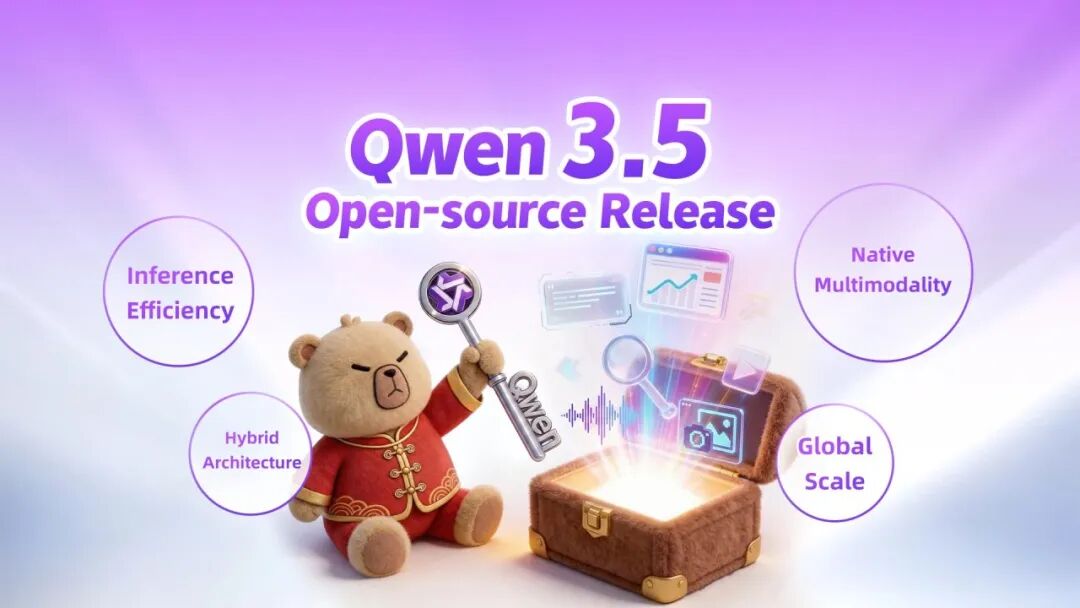
Not to be overlooked is Alibaba's release of Qwen3.5-Plus on New Year's Eve. This model, tailored for the open-source ecosystem, emphasizes 'doing more with less', boasting a staggering 3.97 trillion total parameters but activating only 17 billion.
Alibaba's strategy in the AI race is becoming clearer: on the application front, Qianwen integrates high-frequency lifestyle services into AI, using subsidies to spur consumer migration; on the model front, capabilities are extended both internally and externally to secure a broader ecosystem and establish brand presence.
Taobao's Second Growth Spurt
In platform economics, the scarcer side of supply and demand dictates the higher-ROI investment direction.
For AI applications with pronounced tool attributes and inherently weak stickiness, users can easily switch to alternatives with minimal switching costs. Homogenized text-to-image generation capabilities are clearly in excess, necessitating refinement of user-side services.
Yuanbao emphasizes social companionship with 'Pai', Doubao sparks an AI creation craze with Seedance2.0, and Baidu integrates AI into its search ecosystem. Alibaba's choice aligns closely with its own ecosystem—betting on consumption and lifestyle services to make users feel 'more convenient' in the most intricate life scenarios, with this convenience being repeatable and predictable.
Behind a user's simple request, 'Qianwen, help me', lies a clear sequence: multi-round dialogue to clarify needs, selecting the optimal combination from available options, and finalizing fulfillment.
For users, the shorter and more certain this chain is, the easier it is to shift consumer behavior; conversely, if an experience requires repeated parameter adjustments, constant app-switching, or lacks clear issue resolution, AI will quickly revert to a 'tool used occasionally'.
Thus, beyond consolidating consumption decisions previously scattered across different apps, Qianwen needs a highly penetrative, easily comparable consumption format.
Each Generation Has Its Own 'Battles'
Following last year's food delivery wars, milk tea, with its low barriers, light decision-making, and easy delivery, has become Alibaba's 'weapon' to test the waters. The banners at milk tea shops constantly remind users that Qianwen is not an abstract AI concept but a service entry point for real-world consumption.
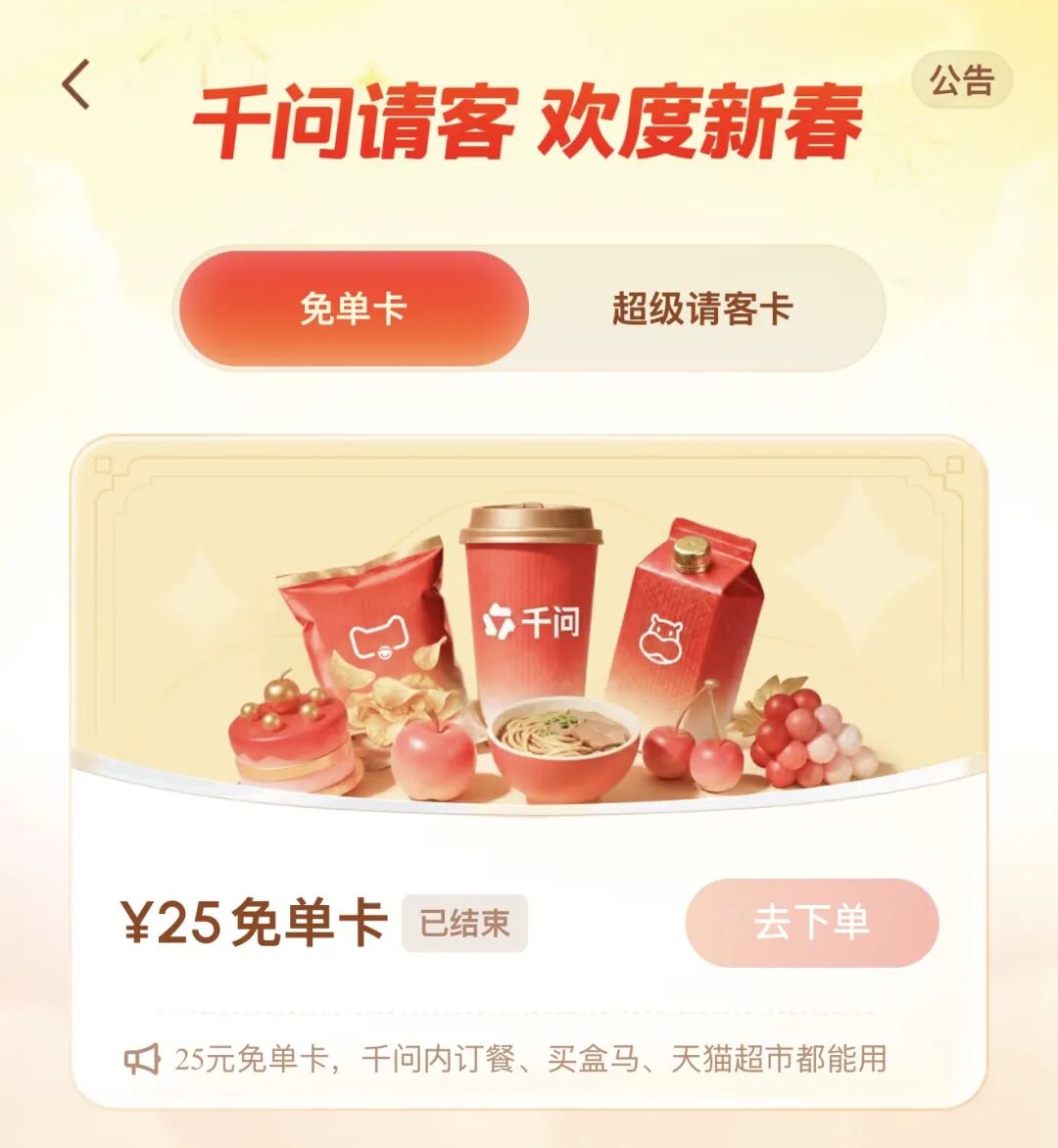
As Wu Jia, President of Qianwen's Consumer Business Group, mentioned in a recent public dialogue, 'The first wave was about capability validation; the second wave truly integrates the entire Alibaba ecosystem'.
From Alibaba Cloud's early days handling e-commerce Double 11 traffic surges to its current 'traditional skill' of maintaining stability under scale pressure, the system faced a brief outage during the February 6 free-order event due to demand spikes driven by social sharing.
On the surface, this proves that O2O-era maps can still find new territories. On the other hand, it can be seen as the entire Taobao ecosystem undergoing a second growth spurt after the food delivery wars.
Since Ele.me's rebranding as 'Taobao Flash Sale' late last year, Alibaba has repeatedly signaled its commitment to this service. Qianwen's Spring Festival offensive used tea drinks under Taobao Flash Sale as its spearhead.
With Taobao subtly 'unifying' Alibaba's consumer ecosystem last year, Qianwen serves as a new front fitting the era's narrative. More precisely, it transforms Alibaba's past reliance on search-and-recommendation traffic pools into a more proactive 'diverter'.
Users only need to entrust their needs to Qianwen; AI breaks them down into executable tasks and distributes them to appropriate fulfillment systems. For Alibaba, this step's value extends beyond giving AI a foothold—it carries defensive undertones after e-commerce growth peaked. Only by occupying a more upstream position in the decision-making chain can full play be given to the initiative of the closed-loop consumer ecosystem.
From this perspective, the 3 billion yuan is not just Qianwen's user acquisition cost but also the retention 'cost' for the broader Taobao ecosystem.
Stepping Out of the 'Novice Phase'
The higher the decision-making cost involved in AI, the greater the need for accountability for results. After the February 6 free-order launch, Qianwen's integration into lifestyle services did not happen overnight but followed a clear gradient.
Following the logic of testing the waters, these services needed to allow users to quickly judge convenience while enabling the platform to iterate rapidly through high-frequency feedback.
To date, Qianwen has integrated food delivery, snack groceries, movie tickets, and travel services, covering four business lines: Taobao Flash Sale, Hema, Damai, and Fliggy.
Besides food delivery, services like movie and flight tickets are essentially highly standardized 'digital vouchers'. AI only needs to extract parameters like time, location, and party size to complete the loop with minimal friction, making them ideal for 'training'; travel's bundled consumption is more complex but relies on a relatively standardized inventory system, highlighting AI's efficiency in bundled decision-making.
In fact, Alibaba does not yet fully trust AI with everything. Our tests showed that even for movie tickets under 50 yuan, Qianwen only lists options matching user needs, with final purchase decisions remaining with users and refund/cancellation policies prominently displayed.
This explains why Taobao shopping and Gaode's group-buying and ride-hailing services have not yet been integrated into Qianwen.
The former involves billion-SKU long-tail filtering and complex post-sale logistics, while the latter operates in a deep-water zone of strong real-time and offline variables. Any fluctuation in explanation, redemption, or dispute resolution would significantly impact Qianwen's user experience.
Alibaba reserves these two most commercially valuable scenarios as 'grand finales', waiting for Qianwen to prove delivery stability and post-sale resolution in earlier scenarios before tackling more complex tasks.
While the application side trains with lifestyle services, Alibaba has also delivered an Alibaba-flavored answer in model infrastructure. On New Year's Eve, Qianwen released Qwen3.5-Plus. This open-source ecosystem model resembles an external battle for developers and ecosystems.
Through an MoE (Mixture of Experts) architecture, it 'splits' the capabilities of a larger model into a group of on-demand expert networks while activating only 17 billion parameters out of 3.97 trillion.
To illustrate, traditional large-parameter models activate all 'brain cells' for every request, incurring high computational costs and slow responses. MoE architecture calls upon only 17 billion elite 'brain cells' out of 3.97 trillion each time, ensuring efficiency and responsiveness without sacrificing capability.
Its narrative is 'doing more with less', aligning higher effectiveness with lower inference costs. Technically, this architecture emphasizes finding a more sustainable balance between effectiveness and cost.
Beyond architecture, Qwen3.5-Plus emphasizes hybrid training on multimodal data like text and vision, strengthening native multimodal understanding.
The application and model chains interlock: business scenario complexity 'squeezes' system limits; the open-source model aims for ecosystem status, attracting developer deployment for continuous iteration.
During the Spring Festival, users completed nearly 200 million operations via Qianwen's 'one-sentence ordering' feature; Qwen3.5-Plus gained traction among global developers with an API price as low as 0.8 yuan per million Tokens.
This model of simultaneous 'body' and 'brain' iteration gives Alibaba unique resilience in this Spring Festival battle.
No Single Decisive Battle
As early as February 7, the day after Qianwen's free-order event launched, QuestMobile released data showing Qianwen's DAU reached 73.52 million, nearing Doubao's 78.71 million. During the Spring Festival, Qianwen repeatedly topped the App Store free chart.
Alibaba excels at coordinated group campaigns and has launched several ecosystem-wide saturation attacks during Spring Festival, a high-consumption period. With an integrated AI strategy at the organizational level and Taobao Flash Sale's collaborative foundation at the business level, Alibaba achieved such leapfrogging results.
With Doubao ahead and Yuanbao catching up from behind, the challenge remains severe for Alibaba as free-order banners fade—the Spring Festival may just be the opening of a protracted war.
Recalling the past decade of internet wars, cultivating any consumption habit has taken considerable time. The muscle memory from trial to certainty involves countless minor deliveries and system-level optimizations beneath subsidy surfaces—mobile payments, ride-hailing, instant retail, and now AI all follow this pattern.
Arguably, AI faces steeper technical and cost curves than mobile internet businesses. While technology speaks for itself, costs now include not just subsidies but also the more complex inference calls, computing power, and electricity behind each interaction.
Subsidies are explicit costs; inference calls are implicit costs beneath the surface. The former is more perceptible, but the latter dominates organizational and engineering challenges. Just as Taobao Flash Sale needed to optimize UE after volume surges, AI portal construction is fundamentally a cost-structuring issue.
On February 25, following the New Year's Eve open-sourcing of Qwen3.5-Plus, Alibaba open-sourced three mid-scale Qwen3.5 series models deployable on consumer-grade graphics cards.
Thus, Qianwen's MoE architecture, which drives down inference costs, signals Alibaba's centralized AI evolution—incorporating computing costs, latency, failure rates, and other metrics into a unified operational ledger, with TCO (Total Cost of Ownership) as the main thread to build resilience for long-term, sustained warfare.
On January 29, T-Head launched a high-end AI chip named 'Zhenwu 810E' on its official website. The 'Tongyunge' full-stack layout, comprising Tongyi Lab, Alibaba Cloud, and T-Head, will continuously release computing power dividends to the application layer. In AI's long race, this 'bringing rations to battle' cost-hedging capability is quite rare.
Scaling habits into sustainable cost structures—this iteration logic is clear.
With dual tracks advancing, Alibaba is ready for the comprehensive war ahead.
-
![]()
Doubao Work Unveiled! Domestic AI Leaders Fully Commit to the 'Work' Sector
-
![]()
Who’s Sounding the Alarm on ‘Rushed Vehicles’?
-
![]()
Over 5.3 Billion Yuan in Losses Over Three and a Half Years! Can Yonyou Reverse Its Fortunes Through Streamlining and AI Transformation?
-
![]()
Baidu AI Adopts Free Model: A Strategic Maneuver in Traffic and Monetization
-
![]()
Silicon-Based OLED Pioneer Unveils Financial Results: H1 Shipments Outpace Entire 2025 Volume
-
![]()
AI's First "Lost Summer"
-
![]()
Zeiss Makes Another €2.2 Million Bet: Will Eye Tracking Be the Next Big Thing in the Smart Glasses Industry?
-
![]()
RUNTO Ranking | Global Top TV ODM Factories' Shipment Figures for July 2026