Will AI Bring a Radical Change to the Short Drama Industry Amid Hongguo's Adjustments?
 03/10 2026
 630
630

Short dramas are set for another shake-up.
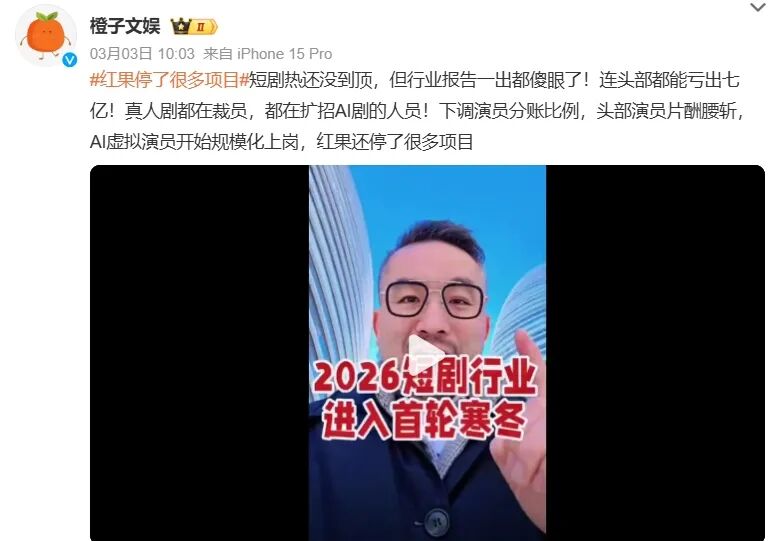
Recently, media reports indicate a mass suspension of live-action micro-short drama projects, with platforms revoking guaranteed profit-sharing commitments to producers and raising content review and production standards. Topics such as 'Hongguo eliminates profit-sharing' and 'Hongguo halts many projects' have sparked discussions, with anxiety over being 'replaced by AI' spreading from directors and screenwriters to actors in micro-short dramas.
A guaranteed minimum for short dramas is the lowest revenue a platform promises to producers—meaning they will receive this amount regardless of performance, providing a basic income. Hongguo short dramas have offered relatively generous guaranteed amounts, which has been a primary reason many producers have chosen to collaborate with them. As news of the elimination of guaranteed payments spread, many screenwriters also mentioned that Hongguo recently suspended script acquisitions, with some scripts submitted in early February still pending.
Source: Weibo Screenshot
During the Spring Festival, ByteDance launched the third-generation AI video generation model Seedance 2.0, which significantly lowered the barrier to video production. Has Hongguo short drama's drastic change been influenced by AI? How greatly will short drama practitioners be affected amid the AI wave?
01. Promoting 'High-Quality' Short Dramas
Regarding discussions about 'eliminating guaranteed payments,' Hongguo short dramas' official channels have not provided a clear response. 'Qujie Business' learned that Hongguo's current stance to producers is a 'complete elimination of guaranteed payments,' but it is uncertain whether this may vary by project; some industry insiders say that guaranteed profit-sharing will still be retained for certain top-tier high-quality projects.
As early as 2024, leading short drama producers expressed similar concerns: Hongguo short dramas attracted a large number of production companies with generous profit-sharing, but there would inevitably come a time when guaranteed payments would be reduced or eliminated, at which point the industry would be largely platform-dominated.
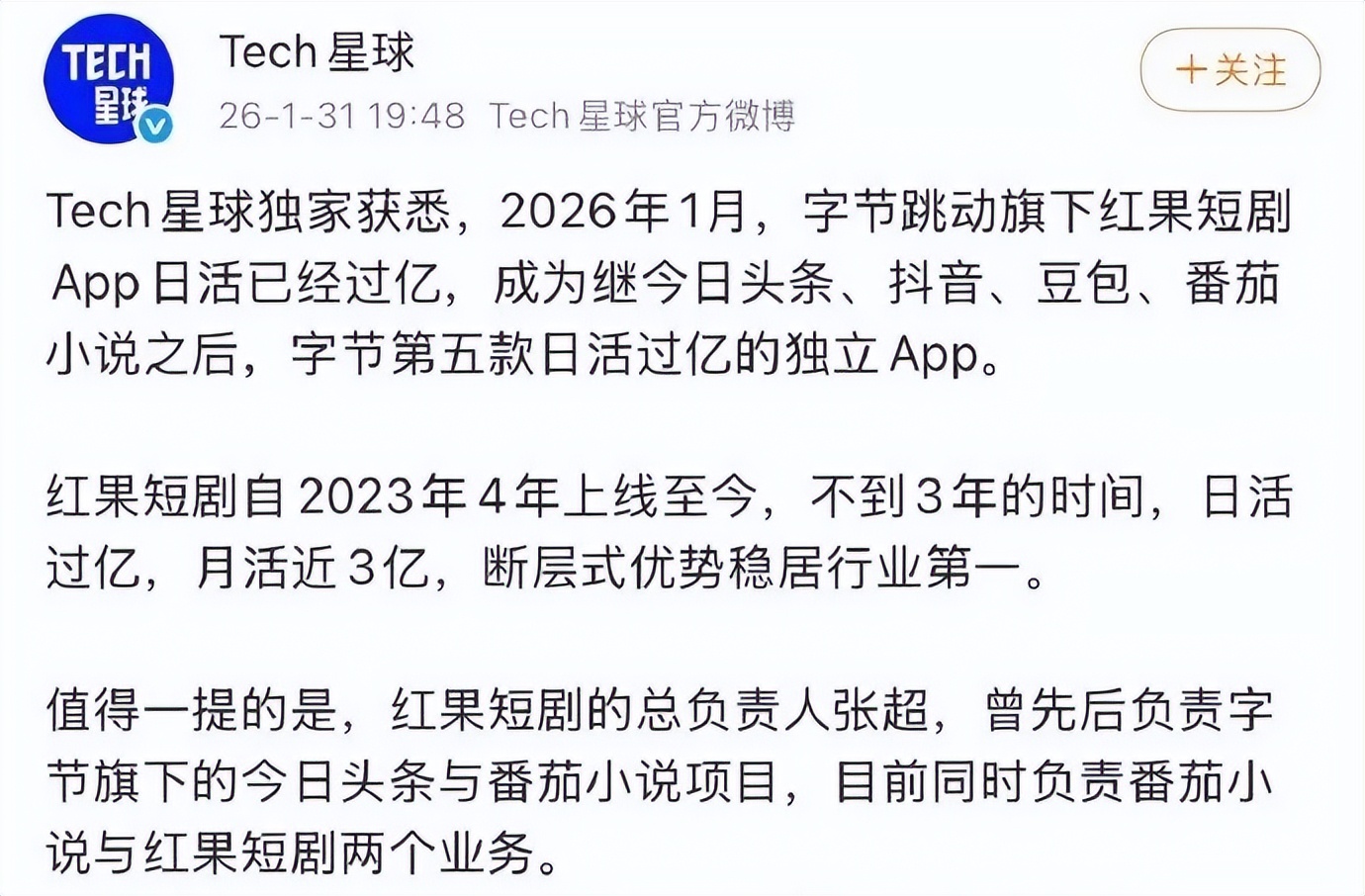
Since its launch in August 2023, Hongguo short dramas quickly reached 245 million monthly active users by the second half of 2025, surpassing Bilibili and Youku. In January 2026, media reported that Hongguo short dramas surpassed 100 million daily active users, becoming ByteDance's fifth independent app with over 100 million DAUs. After controlling over 90% of the industry's supply, any adjustment to Hongguo's profit-sharing incentive policies will trigger a chain reaction across the entire short drama industry.
Source: Weibo Screenshot
'Qujie Business' noted that Hongguo short dramas have been gradually reducing guaranteed collaborations since 2025. In September of last year, Wei Qintao, head of Hongguo's high-quality short dramas, stated that the platform would no longer provide guaranteed funding for completed licensed dramas, focusing instead on pure profit-sharing, while Hongguo's self-produced projects would remain unaffected for the time being. Some screenwriters mentioned that by the end of 2025, guaranteed payments for most producers working with Hongguo had also been eliminated, though screenwriter fees remained unchanged. Platform resources are gradually shifting from production costs to promotional support.
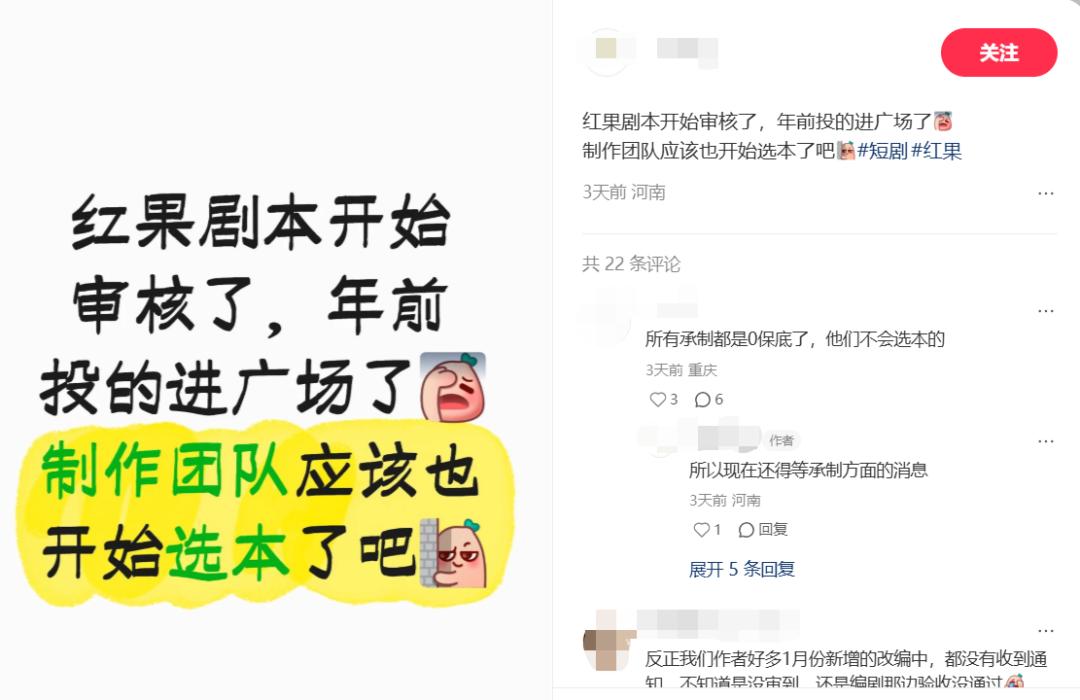
Alongside the elimination of guaranteed payments, some screenwriters reported that Hongguo's script review process has slowed significantly, with some scripts submitted before the Spring Festival still not entering the evaluation phase. Some short drama editors responsible for script acquisitions have also temporarily stopped accepting scripts for Hongguo. Some screenwriters said that since guaranteed payments for many producers were eliminated, these producers are no longer 'selecting scripts' from Hongguo's script marketplace, indirectly affecting screenwriters' script approval rates.
Source: Xiaohongshu Screenshot
Additionally, some industry insiders mentioned that Hongguo is cracking down on the practice of some producers using AI-generated scripts to defraud script fees. Some third-party companies are responsible for evaluating Hongguo's scripts, and some of these companies abuse their evaluation rights, allowing a large number of poorly written scripts to enter the market. Such chaos not only lowers the platform's content quality but also contradicts Hongguo's long-advocated high-quality content route.
From this perspective, whether it's slowing down script reviews, suspending script acquisitions, or completely eliminating guaranteed payments, the same signal is essentially being sent: Hongguo, as a leading short drama platform, is further eliminating the extensive, quantity-focused production model and driving the entire industry toward higher quality.
02. Are 'AI Short Dramas' Cost-Effective?
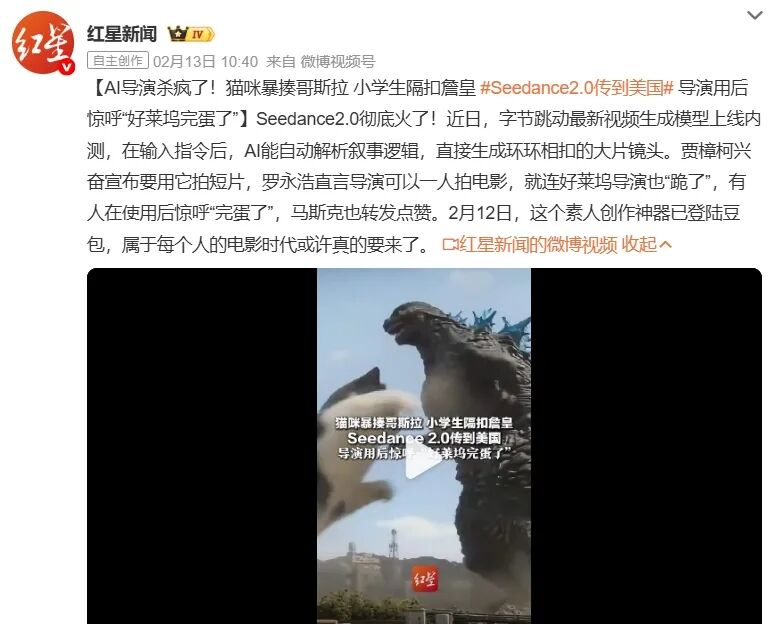
It's worth noting that the timing of Hongguo's major adjustments roughly coincides with the popularity of Seedance 2.0.
The precision of the visuals generated by Seedance 2.0 and its director-like storyboarding capabilities have raised concerns among many film and television professionals about being 'replaced.' In February, Hongguo short dramas announced new incentive policies for comic-based dramas, with AI-simulated human short dramas offering the highest profit-sharing coefficient at 60.
With technological advancements, platform support shifting, and the elimination of guaranteed payments for live-action dramas, many small and medium-sized production companies are turning to AI short drama production. Some production companies have even canceled their 2026 plans for live-action short dramas, fully shifting to AI projects, either producing or directly investing in AI short dramas. 'Qujie Business' learned that a listed gaming company's department for overseas short dramas recently established a dedicated AIGC content center and plans to use AI to explore long-form dramas in the fantasy and sci-fi genres.
Source: Weibo Screenshot
As technology continues to advance, will AI short dramas squeeze out or even replace live-action short dramas?
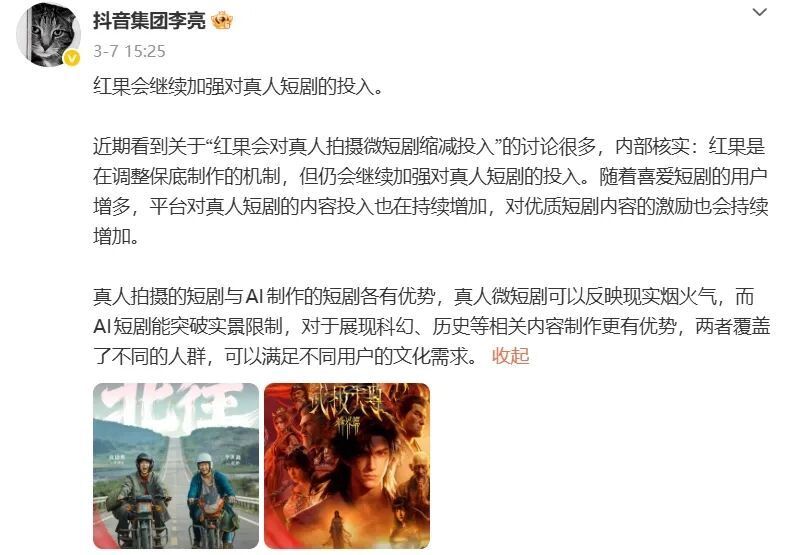
On March 7, Li Liang, Vice President of Douyin Group, responded to recent controversies on Weibo, stating that live-action and AI-produced short dramas each have their advantages and cater to different audiences. He clarified that while Hongguo is adjusting its guaranteed production mechanisms, it will continue to strengthen its investment in live-action short dramas and increase incentives for high-quality short drama content.
Source: Weibo Screenshot
This implies that for teams deeply rooted in live-action short dramas with strong innovation capabilities, Hongguo's adjustments may not necessarily deliver a significant impact. However, for mid-to-lower-tier teams reliant on guaranteed payments and lacking innovation, shifting to AI might be a good choice.
The advantage of AI short dramas lies in their significantly lower costs. The industry categorizes AI-simulated human short dramas under the broader 'comic-based dramas' genre, a new short drama category that emerged in 2025 and continues to expand, encompassing meme-based comics, dynamic comics, and 2D and 3D animated short dramas. The defining feature of comic-based dramas is their reliance on AI creation. Data from 'DateEye Research Institute' shows that the cost of high-quality comic-based dramas was 1,500-2,000 yuan per minute in early 2025, but by the second half of 2025, some high-quality comic-based dramas' costs had dropped to 800-1,000 yuan per minute.
However, the costs of simulated human dramas are generally higher within the comic-based drama category. Due to the early development stage, the AI tools, processes, and staffing vary significantly among companies. Some companies spend around 1,500 yuan per minute on simulated human dramas, while others spend over 3,000 yuan per minute.
Recently, short drama creator Yang Hanhan's 'Huo Qubing' short film went viral domestically and internationally, with some media praising it as a '3,000-yuan production with 500 million views.' However, Yang Hanhan quickly clarified that the 3,000 yuan only covered the computational costs for the four-minute short film, excluding labor costs.
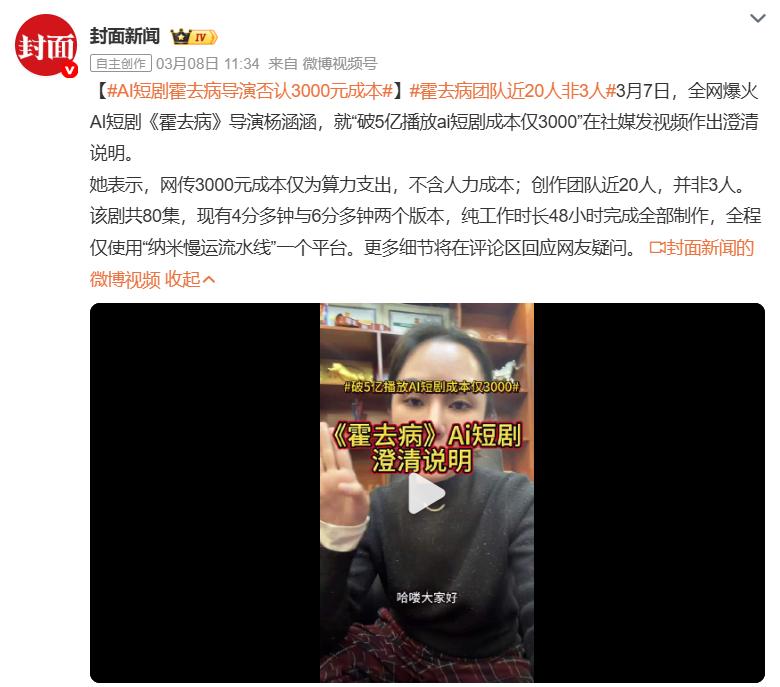
Source: Weibo Screenshot
This suggests that the production costs of some high-quality AI works are not as low as imagined. However, as companies optimize their internal workflows and upgrade creation tools, the costs of comic-based dramas, including simulated human dramas, are likely to decline further. In comparison, the production cost of a top-tier live-action high-quality short drama ranges from 1.5 to 3 million yuan, while high-quality comic-based dramas cost only about one-tenth of that. For small and medium-sized production teams with limited funds and unable to bear high investment risks, this is a more friendly and feasible option.
'Qujie Business' noted that some leading long-form drama companies are also using AI to replace non-leading actors in short drama projects. Zhou Weicheng, Chairman of Shengxi Huashi, a company that has produced multiple hit long-form dramas, stated in an interview that their short drama department had discussed whether live-action short dramas with a production cost of 400,000-500,000 yuan were still necessary.
Zhou Weicheng believes that at a production cost of 400,000-500,000 yuan, the art design, costumes, props, and scripts are relatively crude. Including promotional costs, these dramas need to generate 700,000-800,000 yuan in revenue to be profitable. If produced using AI, the visual effects and viewing experience would be significantly better, with costs reduced to around 50,000 yuan, requiring only 100,000 yuan in revenue to be profitable.
In addition to significantly lower production costs, some industry insiders mentioned that AI short dramas also offer greater efficiency in post-production modifications. Scenes that need to be reshot do not require extensive reshoots; they can simply be adjusted using AI image editing or new video generation.
03. When Will a Blockbuster Hit Emerge?
According to projections from multiple securities firms and research institutions, including DataEye, the market size of AI comic-based dramas is expected to reach 24-24.36 billion yuan in 2026. Among them, AI-simulated human short dramas are undoubtedly the fastest-growing subcategory. According to DataEye and Ju Chacha's research data, the market size of AI live-action short dramas surpassed 12 billion yuan in 2025, representing a year-on-year increase of over 300%. With Hongguo ramping up incentive policies and a large number of new teams entering the market, this growth rate is likely to continue increasing this year.
Amid the industry's rapid expansion, a group of production brands focused on AI short dramas have already emerged, such as Xuebao Studio, which produced hits like 'Wan Xin Ji' and 'Beast World Marriage Swap: My Demon Husband is Hard to Handle,' and Jiuziyuan AI, behind 'Xing'anling Mysteries.'
In addition to producers shifting their focus, content platforms like Tencent, Baidu, iQiyi, and Bilibili have also set their sights on this content format, launching comic-based drama channels, independent apps, or AI creation tools. Currently, Tencent's Huolong Comic Dramas, Baidu's Qimao Comic Dramas, and Youman Dramas have all released a large number of AI short drama works.
However, despite AI becoming a trend in short dramas, AI-simulated human short dramas currently face significant controversy.
Since the promotion of comic-based dramas, Hongguo has seen several highly popular works, such as 'Zhanxiantai AI Live-Action Version' and 'End of the World Cold Wave: With a Mobile Fortress, I Fear No One,' both labeled as 'blockbuster hits.' However, AI-simulated human dramas still lack a phenomenal blockbuster that achieves widespread acclaim in terms of plot, reputation, and popularity.
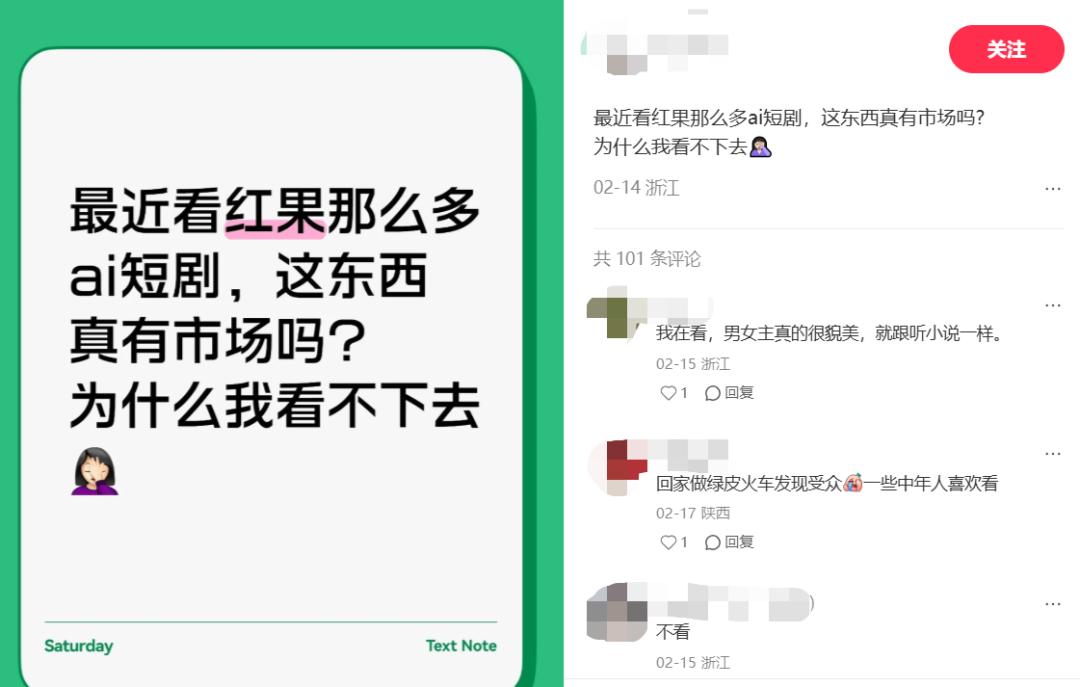
On one hand, many viewers experience the 'uncanny valley' effect with AI-simulated humans. When AI characters' faces closely resemble humans but have hollow eyes, mechanical limb movements, and disjointed emotional transitions, this 'almost human but not quite' dissonance can trigger instinctive aversion and physical discomfort in viewers, directly blocking their emotional engagement with the plot.
This feeling is most common among young viewers. In contrast, some middle-aged and elderly viewers are much more accepting of AI content.
Source: Xiaohongshu Screenshot
Additionally, current AI-simulated human short dramas are still relatively rough in terms of complex emotional expressions and physical interactions, with many details requiring manual correction. AI-generated content is highly random, making it difficult to achieve the desired result with a single input. Instead, it requires an iterative process of 'generation-evaluation-fine-tuning-regeneration,' known in the industry as 'card-drawing' due to the significant human and financial resources it consumes.
The emergence of Seedance 2.0 has alleviated the need for repeated debugging to achieve satisfactory results. As tools iterate and generation stability improves, the production pace of comic-based dramas will further accelerate, reducing both time and labor costs for content creation.
While AI-simulated human dramas cannot yet replace high-quality live-action short dramas, the gap between the two is narrowing as technology advances and production costs plummet. One day, they may compete on equal footing in the same arena, even reshaping the entire short drama industry's competitive landscape. The direction of this shift will likely depend on the pace of AI's evolution.
-
![]()
Doubao Work Unveiled! Domestic AI Leaders Fully Commit to the 'Work' Sector
-
![]()
Who’s Sounding the Alarm on ‘Rushed Vehicles’?
-
![]()
Over 5.3 Billion Yuan in Losses Over Three and a Half Years! Can Yonyou Reverse Its Fortunes Through Streamlining and AI Transformation?
-
![]()
Baidu AI Adopts Free Model: A Strategic Maneuver in Traffic and Monetization
-
![]()
Silicon-Based OLED Pioneer Unveils Financial Results: H1 Shipments Outpace Entire 2025 Volume
-
![]()
AI's First "Lost Summer"
-
![]()
Zeiss Makes Another €2.2 Million Bet: Will Eye Tracking Be the Next Big Thing in the Smart Glasses Industry?
-
![]()
RUNTO Ranking | Global Top TV ODM Factories' Shipment Figures for July 2026