Three Must-Have AI Tools That Have Trapped Many Young People | Focus on '315'
 03/16 2026
 630
630
Author | kiki
After spending 399 yuan to have OpenClaw installed on a second-hand platform, Lin Ran felt she couldn't afford to keep this 'little lobster' for even a week.
The reason was simple: the delivery performance of this 'shrimp' couldn't keep up with the costs it consumed. To try automating her HR work, Lin Ran first paid for over a dozen Skills tutorials from bloggers. Later, to avoid restrictions on her API speed, she bought Coding plans priced at 19.9 and 9.9 yuan from various major companies. Before she even started 'raising the shrimp,' she had already spent nearly a thousand yuan.
Soon, Lin Ran, a computer novice, found that this 'shrimp' was not easy to raise. It not only devoured Tokens crazy but also frequently reported errors during task execution. She had to seek remote assistance again, only to receive a notice from her company a few days later: 'Employees are prohibited from raising lobsters at work.' Lin Ran, who thought she had found a workplace artifact , was thus given a lesson by AI.
Lin Ran is not the only one who has fallen into the pit of AI consumption. As AI enters the stage of large-scale application, young people eager to try new things have become the main force in AI consumption.
Survey data from Beike Finance and Economics shows that among users who frequently use AI tools, the 18-25 age group dominates. AI hardware such as AI toys and AI rings, which are popular on e-commerce platforms, has also attracted significant attention from Generation Z. Some young people even hope to use AI to switch careers, with various crash courses in AI comics, AI short dramas, and more becoming their new tickets to grasp the AI era.
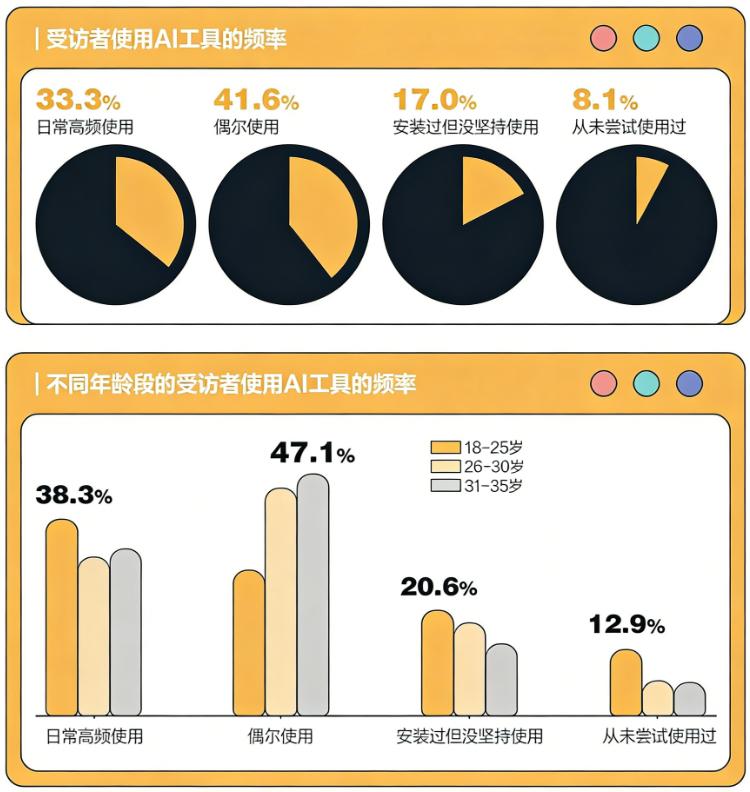 Image Source: Beike Finance and Economics
However, new chaos has emerged amid the hype. Workplace tools disguised as AI have become troublemakers, while AI hardware such as AI desk pets, AI toys, and AI litter boxes are more hype than function...
Young people's AI consumption lists are filled not only with the sweetness of interacting with AI but also with the bitterness of various 'IQ taxes.'
1. Three Must-Have AI Tools Targeting Contemporary Young People
The AI consumption pits for contemporary young people revolve around three types of AI tools: AI applications that understand work, AI toys that provide companionship, and AI training courses that make grand promises.
From writing and PPTs to coding, various general-purpose AI assistants or AI office applications have rapidly infiltrated the daily work of young people. According to survey data from Jiazi Think Tank, the core usage scenarios for AI product target users are 'searching, writing, using, and learning,' with about half of the target users in each of these four scenarios hoping to change their work efficiency through AI applications.
However, for workers, to make AI a true work companion, they must first overcome two hurdles: payment tricks and instability.
AI office products generally adopt a subscription model, offering different value-added services based on the functions users need. This is a mature SaaS product business model, but according to AI product manager Dou Dou, many AI products 'get creative' with paid memberships.
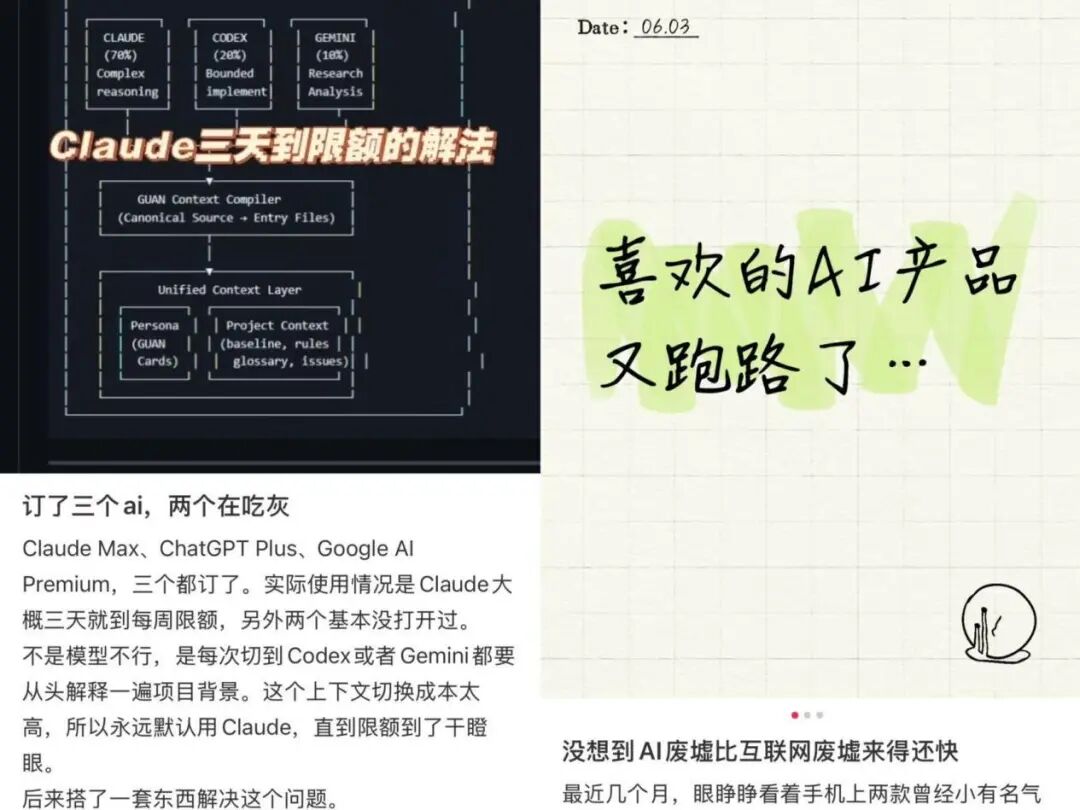 Image Source: Screenshot from Xiaohongshu users @Yibei and @AI Application Spark
For example, they may secretly downgrade the model, using a cheaper, lower-spec model at the same price, which is difficult for average users to detect. Some may also cripple functions, promising continued iteration of a certain feature for members during payment but quietly removing it afterward.
'AI office applications are efficiency tools. Some products can attract many users to try and pay as long as a certain function precisely hits the pain points of workers and is accompanied by a wave of PR,' Dou Dou said.
Besides payment tricks, the 'reliability' claimed by AI office vendors also deserves a question mark.
Li Rong, a programmer at a medical company, generates 80% of her code using AI. However, an AI mishap once made her doubt the reliability of AI applications.
One afternoon before a meeting, she gave her AI assistant the command to 'optimize the code of the current component.' The file contained some unused functions, redundant logic, and explanatory comments for the actual business. However, during execution, the AI assistant directly deleted the most important business explanatory comments without optimizing the code logic, leaving her unable to report on the project during the meeting.
Besides seeking efficiency from AI, workers also need emotional value from AI, which has spurred the growth of a large number of AI toys and AI pet-raising tools. According to JD.com data, in the first half of 2025, AI toy sales on JD.com increased sixfold month-on-month, with a year-on-year growth rate exceeding 200%. The annual market size of AI toys in China is expected to exceed 1 billion yuan, and it is projected to surpass 10 billion yuan by 2030.
However, many young people attracted by the cute appearance, plush texture, and emotional connection of AI toys are now leaving the trend, for a simple reason: the products do not match the descriptions.
'SoC disconnections, lack of memory function, and insufficient dialogue fluency.' A consumer who participated in the internal testing of multiple AI toy products told Caijing Wuji. These basic functions affect the user experience of AI toys, which is why AI companion toys were once known as 'high-return-rate products.'
If many AI applications and AI toys are new tricks, then AI training is a classic project that harvests young people. According to data from the Sichuan Provincial Consumer Council, in 2025, consumer councils at all levels in Sichuan received 3,739 complaints related to 'AI + training,' accounting for 5.46% of service complaints, up 2.21 percentage points year-on-year.
From various large model courses to today's popular AI comics and AI short dramas, a wide variety of AI training courses continue to weave the illusion for ordinary people that 'using AI can earn over 10,000 yuan a month.'
Searching for 'AI training' on the Heimao Complaints platform, Caijing Wuji found that among nearly 200 complaints, consumers' roast about AI training focused on 'the significant gap between promotion and actual results,' 'substandard course content,' and 'difficulty in obtaining refunds.' 'Paid 4,778 yuan for an AI short drama promotion course. Was promised to earn money every month upon enrollment, but now applying for a refund due to no earnings,' one consumer wrote.
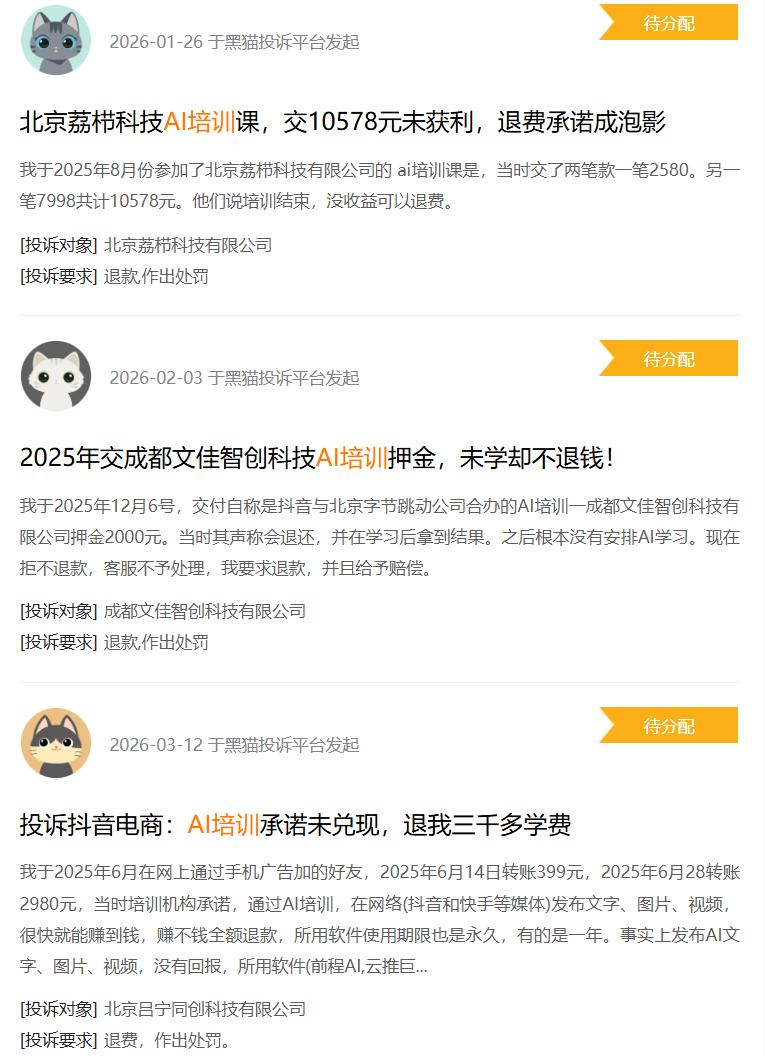 Image Source: Heimao Complaints Network
Meng Meng, an AI comic producer, used AI comics as an example to tell Caijing Wuji that currently, many 'AI factories' on the market, to increase production capacity, generally pay base salaries of 3,000-4,000 yuan to underlying image generators and card drawers, who can get up to speed after just a week of company training. It is almost impossible for a novice to earn over 10,000 yuan a month relying on AI comics at this stage.
2. A Conspiracy of Anxiety and Quick Money
The first group of people to embrace AI have instead become the group most pit by AI.
The reason why the 'Three Must-Have AI Tools' can harvest contemporary young people points to AI consumption itself—behind the hype, anxiety and quick money are also flooding in.
First, from AI training courses costing thousands of yuan to AI tools full of payment tricks and AI hardware with limited functions, they essentially prey on the fear of missing out (FOMO) among contemporary young people.
When social media is flooded with success stories of 'earning over 10,000 yuan a month with AI' and 'easy monetization of AI side hustles,' and when friends around them start talking about how AI tools improve efficiency, young people can easily feel anxious that 'I will be replaced if I don't keep up.' This irrational chasing mentality leads to blind following, ultimately ignoring the judgment of the actual functions and technological capabilities of the applications.
According to Soul App's '2025 Z Generation AI Usage Report,' among the 3,680 young people surveyed, about 40% experience 'AI anxiety.'
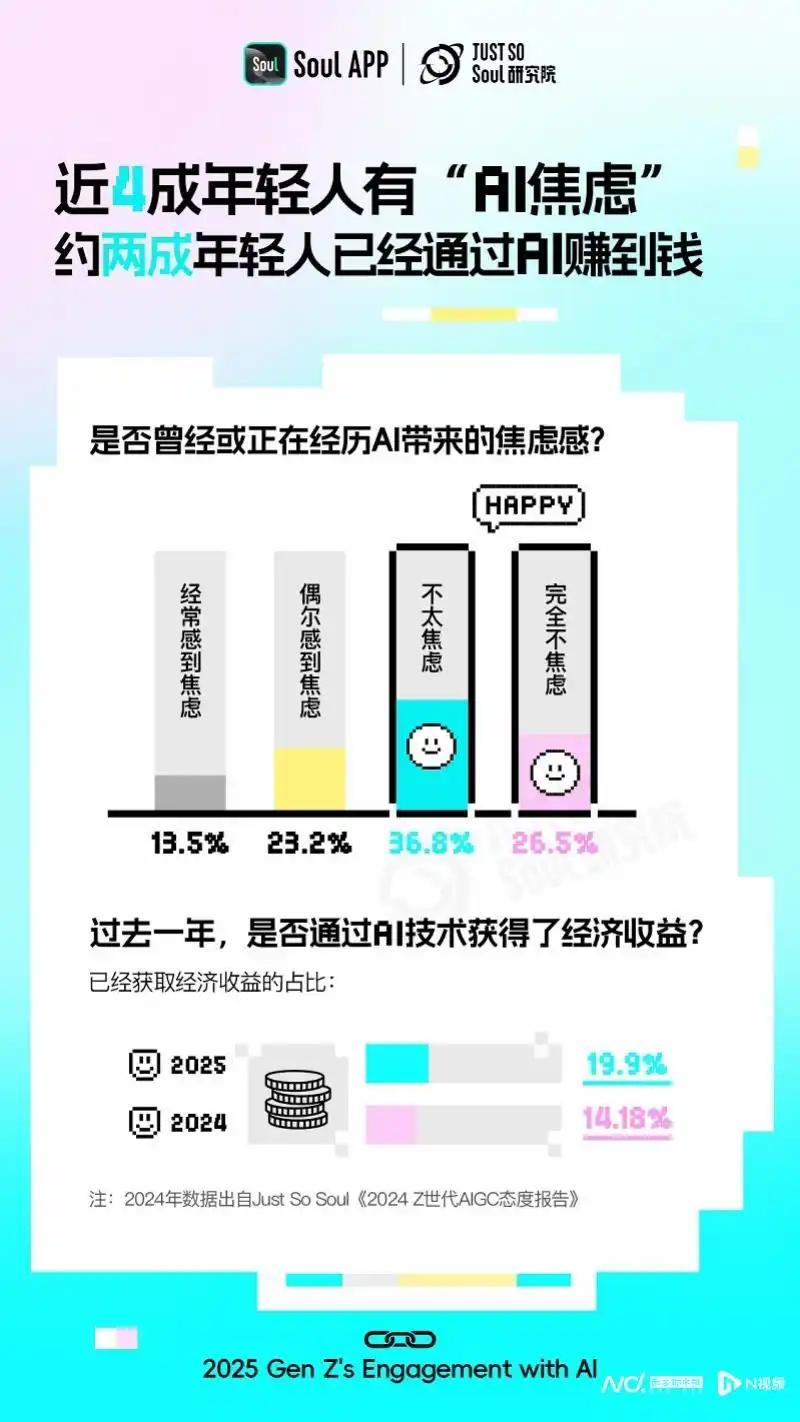
Second, besides selling anxiety, the influx of a large amount of quick money in the AI consumption field has also spurred intense competition and internal roll, leading many startups to choose rapid commercialization over patiently refining their products.
Taking the AI toy sector as an example, according to incomplete statistics by Caijing Wuji, since 2025, there have been 17 investment and financing events, including 3 billion-yuan-level and 7 hundred-million-yuan-level deals, giving rise to star startups such as Luobo Intelligence Robopoet, Lingyuzhou, Haivivi, and Mengyou Intelligence, also driving the industry into a rapid development phase.
Many cross-industry listed companies, software and hardware solution providers, and major firms are also betting on the AI toy sector. The influx of hot money has brought a more fierce competitive environment.
A cute shell/IP + a movement box + an AI interface can create an AI companion toy demo in less than a month. 'The product you launch today can be manufactured in Huaqiangbei tomorrow.' Previously, an AI toy practitioner told Caijing Wuji that homogeneous products, half-baked functions, and hastily launched experiences fall far short of consumer expectations, leading to returns.
 Image Source: Doubao AI Generation
Besides, the rapid development of AI technology and the lag in regulation and rules have created a 'governance vacuum' that leaves many chaos opportunities.
Currently, there is a lack of targeted and precise policy guidance and management regarding the measurement standards for AI application effectiveness and pricing, the compliance management of large model corpora, and the quality control of AI training courses at the source. There are governance gaps between innovative development and safety bottom lines, making it difficult for consumers to defend their rights and providing evidence, while also keeping Merchant violates regulations costs low.
Zheng Shanjie, Director of the National Development and Reform Commission, also mentioned at this year's National People's Congress: 'By the end of the '15th Five-Year Plan,' the scale of AI-related industries will grow to over 10 trillion yuan. Facing the imminent 10-trillion-yuan market, issues such as wild growth and frequent chaos have emerged in the early stages of development. In recent years, phenomena such as AI face-swapping fraud, voice imitation fraud, digital human live-streaming consumption fraud, and large-scale data scraping for commercial infringement have increased. The existing legal system faces applicability challenges in dealing with complex scenarios.'
3. A Practical Pitfall Avoidance Guide for Ordinary People
In the face of the uncertain AI era, people tend to overestimate short-term changes while underestimating the evolution of the next decade. Amid the surging AI wave, governance vacuums, diverse merchant tricks, and anxiety are inevitable. So, how can we avoid such AI consumption pits?
After consulting multiple sources, Caijing Wuji has summarized a practical pitfall avoidance guide for AI tools:
First, be wary of any AI tool claiming to be 'all-knowing and all-powerful.'
If you want to try something new, search for authentic evaluations on reliable social media and video websites. If you want to try it yourself, first understand the vendor's payment plans and prioritize checking whether there is an auto-renewal option.
Second, before purchasing high-priced AI hardware, it is advisable to visit Huaqiangbei to dispel illusions and understand the basic costs and pricing of AI hardware. If you see a certain type of product already being mass-launched in Huaqiangbei, you need to stop and think: Where is its technological difference?
Third, when encountering AI training courses, focus on two points: First, don't rush in blindly for low-priced offers, as this is likely a merchant tactic to guide you into unlocking higher-priced packages. Second, find the name of the company operating the AI training and check websites like Heimao Complaints and Qichacha for any negative reviews. Lessons from previous users are always genuine.
Fourth, be sure to join the internal testing or user groups of newly emerging AI products. Companies that take product development seriously are usually open to feedback. In internal testing or user groups, you can see the most authentic evaluations and the company's progress in addressing feedback. Of course, this is also one of the fastest ways to understand whether a company's product is 'abandoning ship.'
Finally, and most importantly, before paying the bill, ask yourself: Without AI, how much would this product be worth?
Paying for real value is smart consumption. After all, for ordinary people, chasing the cutting-edge of AI and holding onto their wallets—the latter may be more important.
(At the request of the interviewees, Dou Dou and Meng Meng are pseudonyms)
-
![]()
Doubao Work Unveiled! Domestic AI Leaders Fully Commit to the 'Work' Sector
-
![]()
Who’s Sounding the Alarm on ‘Rushed Vehicles’?
-
![]()
Over 5.3 Billion Yuan in Losses Over Three and a Half Years! Can Yonyou Reverse Its Fortunes Through Streamlining and AI Transformation?
-
![]()
Baidu AI Adopts Free Model: A Strategic Maneuver in Traffic and Monetization
-
![]()
Silicon-Based OLED Pioneer Unveils Financial Results: H1 Shipments Outpace Entire 2025 Volume
-
![]()
AI's First "Lost Summer"
-
![]()
Zeiss Makes Another €2.2 Million Bet: Will Eye Tracking Be the Next Big Thing in the Smart Glasses Industry?
-
![]()
RUNTO Ranking | Global Top TV ODM Factories' Shipment Figures for July 2026