Wu Yongming Dismantles the Old Load-Bearing Wall of Alibaba's AI Amid the Aftershocks of Lin Junyang's Departure
 04/10 2026
 510
510
Power Centralized, Responsibility Delegated.
Content/Huanlao
Editor/Yonge
Proofreader/Mangfu
On April 8, Alibaba CEO Wu Yongming issued his second company-wide letter within three weeks. If the establishment of the ATH Business Group on March 16 was a land grab, consolidating scattered AI assets into a single basket using Token logic, then this letter was about dividing the fields and assigning names to each key link.
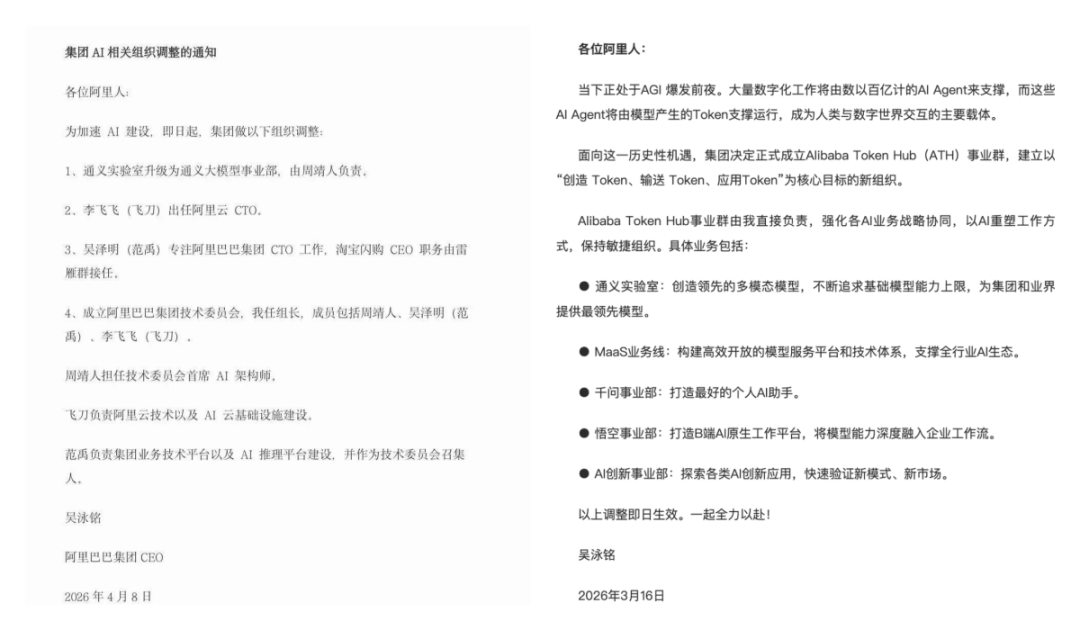
Zhou Jingren will lead the Tongyi Large Model Business Unit, focusing on Qwen; Li Feifei will serve as Alibaba Cloud's CTO, overseeing AI cloud infrastructure; Wu Zeming will step down from Taobao Flash Sale to focus on his role as Group CTO while adding responsibility for the AI inference platform. All three will report to Wu Yongming. A Technical Committee has also been established, with Wu Yongming as its leader and the three as members.
Within a month, Alibaba first established its strategic language and then assembled its execution lineup. Only after these two steps was true alignment across the organization achieved. Alibaba's era of AI unification has officially begun.
Part.1
Token
Alibaba's 'New World Language' for Unification
Most tech companies discuss Tokens in terms of the basic computational units of large models—how many are consumed per call and how much each million Tokens cost. However, Alibaba has incorporated Tokens into the name of its business group, the titles of company-wide letters, and the logic of every organizational layer. This is no longer a technical issue but an economic one.
Over the past two years, Alibaba has paid its dues in AI and left behind difficult problems. On the technical side, Qwen's open-source influence and model capabilities are widely recognized; however, on the commercial side, consumer-facing applications have yet to achieve absolute dominance amid fierce market competition, and the growth of Model-as-a-Service (MaaS) has not fully matched the leap in model capabilities.
The root cause lies in the lack of unified 'measurement standards' across Alibaba's internal business lines.
The model team focuses on parameter count and Benchmark rankings, the MaaS team on API call growth, the consumer product team on DAU and retention, and internal businesses on GMV. There are no conversion formulas between these languages, making the path for transforming AI capabilities into commercial value extremely resistant within Alibaba, even evolving into a situation where each business builds its own AI wheels, leading to internal friction.
Wu Yongming's solution is Tokens, elevating them from a technical unit of large models to a universal value metric within and outside Alibaba's ecosystem.
The establishment of ATH (Alibaba Token Hub) three weeks ago officially Established (changed to: set) Alibaba's 'New World Language' for the future. As the highest-ranking leader (changed from: with the highest No. 1 position), Wu Yongming mandated organizational alignment across the entire group at the foundational level. Any future AI narrative not centered on Tokens is considered nonsense.
Whether it's model inference, API calls, agent execution, or the future use of merchant tools on the e-commerce side, all can be converted into Token consumption. This serves as both a unit of measurement and pricing, as well as a commonly recognized value anchor for cross-business collaboration.
In the past, collaboration between businesses relied on budgets, resource swaps, and high-level coordination, resulting in low efficiency and high friction. In the future, businesses can settle accounts directly using Tokens: Business A calls the model and consumes Tokens, while Business B pays for it. Every cross-departmental use of AI capabilities will have a clear Token bill, no longer relying on vague brotherhood or high-level coordination.
To put it less fashionably, Alibaba is establishing an internal monetary system for its AI ecosystem, with ATH serving as the central bank of this system, quantifying the usage costs of AI capabilities and enabling transparent, automated settlement across different business units.
This is not a product strategy but an infrastructure strategy. The success of infrastructure does not depend on how high a model scores but on the stability, efficiency, and irreplaceability of the entire chain.
Does this strategic judgment carry risks? Of course. But its direction is correct. In the era of AI Agents, true competitiveness lies not in single-point model capabilities but in the ability to build a complete closed loop from model production to application consumption. Tokens, as a unified metric run through (changed to: running) through this loop, possess architectural rationality (changed to: rationality to: rationality).
Part.2
Unbundling and Repositioning
Letting 'Tech Geniuses' Focus on Pure Innovation
To understand the deeper implications of this adjustment, one must first recognize the previous structural vulnerabilities.
Before this adjustment, the burden of technical execution almost entirely rested on Zhou Jingren's shoulders. He served as both Alibaba Cloud's CTO, overseeing the cloud's foundation, and led Tongyi Labs to advance large model R&D.
This superhero-style bundling, while effective in concentrating resources during the pioneering phase, only led to mutual interference between objectives once AI entered the deep waters. Open-source models strive for performance limits, while cloud businesses aim to maintain profit margins, creating inherent conflicts in resource allocation.
Therefore, the first layer of surgery on April 8 was unbundling.
Zhou Jingren stepped down as Alibaba Cloud's CTO to focus solely on the upgraded Tongyi Large Model Business Unit and serve as the Chief AI Architect of the Technical Committee.
Note that the elevation from 'Tongyi Labs' to 'Tongyi Large Model Business Unit' is itself a signal. The KPI for a lab is to publish papers, climb rankings, and pursue technical leadership; the KPI for a business unit is to deliver products, achieve commercialization, and retain developers. The same team, but different evaluation logics, corresponds to entirely different behaviors.
Zhou Jingren's step-down from Alibaba Cloud's CTO position to focus solely on Qwen indicates that Wu Yongming believes the model itself has not yet reached its peak and requires someone's full attention. The departure of Qwen's core leader, Lin Junyang, three weeks ago only makes this role more critical.
Zhou Jingren's current task may not just be to maintain leadership but to create a decisive gap, making Qwen the default choice for developers when selecting a domestic foundational model.
Li Feifei taking over as Alibaba Cloud's CTO is the most nuanced move in this adjustment. Many expected the successor to Zhou Jingren to be a technical leader with a deep model background, but Li Feifei's resume tells a different story. This former professor from the University of Utah is an engineering-oriented figure with a background in databases, having no direct connection to large model R&D.
But this is precisely what Wu Yongming wants. Alibaba Cloud's CTO does not need to be the most model-savvy person—that's Zhou Jingren's role. What Wu Yongming needs is someone who can truly stabilize AI cloud infrastructure. Distributed database systems like PolarDB and AnalyticDB, which have withstood the extreme pressures of Taobao's Double 11, all bear Li Feifei's engineering DNA.
The requirements AI inference workloads impose on infrastructure are entirely different from those of traditional databases, demanding high throughput, extremely low latency, and elastic scalability. Li Feifei's task is to deliver this capability stably as a cloud service, ensuring that Token consumption remains uninterrupted at any scale.
Wu Zeming represents the most practical move in this entire strategy. As Alibaba's first Group CTO from the post-80s generation and a 22-year veteran who rose from Taobao's technical frontlines to the group's highest technical position, he stepped down as CEO of Taobao Flash Sale in this adjustment, handing over the role to Lei Yanqun, a veteran from Alibaba's 'Iron Army' of China Suppliers. Wu Zeming now fully returns to his role as Group CTO while taking on additional responsibility for a tough challenge: the AI inference platform.
This is the underlying infrastructure supporting the entire Token flow from model input to output, determining the efficiency and cost of Token generation. Training a model is a one-time capital investment, while inference represents the ongoing cost behind every Token revenue. Without effective inference, even the strongest model and most stable cloud become unusable.
As the convener of the Technical Committee, Wu Zeming must coordinate AI capability demands across all group businesses—Taobao & Tmall, Local Services, International E-Commerce, Cainiao, and more. Every business wants to use AI, but each has unique workload characteristics, latency requirements, and cost sensitivities. The value of the inference platform lies in enabling unified scheduling, elastic supply, and Token-based billing for these diverse needs.
These three individuals precisely correspond to the three most critical links in the AI industry chain: model R&D, cloud infrastructure, and inference execution—one creates the bullets, one builds the gun, and one pulls the trigger. All are indispensable.
Part.3
From Racing to Centralization
Concentrating Forces for Major Tasks
The prosperity of China's internet over the past two decades has largely been built on a racing mechanism—resources go to whoever emerges victorious. However, in the deep waters of AI large models, which require tens of billions of dollars in computational investment, racing is becoming an extreme luxury and waste.
This is the third layer of meaning behind Wu Yongming's major adjustment: centralization for more efficient breakthroughs.
On the same day, April 8, adjustments were also reported within Taobao & Tmall Group. The AI business focus shifted from consumer-facing (To C) to business-facing (To B), with core OKRs becoming merchant-side AI tool retention rates and GMV contributions. The 'Future Innovation Business Unit' was directly merged into ATH. A source close to Taobao & Tmall put it bluntly: 'ATH will now lead the group's AI strategy this year; other businesses don't need to reinvent the wheel.'
Behind this statement lies a long-standing reality: every Alibaba business has been developing its own AI. Taobao & Tmall, Local Services, Cainiao, DingTalk—each had its own AI team. Resources were fragmented, standards inconsistent, and wheels were being reinvented—a classic ailment of large-company innovation.
Wu Yongming directly centralized power, making ATH the group's sole outlet for AI. Any business wanting to use AI must do so through ATH's Token system. This means that when Taobao & Tmall wants to leverage Qwen's capabilities in the future, it will need to consume Tokens, with ATH managing the billing, scheduling, and optimization of these Tokens uniformly.
As group CEO directly overseeing ATH, this represents a rare instance of Alibaba's top leadership inserting itself so deeply. AI-era computational clusters, data flywheels, and engineering capabilities all require centralized allocation at the highest density across the entire group. This kind of top-down design rationalization is precisely the necessary action before a large company can truly concentrate its forces for major tasks.
The outside world has already witnessed the astonishing combat effectiveness unleashed by this organizational rationalization. Within less than half a month of ATH's establishment, Alibaba released large models almost daily.
Qwen3.5-Omni on March 30, image generation Wan2.7-Image on April 1, and Qwen3.6-Plus targeting code agents on April 2 (which set a single-day call record of 1.4 trillion Tokens). Even stronger models like Qwen-3.6-Max are on the way after Qingming Festival.
Taobao & Tmall's ongoing 'Qianniu Claw' plan is another typical (changed to: typical to: typical) example. Qianniu, the merchant backend, is being upgraded into an AI Agent platform where merchants can access various AI capabilities—automatic product listing, intelligent customer service, marketing copy generation—each consumption depleting Tokens. Taobao & Tmall will no longer earn commissions solely based on GMV but can also generate revenue from Token consumption.
This represents a entirely new revenue stream for Alibaba with extremely low marginal costs. The generation cost of Tokens is rapidly declining as model efficiency improves, but the price sold to merchants can remain stable.
Wu Yongming previously stated in an earnings call that AI and cloud revenue should reach $100 billion annually within the next five years. Achieving this figure would be difficult relying solely on selling computational power and model APIs. However, if all AI calls generated by e-commerce, local services, logistics, and other businesses are incorporated into the Token billing system, the $100 billion target gains tangible support.
From strategic alignment to middleware interoperability and finally to a genuine shift in mindset across each business unit, every step tests execution capabilities and Wu Yongming's determination as the top leader. Architectural clarity is just a good start; the real test begins now.
Fortunately, Alibaba has identified the anchor point to pierce through the fog: power centralized, responsibility delegated, people in their rightful positions, and a clear, executable strategy. From now on, everything listens to the Tokens.
END
-
![]()
Wang Huiwen, Former Meituan Executive, Achieves 20-Fold ROI, Supports 24 AI Startups
-
![]()
Another AI Computing Power Unicorn Launches IPO! Founded by a Changjiang Scholar
-
![]()
OFILM Holdings Secures Zhongke Daojing, Marking a Significant Leap in the Optical Communication Industry!
-
What Will Be the Next Key Battleground for Large Models After AI Coding?
-
![]()
Leapmotor's Sales Soar, Yet Hidden Concerns Loom
-
![]()
China’s Action Camera Market Soars: 3.12 Million Units Sold in Six Months, DJI Secures 74% Dominance
-
![]()
Zhang Yiming: Strategic Retreat as a Path Forward
-
![]()
Exploring Charging for Some Features of QianWen App: Can It Follow the Path of Doubao?