Who Dominates Intelligent Driving: Huawei's Qiankun or Momenta?
 04/10 2026
 484
484
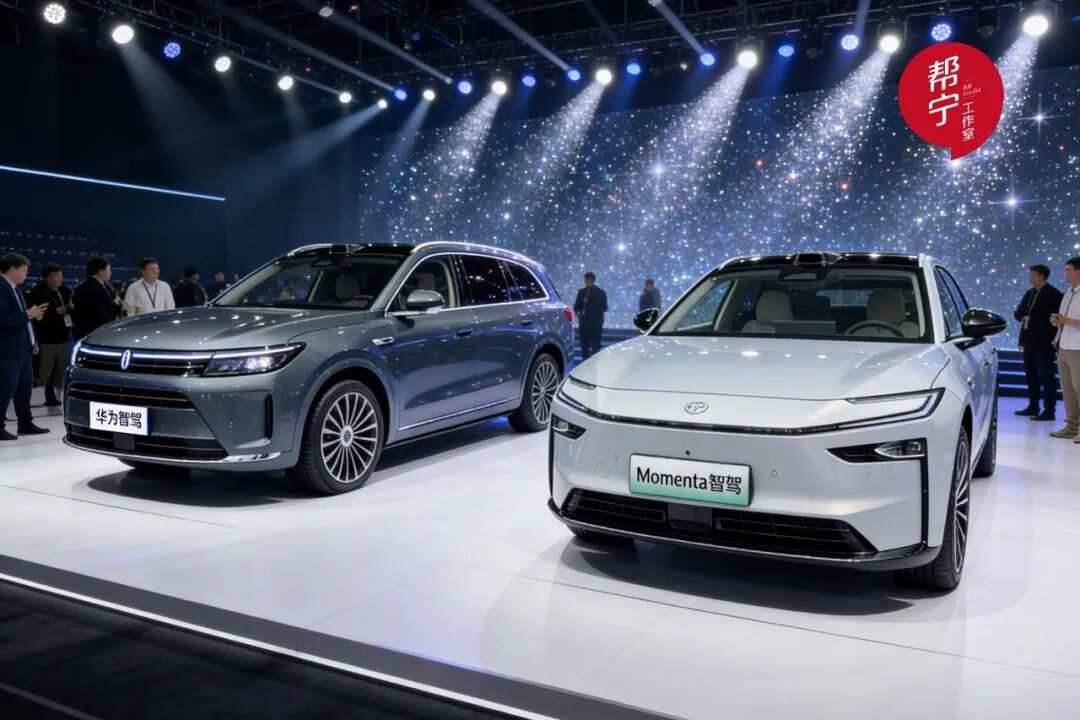
"Nearly 80 new cars launched in March, 17 with Huawei Qiankun, 12 with Momenta"
Author: Gong Chenyan | Editor: Li Guozheng | Produced by: Bangning Studio (gbngzs)
When March is mentioned, many in the automotive industry first think of nearly 80 product launches and various claims of "redefining" the market. However, behind the noise, what truly defines the current automotive landscape are not the numerous new models but the mere two intelligent driving systems.
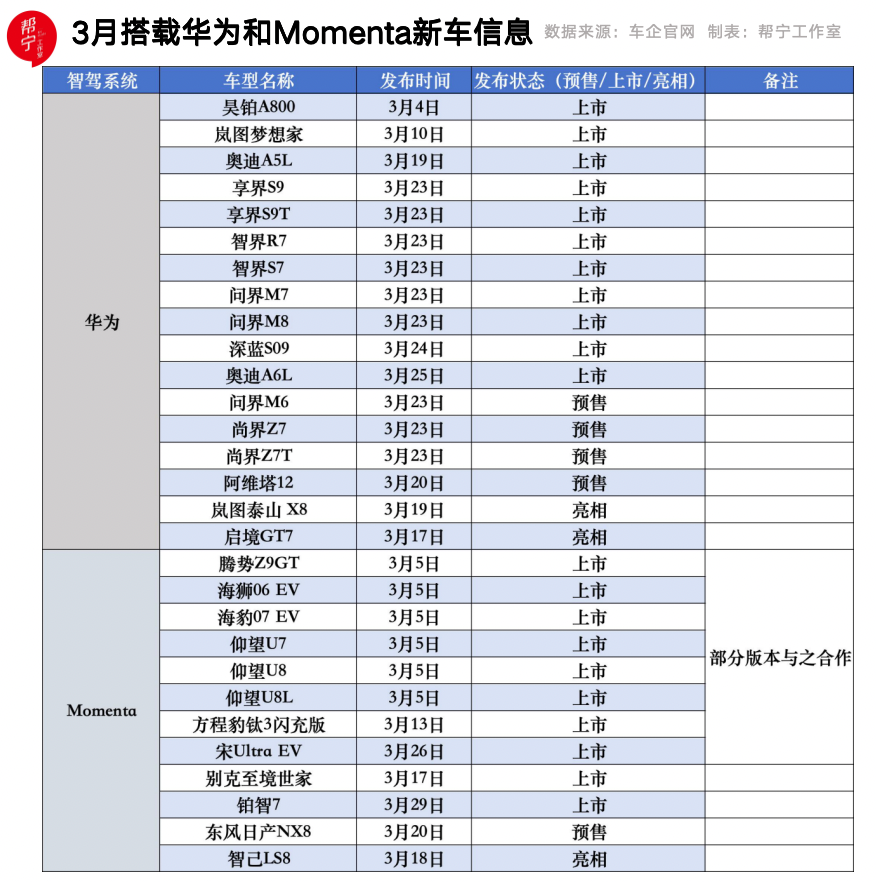
According to incomplete statistics from Bangning Studio, 61 new car models were launched in March this year, with nearly 20 making their debut or starting presales.
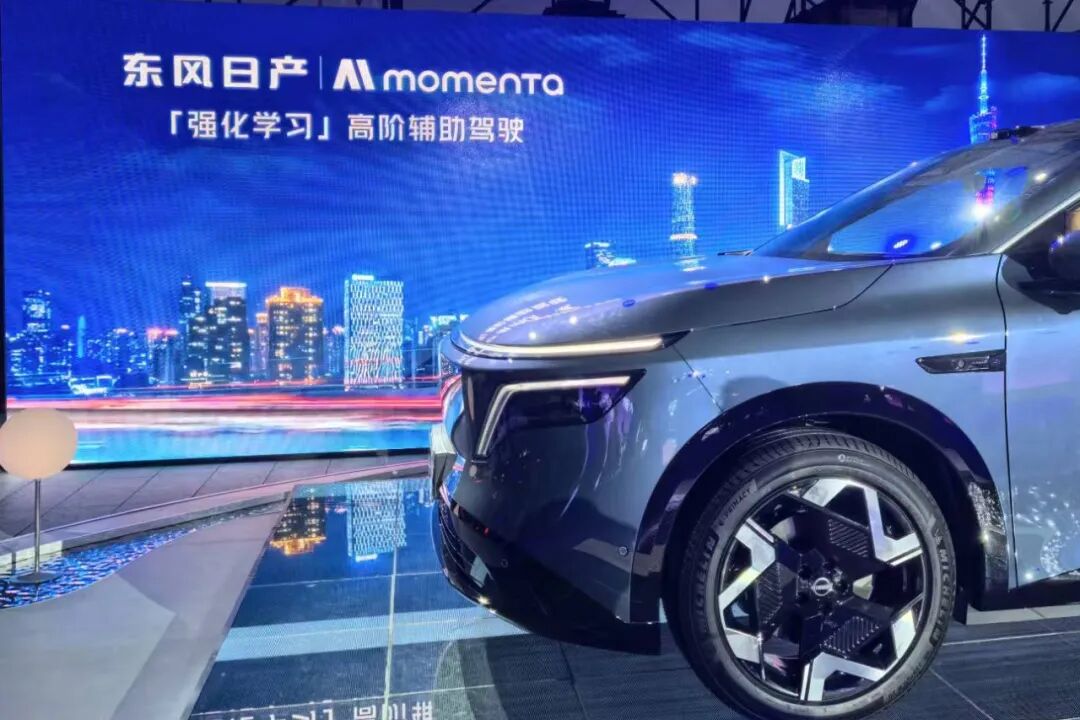
Among them, at least 17 models are equipped with Huawei's intelligent driving system, covering automakers (brands) such as GAC Group, Voyah, Audi, the "Four Realms" under Hongmeng Intelligent Driving, Shenlan, Avatr, and Qijing. Twelve models feature Momenta's intelligent driving system or are associated with it, with partners including BYD, SAIC-GM, Dongfeng Nissan, GAC Toyota, and IM Motors.
For example, at the launch event for the second-generation Blade Battery and Flash Charging Technology in early March, BYD introduced multiple new models, some of which have intelligent driving systems developed in collaboration with Momenta. Meanwhile, Huawei unveiled or launched nearly 10 models equipped with its intelligent driving system at the Spring Full-Scenario New Product Launch on March 23.
Recently, a poll comparing intelligent driving systems was initiated by netizens, with Huawei receiving nearly half of the votes, while Momenta secured less than one-tenth, ranking fourth. The options included Huawei ADS, Li Auto VLA, XPENG VLA, Horizon HSD, and Momenta R6. As of this article's publication, nearly 4,000 people had participated in the vote.
So, when faced with Huawei's intelligent driving system and Momenta, how do car buyers choose?
▍01 Automakers Favor Momenta
"There are only two models for intelligent driving now: one is the Huawei model, where automakers have no say; the other is the BYD model, where intelligent driving companies have no say," joked an industry insider.
This statement highlights the differing levels of influence between various intelligent driving solutions and automakers in partnerships.
In January this year, the China Automotive Technology and Economic Information Institute released the "2025 Urban NOA Automotive Assisted Driving Research Report." The report stated that in the first 11 months of 2025, Momenta and Huawei together accounted for about 80% of the market share among third-party suppliers.
Among them, Momenta led with approximately 61.06%, with its solutions widely adopted by mainstream domestic and international automakers. Huawei, through its HI mode, deeply empowered partner automakers, capturing about 19.76% of the market share.
Of course, Huawei's partnerships with automakers extend beyond the HI mode, offering three paths: component supply mode, HI/"Jing" (HI PLUS) series mode, and Hongmeng Intelligent Driving mode.
The first mode is the simplest, where Huawei supplies standardized components and technical solutions, such as electric drive systems, radars, and intelligent cockpit systems, to automakers. The second mode, led by Huawei's Yinwang, focuses on deep co-creation, where Huawei and automakers jointly develop intelligent automotive solutions, but the models are manufactured by the automakers and retain their brands and sales channels.
In the third mode, Huawei has the deepest involvement and strongest control, directly operated by Huawei's Consumer BG. Under this mode, Huawei is deeply involved in the entire chain of product definition, R&D, design, marketing, and sales.
In contrast, automakers partnering with Momenta enjoy higher autonomy. Their cooperation models generally include deep joint R&D, technology licensing and platform-based delivery, ecological synergy "Iron Triangle" mode, bidirectional data and algorithm empowerment, and global collaborative overseas expansion. When working with automakers, Momenta emphasizes open technology, data sharing, and value co-creation.
A project manager from a domestic automaker believes that, taking the Hongmeng Intelligent Driving mode as an example, Huawei's high level of involvement covers almost the entire chain, from algorithms and chips to radars and cloud computing power, resulting in strong overall product consistency but requiring high resources and organizational capabilities from automakers.
"Unlike Huawei's closed-loop, full-stack self-research approach, Momenta adopts an open software platform strategy that is compatible with different chip hardware. It has a higher match with automakers' cooperation rhythms, with more project landings and stronger solution compatibility. This flexibility is more welcomed by traditional automakers," the project manager further explained.
According to Huawei's release, by the end of 2025, Qiankun Intelligent Driving had jointly launched with 35 partner models, providing intelligent driving solutions for over 1.4 million passenger vehicles. Among luxury models priced above RMB 350,000 in China, Qiankun Intelligent Driving ranks first in market share.
Jin Yuzhi, CEO of Huawei's Intelligent Automotive Solutions BU, once stated that by 2026, the number of models equipped with Huawei Qiankun is expected to exceed 80 annually, with cumulative vehicle installations surpassing 3 million by the end of 2026.
"Huawei is definitely the 'superpower,'" said a head of an intelligent driving supplier when discussing the ranking of intelligent driving companies' capabilities. "It's hard to evaluate which automaker's own intelligent driving is better. No OEM can maintain a particular advantage for long. The landscape changes quickly."
Data shows that as of the end of March this year, Momenta had secured design wins for over 170 models, with nearly 70 models delivered and installations surpassing 700,000 units. In terms of overseas expansion, Momenta's solutions have entered 10 countries, including the UK, Norway, Australia, the UAE, and Thailand.
In February this year, Momenta stated that its core goal for the year is to secure a leading position in the intelligent driving industry, focusing on three directions: scale expansion, technological deepening, and overseas breakthroughs, moving toward mass production scaling from hundreds of thousands to millions.
Cao Xudong, CEO of Momenta, predicted that by 2026, Momenta will jointly occupy over 85% of the domestic third-party intelligent driving market share with leading enterprises.
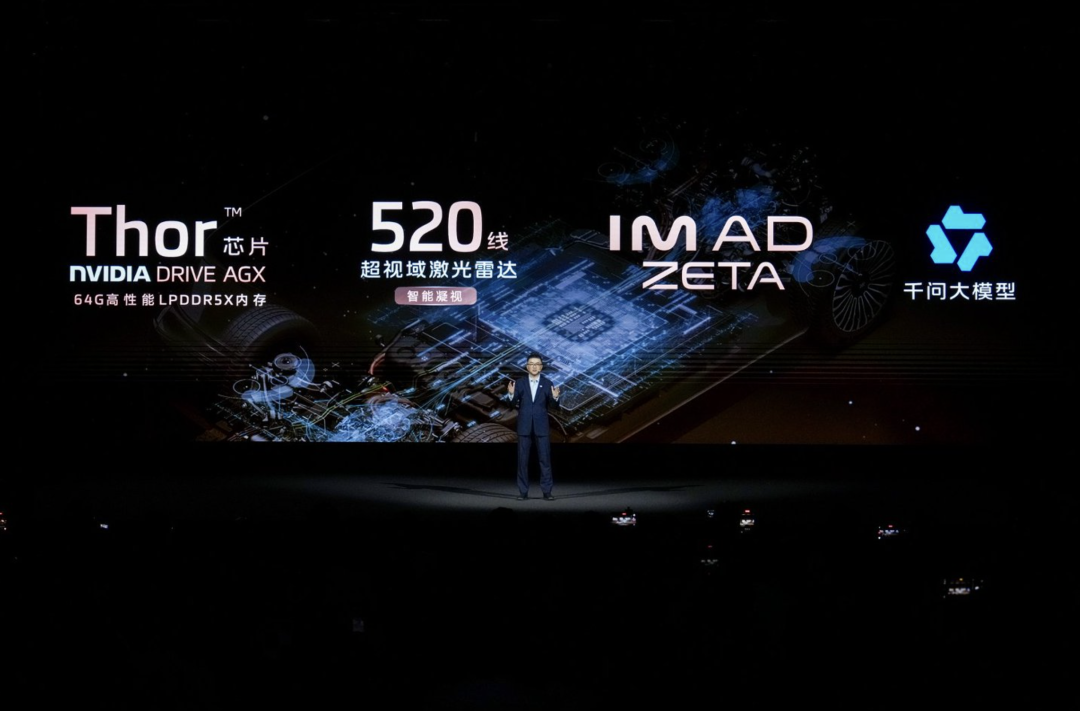
"For hardware specified by automakers, Momenta sends engineers on-site to participate in joint debugging and post-installation testing. This approach, which does not excessively interfere with the automaker's supply chain, is safer and more easily accepted by automakers," said another intelligent driving-related executive from a domestic automaker. "Additionally, for automakers, high supplier inclusivity is beneficial, meaning more room for negotiation in pricing and rights discussions."
He cited an example: a friend working on a 5R1V sensor combination faces a license fee of RMB 50 per unit. Pure software is easily subject to price pressure, with products developed this year requiring significant price reductions next year. "Momenta's business is mainly pure software and faces similar issues."
According to the information, Momenta primarily provides intelligent driving algorithms and software solutions for automakers.
Additionally, among joint ventures, the intelligent driving cooperation between XPENG and Volkswagen is about to debut. Whether it will become another significant force remains to be seen.
▍02 How Users Choose
How do users perceive these two intelligent driving solutions?
"Huawei's intelligent driving feels like a human is driving, actively making many choices for you. People who prefer aggressive driving would likely choose this," Mr. Wang told Bangning Studio. "Momenta's intelligent driving is more conservative, opting for steadier routes."
With 12 years of driving experience, Mr. Wang recently wanted to switch to a new car with intelligent driving capabilities. In late March, he test-drove mainstream intelligent driving models, including brands like XPENG, Li Auto, AITO, Xiaomi, IM Motors, and Buick.
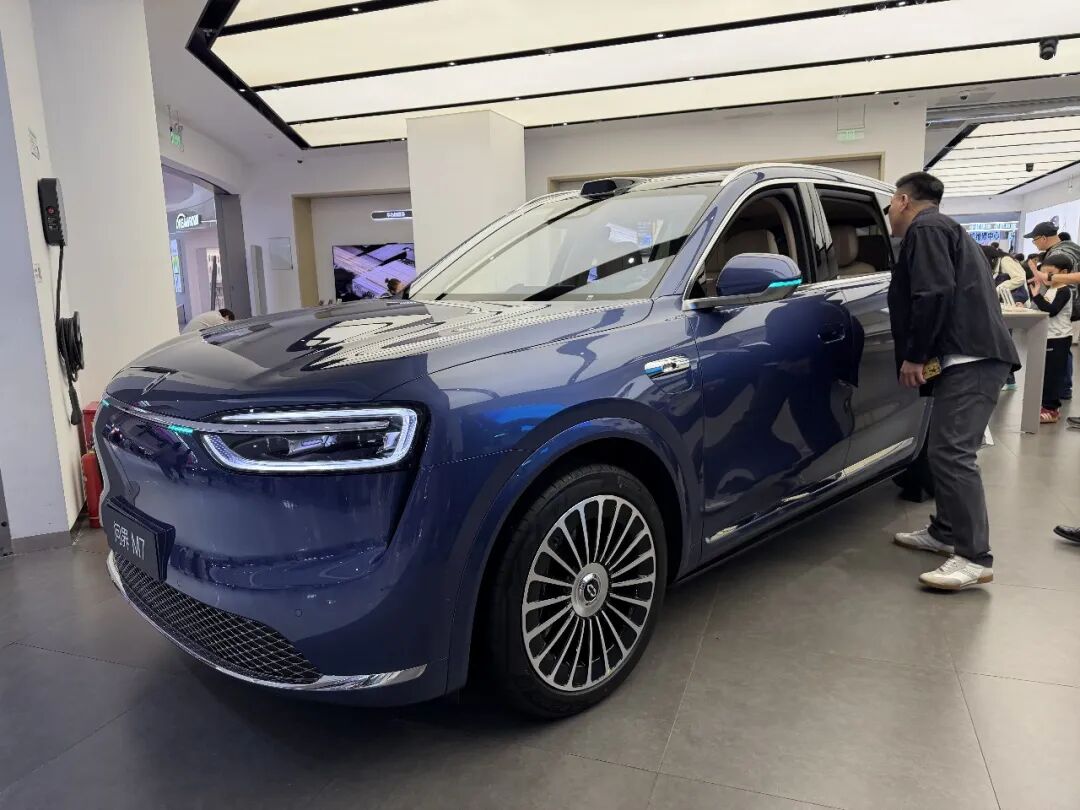
Regarding Huawei's intelligent driving, he believes that whether on narrow or closed roads, vehicles equipped with Huawei's system demonstrate high efficiency and good performance. "It goes when it can, never hesitating, which is its biggest strength," he said. However, Mr. Wang also noticed instances of non-compliance or overly strict compliance, such as when waiting at a red light in a straight lane, if the red light is too far away, the car may use the left-turn lane and then merge right.
Regarding Momenta, Mr. Wang initially had low expectations but was impressed after test-driving the Buick Zhijing Shijia. "If Huawei's intelligent driving scores 98, I'd give Momenta's 95," he said. "It performs exceptionally well on closed roads with high passage efficiency. It's also decisive when meeting oncoming traffic on narrow roads. However, it strictly adheres to speed limits and doesn't consider the riding experience much during intelligent driving."
Through interviews with multiple consumers, Bangning Studio found that, without considering price, many young people's first choice is Huawei's intelligent driving. Some consumers who are used to driving fuel vehicles and prioritize vehicle texture may prioritize the automotive brand before choosing an intelligent driving system. For example, some people only buy joint venture models, which rarely feature Huawei's intelligent driving and mostly use Momenta's.
Why do joint venture and overseas automakers mostly choose Momenta? A sales consultant from a SAIC Volkswagen 4S store said it's because Momenta only acts as a technology partner, does not interfere with the brand's DNA, and respects the automaker's dominance, leading to smoother cooperation—it can complement intelligent shortcomings while maintaining the automaker's driving texture, which is the optimal solution for automakers.
"Actually, a simple test drive doesn't fully allow users to understand this (intelligent driving) system. I have five or six BZ3X customers who said months after buying the car that Momenta's intelligent driving is particularly good, completely breaking their bias [bias] that 'intelligent driving is useless,'" said Zhang Ming (pseudonym), a sales consultant at a GAC Toyota 4S store in Beijing's East Fifth Ring Road.
Mr. Li, who purchased a FAW-Audi A5L Qiankun Intelligent Driving Edition in March this year, also changed his perception of intelligent driving.
"As someone who's somewhat of an insider, I know very well how difficult it is to integrate advanced intelligent driving systems into fuel vehicles. Intelligent driving isn't about who has higher computing power or laser radar; it's about who has more and accurate data samples," Mr. Li said. "Huawei excels in this. I can feel it has the most matching software solution, combined with Audi's driving tuning, giving me a true sense of human-machine co-driving when I drive."
When discussing the superiority of the two intelligent driving systems, Zhang Ming believes they cannot be compared from a single dimension as they focus on different aspects, but both are strong players in China's intelligent driving field. "If you want better cost-effectiveness, buy our (Momenta-equipped) car; if you want to connect all ecosystems and pursue a more extreme driving experience, buy a Huawei-equipped car."
Huawei Qiankun and Momenta represent two distinct paths in intelligent driving: the former is dominant, full-stack, and offers an extreme experience, pursuing ecological closure and user mindshare; the latter is open, compatible, and focuses on low-key [low-key] mass production, adhering to technological empowerment and automaker dominance.
Users generally prefer Huawei Qiankun's intelligence and decisiveness, while automakers, especially joint ventures, favor Momenta's flexibility and safety. Neither is absolutely superior; it depends on the scenario and standpoint.
(Title image generated by AI)

-
![]()
Domestic Pioneer: Changjin Photonics, First Listed Company Focused on Special Optical Fibers, Soars Over 15-Fold on STAR Market Debut
-
![]()
Single-Quarter Orders Break $1 Billion Barrier! Cisco’s Acacia Surfs the AI Boom
-
![]()
Consistently Propelling Technological Progress: Qualcomm’s Xu Hao Elucidates How 6G Trial Frequencies Can Optimize the Balance Between Coverage and Bandwidth
-
![]()
Liushenyu Mine Disaster Drives Industrial Innovation: Pioneering a New Era of Intelligent Mine Safety with Integrated Air-Ground Systems
-
![]()
Ant Group CEO Han Xinyi's Latest Speech: The Emergence of 'Trust Logic' in the AI Era
-
![]()
Demystifying the Rankings: Do High Scores in Robotics Competitions Equate to Real-world Implementation Strength?
-
![]()
Europe's Q1 Smartphone Market Shipments Revealed: Samsung Holds Firm at First Place, Honor Surges Over 60%
-
![]()
Mixed Fortunes: The Ongoing Transformation of the Automotive Industry's Value Landscape