Doubao’s Pricing Strategy Unveiled: A Comparative Analysis of Global Large Model Pricing
 05/15 2026
 592
592

Author|Lin Yi
Editor|Key Points Editor
Doubao is gearing up to introduce subscription fees.
This news has sparked significant discussion within China’s AI community. According to the three subscription tiers Doubao announced on its App Store page, the Standard version is priced at 68 RMB for a continuous monthly subscription, the Enhanced version at 200 RMB, and the Professional version at 500 RMB. For annual subscriptions, the prices are 688 RMB, 2048 RMB, and 5088 RMB, respectively.

The news has elicited mixed reactions from netizens, with some commenting, “You promised it would always be free; looks like you can’t hold on anymore.”
However, this development should not be interpreted as Doubao imposing fees across the board.
Doubao has clarified that it will continue to offer free services while exploring the launch of additional value-added services. Details of these plans are still under testing.
This statement conveys two key pieces of information:
First, the free version of Doubao will remain available. At least from the current official stance, free services will persist.
Second, the leaked subscription plans are not yet finalized. More accurately, Doubao is testing a paid system targeted at productivity-focused users.
Thus, rather than Doubao suddenly attempting to monetize its user base, it is more accurate to say that large model products have reached a stage where they must carefully consider their financial models.
Over the past few years, the predominant strategy for large model products has been to offer free services, provide subsidies, and attract new users, getting them accustomed to using AI before introducing paid options.
However, AI today extends far beyond answering a few questions or generating short pieces of text. Increasingly, users are leveraging AI to create PPTs, Excel spreadsheets, analyze data, write code, generate long documents, and even have agents execute complex tasks continuously.
The costs associated with these activities are substantially higher than those of ordinary chat software.
Mainstream Large Models Have Already Adopted Tiered Pricing
When placed among global mainstream large model products, Doubao’s move to introduce subscription fees is not surprising.
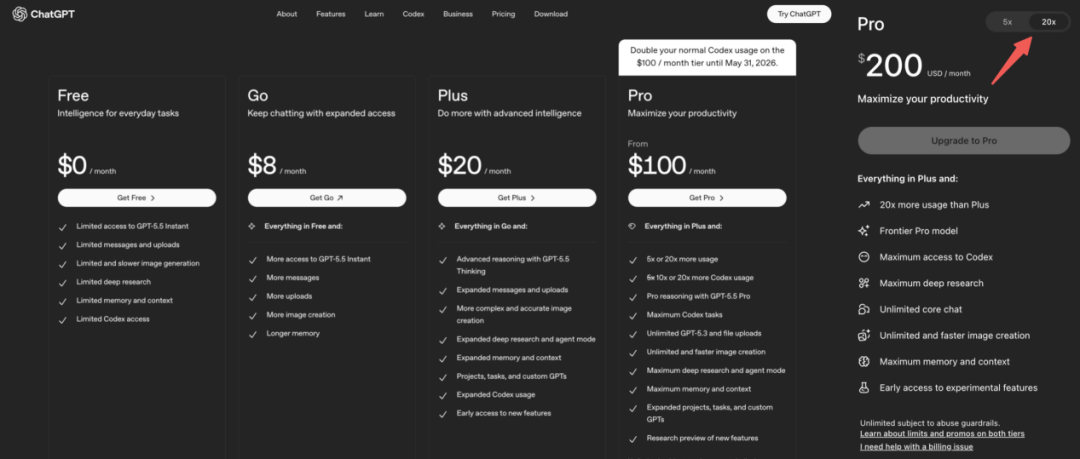
Let’s first examine OpenAI. ChatGPT has developed a multi-tiered paid system. The Go plan targets casual users with a lower threshold (8 USD/month), Plus costs 20 USD/month, and Pro offers two usage tiers at 100 USD/month and 200 USD/month. The core difference between the two Pro tiers lies in usage limits: the 100 USD tier offers approximately five times the usage of Plus, while the 200 USD tier offers about twenty times the usage of Plus.
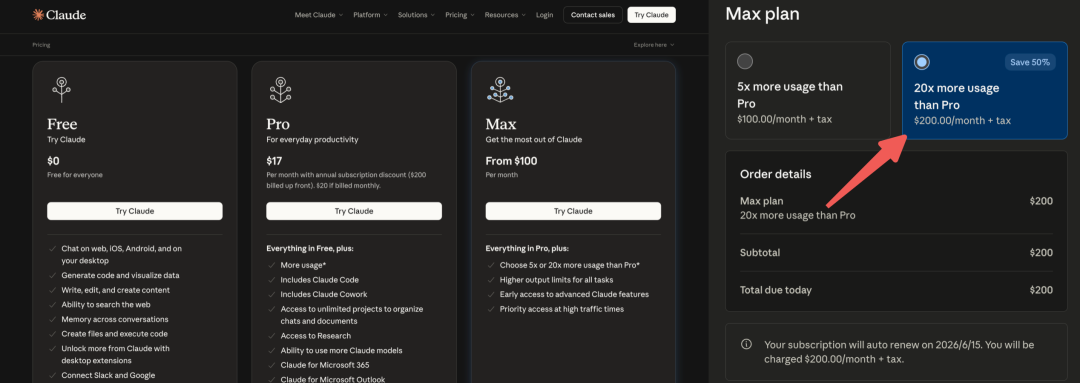
Anthropic’s Claude follows a similar approach. The official price for Claude Pro is 20 USD/month (monthly payment), while the Max plan is divided into two tiers: Max 5x and Max 20x, priced at 100 USD/month and 200 USD/month, respectively. The 5x and 20x essentially represent higher usage limits.
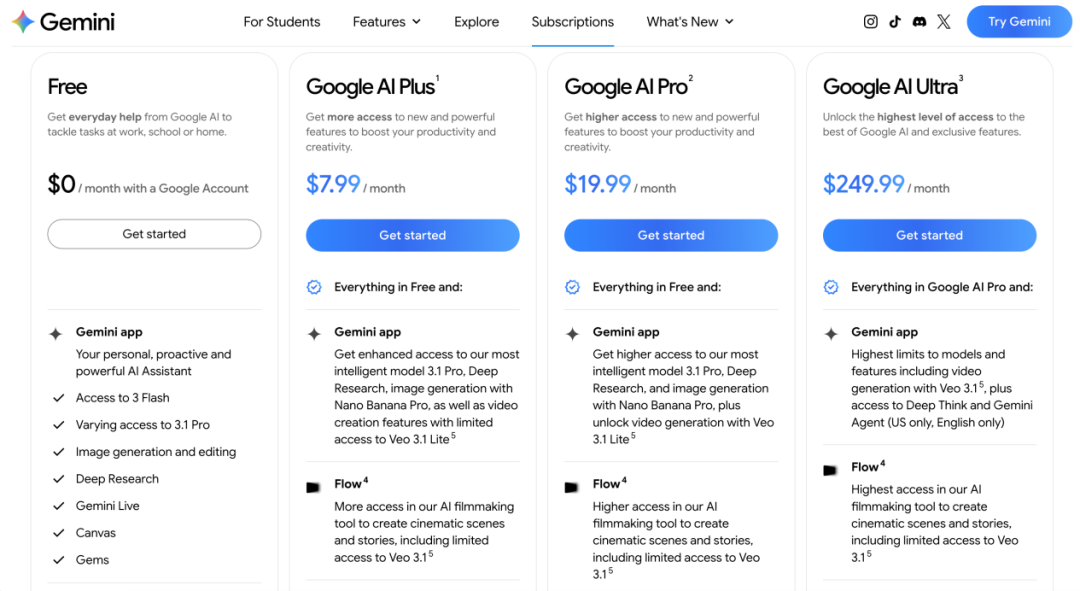
Google AI’s subscription system includes Plus, Pro, and Ultra tiers, priced at 7.99 USD/month, 19.99 USD/month, and 249.99 USD/month in the United States, respectively. Ultra is the most expensive, offering higher usage limits and more comprehensive access to Google AI tools.
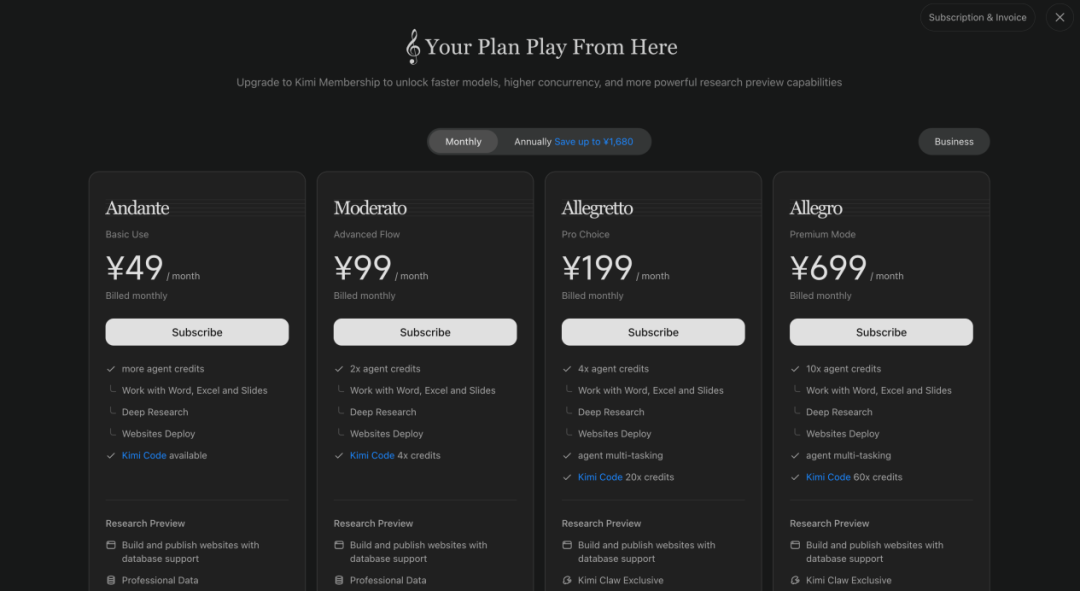
Domestically, Kimi has also introduced a detailed membership system. According to its official help center, Kimi offers five membership plans: free Adagio, as well as Andante at 49 RMB/month, Moderato at 99 RMB/month, Allegretto at 199 RMB/month, and Allegro at 699 RMB/month. Its paid benefits cover functions such as agents, Office file processing, in-depth research, website deployment, and Kimi Code.
When examining these products collectively, a clear commonality—or key signal—emerges:
Large models have evolved from free chatboxes into productivity tools tiered according to user needs.
In other words, casual users can continue to use the service for free, regular high-frequency users can purchase a basic membership, professional users can opt for higher usage limits, and heavy-duty productivity users may require more expensive advanced plans.
This pricing logic increasingly resembles that of mobile phone plans. Some users only need daily calls and data, while others require large amounts of data transfer, hotspot usage, and international roaming every day. The greater the difference in usage, the more finely tiered the plans become.
The same applies to large models.
The computational resources consumed when a user occasionally asks a few questions are vastly different from those required when a user has AI read long documents, generate PPTs, conduct in-depth research, and write code every day.
Continuing to serve everyone with the same free system may ultimately lead to two outcomes:
Either casual users find it sufficient, or heavy users find it inadequate, leaving the platform itself overwhelmed by costs.
Therefore, charging fees does not necessarily mean that AI products are becoming worse. A more accurate assessment is that large model products are transitioning from acquiring users to serving them in tiered ways.
The 68 RMB/month Doubao Standard Version May Not Be the “Entry-Level” Tier You Think
In Doubao’s subscription testing, the most noteworthy aspect to analyze is what the three price tiers are actually targeting.
On the surface, 68 RMB, 200 RMB, and 500 RMB might easily be interpreted as low, medium, and high tiers of membership.
However, when compared with the subscription systems of mainstream overseas large models, Doubao’s 68 RMB tier may not be the so-called entry-level version.
Both ChatGPT Plus and Claude Pro are priced at 20 USD/month, which roughly converts to over 100 RMB. These are currently the most typical standard paid tiers among mainstream large model products.
Doubao’s exposed Standard version is priced at 68 RMB/month, which is lower than ChatGPT Plus and Claude Pro. However, in terms of tier positioning, it is more likely aligned with standard paid membership rather than the lowest-threshold light membership.
In other words, Doubao may not have a separate low-priced membership tier similar to ChatGPT Go or Google AI Plus; instead, it continues to offer those capabilities in the free experience.
This is also an easily overlooked aspect of Doubao’s plan: if the free version continues to exist, then Doubao’s “first tier” is effectively the free tier. The 68 RMB Standard version directly targets users at a higher paid tier.
If we summarize this in a table, the conclusion becomes clearer:
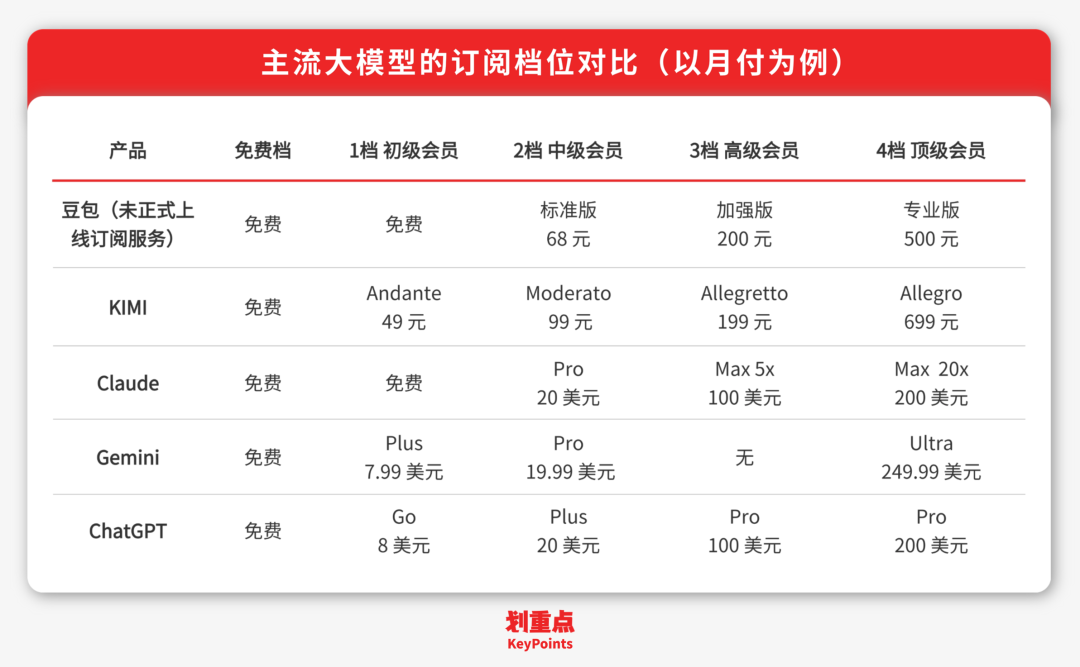
It is evident that if we divide the membership tiers into four levels as shown in the table above, the first tier for both Doubao and Claude is actually free. Among the highest-tier memberships, Doubao is the cheapest among these models (and also lower than KIMI). Of course, when comparing each tier's membership price based on what Doubao has currently announced, all are lower than those of overseas models.
This also aligns relatively closely with the usage habits of domestic AI products.
For most ordinary users who use AI to write a few paragraphs, search for information, or engage in light creative tasks daily, the free version suffices. Those who truly need to pay are often users with higher usage frequencies, more complex tasks, and greater sensitivity to stability.
What matters more to them is whether they can wait less in queues, process longer content, and complete more complex tasks.
Therefore, the significance of the 68 RMB price point is not just that Doubao is starting to charge money; it also suggests that it may set a lower price anchor for standard paid tiers among domestic large models.
This raises a question: if Doubao’s Standard version is priced significantly lower than mainstream overseas products, what kind of benefits can it offer?
This is a more worthy aspect to follow up on later.
The 200 RMB and 500 RMB Doubao Tiers Truly Test Productivity
Looking further up, Doubao’s 200 RMB Enhanced version and 500 RMB Professional version may be the most informative parts of this subscription system.
At 200 RMB/month, this is no longer a price that casual users trying out the service would easily pay; it is clearly aimed at higher-frequency, heavier users.
If we compare it with overseas products, it is close to the user positioning of Claude Max 5x and ChatGPT Pro 100 USD tiers, which require higher usage limits, fewer restrictions, and more stable capabilities for complex tasks.
As for the 500 RMB/month Professional version, there is even greater room for imagination.
It is difficult to justify this price point solely based on "more usage." For an average user, 500 RMB/month already exceeds the prices of many content memberships, cloud storage memberships, and office software memberships. For this tier to be viable, it must correspond to clearer productivity value.
According to public reports, sources close to Doubao have revealed that paid features will primarily focus on complex tasks and productivity scenarios, such as PPT generation, data analysis, and film and television production. These scenarios consume more computational resources and inference time, making them easier to justify as paid features.
This is the key point.
The cost differences among large models do not merely depend on how many questions a user asks. What truly consumes resources are long contexts, multi-round reasoning, multimodal generation, file processing, tool invocation, and agent execution.
Having AI write a single social media post is entirely different in cost from having AI read dozens of pages of material, dissect data tables, generate a PPT, and repeatedly revise it based on feedback.
Future large model subscriptions are unlikely to remain limited to chat usage packages; instead, they will more likely revolve around AI productivity packages designed around real workflows.
In fact, Kimi’s membership system already demonstrates this trend. Its membership benefits are not limited to dialogue limits but also include functions such as agents, Office file processing, in-depth research, website deployment, and Kimi Code within a unified usage pool.
This is also a key point indicating that the pricing logic of domestic AI products is changing.
If Doubao does indeed introduce a 500 RMB Professional version later, it will need to address several very specific questions:
For example, can complex PPTs be stably completed? Can data analysis reach a level usable by a junior analyst? Can the failure rate of multi-step tasks be reduced?
Furthermore, can agents truly complete tasks instead of remaining at the demonstration stage? Can high-consumption scenarios such as film and television production and content creation deliver significantly better results than the free version?...
These questions will determine whether the 500 RMB tier is just an "expensive membership" or a "true tool."
Simply increasing usage limits will not convince users to pay 500 RMB. Only if it corresponds to a stronger model, higher usage limits, and more complex task execution capabilities will professional users have a reason to view it as a productivity investment.
Charging Is Acceptable, Provided the Free Experience Remains Reasonable and Sustainable
Of course, from the user’s perspective, concerns are entirely reasonable.
To put it bluntly, users do not care how AI companies make money; they care more about whether things they could previously use for free will now require payment.
This issue must be addressed openly.
The truly sensitive aspect of Doubao’s subscription testing is how the boundary between the free and paid versions is drawn.
If basic Q&A, daily writing, light searching, and ordinary creative tasks can still be used for free as usual, then the paid version is more like opening a higher-limit channel for heavy users.
If, after the paid version is introduced, the free version is significantly throttled, basic functions are drastically reduced, and advanced capabilities are completely closed off, then user resentment is understandable.
An ideal approach would be: free users continue to receive basic capabilities and occasionally get to experience some advanced functions; paid users receive higher usage limits, shorter wait times, and more stable experiences for complex tasks.
This is also the basic structure that mainstream large model products are forming.
The free version is responsible for expanding the user base and cultivating usage habits; the basic membership serves daily high-frequency users; the advanced membership serves professionals, creators, developers, and some individual productivity users before enterprises.
This structure may not be popular, but the business logic is very realistic.
After all, large models are not traditional internet products. Running a complex reasoning task is vastly different in cost structure from scrolling through a feed or searching a webpage. The more capable AI becomes, the more expensive a single task may be.
Especially for capabilities such as multimodality, long contexts, in-depth research, code generation, and agent execution, higher computational investments are inherently required.
If all complex tasks were offered unlimitedly for free, the overall experience would likely suffer. Platforms would either have to limit traffic, impose queues, reduce capabilities, or find commercialization paths.
This is where the significance of charging models lies.
Do not merely perceive this move as the removal of a previously complimentary offering; rather, it represents the quest for a sustainable approach to providing high-cost functionalities. As long as the parameters are distinctly outlined, free users and paid subscribers need not inherently stand in opposition.
Paid subscribers shoulder a portion of the expenses associated with advanced features, and the platform reinvests the revenue into models, computational resources, and enhancing product experiences. Ultimately, free users may also reap the benefits of the overall enhancement in capabilities.
Naturally, this scenario represents the ideal outcome.
Whether it can be realized hinges on the performance of Doubao's subsequent official strategy:
If successful, implementing fees transforms into a viable commercialization tactic; if not, even a nominal charge will merely introduce an additional membership tier.
-
![]()
From Energy Conservation and Carbon Reduction to AI Decision-Making: GECON East Intelligence and Chery Group Explore a New Green and Smart Paradigm for Automobile Manufacturing
-
![]()
WAIC 2026 Observation | AI Accelerates Towards the Core of Industries, Industrial AI Enters a Critical Phase
-
![]()
Volkswagen China Fires the First Shot in Foreign-Funded 'White Box Delivery'!
-
![]()
AI Agent Smartphones: The Next Competitive Edge Transcends Large Models
-
![]()
Over 880 Million Yuan Worth of Orders Unveiled, Bidding Launched for Shenzhen Eastern Public Transport
-
![]()
Tesla's Robotaxi Hits the Road: A Monumental Gamble with an Uncertain Future
-
![]()
Ford and Geely Forge New Joint Venture in Spain, Sidestepping Changan and JMC
-
![]()
199 RMB! Godox's First Camera Review: Subpar Photography, Transparent Viewfinder Frame is the Highlight