Analysis of the Heated Debate on Doubao’s Charging Model: Short-Term Controversy, Long-Term Rationality
 05/15 2026
 444
444
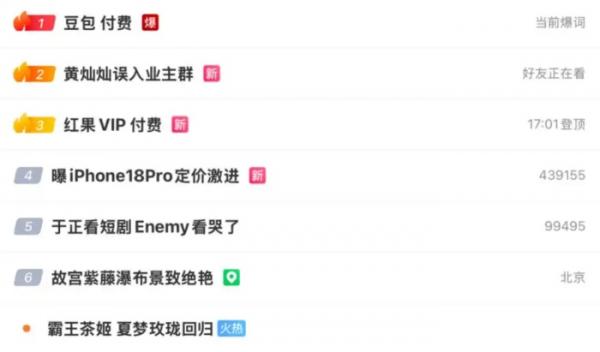
Recently, news that Doubao, ByteDance’s AI application, is set to introduce a paid subscription model has sparked widespread attention. With standard, enhanced, and professional plans priced at 68, 200, and 500 RMB per month respectively, the announcement quickly dominated social media trending lists. In response, Doubao officials clarified that they will maintain free basic services while exploring value-added offerings, with specific implementation details still under testing.
Let’s be candid: Doubao’s decision to monetize should not come as a shock. This move represents a pivotal shift in China’s AI large model industry—transitioning from frenetic subsidy-driven market capture to rational commercialization. Let’s analyze this objectively through four lenses:
1. Fundamental Rationale for Charging: Computational Costs Demand It
AI products differ fundamentally from traditional internet applications (e.g., short video platforms or news feeds). For conventional apps, user growth reduces marginal costs, but AI large models face the opposite dynamic: more users mean exponentially higher computational expenses. As AI adoption scales, so do the costs of GPU clusters and electricity consumption.
Take Doubao’s case: its daily token (text unit) processing volume has surged 1,000-fold since May 2024, consuming massive GPU resources and energy daily. Without monetization, casual users engaging in simple chats would indirectly subsidize professional users generating PPTs, videos, and complex analyses—a commercially untenable model. Even financially robust companies like ByteDance cannot sustain indefinite full subsidies, making charging inevitable. The principle is straightforward: “Computational resource consumption should incur costs.”
2. Pricing Strategy: Tiered Subscriptions with Free Basics
Doubao avoids a one-size-fits-all approach, offering three subscription tiers: Standard (68 RMB/month), Enhanced (200 RMB/month), and Professional (500 RMB/month). These primarily target high-intensity productivity scenarios (e.g., PPT generation, advanced data analysis, film production) that demand significant token usage. Meanwhile, free services remain available for casual conversations, simple Q&A, and basic translations.
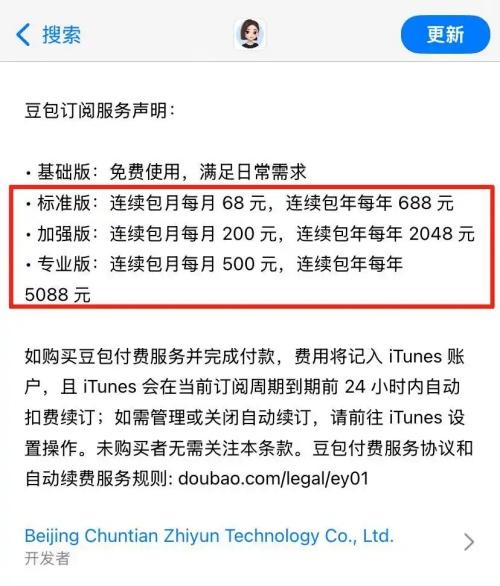
Observations reveal Doubao’s Standard plan (68 RMB/month) sits above domestic rivals like Kimi (49 RMB/month) but below international leaders like ChatGPT Plus (~140 RMB/month). Its top-tier 500 RMB pricing appears ambitious, attempting to redefine premium value for Chinese AI. User willingness to pay at this level remains uncertain.
3. Industry and Market Implications
Doubao’s monetization experiment marks the end of China’s AI large model price wars and unlimited free access. The industry now enters a stratified phase: free basic functions attract users, while advanced productivity features generate revenue. With over 340 million monthly active users, Doubao serves as a critical test case for large-scale commercialization.
Success here would identify core users willing to pay for efficiency and stability, creating a replicable business model for China’s AI application layer. Essentially, Doubao’s move accelerates the maturation of China’s AI ecosystem. Competitors may adopt similar tiered pricing, fostering an “AI consumption mindset” of free basics with paid upgrades—a foundation for sustainable industry growth. The future will shift from capital burning to a virtuous cycle driven by technological value.
4. Impact on Users and Recommendations
Reactions to Doubao’s model range from anxiety over alternatives to skepticism about cost-effectiveness, with many users venting frustrations. A rational perspective is advisable:
- Casual Users: If you use AI for simple chats, copywriting, or translations, the free version suffices—no payment needed.
- Power Users: If Doubao’s paid features (e.g., one-click PPT generation, deep research analysis) significantly save time and enhance output, the subscription becomes a productivity investment.

Post-implementation, monitor the free version’s performance despite official assurances. Watch for “hidden downgrades” like slower responses or reduced quality. If the free tier becomes ineffective, explore alternatives—both free and paid.
In my view, Doubao’s charging model isn’t a “cash grab” but a necessary step toward AI maturity. While controversial short-term, it’s rational long-term. Doubao is evolving from a subsidy-dependent “toy” to a sustainable ecosystem where high-intensity users pay for technical value.
The crux lies in whether Doubao can deliver on its promise: “Free basics without compromise, paid features worth the price.” For users, stick with free if it suffices; pay for efficiency if needed. Rational choice suffices. What’s your take?
-
![]()
From Energy Conservation and Carbon Reduction to AI Decision-Making: GECON East Intelligence and Chery Group Explore a New Green and Smart Paradigm for Automobile Manufacturing
-
![]()
WAIC 2026 Observation | AI Accelerates Towards the Core of Industries, Industrial AI Enters a Critical Phase
-
![]()
Volkswagen China Fires the First Shot in Foreign-Funded 'White Box Delivery'!
-
![]()
AI Agent Smartphones: The Next Competitive Edge Transcends Large Models
-
![]()
Over 880 Million Yuan Worth of Orders Unveiled, Bidding Launched for Shenzhen Eastern Public Transport
-
![]()
Tesla's Robotaxi Hits the Road: A Monumental Gamble with an Uncertain Future
-
![]()
Ford and Geely Forge New Joint Venture in Spain, Sidestepping Changan and JMC
-
![]()
199 RMB! Godox's First Camera Review: Subpar Photography, Transparent Viewfinder Frame is the Highlight