Behind ByteDance’s Massive AI Investment: With Douyin E-commerce Growth Slowing, Can Doubao and Hongguo Offer a Lifeline?
 05/15 2026
 580
580

ByteDance has recently found itself at the heart of a storm. On one hand, Doubao’s move to a subscription model has sparked widespread debate. On the other, Hongguo short dramas are venturing into e-commerce, testing the waters for monetization within the short drama space.
The challenges ByteDance faces are stark—it’s caught in a growth rut: Douyin E-commerce’s GMV growth has plummeted to just 25%, while the company’s overall net profit has nose-dived by 70%.
Given the usage rates and industry scarcity of Doubao and Hongguo short dramas, commercializing these two flagship products could indeed inject much-needed financial support into ByteDance and bolster its financial health. However, for ByteDance, pulling off such commercialization is no walk in the park. On one front, there’s pushback and debate from end-users; on the other, fierce competition from rival firms looms large.
Whether it’s Hongguo short dramas’ foray into e-commerce or Doubao’s experiment with tiered subscriptions, ByteDance is certainly blazing a trail. But which of these monetization strategies can truly turn the tide and unlock fresh growth avenues for ByteDance?
01
Nearly 100 Billion Invested, AI Eroding ByteDance's Net Profit
“Foreign media reports suggest that ByteDance’s total capital expenditures in 2026 will surge, with over half earmarked for artificial intelligence processor procurement and related infrastructure,” explained Li Liang, Vice President of Douyin Group, in a Weibo post amid discussions about ByteDance’s 70% net profit decline. He pinned the blame on heavy investment in AI.
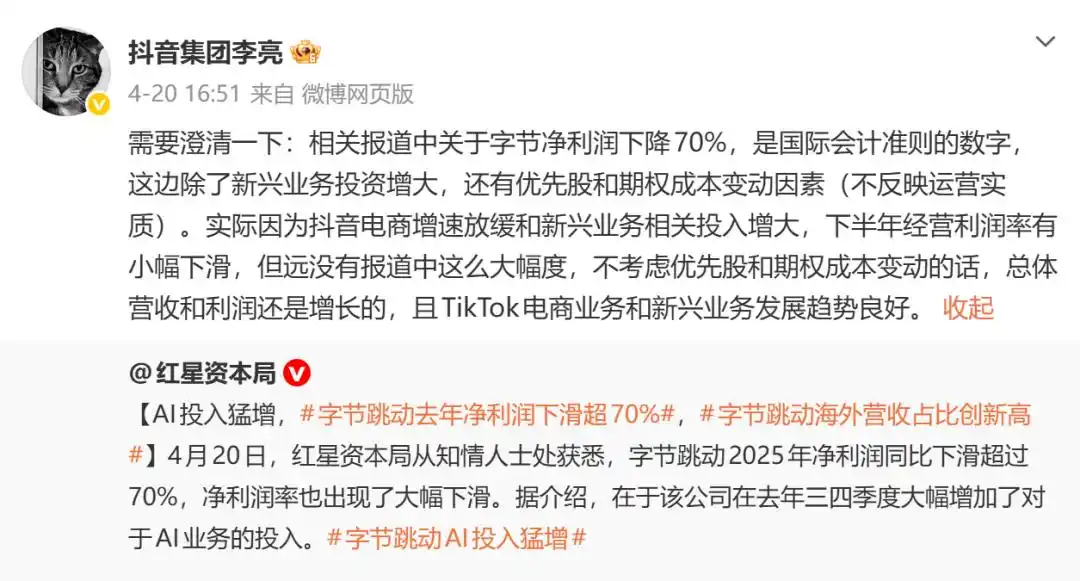
Image source: Li Liang's Weibo
In an article titled ‘Billions Heavily Invested in AI Business, ByteDance Preemptively Launches Domestic Arms Race’ by Securities Star, it was revealed that in 2025, ByteDance’s capital expenditures hit 150 billion yuan, with AI computing-related expenses accounting for more than half, and AI infrastructure investment reaching around 90 billion yuan.
It’s worth noting that outlets like Lan Jing News and CVSource reported ByteDance’s total capital expenditures in 2024 were just 80 billion yuan. This means ByteDance’s 2025 AI computing investment alone surpassed its entire 2024 annual budget.
More crucially, this is just the beginning. ByteDance has long-term plans for AI computing. In 2026, AI chip procurement alone, excluding other costs, will hit 85 billion yuan.
Beyond hardware, ByteDance is also grappling with escalating talent costs. In 2025, the Seed team, responsible for foundational large model R&D at ByteDance, lost nearly 70 core members, most of whom were poached by Tencent Hunyuan and Alibaba Tongyi Qianwen.
To retain AI development talent, ByteDance has adopted a dual strategy: poaching and retention. It recruited Guo Daya, a key researcher from DeepSeek, to lead the Agent direction at L8 seniority, and Yu Bowen, a core leader from Alibaba Tongyi Qianwen. Guo Daya was lured with a compensation package worth hundreds of millions of yuan, including a four-year option and Doubao shares.
Moreover, to keep talent on board, ByteDance offers monthly subsidies of up to 100,000 yuan for large model experts and has introduced ‘Doubao shares’ to align long-term interests. These shares are akin to repurchasable virtual shares, similar to options.
Amid its heavy AI investment, ByteDance has also seen a significant e-commerce growth slowdown. According to LatePost, in early 2025, Douyin E-commerce’s sales growth exceeded 60%, but by September, it had dropped below 20%. For the whole of 2025, Douyin E-commerce’s GMV growth was just around 25%, compared to a staggering 320% in 2022.
On one hand, ByteDance must persist with large-scale AI investments; on the other, its Douyin E-commerce business has hit a severe growth slump. Clearly, ByteDance is under considerable financial strain and urgently needs new revenue streams.
02
Seeking New Growth, Doubao Explores Tiered Subscription Model
It’s reported that in March 2026, Doubao’s large model daily token usage surpassed 120 trillion, a 1,000-fold increase since its April 2024 launch.
While the usage surge is a positive sign, indicating user approval of Doubao, the issue is that costs rise in tandem with usage—every user interaction and content generation demands computing power, bandwidth, and other resources. The fixed 90 billion yuan AI computing expenditure, combined with per-user call costs, has significantly eaten into ByteDance’s net profit, prompting ByteDance to start charging for its star product.
Doubao announced three subscription tiers—Standard, Enhanced, and Professional—with monthly prices ranging from 68 yuan to 500 yuan, and annual options available. The Standard version costs 68 yuan per month or 688 yuan annually for continuous subscription; the Enhanced version is 200 yuan per month or 2,048 yuan annually; the Professional version is 500 yuan per month or 5,088 yuan annually.
Following the pricing announcement, many raised questions. In response, Doubao officials clarified that basic functions and daily use would remain free.
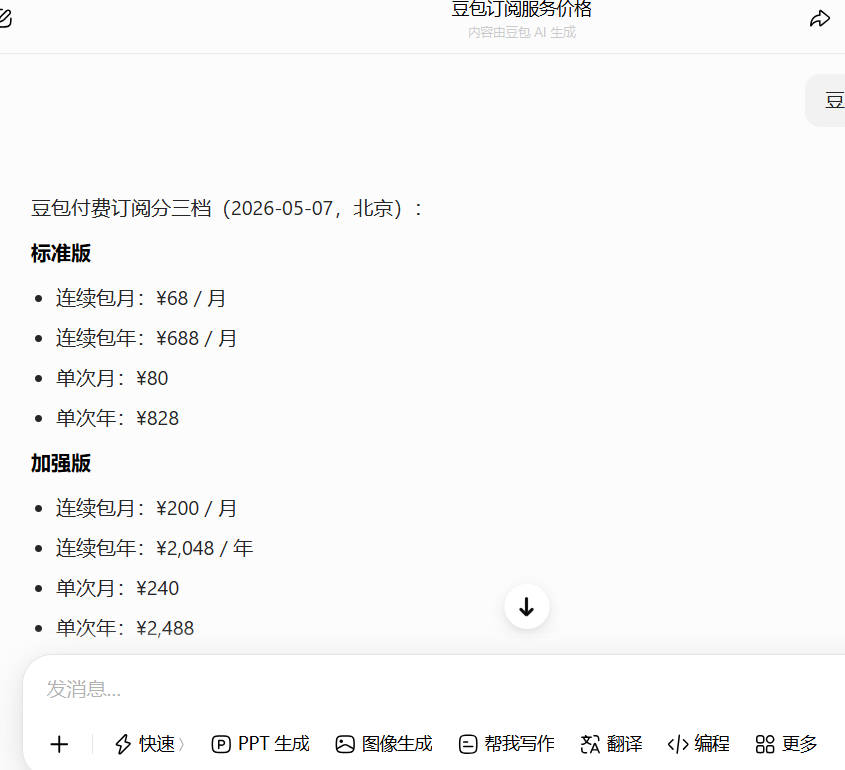
Image source: Doubao web version
Media reports indicate that the paid versions are primarily aimed at complex tasks like PPT generation, in-depth data analysis, long document parsing, and 4K video generation, which incur high single-use reasoning costs.
By offering basic functions for free and charging for advanced features, ByteDance aims to monetize commercially without losing users through tiered operations. However, AI product charging is still in its infancy in China.
Take long document parsing, a common task, as an example. Doubao charges for this service, while other AI models like Kimi and DeepSeek-V4 offer free document parsing for up to 2 million words. DeepSeek-V4 achieves 92% accuracy in logical associations across paragraphs in long texts for legal and scientific research.
For users, if free tools can handle long text parsing, why pay for Doubao?
In fact, ByteDance has already set a precedent for AI commercialization. In April, Jimeng, a ByteDance subsidiary, launched the 1080P feature of Seedance2.0 exclusively for VIP users. Each 15-second video generation requires an additional 495 points. Based on Jimeng’s ‘premium’ membership price of 499 yuan per month for 6,160 points, users can only produce 3 minutes of high-definition video as premium members.
Consequently, numerous complaints have been lodged on Heimao Complaints, with users expressing dissatisfaction: “The earlier promise of ‘growing with creators’ now means finding better ways to fleece us? This is outrageous!”
For Doubao, tiered commercialization sounds promising, but until rival companies offer free alternatives and domestic AI payment habits take root, revenue from Doubao and Jimeng is unlikely to cover ByteDance’s nearly 100 billion yuan AI investments.
03
Hongguo Explores E-commerce, Targeting Lower-Tier & Silver-Haired Markets
In addition to introducing subscription models for AI products, to boost revenue and profit and counter the Douyin E-commerce growth slowdown, Hongguo short dramas have begun ramping up commercialization.
In October 2025, Hongguo short dramas launched an ‘Orders’ feature, enabling users to directly purchase ‘short drama replicas’ and brand store products, completing a full closed loop of ordering, payment, and logistics tracking.
In April of this year, Hongguo E-commerce officially became an independent e-commerce department under the Douyin China E-commerce system, on par with core departments like the Industry Products Department. It’s primarily tasked with e-commerce monetization within the Hongguo short drama context, targeting lower-tier markets and silver-haired users to complement Douyin’s main e-commerce platform.

Image source: Hongguo APP
At the same time, Hongguo short dramas are gradually moving away from the free model. In May of this year, Hongguo introduced a membership program, with some films marked as ‘VIP’ and only available for a 6-minute preview. The full version requires a membership, with current packages including 7-day passes for 8 yuan, monthly passes for 30 yuan, and annual passes for 260 yuan.
However, compared to membership subscriptions on platforms like iQIYI and Tencent Video, Hongguo E-commerce seems to hold more promise than Hongguo memberships.
On one hand, short drama users differ from Douyin’s main platform audience—they skew more toward lower-tier markets and middle-aged and elderly groups, where e-commerce penetration is still low, leaving ample room for growth.
On the other, short dramas are marked by strong emotional engagement and high immersion, making the ‘watch-and-buy’ conversion process more seamless than traditional short videos.
However, this doesn’t mean Hongguo E-commerce is the ultimate monetization path for ByteDance. Short drama users are primarily price-sensitive. Previously, Hongguo built its brand around ‘free short dramas,’ amassing hundreds of millions of monthly active users. Suddenly shifting to membership subscriptions and e-commerce referrals is likely to spark user backlash.
Meanwhile, in the silver-haired and lower-tier markets, platforms like Pinduoduo and JX have already established a strong foothold, and Hongguo E-commerce will have to vie with them.
Reviewing ByteDance’s current predicament, a clear pattern emerges: Heavy AI business investment is continuously draining resources, while the slowdown in Douyin E-commerce growth has weakened its ‘cash cow.’
To survive, ByteDance has had to break free from the free model, pushing Doubao and Hongguo short dramas toward subscriptions and e-commerce monetization.
However, neither tiered subscriptions, membership fees, nor short drama e-commerce can currently bridge the gap left by the nearly 100 billion yuan in AI expenditures. ByteDance still needs to strike a balance between investments and outputs while seeking new revenue streams.
-
![]()
From Energy Conservation and Carbon Reduction to AI Decision-Making: GECON East Intelligence and Chery Group Explore a New Green and Smart Paradigm for Automobile Manufacturing
-
![]()
WAIC 2026 Observation | AI Accelerates Towards the Core of Industries, Industrial AI Enters a Critical Phase
-
![]()
Volkswagen China Fires the First Shot in Foreign-Funded 'White Box Delivery'!
-
![]()
AI Agent Smartphones: The Next Competitive Edge Transcends Large Models
-
![]()
Over 880 Million Yuan Worth of Orders Unveiled, Bidding Launched for Shenzhen Eastern Public Transport
-
![]()
Tesla's Robotaxi Hits the Road: A Monumental Gamble with an Uncertain Future
-
![]()
Ford and Geely Forge New Joint Venture in Spain, Sidestepping Changan and JMC
-
![]()
199 RMB! Godox's First Camera Review: Subpar Photography, Transparent Viewfinder Frame is the Highlight