Anthropic Files, MiniMax Rushes for A-Share Listing, but What I Really Want to Discuss is the M3 Model
 06/08 2026
 363
363
Anthropic has just submitted a confidential prospectus to the U.S. SEC, paving the way for a trillion-dollar IPO—the largest in AI industry history. Around the same time, MiniMax began its sprint for an A-share listing. This year marks a major capital, technological, and application year for AI. Ultimately, technological advancements have accelerated AI commercialization, further fueling optimism in capital markets. This is the biggest difference between the current AI bull market and the internet bubble of the late 1990s!
Exactly two months ago, I had tea with an experienced AI investor friend to discuss the characteristics and strategic positioning of domestic large model companies. When we talked about MiniMax, my view was: “They’ve done well in the application layer and market promotion, especially overseas. But in terms of foundational model technology, there seems nothing special—I don’t see a unique edge.” To my surprise, he immediately refute (fǎnbó, meaning “refuted”) me comprehensively, saying: “Underestimating MiniMax’s foundational model strength is a common mistake, especially in capital markets.” At the time, he didn’t convince me, but he left a prediction: “Within a few months, you’ll reevaluate your view of this company’s technical capabilities.” By the way, our discussion had nothing to do with short-term capital market fluctuations—neither then nor now.
On June 1, that moment arrived: The MiniMax M3 model was released. Unfortunately, around this time, Chinese AI-listed companies, including MiniMax, experienced widespread deep corrections. As a result, discussions on social media largely shifted from the model itself to stock prices (which I deeply regret). Moreover, since domestic large models have been updating so rapidly this year, with hot models emerging one after another, many may have overlooked this model’s special significance. But for heavy users of AI programming and Agentic Workflows, they should quickly grasp its weight:
- Strong Coding/Agent Frontier capabilities;
- 1M Context Window;
- Native multimodal abilities to understand images, videos, and other multimodal information;
- Open-source.
Among domestic large models, MiniMax M3 is the first to combine the first three features (let’s call them the “Frontier Trifecta”). DeepSeek V4, released over a month ago, is an excellent model with a large user base, but it’s text-only and lacks native multimodal capabilities. Many domestic large models have multimodal abilities, but either their context windows are too small, their Coding capabilities are weak, or both (no need to name names here).
Globally, only cutting-edge models like Claude Opus 4.8, GPT 5.5, and Gemini 3.1 offer the “Frontier Trifecta,” but unfortunately, none are open-source. MiniMax M3 is by far the most powerful and comprehensive open-source large model for Coding/Agent tasks—not just my personal view, but also that of many professional evaluators. The narrative of “Silicon Valley’s closed-source models vs. China’s open-source models” isn’t just a media or capital market trope; it’s a clear trend, further confirmed by MiniMax M3’s release.
Well, let’s be more precise—“high-priced Silicon Valley closed-source models vs. low-cost Chinese open-source models.” Domestic large models are known for their affordable Token pricing and generous volumes, a stark contrast to Claude’s premium pricing. Even among domestic models, MiniMax M3’s pricing is highly competitive. Take the Token Plan for individual developers: Max costs 119 RMB/month for 1.8 billion Tokens, twice the capacity of Claude Max 5x (100 USD/month) at just 0.066 RMB per million Tokens on average. MiniMax clearly believes this pricing best suits the model’s current capabilities and use cases.
Of course, we must admit that Claude remains irreplaceable for cutting-edge Coding tasks—that’s why it commands a premium. But for most daily Agent Workflows, M3 delivers satisfactory results at a much better price-to-performance ratio—isn’t that what most users need? Here’s a quote from Guillermo Rauch, renowned AI technologist and CEO of Vercel: “MiniMax M3... just slightly behind Opus & GPT5, but 10x cheaper.” (Right behind Opus & GPT5, but 10x cheaper.)
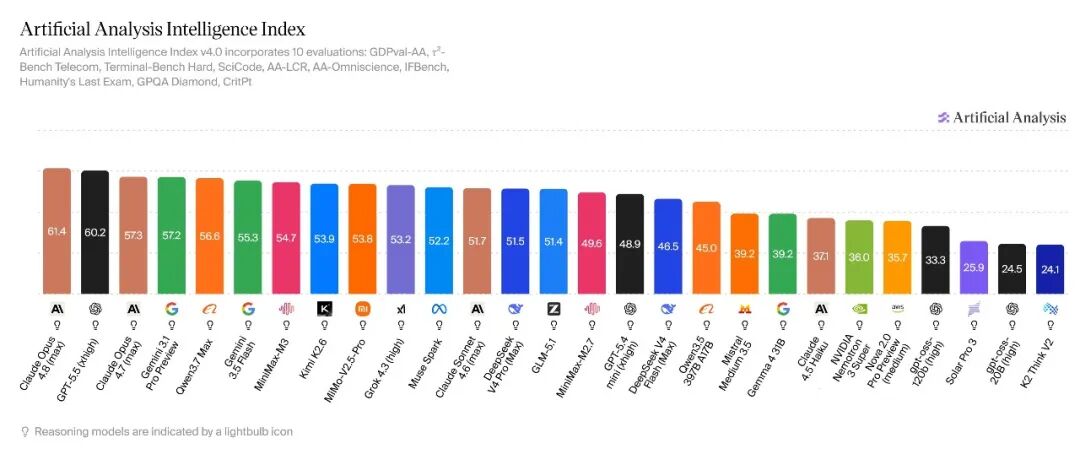
On Artificial Analysis (AA)’s Comprehensive Intelligence Index, MiniMax M3 ranks seventh globally—the highest for any open-source model.
Just half a year ago, capital markets debated whether generative AI could achieve sustainable business models. That’s no longer a question: Anthropic just filed its prospectus and will turn profitable in Q2 this year, with OpenAI not far behind. The “Token economics” of large models are now firmly established—selling Tokens has become a highly promising business, driven by two core forces: first, the Agent trend led by OpenClaw; second, the video large model boom represented by Seedance, Happy Horse, and Veo. Both have strong productivity attributes and consume massive Tokens; It's amazing that (qímiào de shì, meaning “ It's amazing that ” or “What’s fascinating is”), users believe the Token spend is worthwhile—the more you buy, the more you earn. A win-win business!
In Q1 this year, I considered MiniMax’s Coding & Agent capabilities negligible and thus underestimated it. However, M3 has completely changed that perception—for me and everyone else. Compared to its predecessor M2.7, its progress is revolutionary. In international authoritative Benchmark Tests covering software engineering, terminal execution, and other dimensions (e.g., SWE-Bench Pro), M3 achieved global leading levels, even surpassing GPT-5.5 and Gemini 3.1 Pro, trailing only Claude Opus 4.7. I’ve noticed that even evaluators skeptical of MiniMax’s Coding abilities admit: “From now on, lobster-farming tasks can fully be handed over to M3.” (A metaphor for repetitive coding tasks.)
By the way, MiniMax Code, a Coding Agent product designed specifically for and trained alongside M3, was released simultaneously. As everyone knows, the AI Coding & Agent boom since early this year owes half its success to foundational model advancements and half to the release of tools like Claude Code and GPT Codex—which marked Vibe Coding’s true entry into the Agentic era, where AI not only generates code but also fully understands tasks like trained software engineers, building, modifying, and maintaining real software systems. Once Vibe Coding broke through, Token economics became unquestionable—no wonder Musk’s xAI is spending 60 billion USD to acquire Cursor, essentially buying a ticket to the Agent era.
Building foundational models is hard, and building Agents is hard too. Over the past six months, while several domestic large models with coding capabilities emerged, domestic Coding Agents remained blank. Developers still relied on third-party tools like Claude Code. In other words, until a few days ago, domestic AI Coding was at the “model exists, but no Agent” stage, with most developers directly using overseas advanced Agents. This time, MiniMax Code fills that gap. Frankly, the tool is still in its infancy and needs time to refine features and build a user base. If done well, foundational models + Agent tools can deliver 1+1>2 results; if not, users can still operate M3 and future models via other Coding Agents. I’m no tech expert, so I won’t conclude on MiniMax Code’s future yet—we’ll see in the coming quarters.
M3’s 1M context window matters because only a sufficiently long window can accommodate complex inputs/outputs—most people understand that. But native multimodal abilities are often overlooked. Many think the multimodal track is crowded with domestic players like Seedance and Kling, and international ones like Veo and Luma—what’s so special about MiniMax’s native multimodal? I might have asked the same question two months ago, but after deep research in the AI video industry recently, I have some insight.
Multimodal is a complex concept, encompassing both output and understanding of multimodal content. M3’s ability to understand images and videos, combined with strong Coding, unlocks complex workflows—e.g., input a gameplay video, have the model analyze core mechanics, then program a clone or modify it; or input surveillance footage, define marking/alert conditions, and have the model analyze frame by frame; or input reference images/animations, have the model summarize character/scene art styles, and even create new art proposals...
Don’t forget, MiniMax also has text, voice, and video large models, enabling cross-modal input/generation. With the hit film *Ama’s Love Letter* sparking viral copycat letters on Xiaohongshu, an “Overseas Chinese Letter Generator” could easily be built with M3. For AI short drama creators, this is a boon—feed script text, reference images/videos as Prompts to directly generate complex video content. M3’s ultra-long context window allows Repeatedly modify (fǎnfù xiūgǎi, meaning “repeated revisions”). Today, most AI short dramas still require professional toolkits for Assisted Creation (fǔzhù chuàngzuò, meaning “assisted creation”), with higher barriers than imagined. Google I/O’s Omni multimodal model showed the possibility of completing full creation tasks in one dialog window; while M3 currently lags in functionality, perhaps MiniMax could offer similar capabilities someday.
Thus, Coding/Frontier capabilities, ultra-long context window, and native multimodal abilities form an inseparable whole, covering both Token economics’ current focal points—Coding & Agent and video generation. Open-sourcing it is even more valuable, greatly expanding the developer ecosystem. I often marvel: Silicon Valley’s top AI firms, including OpenAI and Google, once embraced open source but grew increasingly closed as technology advanced. xAI once marketed itself as open-source but stopped with Grok 2.5. Today, Silicon Valley’s open-source ecosystem is limited to Meta’s LLaMA series, Google’s Gemma series, and occasional small models from OpenAI—all lagging cutting-edge models by at least half a generation. Does this align with AI’s principle of accessibility?
In contrast, China’s MiniMax, Qwen, Kimi, DeepSeek... all offer open-source versions of their cutting-edge models, with M3 being the first open-source model globally to bundle the “Frontier Trifecta.” On U.S. social media like X and Reddit, we see complaints: While Silicon Valley firms guard their most advanced models closely, Chinese firms offer open-source cutting-edge models at rock-bottom prices. Is this merely a business model choice, or something deeper? Which side truly represents the open, equal, and accessible trend?
I dare not conclude on that question. All I can say is: MiniMax M3 is an impressive model that excites me. I hope it and other Chinese large model firms continue to deliver powerful, open, and affordable models. I’ll add: Generative AI’s transformation of society unfolds over decades, so I don’t focus on short-term capital market fluctuations—daily or weekly market swings driven by emotions don’t affect fundamentals, especially not foundational R&D and technological progress.
-
![]()
73-Day Rapid Listing: Where Does Unitree's Wang Xingxing's 'Sense of Urgency' Come From?
-
![]()
AI Project Mindverse, Backed by Meituan, Faces Data Inflation Allegations Over Its Macaron Product
-
![]()
3000-word In-Depth Analysis | What Makes Physical AI So Magnetic? It Has Captivated Masayoshi Son, Jensen Huang, and Justin Sun All at Once
-
What Does LoRaWAN Plan to Do in the Next Three Years?
-
![]()
Can WeChat ‘Win Over the Bride’ from Doubao?
-
![]()
Transformation, Boarding, and Buying Tickets: Catching the Last Bus with a Leap
-
The Backside Knife Skills of vivo S60 and OPPO Reno16
-
![]()
Breaking News | Core Chip Team Member Unexpectedly Changes Jobs! OpenAI Transforms into Anthropic's Talent Hub, with Over 15 Ex-OpenAI Core Members Now Holding Key Roles at Anthropic