What Exactly Has Changed with the AI That Automatically Opens a Browser to Search Xiaohongshu?
 06/08 2026
 406
406
While most still view AI assistants as smarter chatbots, AWS has dropped a bombshell: Amazon Quick. This isn’t just a product update—it’s moving AI from “chat windows” into “real workflows.”
Recently, AWS played three cards simultaneously: Amazon Quick, four vertical Agent solutions in the Amazon Connect family, and deepened collaboration with OpenAI. While seemingly independent, all three point in the same direction: moving Agentic AI from concept to large-scale deployment.
But what truly excites is the fully real-time product demo.
A Team-Building Task That Showcases the AI Assistant’s True Capabilities
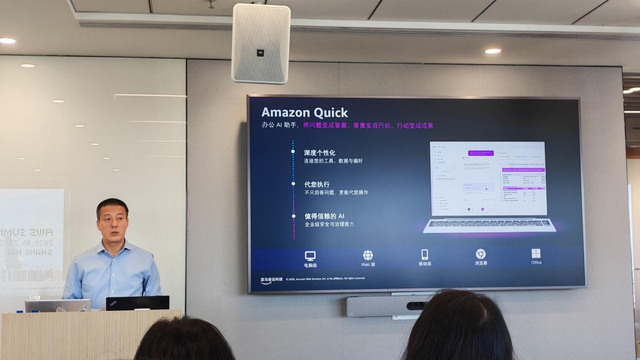
Chen Xiaojian, General Manager of Solutions Architecture at AWS, stated, “Agentic AI represents a critical turning point in technological development. It transforms AI from an assistant into a teammate capable of autonomous reasoning, planning, and execution within complex workflows. This shift is no less significant than the birth of the internet or cloud computing.”
This assertion was vividly demonstrated during the product demo at the launch event.
The demonstrator’s task was to arrange a team-building event in Suzhou. This wasn’t a simple command like “write me a poem” but a business process requiring cross-system, multi-step collaboration to deliver tangible results. Amazon Quick first queried weather and traffic via Gaode Maps, then automatically opened Chrome on the computer, navigated to Xiaohongshu to search for “Suzhou outdoor team-building, rock climbing, kayaking,” scrolled through pages, and saved screenshots. Next, it jumped to Dianping to find restaurants, cross-verifying reviews. Finally, it generated a complete HTML plan covering weather, activities, dining, transportation, timeline, and budget, using the automatically captured Xiaohongshu and Dianping screenshots as illustrations. More impressively, when the demonstrator said, “Send this to XX,” Amazon Quick automatically located XX’s email from its constructed knowledge graph, drafted the email, attached the plan, and sent it after confirmation. Subsequently, when asked to create a presentation PPT, Amazon Quick, remembering her preferences, directly generated a sleek two-page white-background slide deck.
Throughout the process, the demonstrator didn’t manually open a browser, copy-paste, or switch between apps. She only did one thing: issue instructions in natural language.
This exposes the real gap with current AI assistants on the market. Over the past two years, user communities for “shrimp farming” and “horse breeding” (referring to desktop Agent tools like OpenClaw and Hermes) have validated the value of such product forms. However, Agents built by individual users struggle to address two critical issues in enterprise scenarios: data integration and security compliance. Guo Ren, AI Technology Director at AWS, bluntly stated in an interview, “For similar products, whether used by individuals or enterprise employees, achieving internal data integration, security control, and governance within enterprises is extremely difficult.”
Building Secure Enterprise-Grade AI Assistants
What truly distinguishes Amazon Quick from general-purpose personal AI assistants isn’t its natural language prowess but its answers to three questions IT departments care most about from the outset: Who can use it? What can they see? Who did what and when?
It supports SSO, RBAC role-based access control, audit logs, and various compliance certifications. It includes built-in connectors for enterprise tools like Outlook, Salesforce, Slack, Jira, and Asana—not third-party plugins downloaded haphazardly but officially provided, secure, and auditable integrations.
“You can view Amazon Quick as your sole desktop gateway,” said Chen Xiaojian, General Manager of Solutions Architecture at AWS. “These connections and access points aren’t random third-party plugins you download yourself. Behind them, the company ensures security and availability. That’s the fundamental difference.”
This “enterprise DNA” is also reflected in another key capability: local file access and execution. Amazon Quick can read, write, and search files in user-authorized folders and safely execute code in a local sandbox environment without contaminating the operating system. This means enterprise employees can finally bring scattered Excel, PDF, and Word documents under the AI assistant’s purview without fear of data being uploaded to unknown cloud servers.
Most AI tools are passive by nature. You ask; they answer. If you don’t ask, they idle. But Amazon Quick’s design logic differs. It resides in the desktop background, continuously monitoring emails, calendars, chat tools, and application data to proactively push items requiring attention.
For example: With an important 2 PM meeting, Amazon Quick automatically organizes relevant Slack conversations, documents edited the previous day, and associated meeting minutes without a prompt. If there’s a scheduling conflict or urgent alert, it provides advance warning.
Another source of this “proactive feel” is its learning ability. Over time, Amazon Quick better understands users’ work habits: who they collaborate with frequently, which projects they focus on, preferred document formats, etc. It even constructs a visual knowledge graph intuitively displaying relationships between users’ associated information, people, and projects. All preference memories used in Amazon Quick are editable and traceable—a must for responsible generative AI products, not black boxes.
Internal data from Amazon Books shows that after adopting Amazon Quick, management’s time spent drafting coordination documents dropped by 80%, and engineering teams reduced factory testing time by 67%. 3M sales reps saved over 5 hours weekly preparing for client meetings. Behind these numbers, AI has “consumed” tedious tasks like information gathering, cross-system operations, and formatting.
Connect Family Expands: When Agents Enter Supply Chains, Recruitment, and Healthcare
If Amazon Quick is the Agent interface for general office scenarios, the four products in the Amazon Connect family released simultaneously serve as AWS’s boosters for deploying Agentic AI into vertical domains.
The most eye-catching is Amazon Connect Decisions, an Agent solution tailored for supply chain management. Its confidence stems from Amazon’s 30 years of global supply chain experience. Internally, it comprises six specialized Agents forming a collaborative network covering demand forecasting, supply planning, root cause analysis, recommendation generation, and autonomous execution. Critically, it designs a progressive trust-building path: “human-Agent collaboration → Agent autonomous decision-making → continuous learning and improvement.” Every AI insight comes with a clearly explainable reasoning process, avoiding “black box decisions.”
Amazon Connect Talent directly addresses recruitment pain points: limited interview resources, inconsistent standards, and losing top candidates due to scheduling delays. Its solution is AI-driven skills assessment plus 24/7 voice interviews, evaluating every candidate uniformly. Amazon’s experience hiring ~250,000 seasonal workers during peak seasons last year is distilled into this product.
Xia Zhanwang, AI Product Director at AWS, noted that these vertical Agents “originate from actual business challenges within the Amazon Group.” Connect Decisions builds on operational research accumulated from managing over 400 million SKU inventories, while Connect Talent draws from automation experience in high-volume recruitment.
Partnering with OpenAI: The Logic of a Model Marketplace and a “Non-Aligned” Strategy
The third major announcement at the event was collaboration with OpenAI, integrating OpenAI’s cutting-edge models, programming Agent Codex, and OpenAI-hosted Agents into the Amazon Bedrock platform. This raises an immediate question: With AWS already collaborating closely with Anthropic, doesn’t adding OpenAI create internal competition?
Chen Xiaojian responded candidly, “When Amazon Bedrock was officially launched years ago, its design intent was to serve as a model marketplace, accessing more leading global models. Whether Anthropic or OpenAI, neither is the first model integrated, nor will they be the last.” He further revealed that using services like Codex on Amazon Bedrock counts toward AWS’s committed consumption and follows the same policies as native services, “reflecting the depth of our collaboration with OpenAI.”
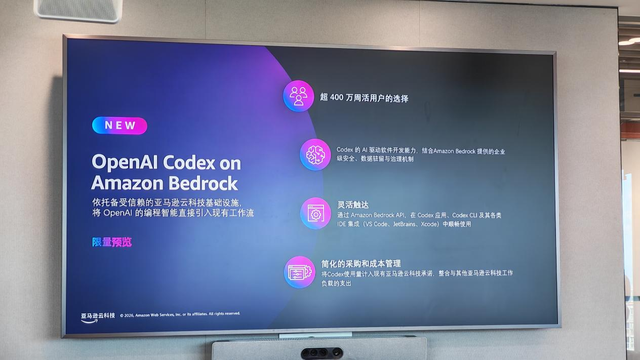
This “platform-agnostic” strategy appears increasingly pragmatic in today’s AI competitive landscape. Enterprise clients don’t want to be locked into a single model vendor; they need the freedom to choose the best models under a unified security governance framework. Xia Zhanwang highlighted the trend: “More model providers partnering with cloud vendors is a major trend. Clients’ data and applications already run on the cloud. Combining model capabilities with cloud-native architectures boosts efficiency without compromising intelligence or governance.”
A “Full-Stack Experiment” in Agent Deployment
Looking back at the announcements, AWS’s ambition isn’t to create a couple of viral AI apps but to comprehensively deploy across five layers of the AI technology stack: foundational self-developed Trainium chips (4th gen on the way); model layer with Amazon Bedrock aggregating first-party, open-source, and commercial models; data and knowledge layer with database and storage capabilities; Agent development platform layer with Amazon Bedrock AgentCore; and top-layer out-of-the-box Agents: Amazon Quick, Kiro (developer Agent), and the Amazon Connect family.
This explains why AWS dares to operate simultaneously in general office and vertical scenarios. General scenarios rely on Amazon Quick as the “interface,” while vertical scenarios leverage the Connect family for “depth,” all underpinned by a unified AI infrastructure and security architecture. “Whether a task is handled by Kiro or Amazon Quick depends on the user’s preferred interaction style. The underlying capabilities and skills are interoperable and reusable,” said Chen Xiaojian.
At the turning point where Agentic AI moves from concept to deployment, the real competition may not lie in whose model has more parameters but in who can safely, controllably, and sustainably integrate AI into enterprises’ real business processes. The significance of Amazon Quick Desktop lies not in adding a few features over ChatGPT but in enabling enterprises to treat AI assistants as “full-fledged employees”: granting permissions, teaching business processes, integrating them into systems, and maintaining full auditability throughout.
As Chen Xiaojian quoted AWS CEO Matt Garman’s vision at the beginning of his speech, “In the future, every enterprise will have billions of Agents operating in every conceivable domain.” Making this a reality depends not on the models themselves but on the infrastructure that makes Agents “trustworthy, affordable, and manageable” for enterprises.
-
![]()
73-Day Rapid Listing: Where Does Unitree's Wang Xingxing's 'Sense of Urgency' Come From?
-
![]()
AI Project Mindverse, Backed by Meituan, Faces Data Inflation Allegations Over Its Macaron Product
-
![]()
3000-word In-Depth Analysis | What Makes Physical AI So Magnetic? It Has Captivated Masayoshi Son, Jensen Huang, and Justin Sun All at Once
-
What Does LoRaWAN Plan to Do in the Next Three Years?
-
![]()
Can WeChat ‘Win Over the Bride’ from Doubao?
-
![]()
Transformation, Boarding, and Buying Tickets: Catching the Last Bus with a Leap
-
The Backside Knife Skills of vivo S60 and OPPO Reno16
-
![]()
Breaking News | Core Chip Team Member Unexpectedly Changes Jobs! OpenAI Transforms into Anthropic's Talent Hub, with Over 15 Ex-OpenAI Core Members Now Holding Key Roles at Anthropic