BIWIN Storage, Betting 20 Billion on the Future with Hundreds of Billions in Market Cap
 06/11 2026
 517
517

BIWIN Storage's AI Surge and Hidden Concerns
Source | Silicon-based Quadrant
In the capital market, BIWIN Storage has transformed from an unknown player to a star enterprise in just one year. Over the past year, its market cap has increased by hundreds of billions, with its stock price surging at "quadruple speed." Last June, the company's stock hovered at 62 yuan per share; by June 10 this year, it had risen to 317 yuan per share, a nearly fivefold increase in a year, with a market cap exceeding 140 billion yuan. However, its main revenue growth does not come from AI servers with massive computing power but from electronic products like watches, smartphones, and PCs. For example, in small AI terminal scenarios like AI glasses, global AI glasses shipments are expected to reach only about 8 million units in 2025, with the related memory chip market valued at less than 10 billion yuan. Yet, BIWIN Storage generated 960 million yuan in revenue in this field, securing contracts with leading companies like Meta, Xiaomi, and Thunderbird Innovation.
This company, established nearly 30 years ago, continues to bet big on the future. In March and June this year, it placed orders worth $1.5 billion and $1.661 billion, respectively, totaling over 20 billion yuan, with suppliers. Meanwhile, the company has submitted an A+H listing application to the Hong Kong Stock Exchange, hoping to raise more capital in the international market.
Behind the 20 billion yuan bet and capital ambitions, does BIWIN Storage, as a beneficiary of the memory chip upcycle, have its own moat? Where is the ceiling for its growth?
01 The Secret to Its Rapid Growth
BIWIN Storage is not the Chinese version of Samsung but a "high-end precision packaging factory for chips."
BIWIN Storage's core business is the "high-end precision packaging of memory chips." It purchases core raw materials from storage giants like Samsung and Micron, such as NAND Flash wafers and chips, DRAM wafers, and then procures controller chips and substrates/PCB boards for IC packaging and testing or module manufacturing. These products are sold to companies requiring customized solutions for AI glasses, smartwatches, tablets, and PCs.
Its storage wafers come not only from Samsung, SK Hynix, and Micron but also from Kioxia, Western Digital, Yangtze Memory Technologies, and ChangXin Memory Technologies. Controller chips are purchased from companies like Silicon Motion, Maxio Technology, and InnoGrit. Substrates are sourced from Shennan Circuits, Fastprint Circuit Tech, and HMT Technology, while PCBs are procured from Victory Giant Technology, Xiangqiang Electronics, and Zhen Ding Technology.
BIWIN Storage's business is divided into four main categories. Embedded storage is its largest business, accounting for over 60% of revenue. PC storage is the second-largest, contributing nearly 30% of revenue. The other two businesses, automotive-grade storage and advanced packaging and testing services, together account for less than 5% of revenue.
Embedded storage is used in smartphones, tablets, AI/AR glasses, smartwatches, and AI learning devices. By 2025, revenue in this segment reached 6.878 billion yuan, making it the largest income stream.
BIWIN Storage generated 960 million yuan in revenue from memory chips for AI glasses, accounting for about one-eighth of its embedded storage business. Although this is an emerging field with a low overall market share, it has become a key driver of the company's performance growth, with a compound annual growth rate of approximately 378.09% over the past two years. In the first quarter of 2026, BIWIN Storage's revenue from AI-enabled emerging edge storage products reached about 1.175 billion yuan, a year-on-year increase of 496.45%.
PC storage includes SSDs (including SATA/PCIe 3.0/PCIe 4.0/PCIe 5.0) and DRAM modules (including DDR4 and DDR5), used in desktops, laptops, and gaming consoles, generating about 3.694 billion yuan in revenue. In the PC pre-installation market, it has secured clients like HP, Lenovo, Acer, ASUS, and Xiaomi. In the aftermarket, it has obtained licenses from HP, Acer, and Predator. However, this segment has the lowest gross margin at 18%, with low technical barriers and fierce industry competition.
In 2025, the company's revenue reached 11.302 billion yuan, a year-on-year increase of 68.82%; net profit was 932 million yuan, a year-on-year increase of 465.47%. The first-quarter financial report showed even more rapid growth, with revenue of 6.814 billion yuan, a year-on-year increase of 341.53%; net profit was 2.899 billion yuan, compared to a loss in the same period last year.
Behind its rapid growth in performance and stock price, on the one hand, in the second half of 2025, memory chips were in short supply, and the storage industry experienced a cyclical upturn. Leading companies like Samsung, SK Hynix, and Micron saw their first-quarter profits surge by over 300%, driving BIWIN Storage's growth. On the other hand, AI has brought new growth stories, with AI servers, AI PCs, AI smartphones, AI glasses, and embodied AI requiring customized memory chips.
BIWIN Storage's in-house packaging and testing factory enables it to respond extremely quickly to the small size and high-density packaging demands of AI products.
02 The "Precision Packaging Factory" Built by Two Generations
The key to BIWIN Storage securing orders from a large number of AI glasses manufacturers like Meta, Xiaomi, Rokid, and Thunderbird Innovation lies in a critical technology—ePOP (embedded package on package).
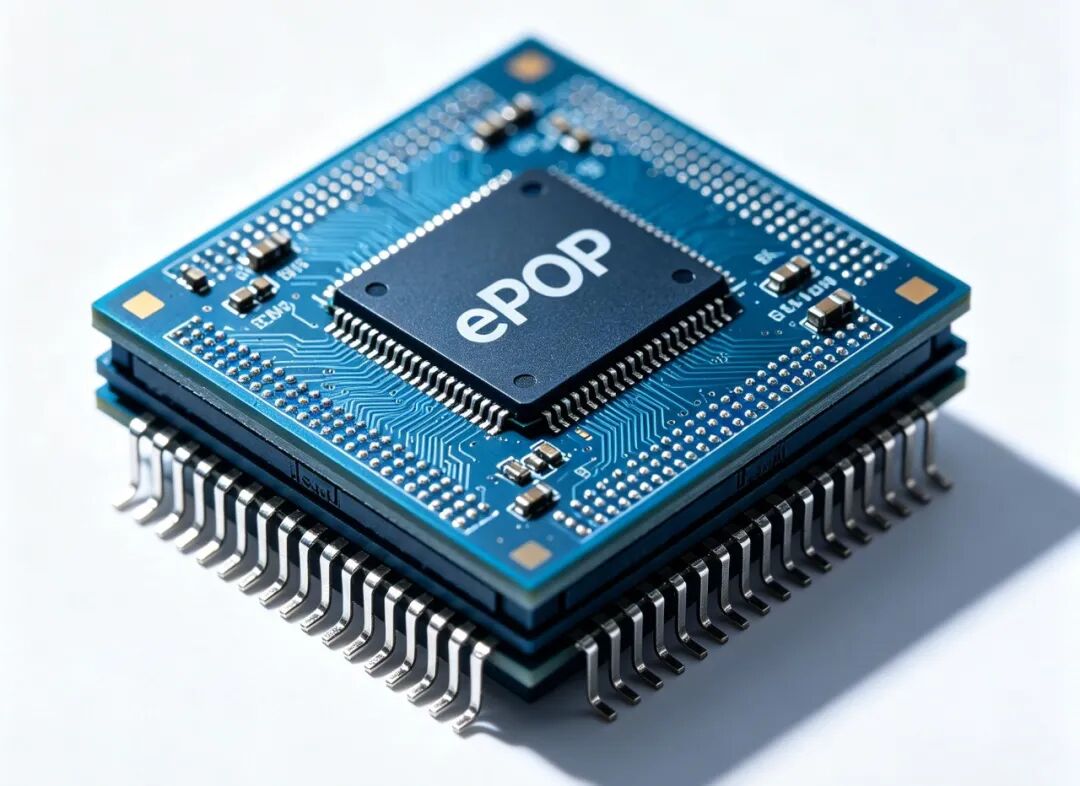
ePOP was first proposed by Samsung in 2015, aiming to stack SoC chips and memory chips on a single motherboard to achieve low power consumption, fast response, and a lightweight, compact design. Currently, BIWIN Storage's ePOP can achieve a packaging thickness of 0.54mm, making it a relatively lightweight solution in the industry.
BIWIN Storage was founded in 1995 by Sun Rixin, a post-1960s college graduate who majored in automatic control at Southwest Jiaotong University and worked as an engineer at the First Survey and Design Institute of the Ministry of Railways for nine years before moving to Shenzhen in 1995. There, he established BIWIN in Huaqiangbei with a registered capital of just 500 yuan, selling storage hard drives and floppy disks for computers.
However, Sun Rixin did not limit himself to trade. In 1999, he established a factory, transitioning the company into storage contract manufacturing, focusing on the contract manufacturing of flash memory modules, graphics cards, and other products, and gradually building partnerships with international wafer foundries like Intel, Samsung, and Micron.
In 2008, during the global financial crisis, many companies saw declining orders, financing difficulties, and shrinking market demand. Undeterred, Sun Rixin invested in building an 8-inch and 12-inch IC wafer packaging and testing factory in 2009.
This "somewhat risky" decision allowed the company to secure a foothold in the storage industry.
There are two types of chip design companies: Fabless, which outsources wafer manufacturing to foundries like SMIC and TSMC and packaging and testing to companies like JCET and Changxin Advanced Packaging (e.g., GigaDevice); and IDM, which owns wafer foundries and packaging and testing facilities, completing the entire chain from design, wafer fabrication (Fab), to packaging and testing, like Samsung, Micron, and SK Hynix.
However, for NAND Flash and DRAM in memory chips, there is an advanced process at the Fab end—3D stacking of wafers. Currently, Samsung and Micron have achieved 200-300 layers of 3D stacking and are evolving toward 400 layers. DRAM currently uses a 10nm-level process but requires TSV (through-silicon via) stacking during packaging and is researching 3D stacking technologies to meet high-computing power demands.
As product performance improves, higher-capacity and thinner memory chips are required, and packaging technology has evolved from traditional "protection and pin" solutions to advanced packaging, stacking chips to increase integration.
In 2012, BIWIN Storage welcomed new blood as Sun Chengsi, the second generation, joined the company. Three years later, at just 27 years old, Sun Chengsi officially took over as chairman.
After taking power, Sun Chengsi began layout (strategically planning) frontier packaging and testing capabilities and planned to go public to raise more funds for R&D and expansion of packaging and testing factories. In December 2022, the company officially listed on the STAR Market and used the raised funds to continue expanding its packaging and testing factories. Currently, it has two production bases in Huizhou and Dongguan, namely Tailai Technology and Xincheng Hanqi.
03 The "Hidden Concerns" of the Hundred-Billion-Dollar Packaging Factory
Although packaging and testing are important, the bargaining power in the industrial chain is still weaker than that of wafer foundries.
Memory chips are divided into volatile memory (mainly DRAM) and non-volatile memory (mainly NAND Flash), with these two markets long dominated by Korean giants.
The DRAM market has long been dominated by Samsung, Micron, and SK Hynix, which together account for about 90% of the market share. CFM Flash Market data shows that in the fourth quarter of 2025, Samsung, SK Hynix, and Micron ranked in the top three with 37.1%, 33.1%, and 20.8% market shares, respectively, while Nanya Technology and Winbond Electronics ranked fourth and fifth with only 1.9% and 0.6% market shares.
The NAND Flash market is similar, with Samsung, SK Hynix, Kioxia, SanDisk, and Micron accounting for about 90% of the market share, while other companies share the remaining 10%.
In the storage industry, Samsung, Micron, and SK Hynix still control global major resources. The core technologies of storage products lie in NAND Flash, DRAM wafers, and controller chips, which BIWIN Storage relies on external procurement for. This leads to the need for significant inventory stockpiling, with bargaining power constrained by upstream companies and relatively low gross margins. Over the past four years, its comprehensive gross margins were 13.73%, 1.71%, 18.19%, and 21.44%, respectively.
The storage industry is inherently cyclical, which is its most significant characteristic. Profits surge when prices rise and shrink rapidly when prices fall. In 2023, during the storage downturn, BIWIN Storage's gross margin was only 1.71%. At that time, the global memory chip market collapsed, with inventory clearance and price plummets, causing Micron's gross margin to drop to -9.11%.
In the upcycle of 2025, Micron's gross margin rebounded to 40%. However, even though BIWIN Storage became the global leader in "AI glasses storage," with its core NAND Flash and DRAM wafers entirely reliant on external procurement, the majority of profits still went to upstream suppliers, and its comprehensive gross margin was only about half that of the original equipment giants.
In addition to pressure from international giants, BIWIN Storage faces direct competition from Jiangbo Long, another Huaqiangbei-based company also engaged in memory module packaging. In 2023, after Jiangbo Long acquired the packaging and testing factory Powertech Technology (Suzhou), it gained its own packaging and testing factory, and the two companies will engage in fierce competition in the smartphone embedded storage (eMMC/UFS) and consumer markets.
Over the past three months, BIWIN Storage has signed two wafer procurement contracts totaling $3.3 billion, with locked quantities and prices for a 24-month period, while its book value of inventory reached 17 billion yuan in the first quarter. This bet indicates that management remains confident in the future growth cycle of the storage industry.
Clearly, BIWIN Storage is one of the beneficiaries of this round of storage market upturn. Whether it can continue to surge at quadruple speed in the future hinges on the pace of AI development and, more importantly, its ability to correctly navigate market cycles.
-
![]()
Why Do All Cars Look Alike These Days?
-
Don't Just Focus on Financing Amounts—Look at the 'Order Truth' Behind the Commercialization of Embodied AI
-
![]()
Are Traditional Fuel Cars Really Losing Their Market?
-
![]()
Comprehensive PPT Guide to Understanding CAAM Production and Sales Data: Auto Production and Sales Declines Narrow Again in May; New Energy Vehicle Market Share and Auto Exports Reach New Monthly High
-
![]()
Chinese Cars Seize Overseas Markets: The Advent of a Winner-Takes-All Era
-
![]()
Will WeChat Start Charging Fees?
-
![]()
Cross-border 'Golden Window' in 2026: Chinese Products Sweep Across Southeast Asia
-
![]()
BIWIN Storage, Betting 20 Billion on the Future with Hundreds of Billions in Market Cap