MiniMax at the Crossroads: The Triple Threat of Policy Relaxation, Price Hikes, and Global Competition
 06/15 2026
 458
458
Produced by | RoboIsland
Recently, MiniMax launched its new flagship M3 model and, on the same day, switched from a long-standing per-use billing model to token-based pricing, with monthly subscription plans jumping from 29 RMB to 49 RMB without prior notice to users.
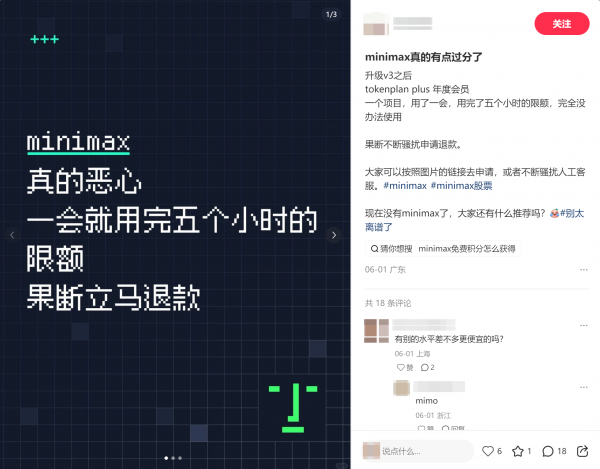
The developer community erupted in outrage as token consumption for equivalent tasks far exceeded expectations, with some users calculating actual cost increases of up to 257%.
Overnight, MiniMax transformed from a tech darling into a consumer betrayer.
How did an AI unicorn once valued at over HK$300 billion fall from grace due to a single pricing adjustment?
The price hike controversy was not an isolated operational mishap but a concentrated eruption of deep-seated contradictions in MiniMax's business model: relying on quick profits from C-end virtual companions to fund expensive foundational model R&D.
This path is becoming increasingly untenable in 2026, amid soaring computational costs and intensifying price wars.
I. The Price of Acting First and Explaining Later
Before the M3 release, MiniMax enjoyed a strong reputation among developers.
Its Coding Plan, with its "per-use deduction, no weekly limit" model, was virtually unique in China's AI programming service market.
Coupled with an aggressive pricing strategy—the Starter tier at just 29 RMB/month (9.9 RMB for the first month), far below the 40-50 RMB range of mainstream competitors—MiniMax rapidly amassed a large user base of individual developers.
The 2025 annual report revealed explosive growth in token consumption under the Coding Plan, becoming a key driver of revenue growth for its open platform.
However, the M3 release fundamentally altered the rules of the game.
The new model adopted token-based consumption pricing, with the lowest available plan surging from 29 RMB to 49 RMB. What users found even harder to accept was the complete lack of prior notice for this adjustment.
Many developers discovered the rule change only upon logging in, finding their monthly allowances exhausted within days.
One Plus-tier user reported on social media that what previously allowed approximately 1,500 calls within a 5-hour window now supported only 300-500 calls after the change. Another user calculated: whereas consuming 3-5 billion tokens monthly once cost 49 RMB, the same volume now required roughly 175 RMB.
To make matters worse, MiniMax was accused of applying double standards to API pricing in China and overseas.
For contexts under 512K, domestic input pricing stood at 2.1 RMB/million tokens, compared to 0.3 USD (approximately 2.04 RMB) overseas. While the difference was minor, at a time of heightened user tension, this differential treatment quickly escalated into a trust crisis.
Facing a deluge of complaints, MiniMax's parent company, Xiru Technology, issued an emergency apology on the evening of June 1, admitting "failure to adequately communicate this adjustment in advance" and "improper handling of issues like weekly limits for existing users."
The company subsequently introduced compensation measures: retaining unlimited weekly access for users subscribed before March 22, granting 50% additional tokens to new users, and uniformly resetting usage quotas from June 1-7.
From a technical standpoint, this price hike was arguably inevitable. The M3 model's computational demands far exceeded its predecessor, making the original per-use billing model unsustainable in the age of intelligent agents.
Global peers like Anthropic and OpenAI also employ token-based pricing, so the model itself was not the issue. MiniMax's problem lay in execution: failing to provide users with a sufficient grace period, neglecting to transparently communicate the magnitude and rationale for price increases. In a developer market highly sensitive to pricing, this act of "acting first and explaining later" was tantamount to self-sabotage.
The deeper issue is that this price hike exposed the fragility of MiniMax's business model.
Over 70% of the company's revenue comes from overseas C-end products (primarily the virtual companionship app Talkie), yet the C-end business operates at a mere 4.7% gross margin—effectively "charity work" by tech industry standards.
As computational costs continue to rise, the original low-price strategy became untenable, making price hikes inevitable.
However, how to implement price increases and communicate with users tests a company's fundamental capabilities in transitioning from technology-driven to platform-driven operations. From this perspective, MiniMax still has a long road ahead.
II. Awkward Positioning Amid Price Wars
Judged purely by technical metrics, the M3 model performs impressively.
On SWE-Bench Pro, M3 scored 59.0%, surpassing GPT-5.5 (58.6%) and Gemini 3.1 Pro (54.2%), trailing only Claude Opus 4.7. On BrowseComp, it scored 83.5, even exceeding Opus 4.7's 79.3.
More importantly, M3 is the world's first open-source model combining "cutting-edge programming capabilities + 1M ultra-long context + native multimodality." Vercel CEO Guillermo Rauch evaluated it as "only slightly inferior to Opus & GPT-5 but 10 times cheaper."
In an era where Silicon Valley giants are increasingly moving toward closed-source models, MiniMax's commitment to open-sourcing its most advanced large models has earned it substantial goodwill in the global developer community.
OpenRouter data shows that daily token consumption for M3 rapidly surpassed 500 billion after release, with the M2 series once ranking among the top 10 globally in call volume.
Company co-founder and COO Yun Yeyi disclosed in late May that global enterprise and developer clients had exceeded 1 million, a fivefold increase from six months prior, with ARR doubling over the past two months.
The problem, however, is that capital markets have shifted their valuation logic. In the first half of this year, AI transitioned from an infrastructure boom to a focus on application delivery. Investors are no longer satisfied with benchmark scores; they demand verifiable commercialization data.
M3's pricing strategy collided head-on with this price war.
In cross-comparison, M3 finds itself in an awkward position. Compared to overseas giants, it does offer "domestic substitution" cost advantages: Claude Opus 4.7 costs approximately 5 USD (35 RMB) per million input tokens and 25 USD (175 RMB) for output in standard mode—several times higher than M3.
But in the domestic market, M3's pricing is significantly higher than the recently price-reduced DeepSeek-V4 series and Xiaomi's MiMo-V2.5 series. DeepSeek-V4-Flash costs just 0.14 USD (1 RMB) per million input tokens and 0.28 USD (2 RMB) for output. Even Alibaba's Qwen-3.7 Max, though originally more expensive, becomes cheaper than M3 after long-term 50% discounts.
This means M3's "justified premium" holds only in specific high-end scenarios (e.g., long contexts, complex programming); in cost-sensitive mass B-end markets, its cost-effectiveness advantage is not obvious.
This explains why MiniMax's stock price plummeted 15.71% on June 1 (M3's launch day) after an initial surge—the market voted with its feet, expressing doubts about the viability of this high-pricing strategy.
Notably, MiniMax is not unaware of the urgency of B-end transformation. Company management explicitly states that enterprise users are growing rapidly, now accounting for half of revenues alongside C-end earnings.
The issue is that transitioning from a 50-50 split to B-end becoming a true growth engine requires passing a severe test (severe test): Can M3 achieve simultaneous volume and price growth in real enterprise scenarios?
The upcoming mid-year report will be the first litmus test. If B-end revenue growth slows and gross margins don't improve, the narrative of successful B-end transformation will be disproven, and the stock price may not have bottomed out.
III. July Siege: Countdown to the Unlocking Flood
If the price hike controversy represents internal troubles, the impending unlocking flood and global AI giants going public constitute external threats.
First, consider the unlocking pressure. According to CICC analysis, MiniMax will face a massive share unlocking on July 9, with approximately 63% of its Hong Kong-listed shares becoming eligible for sale, of which financial investors hold over one-third.
Currently, only about 5% of the company's shares are freely tradable. After unlocking, supply will surge nearly 10-fold. Early investors, sitting on substantial profits relative to the IPO price (165 HKD), have even greater gains in some cases.
With market sentiment already fragile, selling pressure is virtually inevitable. HSBC's estimates are more direct: MiniMax currently burns about 28.1 million USD in cash monthly, and post-unlocking stock price support will depend entirely on whether fundamentals can deliver upside surprises.
Meanwhile, global AI giants are flooding capital markets.
Anthropic closed a 65 billion USD Series H funding round, reaching a 965 billion USD valuation, and has secretly filed for IPO; OpenAI has also initiated its listing process; SpaceX debuted on Nasdaq on June 12.
As these global top-tier AI assets enter public trading, valuation benchmarks for Hong Kong-listed large model companies will fundamentally shift.
Take Anthropic as a reference: its latest ARR stands at approximately 47 billion USD, with a P/ARR ratio of about 20x, and it expects to turn profitable in Q2 2026.
MiniMax currently has a market cap of about 27.4 billion USD and ARR of around 300 million USD, with a P/ARR ratio of approximately 60x. Even if MiniMax achieves its management target of 1 billion USD in ARR by year-end, its P/ARR would still be around 19x, roughly aligning with Anthropic.
This means that a significant portion of its current near-60x valuation is built on market expectations of high ARR growth and Hong Kong stock scarcity premiums. Once scarcity disappears, valuations will face systemic retracement.
Under this pressure, MiniMax signed an Tutoring Agreement (coaching agreement) with CITIC Securities on May 29 to pursue a "A+H" dual-capital platform strategy. This move is both defensive and speculative.
From a defensive standpoint, with its Hong Kong market cap sharply contracted and secondary financing capabilities impaired, the STAR Market offers lower financing costs and a more stable valuation anchor.
Historical data shows that A-shares typically trade at a roughly 20% premium to H-shares, with potentially higher premiums for hard tech labels.
This capital could provide MiniMax with crucial ammunition before reaching profitability. In 2025, the company spent 253 million USD on R&D, with operating cash flow outflows reaching 280 million USD. Its net loss (adjusted) was approximately 251 million USD, narrowing from previous periods but still far from profitability.
However, whether the STAR Market premium materializes depends on whether MiniMax is viewed as a "scarce large model asset" or a "replaceable API commodity."
If M3 commercialization stalls and B-end growth underperforms, the A-share market will not grant a premium, and Hong Kong valuations will face renewed scrutiny.
Meanwhile, if the A-share listing process stalls or valuations disappoint, the psychological value of equity incentives may waver, leading to core AI talent loss and, consequently, model iteration delays—a far more fatal blow than stock price declines.
From an industry perspective, MiniMax also faces subtle shifts in competitive dynamics.
Zhipu has surged ahead in market cap with stronger programming capabilities and B-end DNA; DeepSeek has rapidly seized API market share through aggressive price cuts; tech giants like Xiaomi and Alibaba continue to squeeze independent startups' survival space through ecosystem subsidies.
Under this four-front assault, MiniMax's ability to hold its ground appears uncertain.
IV. Conclusion
MiniMax currently faces three critical tests:
In the short term, whether the July share unlocking selling pressure can be absorbed by the market; in the medium term, whether the mid-year report can deliver "high B-end revenue growth + gross margin improvement"; in the long term, whether gross margins amid price wars and STAR Market financing channels can sustain the company until it reaches profitability.
The company boasts solid technical foundations, a global user base, and the leading open-source model M3—assets difficult for other domestic AI startups to replicate.
However, it also faces a fundamental contradiction: relying on C-end "dopamine business" profits to fund high-investment, long-cycle AGI R&D is increasingly precarious amid soaring computational costs.
The price hike controversy serves as a wake-up call but does not negate MiniMax's entire value.
The true test is whether, as technological luster fades beneath the shadow of computational costs and capital market patience turns toward hard numbers, MiniMax can complete the critical leap from having technology to making money.
Until then, maintaining caution is wiser than blind optimism or pessimism.
 Copyright RoboIsland. All rights reserved. No reproduction without authorization.
-
![]()
A Strategic Vision: Taking a Leaf Out of Apple’s Book in China’s Operation-Intensive Auto Market
-
![]()
Yu Chengdong Declares, ‘Only First Place Exists in My Lexicon.’ Is This Bold Claim or a Promise of Excellence?
-
![]()
Agent OS is Here! HarmonyOS 7 Unveiled, Huawei Redefines OS
-
![]()
Agent OS is Here! Huawei Unveils HarmonyOS 7, Redefining Operating Systems
-
DingTalk’s Evolution and the Dilemma Facing Alibaba
-
![]()
Can DingTalk's 'Historical Loopholes' Be Resolved by Its New, 90s-Born Leader?
-
![]()
MiniMax at the Crossroads: The Triple Threat of Policy Relaxation, Price Hikes, and Global Competition
-
![]()
Apple Shareholders Paid $230 Billion in 'Make-Up Exam Fees' for Apple's AI