Executives Exit in Style: Alibaba's AI Doesn't Need a 'Top Dog'
 06/15 2026
 535
535
AI Geniuses Are No Longer Essential for Big Firms
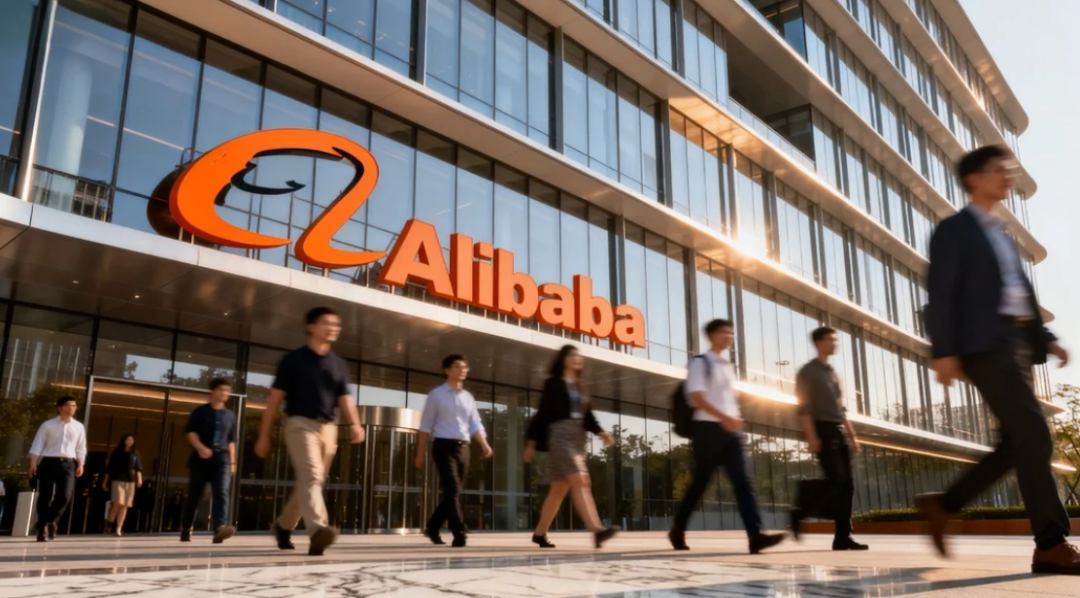
A prolonged and bizarre rumor of executive departures is once again pushing Alibaba's AI business into the spotlight.
On June 13th, IT Home reported that Alibaba partner Zhou Jingren had recently submitted his resignation application. Just six days earlier, on June 8th, Alibaba had announced Zhou's appointment as Chief Scientist, leading the establishment of the AI Future Research Institute to focus on exploring and breaking through cutting-edge AI technologies.
In just half a year, Zhou Jingren has actually undergone three job transfers. After Lin Junyang's departure in March, he temporarily oversaw Qwen. In April, he was appointed Chief AI Architect, taking charge of the Tongyi Large Model Business Unit. With this latest arrangement to focus on frontier exploration without handling specific operations, it's no wonder outside observers comment on a "promotion in name but demotion in reality."
As of press time, Alibaba has not directly responded to this rumor, but this is not the first time its AI business has faced a "less-than-graceful" transition.
From Lin Junyang in March, Wu Zhao in June, to the rumors surrounding Zhou Jingren a few days later, each change has swept through the internet with thunderous force, abruptly hitting the brakes at critical junctures.
When these personnel upheavals are pieced together, they may point to the same answer: In this company's AI landscape, there is no need for an absolute "top dog."
01 Those Who Can't Stay
In the early hours of March 4th, Lin Junyang, the technical leader of the Qwen team, left a line on social media: "me stepping down. bye my beloved qwen."
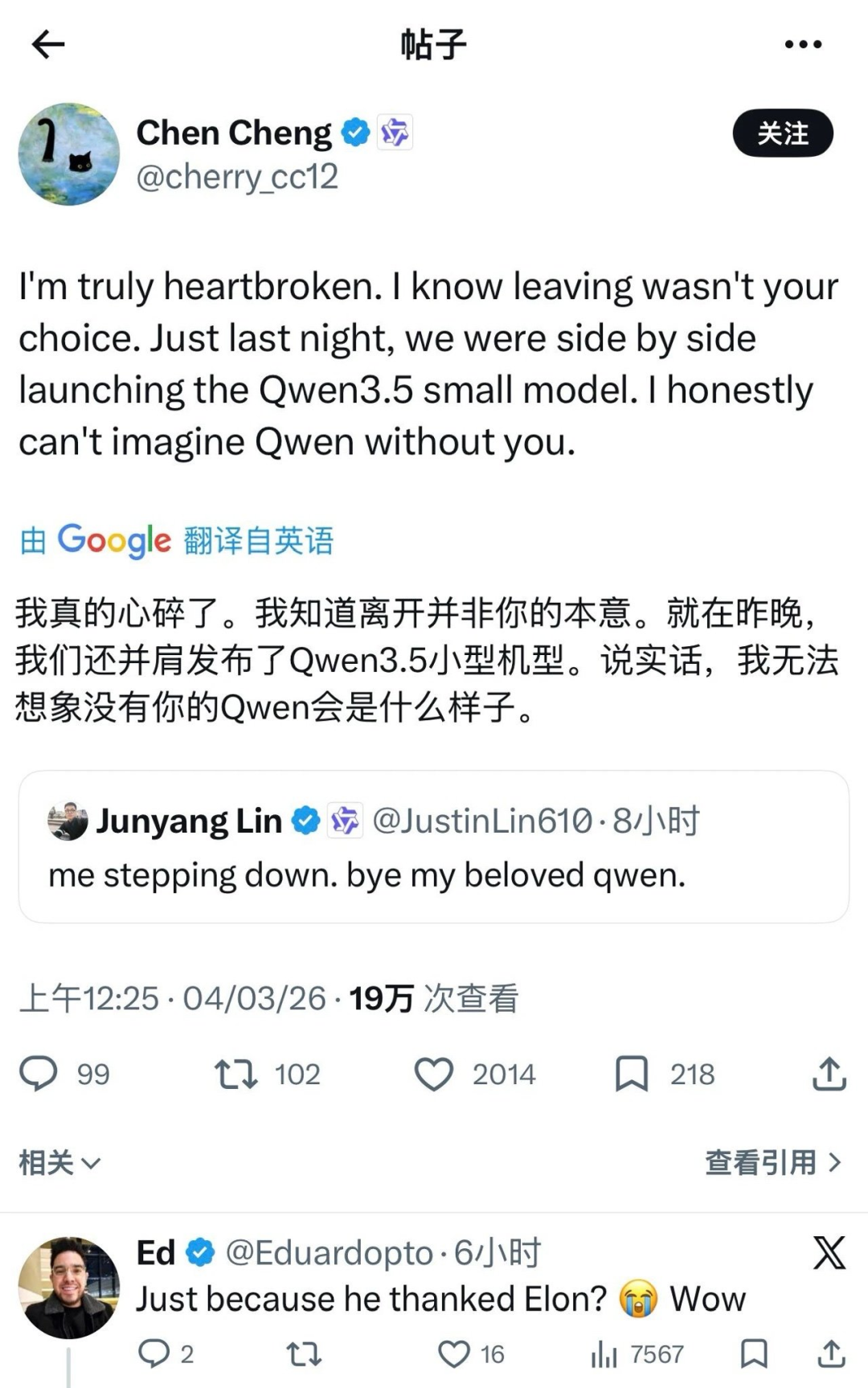
Less than 24 hours earlier, he had led the team to open-source Qwen 3.5, earning public praise from Elon Musk as "amazing."
This 32-year-old tech geek bid farewell to the project he had built with the simplest of words. At the same time, Yu Bowen, the post-training leader of Qwen, and core member Hui Binyuan also left the team. An open-source dream team once sought after by developers worldwide faced disintegration at its peak.
According to LatePost, organizational restructuring was one of the triggers.
The Tongyi Lab planned to split the Qwen team from a vertically integrated model into horizontally divided teams, with pre-training, post-training, text, and multimodal functions becoming independent teams. This ran counter to Lin Junyang's long-advocated "small team, big closed-loop" full-stack approach. The results-oriented KPI pressure and internal evaluations of "half-baked" products ultimately crushed this idealist.
The controversy quickly escalated to the group level, with senior executives such as Wu Yongming, Jiang Fang, and Zhou Jingren stepping in to communicate. An internal meeting was held to barely stabilize the situation.
Just when people thought this was Alibaba's biggest variable this year, DingTalk experienced an even more sensational leadership shakeup.
On June 11th, Alibaba announced the resignation of DingTalk CEO Chen Hang (alias: Wu Zhao), with post-92 tech geek Chen Yusen taking over. The trigger for this entire event was a 75,000-word resignation essay titled "Inside DingTalk."
Written by a former DingTalk product manager, the article comprehensively reviewed the entire process of DingTalk's AI project "ONE" from inception to failure, naming Wu Zhao 73 times and pointing directly to deep-seated issues such as high-pressure overtime, chaotic product decision-making, repeatedly (repeated) strategic positioning, and rigid management within the team.
After the article went viral, Alibaba's Partner Committee rarely issued a sternly worded criticism of DingTalk's management style on the company's intranet, stating, "This is not what Alibaba's culture should look like."
At the same time, DingTalk's vice president and AI product-related person in charge (leader) Ma Ruila also confirmed his resignation, posting "Inside and Outside DingTalk" on social media and lamenting, "It's increasingly hard to confirm whether I'm creating products or just consuming my body."
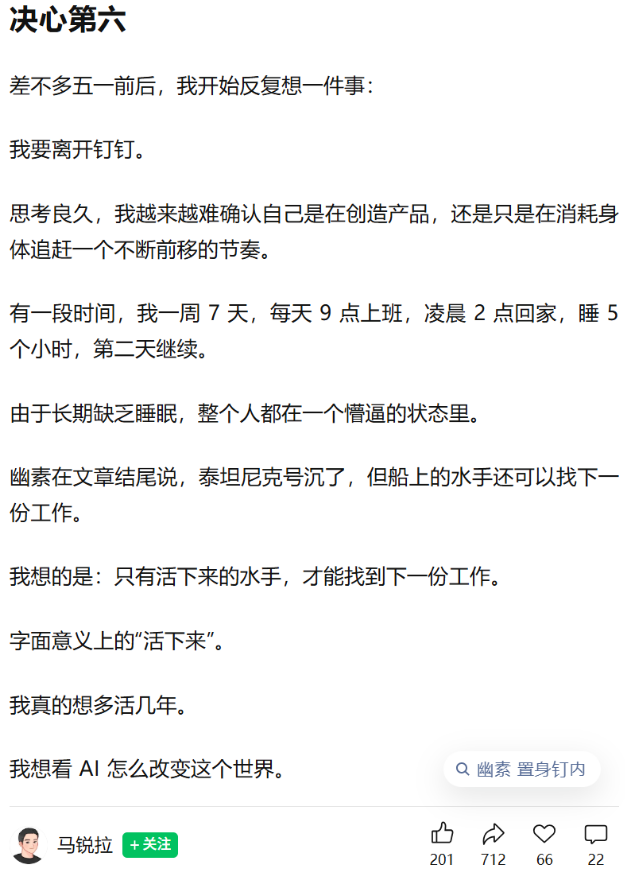
After Wu Zhao, the founder of DingTalk, returned, he championed AI transformation, holding three major press conferences within a year to go all-in on AI. However, the 75,000-word essay exposed the cracks beneath the halo: extreme leadership will, high-pressure militarized management, and organizational inefficiencies caused by chasing "product illusions."
His successor, Chen Yusen, also a technologist, believes more in certainty as a prerequisite for commercial AI. The product MuleRun he is responsible for has served enterprises and users in 43 countries worldwide within two years of its launch, with 34% of paying users spending over $200 per month. It has shown more maturity in overseas expansion and user retention, being more adept at operating AI-native organizations.
Three personnel changes, three nearly identical patterns: internal conflicts building to a critical point, some form of public outbreak, and top-level intervention to remedy the situation. However, the market sentiment after each storm always carries a lingering sense of speculation and unease.
02 Centralization vs. Decentralization
Alibaba's AI strategy is undergoing a dramatic shift from "decentralization" to "centralization."
Over the past two decades, Alibaba has undergone multiple organizational reforms. From business expansion during the Taobao era to the "Big Middle Platform, Small Front Platform" model in 2015, and then to the "1+6+N" structure in 2023.
These adjustments may seem different on the surface, but they all share a common thread: decentralizing power. Granting more businesses independent decision-making authority and letting those closest to customers make decisions.
However, when it comes to AI, the logic has changed. AI is not an independent business like e-commerce, payments, or cloud computing; it is becoming an infrastructure relied upon by all businesses.
If each business develops its own model, the result will be redundant resource investment, inability to accumulate capabilities, and inability to share data. Computing power is becoming increasingly expensive, talent is increasingly scarce, and AI is becoming increasingly "large."
Since 2026, Wu Yongming has made three major adjustments to Alibaba's AI organizational structure.
In March, the Alibaba Token Hub Business Group was established, integrating the Tongyi Lab, MaaS business line, Qianwen Business Unit, Wukong Business Unit, and AI Innovation Business Unit, directly overseen by Wu Yongming. In April, the Group Technology Committee was established, with Wu Yongming as the leader, Zhou Jingren as Chief AI Architect, and Wu Zeming and Li Feifei entering a unified decision-making framework. In June, the Tongyi Large Model Business Unit and Future Living Lab were merged to form the Token Foundry Business Unit, still directly managed by the CEO.
The logic behind these three moves is clear: consolidating models, talent, and products. The reporting lines for Alibaba's AI business are becoming shorter, and decision-making processes are becoming more centralized.
Zhou Jingren's appointment as "Chief Scientist" can, in a sense, be seen as a symbolic footnote to this power consolidation. Zhou Jingren has been responsible for the Tongyi Large Model at Alibaba for many years, but the June 8th organizational adjustment transferred the core model R&D team of Tongyi to Token Foundry, no longer under his purview.
In other words, Zhou Jingren's core team was taken away, and Alibaba gave him a "top academic title." This was a promotion in position but a substantive stripping of power.
From a team perspective, this model is equally evident. The reason Qwen was able to achieve rapid results under Lin Junyang's leadership was largely due to a "small team, big closed-loop" vertically integrated model, where researchers handled both pre-training and post-training, wrote code, and managed infrastructure, enabling extremely fast information flow and very short decision chains.
However, under this model, Qwen was relatively isolated from other Alibaba businesses.
When the AI strategy shifted from "single-point battles" to "overall warfare," and when models were no longer independent projects but must drive the commercialization of the entire group, vertically integrated "small kingdoms" inevitably had to give way to horizontally divided "assembly lines," even if it meant the loss of some core members.
Wu Yongming seems to have made his choice. Alibaba Cloud's AI-related product revenue has seen triple-digit growth for 11 consecutive quarters, reaching 8.971 billion yuan in the fourth quarter of fiscal year 2026, accounting for over 30% of external commercial revenue for the first time. Qwen 3.7-Max ranked among the top five globally and first in programming domestically on international leaderboards.
From a data perspective, this integration is producing results, but in the process, some people inevitably have to leave their current centers of power.
03 People Exit in the AI Era
Taking a broader view, Alibaba's issues are not unique. This round of AI-driven organizational transformations is happening simultaneously on a global scale.
Google was the first to act. In April 2023, it merged the Brain team and DeepMind, which had been running for nearly a decade, into Google DeepMind, led by Hassabis and reporting directly to CEO Pichai.
In early 2025, it further incorporated all AI engineering teams dispersed across various product lines under DeepMind. Hassabis later said that this organizational upheaval was accompanied by painful integration but was worth it.
Meta's moves were even more dramatic. In the first half of 2025, it restructured its AI organization four times, with the core direction being to bridge the gap between the FAIR lab and product AI teams. In May 2026, Meta announced the layoff of approximately 8,000 employees while transferring about 7,000 to new AI-related teams, establishing an "AI-native design structure."
Zuckerberg straightforward words (bluntly stated) that AI transformation "will inevitably encounter various challenges" and that "almost certainly more mistakes will be made" in the future.
Domestically, Tencent dissolved its nearly decade-old enterprise-level AI Lab, with some personnel being incorporated into the Hunyuan team. Yao Shunyu joined Tencent from OpenAI as Chief AI Scientist, reporting directly to President Martin Lau.
Gu Quanquan, a core scientist from ByteDance's Seed team, announced his resignation, with its AI4S team facing organizational adjustments and several key members starting their own ventures. Every company is facing similar issues of "tension between organization and technology" amid the AI competition.
Alibaba's current adjustments are fully in line with this global trend. However, the issue lies in the manner and pace of implementing these adjustments, which determine the magnitude of the upheaval.
Google's merger occurred in April 2023, but the true "unification" integration was not completed until nearly two years later, allowing for a considerable period of internal run in (integration). Microsoft and Meta's restructurings were accompanied by layoffs and personnel turmoil but were relatively concentrated on functional adjustments at the management level. Alibaba's upheavals, however, directly impacted team founders and technical soul figures.
This perhaps indicates that Alibaba's strategic posture in the AI era is a more aggressive model than most of its competitors. It does not intend to wait for internal integration to occur naturally but is more willing to use the "scalpel" of personnel adjustments to cut through the Gordian knot. The cost is that each organizational surgery is accompanied by a public relations storm, and each high-level transition requires management to personally step in to extinguish the fires.
But from another perspective, in this AI arms race, OpenAI has Microsoft as its backer, Google has DeepMind, and Meta holds the world's largest user data pool. Alibaba doesn't have many choices.
Alibaba is not at the forefront. To catch up or even surpass, it requires not a gentle, gradual organizational evolution but a more concentrated and decisive power integration. From Wu Yongming's series of operations since taking office, it is clear that he knows exactly what he is doing.
If Zhou Jingren does leave, he will be the fourth core figure to depart from the Tongyi Qianwen team in 2026. This team, which personally built Qwen into a global open-source star model, has been dismantled in just a few months.
In just half a year, Alibaba's AI business has experienced three major personnel upheavals: Lin Junyang's departure, Zhou Jingren's reported resignation, and Wu Zhao's stepping down as CEO of DingTalk. Each was somehow related to the centralized adjustment of AI strategy, and each was accompanied by public opinion and controversy.
Over the past decade, Alibaba has been accustomed to narrating its rise through "heroic stories": Jack Ma's visionary thinking, Daniel Zhang's strategic maneuvering, Wu Zhao's wild growth, and the passionate struggles of countless tech talents.
However, entering the AI era, personal narratives have given way to systemic competition. The deployment of computing power, the orchestration of data, the penetration of scenarios, and the pace of commercialization all require a set of mechanisms that transcend individuals to operate.
Heroes exit, and factories open. This battlefield without protagonists may be the truest portrayal of AI commercialization.
- END -
-
From Product-Driven to Tech-Empowered: The Second Growth Phase of Li Auto
-
![]()
Li Auto's Further Evolution: 'Full-Stack' as the Only Path to Surpass Tesla
-
![]()
Huawei and Cambricon Take the Lead as Chinese Chip Companies Step Up Efforts to Capture NVIDIA’s Market Share
-
![]()
Intelligent Agent Payment Landscape: Navigating Opportunities and Challenges in a Flourishing Market
-
![]()
Xiaomi and Others Boost Old Smartphone Battery Capacities, Power Banks Face Uncertain Future
-
![]()
Zhipu Soars to New Heights, MiniMax Faces Pressure: The Diverging Trajectories of the 'Dual Titans in Large Models'
-
AI Asset Spin-offs at Major Companies: Is Kling Paving the Way for ByteDance and Alibaba?
-
![]()
AI Agent Security Firm NewCore Raises $66 Million in Seed Funding, Achieves $300 Million Post-Money Valuation