Xiaomi and Others Boost Old Smartphone Battery Capacities, Power Banks Face Uncertain Future
 06/18 2026
 371
371
Source | YuanSight
From being an essential travel companion for extended battery life to becoming a "carry-only-when-absolutely-necessary" safety concern, are power banks on their way out of the limelight?
Recently, a Tianjin Airlines flight from Tianjin to Jieyang encountered thick smoke in the cabin just before landing. Following standard procedures, the crew identified that the incident was triggered by a passenger's power bank emitting smoke. Although no injuries or damage to aircraft facilities occurred, Tianjin Airlines has since advised passengers to "consider avoiding carrying power banks" on future flights.
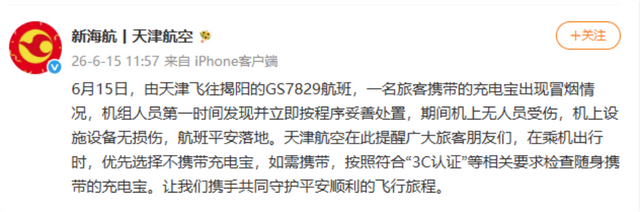
Source: Weibo
Since frequent product quality issues rocked the industry in the first half of last year, power banks have become a focal point of regulatory scrutiny in public transportation over the past year.
According to regulations from the Civil Aviation Administration of China (CAAC), starting June 28, 2025, passengers carrying power banks on domestic flights in China are prohibited from bringing products that lack 3C certification, have unclear 3C markings, or are from models or batches that have been publicly recalled by manufacturers. Only 3C-certified power banks that meet the requirements can be carried normally.
In April of this year, the "New National Standard for Power Banks," formally known as the Safety Technical Specifications for Mobile Power Supplies (GB 47372-2026), was released by the Ministry of Industry and Information Technology (MIIT). The new standard significantly enhances safety testing for power bank cells, mandates the labeling of the manufacturer, production date, and recommended safe service life, and extends regulatory oversight to raw material control and production process quality management.
Guotai Junan Securities estimates that the new standard will substantially raise industry barriers, forcing nearly 70% of the existing production capacity to exit the market due to non-compliance.
As the "strictest new national standard" sparks debate over the future of the power bank industry, Anker founder Steven Yang's "power bank obsolescence theory" has recently surfaced on social media, generating widespread discussion.
In a recent interview, Yang revisited his 2016 prediction: "Power banks will not become a hundred-billion-yuan category and will likely die out in a few years." While acknowledging that power banks have not yet reached obsolescence, he remains convinced that the category will eventually disappear.
01 Recall Controversy
Yang's bold remarks reflect Anker's strategic shift amid corporate transformation needs.
Yang compares power banks to past hit products like MP3 players and cassette recorders, which had lifespans of 10-15 years. Since power banks surged in popularity around 2012, he predicts a decline by 2027.
Based on this, Anker has accelerated its "de-power-banking" efforts to diversify into three product lines: charging and energy storage, smart innovation, and smart audio-visual. Financials show that in 2025, revenue reached RMB 30.514 billion (+23.49% YoY), with non-GAAP net profit of RMB 2.179 billion (+15.44% YoY). Charging and energy storage contributed RMB 15.402 billion (+21.59% YoY, 50.47% of revenue); smart innovation RMB 8.271 billion (+30.53% YoY, 27.11% of revenue); and smart audio-visual RMB 6.833 billion (+20.05% YoY, 22.39% of revenue).
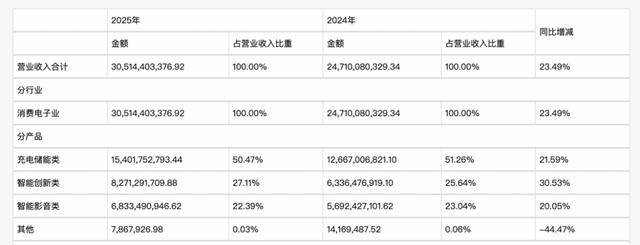
Source: Anker Innovations Financials
While diversifying, Anker is also streamlining its power bank models. At last month's annual shareholder meeting, executives cited excessive product models as a quality control risk. Over 18 months, Anker cut approximately 70% of its charging product models and plans to reduce another 50-70% in the next 18 months.
Since last year, the power bank industry has faced prolonged recalls, prompting reflection on the category's direction.
In June 2025, multiple Beijing universities warned that Romoss power banks were more prone to spontaneous combustion than other brands. The news topped Weibo trends, exposing long-standing safety risks. Media investigations traced the issue to upstream supplier Ampricus, which outsourced some battery cell production to external factories that illegally substituted raw materials for battery separators, creating combustion and explosion risks.
Ampricus had over 70 battery-related 3C certifications suspended, and major power bank brands terminated partnerships. Data from the State Administration for Market Regulation (SAMR) revealed 10 recalls involving 1.3977 million units in 2025.
The recalls exposed industry chaos: behind market prosperity lay safety hazards like low-quality cells, certification fraud, and lax production due to price wars. Official sampling once found a 25% defect rate in mobile power supplies.
02 New National Standard
As power bank thermal runaway incidents proliferated, regulators cracked down. Companies like Romoss, which long ignored quality control, faced shutdowns, but market trust remained fragile.
CAAC's power bank regulations took full effect last June, banning non-3C-certified, unclearly marked, or recalled models on domestic flights. Yet many consumers remain unaware of the rules, still prioritizing flight compatibility when buying power banks.
The new national standard may change this.
MIIT released the "strictest new national standard," Safety Technical Specifications for Mobile Power Supplies (GB 47372-2026), on April 3, 2026. As China's first mandatory national standard for mobile power, it marks the end of the industry's rough development. Implementation begins April 1, 2027.
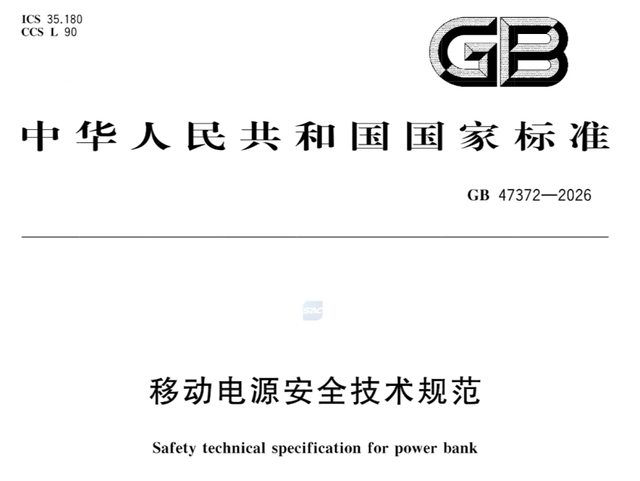
Source: National Standards Information Public Service Platform
Compared to previous general standards, the new norm significantly raises safety requirements.
It mandates enhanced protection against abuse scenarios (high temperature, overcharging, crushing), raising thermal abuse test temperatures from 130°C to 135°C and duration from 30 to 60 minutes. "Outdoor power" products must not ignite when heated, and battery nail penetration tests are introduced to reduce risks.
The standard adds lithium plating detection after battery cycling to lower internal short-circuit risks, requires real-time monitoring of battery voltage and temperature, abnormal data storage and retrieval, and mandates labeling of the manufacturer, production date, and safe service life.
Critically, it extends safety oversight to full production processes, specifying raw material and manufacturing controls to limit impurities and enhance safety.
According to Nandu Bay Area Finance, MIIT officials stated that compliant 3C-certified power banks purchased before the new standard remain usable.
Guotai Junan Securities predicts the standard will raise industry barriers, forcing approximately 70% of the existing capacity to exit. Many OEMs lacking quality control and R&D face elimination, while costs will rise due to high-quality cells, new BMS chips, and screen upgrades.
This suggests the standard will end low-end price wars but may trigger price hikes.
03 Shifting Demand
For over a decade, smartphone market growth fueled demand for mobile power amid battery anxiety.
CIConsulting reports that China's mobile power market surged from approximately RMB 10 billion in 2015 to approximately RMB 30 billion in 2020 (30% CAGR), projecting approximately RMB 50 billion by 2025.
However, as power banks face the "strictest standard," demand is structurally shifting. LuoTu Tech data shows online mobile power sales in China reached 3.237 million units in April 2026 (-4.2% YoY), with declines in the first four months.
The most direct impact comes from breakthroughs in smartphone battery technology.
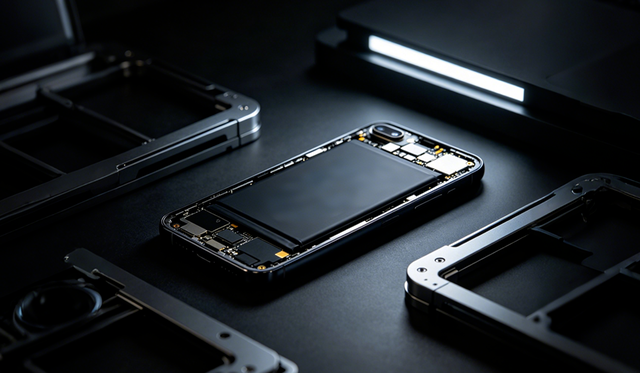
Counterpoint's Global Smartphone Model Sales Tracker shows the average smartphone battery capacity in China reached 5,418mAh in May 2025 (+11% YoY), 518mAh higher than overseas markets. Domestic vendors rapidly adopted silicon-carbon anode batteries, replacing graphite anodes with "silicon+carbon" composites to boost capacity without increasing size.
Statistically, 6,000mAh batteries, once limited to rugged or large phones, are now standard in flagship models. Brands like Honor, vivo, OPPO, and Redmi have launched or plan 10,000mAh models this year.
Xiaomi launched official "battery upgrade" services in April 2026, charging RMB 149 for materials (+RMB 40 labor) to expand capacities: Xiaomi 13 (4,500mAh→4,850mAh), Xiaomi 13 Ultra (5,000mAh→5,500mAh).
Sources say vivo is exploring similar upgrades, increasing old model capacities by 500-1,500mAh.
Notably, the EU's Battery and Waste Batteries Regulation (EU 2023/1542) is driving another shift.
The regulation mandates user-replaceable batteries for consumer electronics (smartphones, smartwatches, wireless earbuds) sold in the EU starting February 18, 2027, potentially reviving removable battery designs.
Under EU rules, direct battery replacements may replace power banks as a battery life solution, further shrinking their market.
Some images sourced from the internet. Please notify us for removal if infringement occurs.
-
![]()
Xiaomi and Others Boost Old Smartphone Battery Capacities, Power Banks Face Uncertain Future
-
![]()
Zhipu Soars to New Heights, MiniMax Faces Pressure: The Diverging Trajectories of the 'Dual Titans in Large Models'
-
AI Asset Spin-offs at Major Companies: Is Kling Paving the Way for ByteDance and Alibaba?
-
![]()
AI Agent Security Firm NewCore Raises $66 Million in Seed Funding, Achieves $300 Million Post-Money Valuation
-
From Pessimism to Optimism: China’s Hydrogen Fuel Cell Vehicles Set for Expansive Growth
-
The Race Against Time for Survival of Unitree and Its Peers
-
Dream Weaver in the Eye of the Storm: Elon Musk's Business Empire and SpaceX's IPO Moment
-
![]()
From 'Daydream' to 'Trillions in Wealth': Is SpaceX Really That 'Sci-Fi'?