Zhipu Soars to New Heights, MiniMax Faces Pressure: The Diverging Trajectories of the 'Dual Titans in Large Models'
 06/18 2026
 366
366
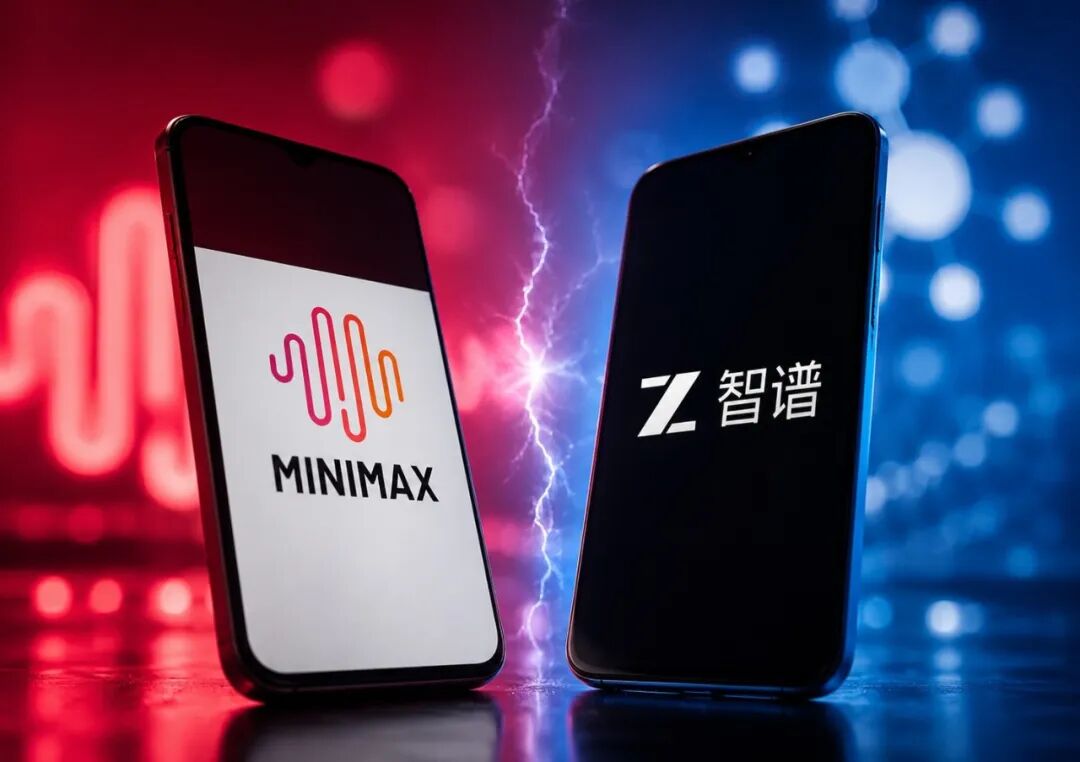
The paths of the 'Dual Titans in Large Models' are beginning to diverge.
On June 18, Zhipu reached an unprecedented peak. Its stock price soared to HK$2,094, marking an increase of over 20% in a single day, with its total market capitalization briefly surpassing HK$930 billion.
This surge made the previous 'halving' seem like a fleeting concern from just a few days prior.
Following May 29, Zhipu's stock price steadily declined from its peak, nearly halving in value.
However, on June 15, the market suddenly rebounded, closing the day up by over 32%.
Within days, Zhipu not only recouped nearly all its previous losses but also set a new all-time high.
The catalyst appeared straightforward: Zhipu's flagship model, GLM-5.2, had been released.
In contrast, MiniMax, another Hong Kong-listed large model company, also launched its flagship model, M3, on June 1, but failed to replicate Zhipu's success, with its stock price continuing to face downward pressure.
By the close on June 18, MiniMax's stock had fallen nearly two-thirds from its March historical high.
Why did the capital markets value these two companies so differently, despite both focusing on large models, open-source approaches, and emphasizing Agent and Coding capabilities?
Zhipu's release of GLM-5.2 was imbued with clear commercial intent.
The model boasted a 1M context window, a full release of the Coding Plan, API availability the following week, and MIT-licensed open-source code—key indicators of enhanced model capabilities.
Zhipu explicitly stated in its HKEX announcement that the model is expected to drive increased usage on the company's open platform and API business.
In simpler terms, this means attracting more developers, increasing API calls, and facilitating faster integration into enterprise workflows.
Although GLM-5.2 had just been launched and lacked full validation, the capital markets wasted no time in seizing the potential.
On June 15, Zhipu's stock rebounded sharply. Within days, its nearly halved stock price reached a new all-time high.
Coincidentally, the release of GLM-5.2 coincided with a unique opportunity.
On June 13, the U.S. government issued export control directives citing national security concerns, forcing Anthropic to disable Fable 5 and Mythos 5 for all global clients just three days after their launch.
At 5 p.m. the same day, Zhipu announced full user access to GLM-5.2.
This timing elevated the significance of the release.
Zhipu included a line in its announcement: 'Cutting-edge intelligence should not be the exclusive domain of a few, nor should it be revoked by a few rules at any time.'
This resonant statement addressed a market concern: If top overseas models become unavailable, which company will Chinese enterprises turn to?
Against this backdrop, GLM-5.2 became more than just a new model—it was seen as a leading model for localization substitution.
Thus, Zhipu's surge was fueled by three layers of expectations: model capabilities, API commercialization, and localization substitution.
MiniMax, however, did not receive the same market reception after its flagship model release.
On June 1, MiniMax launched M3, boasting impressive features:
1M context window, Coding capabilities, Agentic Work, native multimodality, and compatibility with MiniMax Code, Token Plan, and API platforms.
For any large model company, this would represent a significant update.
But M3's issue lay in its pricing strategy.
Initially, it attempted to sell at a premium price.
The market initially viewed this as a positive signal—MiniMax was finally offering a more robust flagship model, aiming for the high-end API market.
However, M3 soon permanently slashed its prices by 50%, returning to levels close to its predecessor, M2.7.
On the same day as M3's release, MiniMax switched from per-use billing to Token-based billing, raising monthly plans from 29 yuan to 49 yuan without prior notice.
The developer community reacted strongly, with some users calculating that actual cost increases for equivalent tasks could reach up to 257%.
Overnight, MiniMax transformed from a tech darling to a company perceived as betraying its consumers.
The capital market's logic was straightforward: If a model is truly strong and irreplaceable, its pricing should reflect confidence.
But M3's release day, marred by user complaints, directly cast doubt on its commercialization prospects at a critical moment for building confidence.
Even more problematic was MiniMax's scattered narrative, which lacked a clear focus.
MiniMax simultaneously promoted large models, multimodality, video, audio, AI companionship, overseas consumer products, Agent platforms, Coding, and API commercialization.
With too many anchors, MiniMax effectively had none.
Which business line would ultimately drive its valuation? Could consumer growth offset model training costs? How vulnerable was overseas revenue amid tightening regulations?
No clear answers existed for any of these questions.
Beyond technical narratives, a colder structural pressure weighed on MiniMax's stock price.
Neither Zhipu nor MiniMax are typical retail-driven stocks.
With heavy institutional holdings and small free floats, any market movement is easily amplified—leading to rapid gains but also sharp declines.
Yet the same structure produced opposite effects under different lock-up expiration timelines.
MiniMax faces its first major lock-up expiration around July 9.
CICC analysts noted that, based on Hong Kong's share structure, the expiring shares account for roughly 63% of Hong Kong-listed stock, with financial investors holding over one-third.
Even after MiniMax's stock price retreat, it remains significantly above its IPO price, offering investors substantial paper profits—ripe for cashing out at lock-up expiration.
The market began digesting this supply shock well before July.
Zhipu's lock-up structure, however, differs entirely.
Its initial lock-up expiration around July 8 involves roughly 11.6% to 11.9% of H-share capital (or about 5.8% of total company shares).
CICC, citing sources, stated that the largest expiring holder is a state-backed cornerstone investor with limited selling motivation.
With minimal short-term supply pressure and the catalytic timing of GLM-5.2, its low float became a driver for stock price growth.
In summary, Zhipu's gains stemmed from expectations amid low liquidity, while MiniMax's declines reflected supply fears ahead of lock-up expiration.
The divergence between Zhipu and MiniMax reflects more than just short-term stock fluctuations.
A deeper shift is underway: Capital markets are now evaluating model companies under a new framework.
Over the past two years, large model valuations were essentially based on narrative discounts.
Parameter scale, financing backing, founding teams, model benchmarks, user growth—these metrics combined to create visions of a 'Chinese OpenAI.'
But by 2026, the market cares about different factors:
Can models consistently reach state-of-the-art (SOTA) performance? Will clients remain after price hikes? Is API usage growing organically or through subsidies?
Are Coding and Agent services generating real revenue or just hype traffic? Have enterprise workflows truly adopted these tools?
Does open-sourcing drive commercial revenue, or does it merely erode competitive moats?
Is margin improvement due to a viable business model or cost-cutting measures (e.g., layoffs, reduced training budgets)?
Companies whose narratives better align with these questions will receive stronger stock support.
This is not a tale of 'Zhipu wins, MiniMax loses.'
Both companies remain in a state of valuation reconstruction (guzhi chonggou), needing longer-term financial data to clarify their futures.
The real question is: After this market shift, how many large model companies can transition from storytelling to sustainable business models?
Next, more large model firms will enter capital markets, facing the same scrutiny.
-
![]()
Xiaomi and Others Boost Old Smartphone Battery Capacities, Power Banks Face Uncertain Future
-
![]()
Zhipu Soars to New Heights, MiniMax Faces Pressure: The Diverging Trajectories of the 'Dual Titans in Large Models'
-
AI Asset Spin-offs at Major Companies: Is Kling Paving the Way for ByteDance and Alibaba?
-
![]()
AI Agent Security Firm NewCore Raises $66 Million in Seed Funding, Achieves $300 Million Post-Money Valuation
-
From Pessimism to Optimism: China’s Hydrogen Fuel Cell Vehicles Set for Expansive Growth
-
The Race Against Time for Survival of Unitree and Its Peers
-
Dream Weaver in the Eye of the Storm: Elon Musk's Business Empire and SpaceX's IPO Moment
-
![]()
From 'Daydream' to 'Trillions in Wealth': Is SpaceX Really That 'Sci-Fi'?