Where Are AI Companies Setting Up? 2026 China's Top Districts and Counties for New AI Enterprises
 06/17 2026
 395
395
Currently, artificial intelligence technology is accelerating its iterative evolution, deeply integrating with the real economy, and becoming a key variable driving industrial upgrading and reshaping the global competitive landscape. The number and distribution of new AI enterprises serve as important indicators for measuring regional AI industry vitality, business environment, innovation ecosystem, and investment attraction effectiveness. They also foreshadow the future direction of industrial chain expansion and competitive dynamics.
The true fabric of the industry only becomes clear when examined at the district and county level. Based on this, Huoshi Create, a leading domestic industrial data intelligence service provider and a national-level 'Little Giant' enterprise specializing in precision and innovation, has utilized its 'Huoshi Xinglian' industrial data center to integrate vertical scenarios for industrial investment attraction. It has compiled a ranking of the top 50 districts and counties for new AI enterprises in China from January 2026 to the present, aiming to provide industrial insights and decision-making references for governments at all levels, industrial parks, and financial institutions.
[Note] The statistical scope for districts and counties in this article includes county-level administrative regions, such as municipal districts, county-level cities, and counties. The statistical criteria for AI enterprises are based on 'industrial scope' rather than 'business registration scope,' meaning enterprises genuinely engaged in AI-related businesses are selected based on industrial chain maps and multi-dimensional tags, providing greater reference value for industrial analysis, policy formulation, and investment attraction.
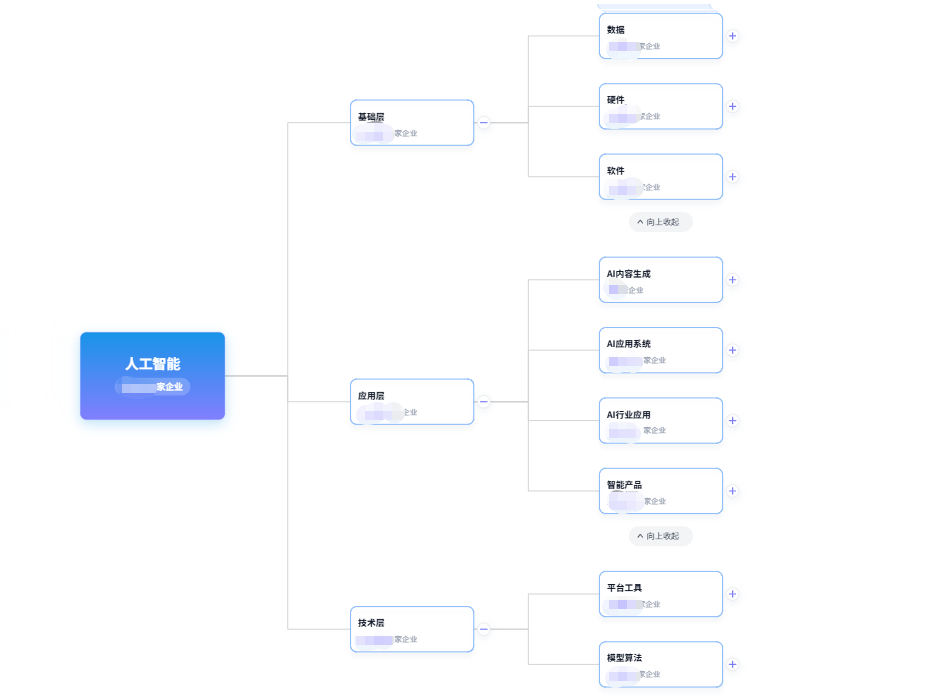
Figure: Artificial Intelligence Industrial Chain Map
View complete nodes and optional national/regional maps via the 'Huoshi Xinglan' Industrial Investment Attraction Intelligence Agent
Source: 'Huoshi Xinglan' Industrial Investment Attraction Intelligence Agent
01. National Growth of AI Enterprises
As of June 2026, there are over 134,000 AI enterprises nationwide. From January 2026 to the present, more than 7,300 new AI enterprises have been added.
By industrial chain node, new enterprises are predominantly concentrated in the application layer, accounting for 94%. The technical and foundational layers account for 3.5% and 1.9%, respectively.
In terms of registered capital scale, new AI enterprises in 2026 exhibit a pronounced 'small and micro entity-dominated' characteristic. New enterprises with registered capital of 10 million yuan or less account for a staggering 94%. Notably, over 1,300 new enterprises have registered capital exceeding 500 million yuan, representing 3.6%. Large enterprises and capital are accelerating their layout (layout) in the AI sector, with initial trends of industrial consolidation and head (leading) enterprise clustering emerging.
02. Distribution of Top 50 Districts and Counties
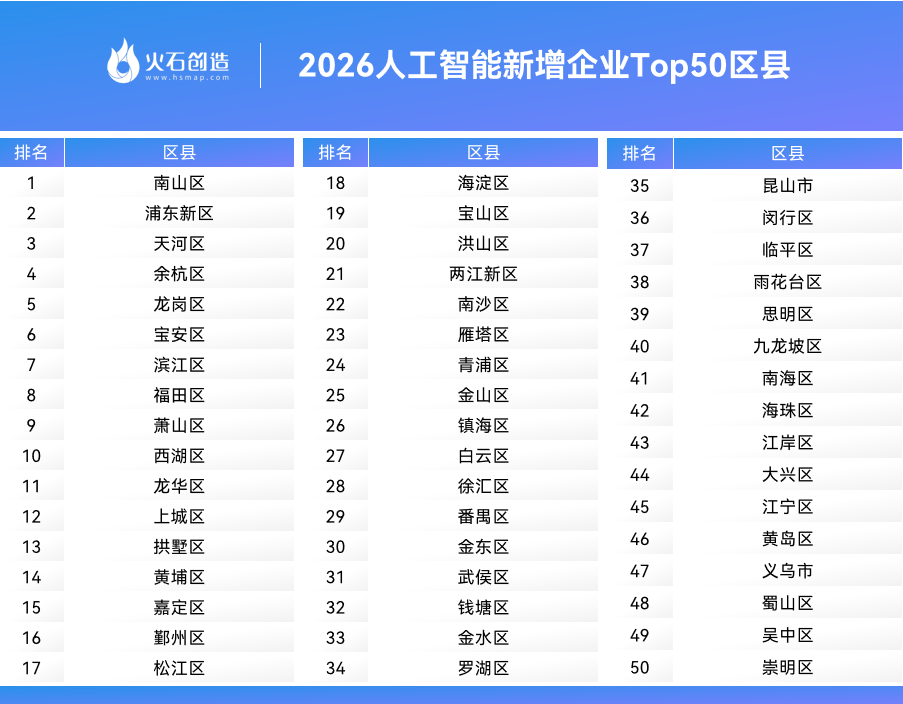
From the distribution of the top 50 districts and counties, new AI enterprises are highly concentrated in the Yangtze River Delta and Guangdong-Hong Kong-Macao Greater Bay Area city clusters. The top 50 districts and counties collectively account for 38% of the national total of new AI enterprises.
Six districts in Shenzhen make the list, with Nanshan leading the nation. Among the top six, Shenzhen occupies three spots. Nanshan District ranks first nationwide in new AI enterprises, with Longgang and Bao'an districts ranking fifth and sixth, respectively. Additionally, Futian, Longhua, and Luohu districts also feature in the top 50 for new AI enterprises.
Shanghai has the highest number of districts on the list, demonstrating city-wide collaboration (synergistic) development. Nine districts in Shanghai—Pudong New Area, Jiading, Songjiang, Baoshan, Qingpu, Jinshan, Xuhui, Minhang, and Chongming—make the list. Pudong New Area, leveraging the agglomeration (clustering) effect of innovation carriers like Zhangjiang Science City, ranks first in the city and second nationwide in new AI enterprises.
Eight districts in Hangzhou make the list, with its digital economy advantages continuing to pay dividends. As China's leading digital economy city, Hangzhou has a comprehensive layout (layout) in the AI industry, with Yuhang, Binjiang, Xiaoshan, Xihu, Shangcheng, Gongshu, Qiantang, and Linping districts on the list. Yuhang District has prioritized becoming the core bearing ground (bearing area) for AI, ranking first in the city and fourth nationwide in new AI enterprises from January 2026 to the present.
Guangzhou is making steady progress. Six districts in Guangzhou—Tianhe, Huangpu, Nansha, Baiyun, Panyu, and Haizhu—make the list. Tianhe District, as Guangzhou's core area for technological innovation, continues to lead the city in the AI sector.
Central and western cities are rapidly emerging. Hongshan and Jiang'an districts in Wuhan, Liangjiang New Area and Jiulongpo district in Chongqing, Wuhou district in Chengdu, and Yanta district in Xi'an have all made the list. Central and western core cities are becoming important bearing ground (bearing areas) for AI industry relocation and incremental layout (layout), with the regional landscape becoming increasingly optimized.
03. Gaining the Initiative Through Digital and Intelligent Empowerment
The race in the AI industry is far from over. The speed at which AI reshapes regional economic landscapes is described as 'exponential.' Industrial investment attraction is the first move in regional economic development, and traditional methods struggle to keep pace with the rapid rhythm of AI-era industrial competition. As Jin Xia, Chairman of Huoshi Create, stated, 'Succeeding in the first move doesn't rely on 'luck.' Future development zones that effectively leverage AI will undoubtedly surpass those that do not.'
The 'Huoshi Xinglan' Industrial Investment Attraction Intelligence Agent 3.0, built on a foundation of tens of billions of data points and encapsulated expert experience, creates a modular, end-to-end 'Investment Attraction Empowerment Center.' It helps investment attraction professionals navigate industrial complexities, identify shortcomings and opportunities across the industrial chain, and swiftly pinpoint target lists suited to regional industries. The error rate in enterprise evaluation has dropped to 5%, with analysis cycles shortened from three days to hours and decision-making cycles reduced by over 50%.
-
Trillion-Dollar Commercial Space Industry: Profits Start Not with Rockets
-
![]()
Baidu Netdisk Encounters a 'Significant' Challenger: Tencent Netdisk Makes Its Debut
-
![]()
Tencent Cloud Drive: A Rising Contender to Baidu Cloud
-
![]()
AR Optical Leader Quietly Achieves 1 Million Units in Mass Production!
-
![]()
Raising 289 Million for Optical R&D! Olight Technology Prepares for GEM IPO
-
![]()
【OFweek Weike Cup】Cybernetics Officially Nominated for the 2026 Outstanding Contribution Award for Optical Industry Application Solutions
-
![]()
Precocious Ideals, Rebuilding A New Ideal
-
![]()
DeepSeek Finally Accepts 50 Billion Yuan in Funding