Is WeChat Feeling the Heat from AI-Powered Alipay's Debut?
 06/17 2026
 571
571

Last week, whispers circulated about WeChat potentially rolling out an intelligent agent, which could be activated with a simple right swipe to trigger a floating, independent dialog panel.
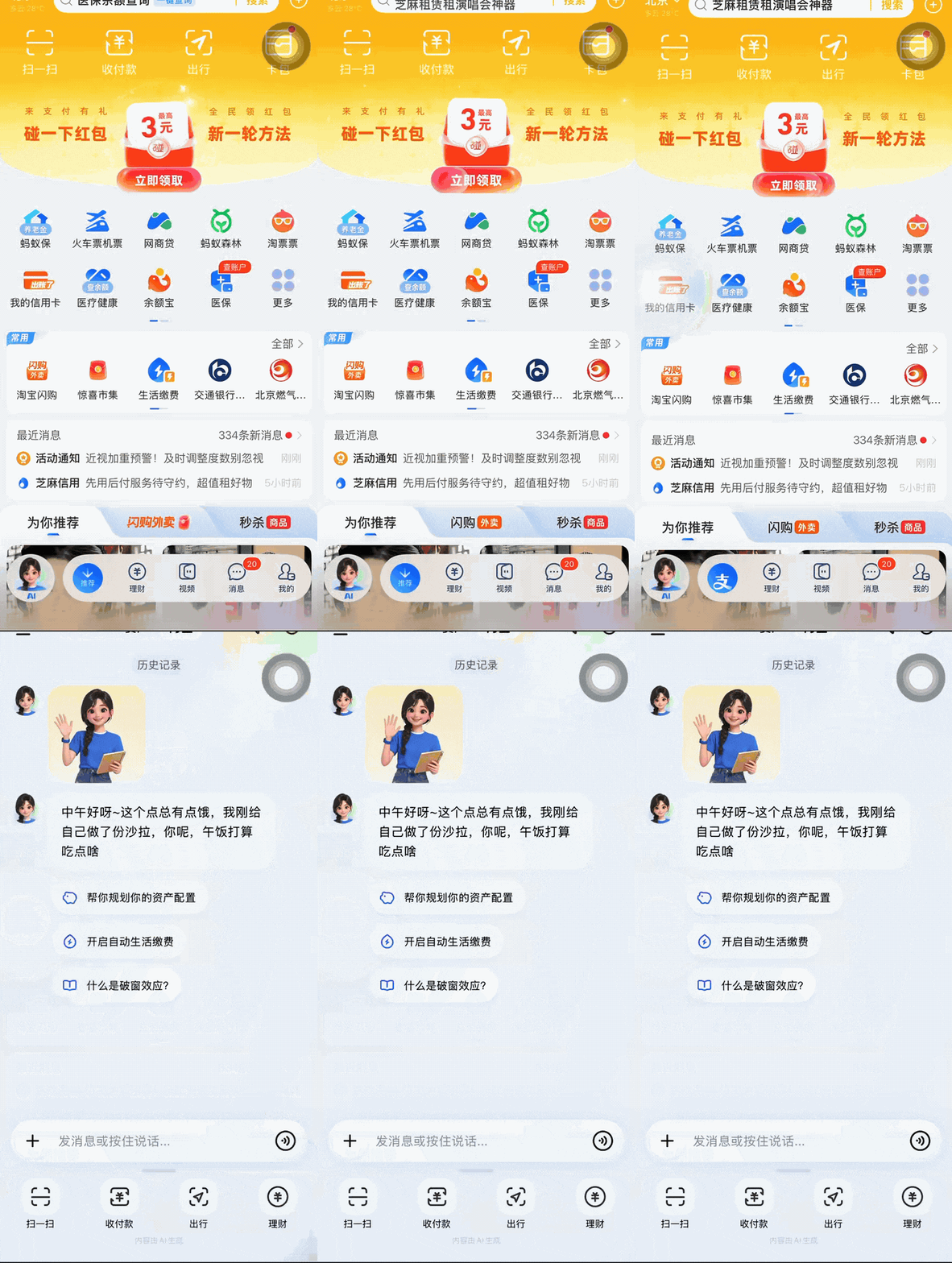
This week, Ant Group unveiled its highly anticipated project—the AI-driven version of Alipay. Interestingly, its interaction design bears a striking resemblance to the rumored WeChat intelligent agent: a floating AI button discreetly placed in the bottom left corner of the Alipay homepage. A right swipe unveils a brand-new chat interface, where a friendly female assistant named "Abao" greets users with a warm smile, reminiscent of a neighborly gesture. It appears that the product managers behind these national-level apps share a common design ethos. However, this poses a rather awkward scenario for WeChat, especially since Alipay has already served its AI dish, while WeChat's AI version remains on the horizon. So, how does this AI-powered Alipay, touted as the world's first AI super app, stack up? We splurged a whole 1 yuan on an invitation code via Xianyu to bring you the lowdown.
1. Old Alipay, Dreaming of Becoming a National AI Assistant?
New growth sprouts from established roots.
Upon entering the invitation code in Alipay, an AI icon magically appears in the bottom right corner of the interface, nudging aside the original bottom menu bar. A subsequent click or right swipe transports users into the realm of AI.
The AI version of Alipay keeps it simple, featuring just two categories at the top: Assets and Abao. The bottom section is populated with various commonly used life tools, such as payment options, train ticket purchases, ride-hailing services, and utility bill payments. For a super app, this represents an extreme level of streamlining.
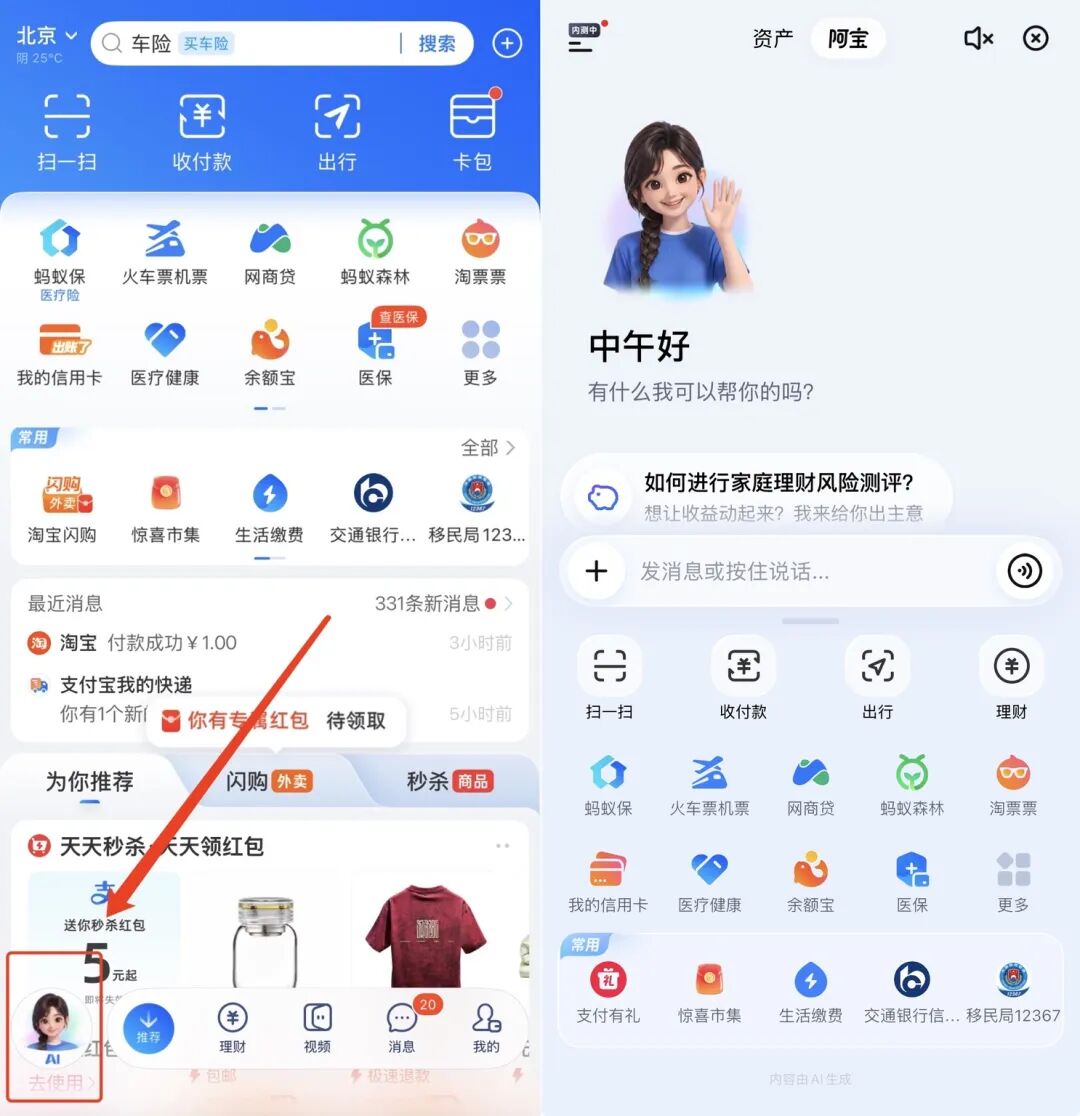
According to Abao's introduction, the AI version of Alipay primarily offers four types of functions: bill checking and asset management, discount hunting and savings, task handling and life service access, and entertainment chatting. However, in practice, its capabilities extend even further. For instance, it can hail rides, order food delivery, track shipments, pay utility bills, find nearby discounts, check medical insurance, and view bills, among other functions.

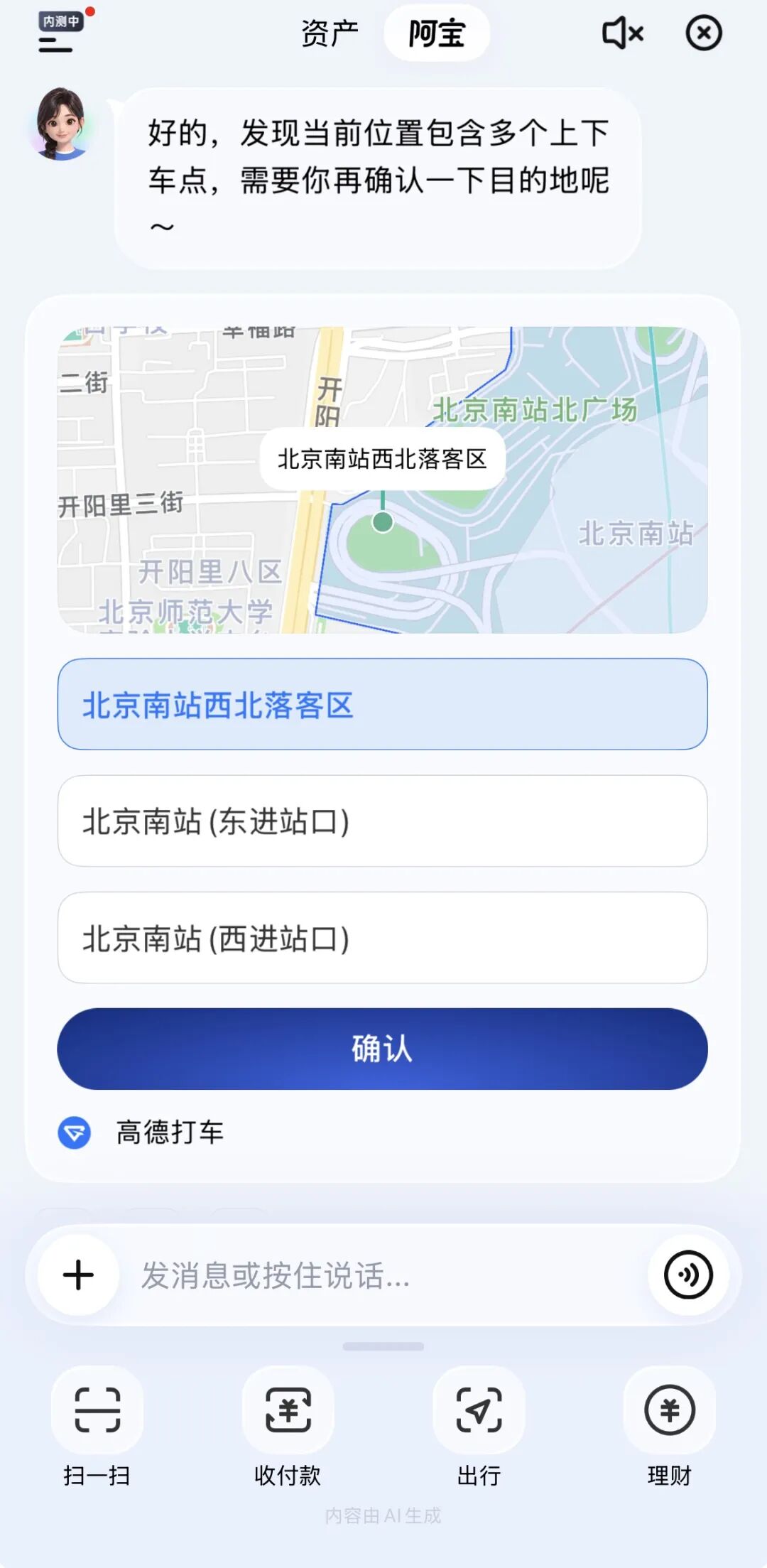
We put several functions to the test. For example, when hailing a ride, I simply instructed Abao, "Hail a ride to Beijing South Railway Station." Abao seamlessly invoked AutoNavi's ride-hailing service, planned the route, and inquired about the desired drop-off point. After confirmation, it initiated the ride-hailing process and successfully secured a ride. Throughout this process, users no longer need to separately open a ride-hailing app or navigate through multiple layers of entries within Alipay.
Another example is ordering food delivery. I told Abao, "Order some food delivery and see what's available." Abao recommended several nearby discounted meal packages. If you accept Abao's recommendation, you can directly confirm the payment, and the food will be delivered to your doorstep shortly.
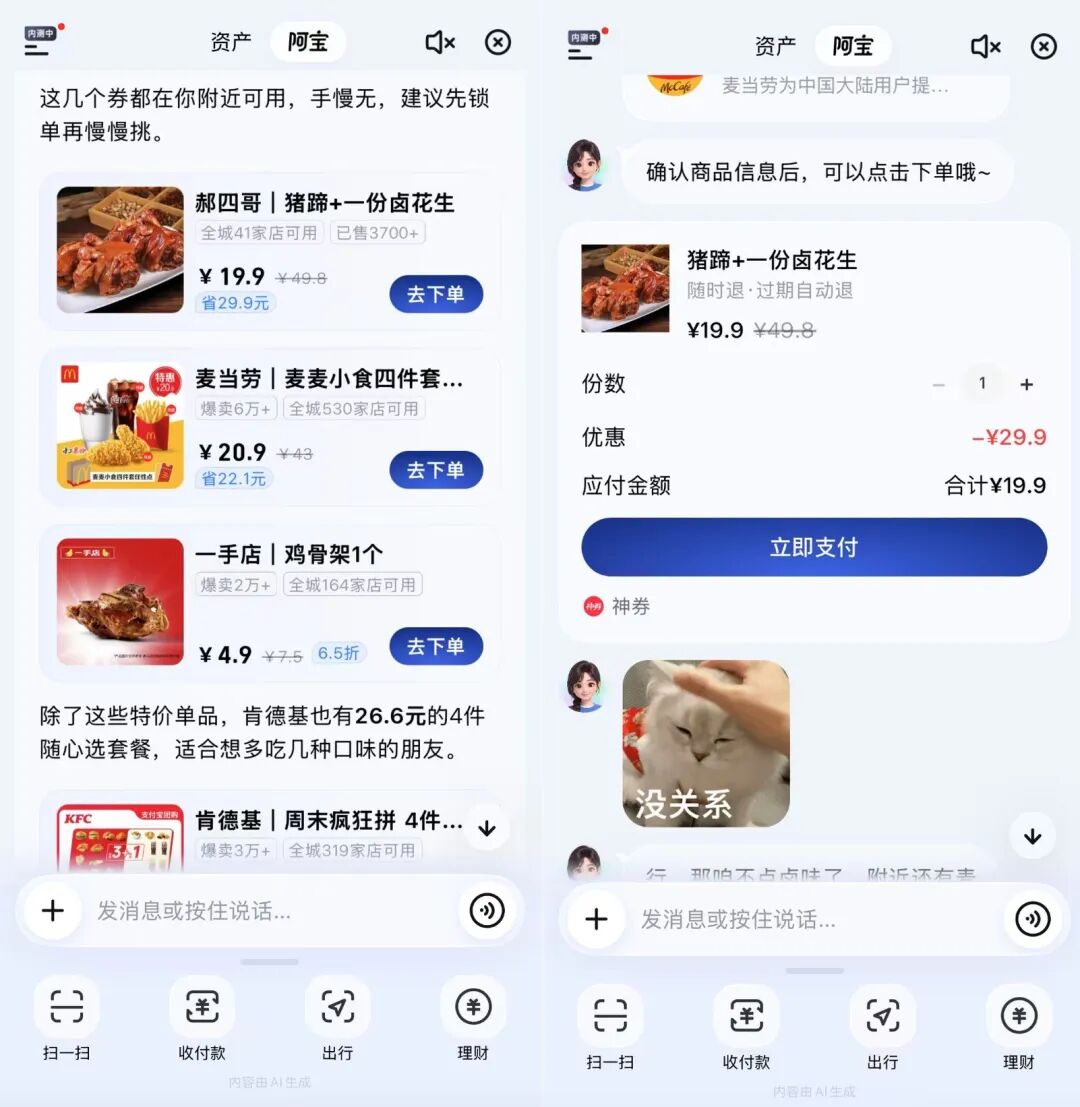
An interesting incident occurred during our testing. Our colleague also attempted to order food delivery using Abao but couldn't access the direct ordering page. Instead, Abao kept recommending mini-programs for Taobao Deals and Meituan Food Delivery.
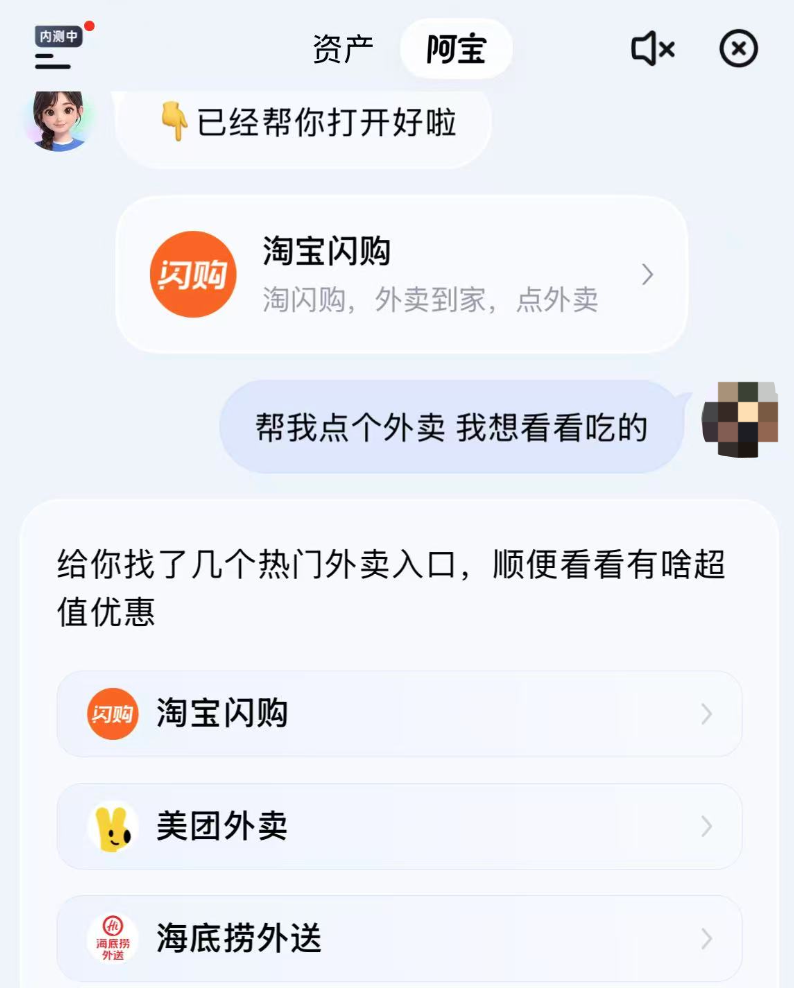
Later, we realized that the key lay in the prompt words. Our colleague's prompt was, "Help me order some food delivery. I want to see what's available." Literally interpreted, Abao assumed that the colleague didn't want ready-made results but preferred to browse and filter options herself. However, the colleague's true intention was for AI to provide several ready-made options. This actually exposed Abao's shortcomings in "understanding human intent."

Of course, these are some of the better-performing functions. Abao also has average or underperforming aspects. For example, when it comes to querying social insurance and housing provident fund or paying utility bills, Abao cannot complete these tasks directly.
In these scenarios, Abao functions more like a shortcut entry. For instance, if you say to Abao, "Pay the electricity bill," it will bring up the payment entry, and you need to click in and complete the payment process yourself. However, it could go a step further by asking questions like, "How much should be paid?" and then directly helping with the payment. We understand that Alipay may not yet have the permissions to integrate with these platforms, and we hope for improvements in the future. Finally, we tested the financial management scenario. This is probably one of Alipay's most valued functions, as it occupies a dedicated section. In this regard, Alipay has long positioned itself as a national-level financial management platform. Over the years, many young people have entered the fund market primarily through Alipay.
However, our evaluation of the related functions was mixed. For example, I asked Abao to analyze my fund holdings. Abao concluded that my holdings were highly diversified, in crowded sectors, and lacked liquidity. It provided numerous arguments, such as several of my funds having only a few dozen or hundred yuan in shares, most of my funds being in current popular sectors, and my assets lacking other components like fixed-term or demand deposits besides high-risk funds...
In short, there were many reasons. But in my opinion, these analyses were largely irrelevant. Because I only buy popular funds on Alipay, and I don't keep all my money there, it may seem like I lack liquidity and have crowded investment sectors. Furthermore, the diversification of holdings often results from selling off profitable positions and keeping a small portion as a core holding, but Abao misinterpreted these actions as my holding strategy.
More interestingly, when I asked Abao to analyze my bills, it found that I only spent 200 yuan on food delivery last month. Abao then praised me for being extremely frugal and having strong saving skills. However, the reality is that I only spent 200 yuan on Alipay, while I had already become a Black Diamond member on Meituan. The key issue here is that Alipay aspires to be your asset manager, assuming that all your assets and consumption are handled through it. This is certainly Alipay's ambition, but in reality, it can only see a partial picture—the portion of your assets managed through Alipay. These factors lead to its analyses and conclusions being vague and unreliable.
Therefore, if someone were to invest and manage their wealth based on Abao's conclusions, the results would be predictable. As one of Alipay's most important functions, this aspect may need further optimization. Overall, the AI version of Alipay boasts many commendable capabilities. Compared to those chatbots that only engage in conversation, it has taken a significant step forward, truly simplifying many experiences, streamlining interactions, and giving the concept of a personal AI assistant a concrete form for the first time. Of course, as mentioned earlier, the AI version of Alipay also has many issues that the Alipay team may need to address in the future.
2. Why Alipay?
After testing the new functions, we were left pondering another question: Why did Alipay become the first national-level AI assistant? What kind of future does the AI version of Alipay herald?
I believe the crux lies in the fact that Alipay didn't start from scratch to create a life assistant but integrated AI into an already established life service ecosystem.
Over the years, Alipay has been vigorously building its mini-program ecosystem. However, due to the pioneering presence of WeChat mini-programs, Alipay's mini-programs remained relatively obscure until recently. Today, Alipay's long-term investments have paid off. It has built a complete ecosystem based on life infrastructure through mini-programs, distinct from WeChat's. This ecosystem encompasses payments, transportation, medical insurance, government services, financial management, local life services, and more. When AI connects these elements, it serves as the hands and feet for agents to extend from the digital world into the real world, enabling them to complete various tasks.
This is an advantage that some newly emerging AI applications lack. For example, Meituan Xiaomei, which should theoretically be the most convenient example in life service scenarios, failed to make a significant impact after its launch due to the absence of such an ecosystem. Similarly, Qianwen, also from the Alibaba ecosystem, is limited to Taobao, Deals, and other in-house services. In fact, connecting everything has traditionally been WeChat's strength. However, due to its hesitance and restraint in this regard, Tencent was forced to push WeChat to the forefront only after Yuanbao's failure. Therefore, WeChat missed out on being the first national-level app to embrace AI. Of course, being first doesn't necessarily mean victory.
WeChat's national popularity and the user habits ingrained in everyone's "DNA" remain WeChat's greatest strengths. Honestly, ask yourselves: How often do you open Alipay? How many of your actions occur within Alipay? This is probably Alipay's biggest weakness when competing with WeChat in the same arena.
Finally, the AI-powered Alipay also provides us with clearer insights into the development trends of the AI era. For example, a clear trend is that the value of many apps will be challenged. Take ride-hailing apps as an example; through Abao, we can invoke AutoNavi's ride-hailing service without needing to enter the AutoNavi interface. Similarly, for food delivery, there's no need to enter Meituan or Taobao Deals. This doesn't mean AutoNavi, Meituan, or Taobao Deals are doomed, but rather that they may lose their front-end connections with users in the future. This change may not be immediately apparent with Alipay, but it might become more intuitive once WeChat's AI version is released.
More interestingly, around the same time, Qualcomm CEO Cristiano Amon, the global giant in mobile phone chips, also predicted that agents will replace apps. He didn't just toss out a viewpoint but presented tangible evidence, as Qualcomm is developing designs for over 40 new AI-powered smart devices. Therefore, the future is already unfolding, and the time for many national-level apps is running out. One wonders if the CEOs of these companies can sleep soundly at night.

- END -
-
Trillion-Dollar Commercial Space Industry: Profits Start Not with Rockets
-
![]()
Baidu Netdisk Encounters a 'Significant' Challenger: Tencent Netdisk Makes Its Debut
-
![]()
Tencent Cloud Drive: A Rising Contender to Baidu Cloud
-
![]()
AR Optical Leader Quietly Achieves 1 Million Units in Mass Production!
-
![]()
Raising 289 Million for Optical R&D! Olight Technology Prepares for GEM IPO
-
![]()
【OFweek Weike Cup】Cybernetics Officially Nominated for the 2026 Outstanding Contribution Award for Optical Industry Application Solutions
-
![]()
Precocious Ideals, Rebuilding A New Ideal
-
![]()
DeepSeek Finally Accepts 50 Billion Yuan in Funding