One-Person Company Finds 'All-Purpose Colleague' During 618
 06/18 2026
 413
413

In the past month, Xiaogang, the operations manager of Zhihuang Flagship Store, has been too busy to even take a sip of water.
As the person in charge of a store specializing in services like graphic design and video editing, he didn’t originally anticipate much from 618. In the past, major sales events were exclusive to the consumer goods industry, and enterprise services naturally lacked the incentive for 'promotions'—after all, few people would wait specifically for 618 to place orders.
But this year, that pattern was broken. During Tmall's 618 event, inquiries for services like AI photo editing and AI video production, which are well-suited for 'one-person companies,' continued to grow, with overall transaction volume surging by over 200% year-on-year.
Similar changes are happening across Taobao. Platform data shows that during this year's 618, transactions for AI video and AI graphic design products increased by over 150% year-on-year. Among users who purchased AI-related services, new customers accounted for more than 52%, with over 60% being young people under 29. Meanwhile, transactions for international business services like overseas company registration and international trademarks grew by over 420% year-on-year, with the number of users visiting related product pages increasing by nearly 380%.
In the past, people shopped for consumer goods during 618; this year, from AI content production to company registration and trademark applications, a wave of entrepreneurial needs centered around 'one-person companies' is erupting on Taobao.
01 One-Person Companies Flock to Taobao to Place Orders
Starting in the second half of last year, keywords like 'personal studio,' 'freelancer,' and 'blogger' began frequently appearing in customer service chats and order notes at Zhihuang Flagship Store, which Xiaogang oversees.
Compared to traditional corporate clients, this group has distinct characteristics: each person is a one-person team, and they outsource what they cannot handle themselves.
Xiaogang and his team quickly realized that these clients needed low-barrier, high-efficiency, and affordable services. As a result, the store launched services like AI photo editing and AI video generation, unexpectedly hitting the surge in demand.
The origin of this 'procurement' wave began with the sexiest term in the AI circle over the past year: AI Agent. As AI Agents gradually gained the ability to deliver complex tasks like coding, design, and operations, it became feasible for a single person to establish a company.
According to the <2025 China Digital Economy Entrepreneurship White Paper>, over 12 million individual entrepreneurs nationwide have chosen OPCs.
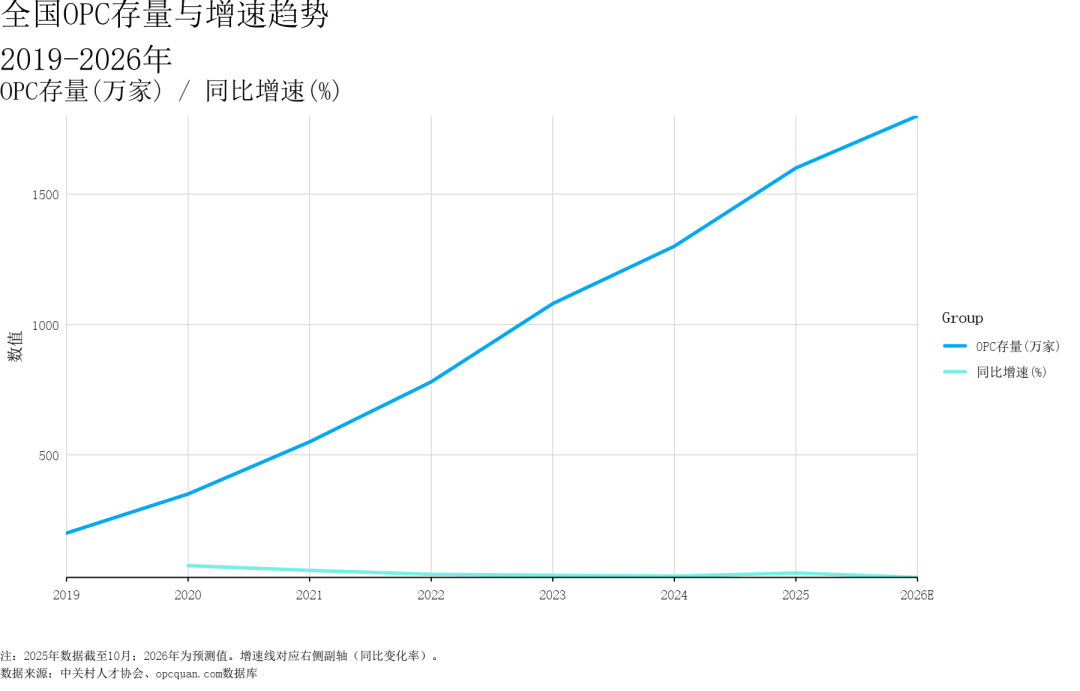
▲Source:
For Taobao merchants, the most intuitive (intuitive) sign of change is the shift in backend orders. Zhihuang Flagship Store’s homepage shows that after launching its AI video service, monthly sales exceeded 3,000 orders.
'We initially thought that as AI became more widespread, the unit price of custom services would drop,' Xiaogang said. But he soon discovered the opposite: the proliferation of large models eliminated simple demands while creating more complex ones.
For example, traditional video footage only required editing, but with AI, clients wanted characters in videos to stand up, talk to people, or even dance. Orders for video editing, previously priced at around 100 yuan, now average 200-300 yuan, and demand for such AI video services continues to grow.
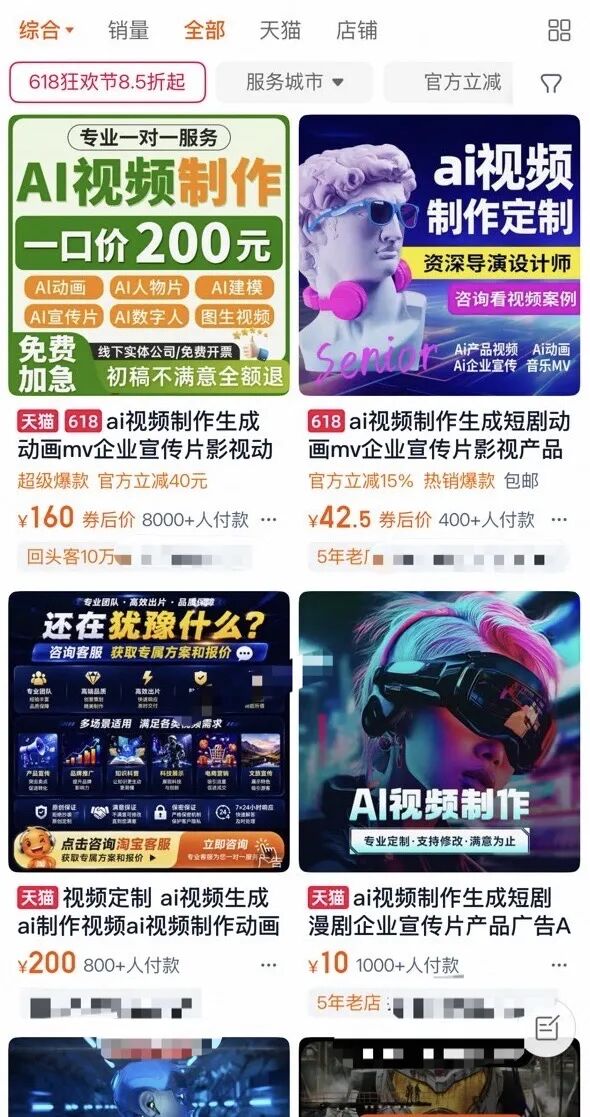
▲A surge of AI video products appears on Taobao
A bigger turning point came in February this year, when OpenClaw gained traction, making more people realize that AI capabilities had shifted from 'conversation' to 'delivery,' marking the maturity of one-person entrepreneurship. Meanwhile, local governments introduced support policies for OPCs, including funding, computing power, and tax incentives, further lowering the barrier to individual entrepreneurship.
As more customers flocked in, new demands emerged, such as OpenClaw installation services and custom Agent workflows, driving the store’s business scope to expand continuously. Over the past year, Zhihuang Flagship Store’s service revenue has exceeded 30 million yuan.
In the face of trending waves, e-commerce merchants are perhaps the most sensitive group. A corporate store that originally provided outsourced human customer service for e-commerce saw sales of its AI e-commerce customer service product quickly surpass 700 orders, while its traditional human customer service sales remained at 100 orders.
According to Xuanyan, head of Taobao-Tmall’s Personalized Customization Industry, where AI services reside, platform transactions for AI-related services grew by nearly 150% in March this year compared to December last year, with double-digit month-on-month growth every month since.
Objectively, the explosion of AI tools and services has expanded the capabilities of individual entrepreneurs, making the OPC model viable sooner.
This acceleration also directly impacts the upstream—when entrepreneurs begin thinking about business issues, their first need is to register a company.
From company registration and trademark applications to finance, tax, social security, and legal advisory, these modules form a complete 'entrepreneurial qualification' package, serving as the 'identity guarantee' for OPC operations. If AI tool merchants sell 'shovels' for gold mining, company registration and bookkeeping service providers sell the 'entry tickets.'
After a large influx of OPCs onto Taobao, traditional service providers centered around 'starting a company' also adjusted their strategies this year, targeting super-individuals in the AI era as a new customer base for intensified operations. 'One-stop company setup' and 'one-person company' have become keywords in many store product descriptions.
A natural procurement chain for entrepreneurship centered around OPCs is taking shape on Taobao.
02 One-Person Companies Move Toward 'Industrialization' on Taobao
The reason this entrepreneurial service chain formed naturally is that it is demand-driven.
An OPC’s 'AI colleague' might be impressive, but the first challenge entrepreneurs face is how to establish a company. This involves significant information gaps, such as whether to choose a sole proprietorship or a limited company, or the differences in tax incentives across cities...
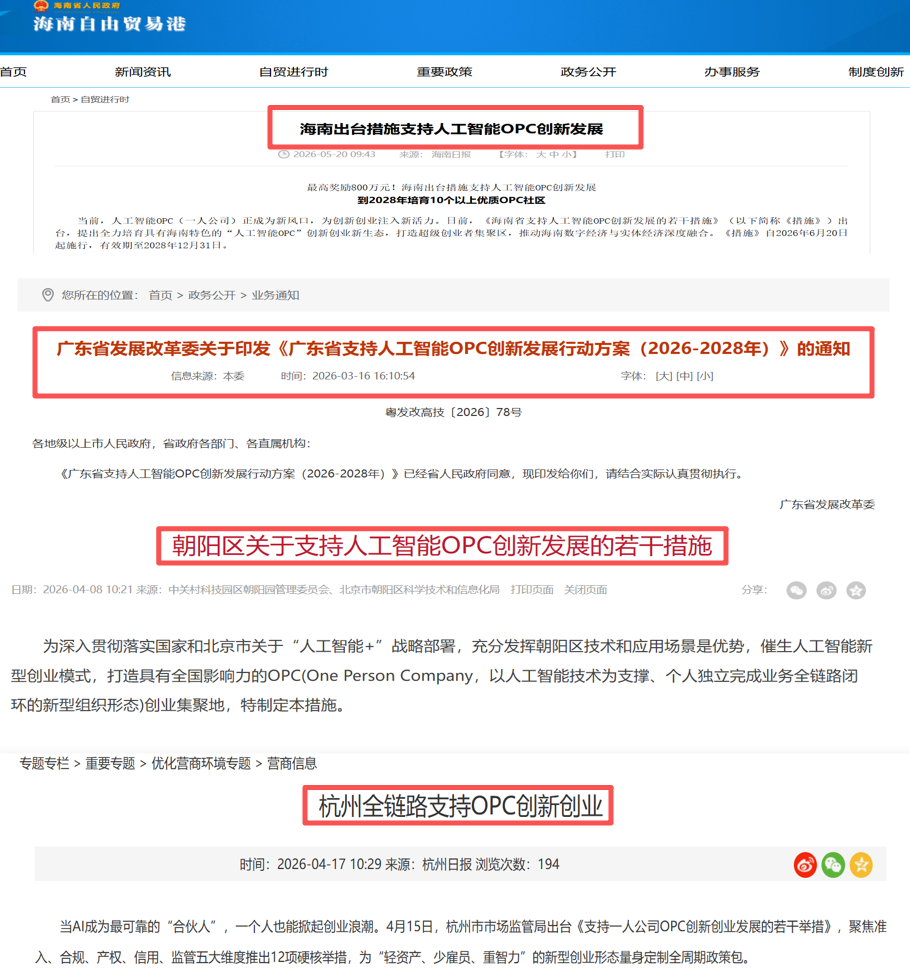
▲Since the start of the year, local governments nationwide have introduced new policies supporting OPCs
Beyond information asymmetry, the market for these services is fragmented—service providers vary in qualifications, quotes are arbitrary, capabilities are exaggerated, and some even abscond with payments.
For Taobao to meet this new demand, the first step is to collaborate with merchants to refine infrastructure, allowing entrepreneurs to experience 'hassle-free' operations intuitively.
As early as September 2024, to support procurement needs of small and medium-sized enterprises (SMEs), Taobao launched 'Taobao Enterprise Purchase,' a one-stop corporate procurement platform.
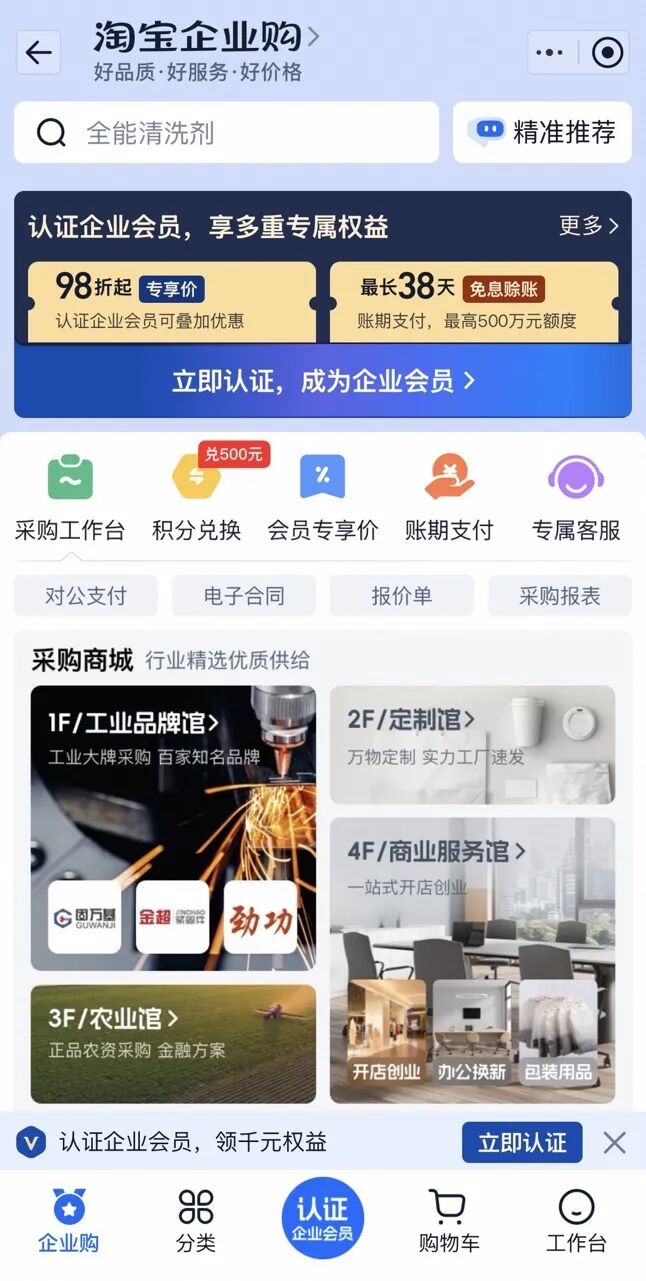
▲Taobao Enterprise Purchase platform
This platform is not just a 'special zone' on Taobao. Corporate procurement and personal consumption are entirely different business models: the platform needs to help SMEs reduce the cost of screening service providers and clarify accountability through electronic contracts during transactions. For software and services with longer cycles, staged payment mechanisms must be designed to link fund flow directly with service progress.
This platform capability, honed through serving SMEs, proved immediately valuable during the OPC wave.
However, compared to SMEs, OPCs face an additional challenge: the entire enterprise service market is not designed for them.
Traditional enterprise services use a negotiated pricing model: the same company registration service might have a 'custom' quote based on client size, region, and specifics. For OPCs, this model involves high communication costs and lacks transparency.
After identifying this supply-demand mismatch, Taobao restructured enterprise service transactions around OPC scenarios this year, using platform rules and standardized offerings to transform 'negotiated customization' into 'standardized package pricing.' Enterprise services that previously required itemized communication and quoting are now bundled into directly purchasable packages.
The shift from non-standardized to unified pricing drastically reduces decision-making costs, making transaction growth possible. During Tmall's 618 this year, Taobao backend data showed significant growth in orders for customized enterprise services purchased by individuals. The average unit price also dropped to a range affordable for one-person companies, with industry-wide prices declining by about 20% compared to before.
As one-person companies quickly navigate the 'industrialization' process on Taobao, fueled by entrepreneurial passion, business demands begin to surge.
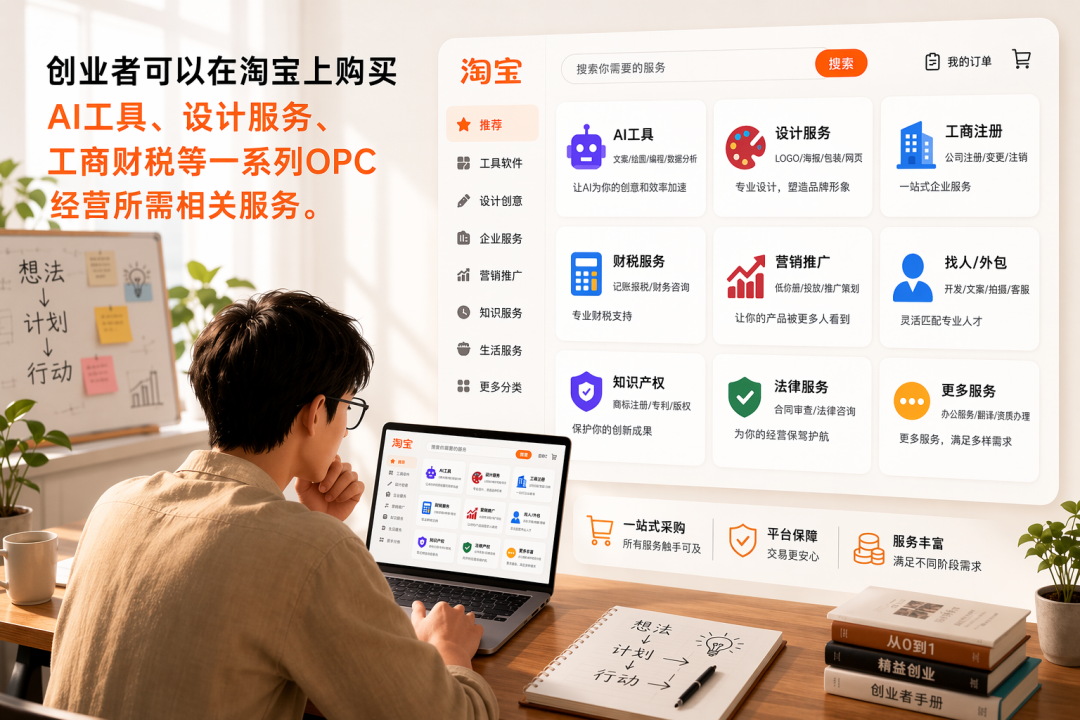
From the service scenarios in these transactions, some are betting on AI video generation, others need to build vertical Agent workflows, some register overseas companies to expand cross-border operations, and others purchase design, operations, and content production services for their retail projects.
Taobao’s versatile supply quietly transforms into the 'all-purpose colleagues' for one-person companies.
03 When Taobao Starts Selling 'Productivity'
Domestically and internationally, enterprise procurement platforms are not scarce, but when more and more OPC entrepreneurs seek startup support, many still choose 'Taobao, the all-purpose platform' as their first option.
The reason is simple. Over the past 20+ years, Taobao has organized scattered goods and services into a mature transaction system: search, reviews, escrow transactions, standardized products, and fulfillment capabilities collectively reduce transaction costs between strangers, fostering a vast ecosystem of small and medium merchants.
This means that when new demands emerge, supply on the platform can grow rapidly.
Over the past year, this transformation has been particularly evident in the AI entrepreneurship wave. Merchants originally offering video editing and graphic design now handle AI video production and Agent workflow setup. Enterprise services like company registration, bookkeeping, and trademark applications, which previously required repeated quote negotiations, are now packaged into standardized bundles for direct online transactions.
The platform is actively driving this process. On one hand, it trains merchants to transition to AI services; on the other, it introduces more professional AI enterprise service providers to enrich entrepreneurial service offerings.
Simultaneous expansion on both supply and demand sides has enabled Taobao to form a capability network centered around entrepreneurial needs. If Taobao lowered consumption barriers over the past 20 years, in the AI era, it now has the potential to lower entrepreneurial barriers.
Compared to traditional enterprise service platforms, Taobao’s unique strength lies in connecting the same group of people.
Many who purchase AI tools, design services, and business registration services on Taobao are also service providers on the platform. They procure capabilities needed for entrepreneurship while selling their own professional skills, completing capability exchanges and value circulation within the platform. Consumption, entrepreneurship, and operations form a closed loop on a single platform.
In a sense, this is another identity Taobao is developing—it is no longer just a platform for consumer goods distribution but is beginning to serve as entrepreneurial infrastructure. Traditionally, entrepreneurship meant assembling a team and integrating resources; today, more capabilities can be acquired through platform procurement, further lowering entrepreneurial barriers.
However, in the internet sector, the emergence of any new infrastructure-level platform brings new dependencies and constraints. When OPCs rely heavily on 'external support' from the platform, risks intensify if platform rules change, such as when certain services are delisted for compliance reasons.
Additionally, whether service standardization will compress space for differentiated services or cause dynamic supply-demand imbalances remains to be seen. After all, AI evolves rapidly, and entrepreneurs’ new needs will continue to emerge. Whether merchants and the platform can keep up is a test of this entrepreneurial service ecosystem’s vitality.
Of course, for Taobao, the emergence of new demands is always positive. New demands bring new growth opportunities.
In the past, users came to Taobao primarily to buy goods, but with overall pressure on social retail, every e-commerce platform is seeking new growth areas—Taobao included. Now, users are starting to procure 'entrepreneurial capabilities' like AI tools and enterprise services on Taobao, extending platform transactions from consumer goods to productivity itself.
As one-person companies grow into SMEs or even larger organizations, their underlying needs for enterprise services, operations, and commodity procurement will continue to amplify, creating longer-term transaction relationships than traditional consumption.
The OPC wave that began earlier this year has introduced a second growth curve beyond consumption during this year’s 618.
Whether growth is linear or hockey-stick-shaped depends on where this AI wave takes entrepreneurs.
-
![]()
Xiaomi and Others Boost Old Smartphone Battery Capacities, Power Banks Face Uncertain Future
-
![]()
Zhipu Soars to New Heights, MiniMax Faces Pressure: The Diverging Trajectories of the 'Dual Titans in Large Models'
-
AI Asset Spin-offs at Major Companies: Is Kling Paving the Way for ByteDance and Alibaba?
-
![]()
AI Agent Security Firm NewCore Raises $66 Million in Seed Funding, Achieves $300 Million Post-Money Valuation
-
From Pessimism to Optimism: China’s Hydrogen Fuel Cell Vehicles Set for Expansive Growth
-
The Race Against Time for Survival of Unitree and Its Peers
-
Dream Weaver in the Eye of the Storm: Elon Musk's Business Empire and SpaceX's IPO Moment
-
![]()
From 'Daydream' to 'Trillions in Wealth': Is SpaceX Really That 'Sci-Fi'?