Can AI-Generated Songs Rake in Over 100,000 Yuan Monthly? Our Hands-On Experiment Unveils Its Core Strength Lies in Marketing
 06/22 2026
 390
390
We crafted a song, titled 'Song of Leitech,' using AI technology.
Before diving in, let's take a moment to listen to 'Song of Leitech,' our AI-created masterpiece.
After a live performance duel against an AI-composed piece, 'Tears of the Sea,' Zeng Yiming, the first-season winner of 'The Voice of China,' boldly predicted:
'Soon, AI-generated music will top the charts across major platforms.'
This forecast materialized sooner than anticipated. Lately, while browsing online, you've likely stumbled upon a plethora of 'AI Jay Chou' and 'AI Stefanie Sun' renditions of songs never sung by the original artists, leaving fans in awe.
When discussing AI-generated songs, we must mention the AI virtual singer 'Pushpin,' independently developed by Kugou's Apollo Sound Lab. To date, 'Pushpin' has released nearly 2,000 cover versions, with a peak monthly listener count of 25.17 million. In terms of streaming figures, this is comparable to Jay Chou's current monthly listener base.

Image Source: QQ Music
Meanwhile, AI virtual singers are transitioning from 'mere audio entities' to 'virtual idols' with distinct personalities. In January, 'Yuri,' China's first virtual idol to receive an official ID card in Beijing's Yizhuang, not only continues to produce music platform content but also deeply integrates into public cultural events. Following the release of her debut song 'Surreal,' she secured commercial collaborations with brands like Wuthering Waves and VOYAH, proving the viability of monetizing virtual vocals.

Image Source: VOYAH
This trend is spreading globally. On June 6th, Donald Trump unveiled an AI-generated single, 'Everyone Loves Trump,' with lyrics proclaiming, 'No matter where I go, everyone loves Trump. In Mexico, they love Trump; in Italy, they love Trump...'
Embracing a 'learn-by-doing' approach, Leitech (ID: leitech) embarked on a practical experiment to produce 'Song of Leitech.' However, after hours of intense effort, we uncovered fundamental flaws in AI music's underlying mechanisms.
As the current frontrunners in AI music platforms, Suno and Udio essentially control half of the market. Prior to the test, I assumed AI songwriting, like human songwriting, involves iterative refinements based on real-time melody and rhythm feedback. However, during the initial attempt to generate 'Song of Leitech,' the first round of testing revealed a logical failure in cross-modal alignment.

Image Source: Suno.cn
The issue stemmed from lyric interpretation. To thoroughly test AI's ability to handle vertical jargon and complex Chinese phrases, I used GPT to generate lyrics, incorporating numerous multi-word parallel structures and references to Leitech's vertical IP matrix, such as 'WeChat, Douyin, Bilibili / Watch Xiaolei dissect hardware in digital discussions / See how AI, blending software and hardware, enhances the experience.'
However, the algorithm's output revealed its lack of understanding of vertical terms. AI abruptly truncated 'Xiaolei's digital discussions,' creating a meaningless pause after 'Xiaolei,' and then sang 'discussing digital hardware' in a muddled manner. Such basic dissonance, violating fundamental music theory and pronunciation norms, frequently occurred in subsequent attempts.
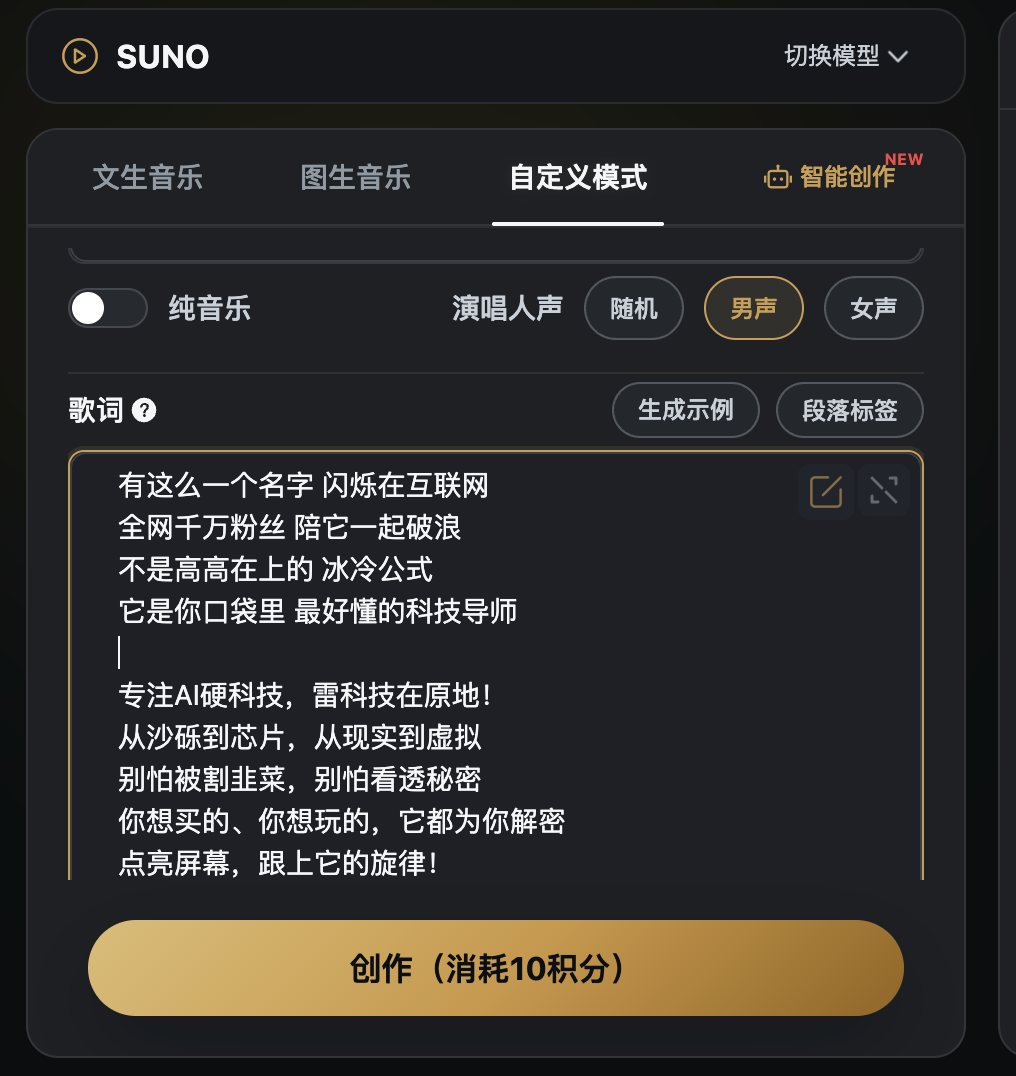
Image Source: Suno.cn
Clearly, AI music lacks auditory perception; it essentially uses visual large model logic to 'draw' a spectrogram.
From a structural standpoint, Suno or Udio's initial step is to employ neural audio codecs to break down continuous audio signals into hundreds of tiny audio slices per second, converting them into discrete codes, or audio tokens.
Within the model, there's no distinction between the emotional intensity of a chorus and the flatness of a monologue; they're merely two sets of matrix data with different probability distributions.
This remains a probability prediction game that the Transformer architecture excels at. The model calculates, based on the current context, which audio token has the highest probability of following the previous second's digital encoding. After generating a sequence of numbers via an autoregressive model, it employs a diffusion model for denoising and realism, ultimately outputting an audio track.
This puzzle-like logic, reliant on statistical probabilities, establishes only a strong binding between 'characters' and 'pronunciation codes.' It lacks true melodic logic and fails to grasp the contextual semantics of Chinese phrases, making it prone to misaligned phrasing and tonal collapses when handling slightly complex vertical terms.
After understanding the underlying mechanism of audio tokenization, I initiated a second round of testing. In the third verse, the timeline jumps to 2026, with more vivid and immersive details: 'Flying over the Pacific, heading to the sleepless Nevada / At the CES exhibition, no snow—only sandstorms.'
To complement this 'founder-led frontline mission' geek aesthetic, I aimed for an avant-garde, cold, and grand tech-electro-pop style. However, the algorithm quickly revealed its limitations as a mere reseller of big data.
Thirty seconds later, the software output an audio track with a strong nightclub vibe. The model mechanically shouted 'no snow—only sandstorms' in a monotone DJ voice, paired with cheap bass, transforming a majestic tech reporting team's journey to the Nevada desert into a tacky nightclub anthem.
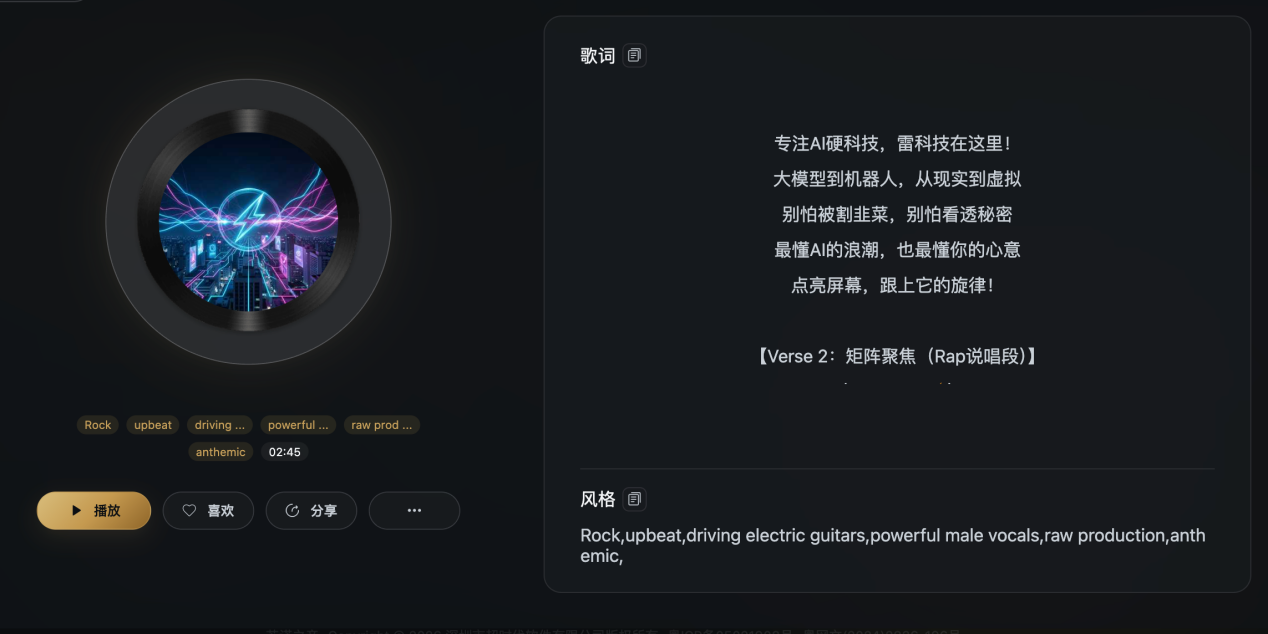
Image Source: Suno.cn
This exposed another technical bottleneck in AI songwriting: its inability to innovate in aesthetics and style, relying instead on stereotypes derived from big data.
Human style innovation often arises from breaking existing rules, whereas AI's algorithmic logic does the opposite, always favoring the most probable and safest clichés based on internet-wide big data statistics. After scraping music samples labeled as 'tech' across the web, AI found that cheap synthesizers and bass were prevalent, prompting it to amplify these big data averages.
When encountering terms like 'Nevada, CES, sandstorms,' which lack corresponding templates in traditional music libraries, its algorithmic mechanism defaults to the most banal and safe 'nightclub style.'
Due to its uncontrollable black-box logic, any slight adjustment to a prompt word in this probability-driven system can cause a complete collapse and reshuffle.

Image Source: Suno.cn
To forcibly correct it, I abandoned macro human language descriptions and resorted to purely structured thinking: manually fragmenting the lyrics, using square brackets to mark strict structural tags, forcibly correcting phrasing with punctuation between 'Nevada' and 'CES,' and utilizing the 'Extend' function to capture the barely passable first 30 seconds for incremental local rewriting.
After expending hundreds of platform credits and manually sifting through countless ineffective audio tracks, 'Song of Leitech' was finally pieced together.
Frankly, the diffusion model lent the final product a high degree of technical polish, featuring highly realistic overtones and balanced reverb, giving it an industrial-grade shell. However, this does not mean the technology understands music; it is merely the result of efficient reassembly on an assembly line.
AI has not eradicated the artistry of music; it has merely reconstructed its industrial foundation.
It can swiftly eliminate repetitive low-end market producers, but due to its reliance on statistical averages, it struggles to surpass probabilities and deliver the inspired strokes of human creators.
Frankly speaking, the above criticisms of AI songwriting may seem overly critical. When we shift our focus from a narrow artistic perspective to an industry and brand marketing standpoint, these microscopic flaws in AI music become insignificant in the face of commercial efficiency.
'Song of Leitech,' including song production and MV generation, cost me approximately 56 yuan in membership fees (with credits remaining), a negligible amount in marketing terms.
Without AI, traditional brand marketing songs are high-marginal-cost consumer goods. From inviting songwriters and composers, finding singers, to studio recording and post-production mixing, a qualified brand theme song often requires a budget of hundreds of thousands of yuan and several months of production time. AI music, however, has pushed production costs and timelines beyond the traditional industry's line of sight.
This nearly zero trial-and-error cost makes 'real-time content marketing' truly feasible.
For instance, Trump's AI single, while humorous, represents a highly precise political and emotional marketing strategy from a commercial perspective. Using AI tools, political slogans and current event memes can be transformed into pop symbols at minimal cost within minutes.
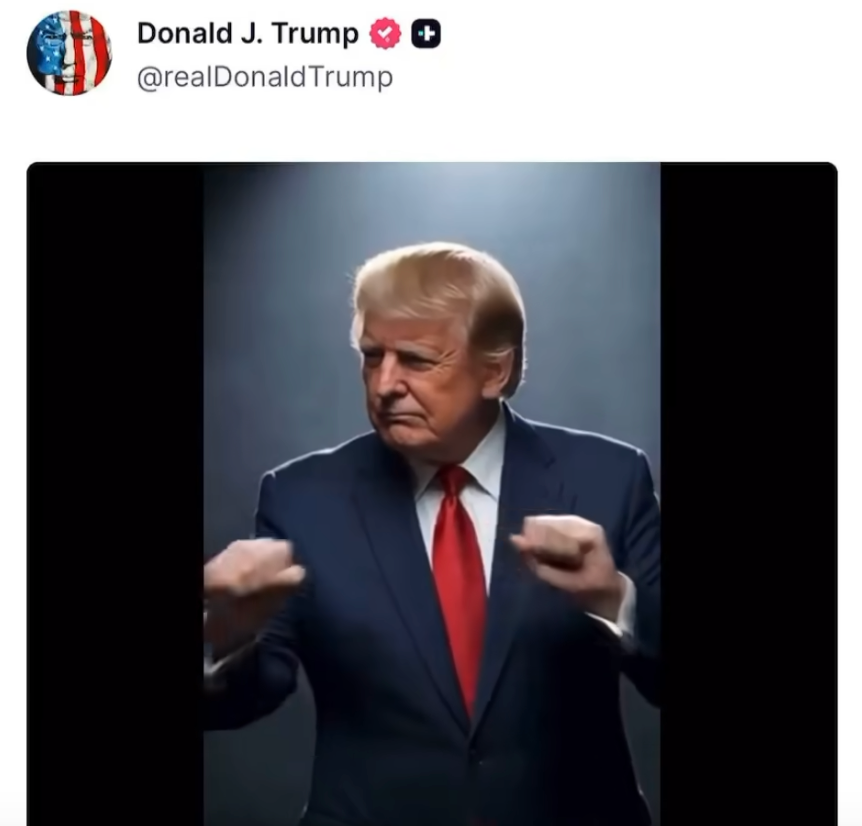
Image Source: X
This approach can also be replicated for commercial brands. For example, if an internet meme emerges at noon, operations can use AI to create a catchy song by the afternoon for distribution, significantly enhancing content output efficiency.
Another application is enhancing user engagement. For instance, when a new energy vehicle owner picks up their car, the system can extract the user's interest tags and automatically generate a personalized pickup song including the owner's name in seconds, directly pushing it to the vehicle's infotainment system.
During year-end summaries, platforms can also generate a unique life journey song for each of their vast user bases. Such a strategy would have been incalculable in terms of ROI in the traditional music industry but has now become a low-cost emotional value proposition.
When 'Song of Leitech' was finally pieced together, I felt a sense of 'finally done,' but this relief itself highlights the issue: AI can help you deliver, but not surprise. It excels at packaging big data averages into safe bets but cannot write those goosebump-inducing lyrics born from late-night inspiration.
Future music creation will likely stratify: inspired strokes will remain human, while standardized, real-time content production can be left to algorithms. Music will not die; only the barriers and power dynamics of creation are being reshuffled.
AI composition, AI songwriting, AIGC, AI music, Suno
Source: Leitech
Images in this article are from 123RF's licensed library. Source: Leitech
-
![]()
Insta360’s Post-Lockup Period Begins: Employees Suspected of Selling Shares, Institutions Biding Their Time—Is a Major Storm on the Horizon?
-
![]()
Are Houses Getting 'ID Cards' Now? In the Future, House Decorating, Renting, and Buying Will All Be Possible with a Simple Scan!
-
![]()
Where Should the Senior Citizens in County Towns Go?
-
![]()
【OFweek Weike Cup】Santec Officially Enters for the 2026 Optical Industry Annual Innovation Product Award
-
![]()
Anhui’s Taihu County Establishes a Project with an Impressive Annual Production Capacity of 850 Million Square Meters of Optical Film, Along with Supporting Rollers!
-
![]()
The AI Unicorn Valued at 960 Billion is Raising Funds Again
-
![]()
Unveiling the Strategy: The RMB 11.5 Million Deal of MLOptics
-
![]()
Qingtian Lease Hits 7 Billion Valuation in Six Months, Coexistence of Robot Leasing Bubble and Reality