Chongqing's Post-90s Entrepreneur Drives Firm to $2 Billion Annual Revenue Milestone
 06/22 2026
 344
344

The AI-driven creative industry is experiencing a surge in commercialization.
Today, Yanyu Technology announced the successful completion of a $300 million funding round, propelling its valuation to $2 billion and its annual recurring revenue (ARR) to $300 million. Notably, Yanyu Technology is not an isolated success story but rather a testament to the burgeoning profitability within the AI-driven creative sector, which boasts several other thriving companies worldwide.
Suno reports an ARR of $300 million, Runway generates $265 million, ElevenLabs achieves $500 million, and Midjourney, operating independently without external financing, also hits $500 million in annual revenue. The simultaneous crossing of the $200 million ARR threshold by at least five AI-driven creative companies globally signifies the industry's profitability turning point.
- 01 -
Yanyu Technology, valued at $2 billion, was founded in May 2023.
The company has witnessed rapid growth, securing six rounds of financing in under three years and achieving a post-investment valuation exceeding $2 billion (over 13 billion RMB). Founder Chen Mian, a 1992 native of Chongqing and a Southeast University graduate, previously spearheaded the global commercialization of CapCut and Jianying at ByteDance, becoming the youngest product 4-1 level employee at the age of 28. 
Yanyu Technology Founder Chen Mian, Former ByteDance Product 4-1 Level Employee
Yanyu Technology's financing journey has been consistently propelled by top-tier investors.
The angel round saw participation from Source Code Capital, GaoRong Capital, and GSR Ventures, followed by Pre-A and A rounds. In February 2025, Shunwei Capital and INCE Capital led a new round of financing. October 2025 marked a $130 million Series B round led by Sequoia China and CMC Capital. Now, in this nearly $300 million Series B+ round, Granite Asia, Tencent, and Shunwei Capital jointly led the investment, with HT Investment and Times Capital also participating. Existing investors, including GaoRong Capital, Ant Group, INCE Capital, Mingshi Capital, Source Code Capital, and Sequoia China, continued to increase their stakes.
However, the focus extends beyond financing; the company's revenue generation is equally noteworthy.
As of May 2026, Yanyu Technology's ARR surpassed $300 million, nearly tripling since the previous financing round.
In May 2026, the company's overall revenue witnessed a year-on-year increase of over 3000%. Its revenue streams primarily stem from three product lines. The first is LiblibAI, an AI design community.
Official data reveals that LiblibAI boasts over 30 million cumulative users, over 500,000 original models, and hundreds of millions of professional materials, claiming that "one in every three designers in China uses it." 
LiblibAI Product Interface. The second product line is Xingliu AI Design Agent. Functioning more as a design production tool than an AI image community, it caters to over 10 million cumulative users with more specific design needs. 
Xingliu AI Design Agent Interface. Source: Xingliu Official Website
The third product is LibTV, a video production platform launched by Yanyu Technology in March this year, experiencing the fastest recent revenue growth. Company data indicates that LibTV's daily revenue exceeded $1 million in its first month of launch; by May this year, revenue had reached 13 times that of the first month. 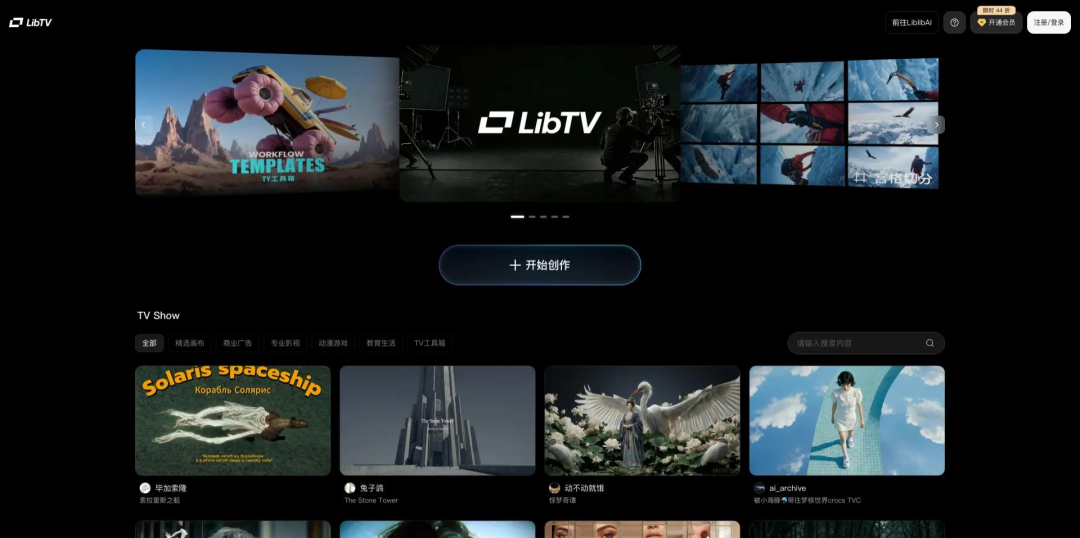
LibTV Interface. Source: LibTV Official Website
LibTV's uniqueness lies in its user base—comprising not ordinary early adopters but short drama teams, film and television institutions, and advertising companies. Yanyu Technology disclosed that LibTV has served nearly a thousand professional teams, with short drama content incubated by LibTV surpassing 10 billion views across platforms. 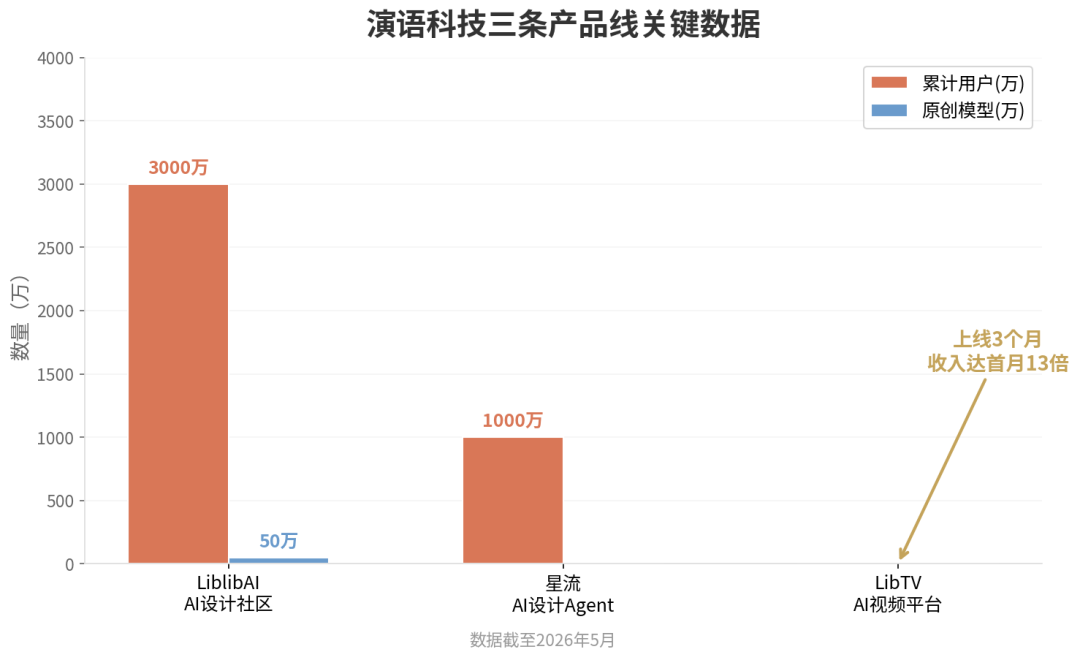
Key Operational Data of Yanyu Technology's Three Product Lines. Source: Company Disclosure
- 02 - Annual Revenue of $300 Million
Why can AI-driven creative companies generate revenue? The key lies not in whether users can utilize AI but rather in whether users were already paying for "creative production." Ordinary users often engage with AI out of curiosity.
Creating an avatar, designing a poster, or experimenting with a video is frequently driven by novelty. Such users can drive traffic but not necessarily sustained revenue.
Those genuinely willing to pay continuously are individuals who were already investing in purchasing efficiency. Data disclosed by Yanyu Technology underscores this point.
LibTV, launched in March this year, exceeded $1 million in daily revenue in its first month; by May, revenue had reached 13 times that of the first month.
It serves not ordinary consumer users but nearly a thousand short drama teams, film and television institutions, and advertising companies.
Short drama content incubated by LibTV has surpassed 10 billion views across platforms. Behind these numbers lies a straightforward business logic: short drama teams, advertising companies, and film and television institutions already allocate funds for content creation.
Previously, they had to invest in hiring screenwriters, storyboard artists, shooters, editors, post-production specialists, and visual effects artists.
Now, if AI can expedite and reduce the cost of certain production processes, they have a compelling reason to pay.
The same rationale applies to design. LiblibAI boasts over 30 million cumulative users, over 500,000 original models, and hundreds of millions of professional materials, officially claiming that "one in every three designers in China uses it."
Xingliu AI Design Agent has over 10 million cumulative users. These figures indicate that Yanyu Technology is not targeting one-time early adopters but a group of high-frequency creative producers.
Designers need to deliver schemes faster, advertising companies need to produce materials faster, short drama teams need to reduce production costs, and film and television institutions need to enhance production efficiency.
AI here is not selling "novelty" but faster and cheaper delivery capabilities. Therefore, the success of the AI-driven creative business does not stem from users' affection for AI but rather from the fact that creative production has always been a costly endeavor.
AI has simply re-priced a portion of these costs. So, what are its challenges? From a revenue perspective, Yanyu Technology is already on par with Suno and Runway; from a valuation perspective, it is significantly lower than Suno, Runway, and ElevenLabs.
With an ARR of around $300 million, Suno is valued at approximately $5.4 billion, while Yanyu is valued at around $2 billion, a difference of more than two-fold.
The gap may arise from three factors: First, the clarity of market positioning differs. Suno focuses on AI music, Runway on AI video, and ElevenLabs on AI voice, with simple and direct positioning.
Yanyu covers images, design, and video simultaneously, offering a broader scope but a more complex narrative. Second, the degree of globalization differs. ElevenLabs, Suno, and Runway naturally target the global market, with stronger brand recognition. Yanyu Technology's overseas market presence, copyright compliance, and enterprise client capabilities still require further validation. Third, the competitive moats differ.
Vertical companies can more easily establish a strong brand presence—for example, Suno for AI music and Runway for AI video. Yanyu needs to demonstrate that an image community, design tool, and video platform can be integrated into a long-term creative production system.
Yanyu Technology is not simply "cheap" or "expensive." It serves more as an observational sample: AI-driven creative companies can indeed generate revenue, but whether they can achieve valuations comparable to global leading companies depends on their ability to retain clients, increase average revenue per user, succeed in overseas markets, and avoid being replaced by foundational models.
- 03 - Who is the Most Profitable in the Global AI-Driven Creative Sector?
Focusing on AI-native creative companies, several players globally have achieved annual revenues exceeding $100 million.
ElevenLabs, specializing in AI voice, has an ARR of approximately $500 million, a valuation of around $11 billion, a PS ratio of about 22 times, and is used by 41% of Fortune 500 companies.
Midjourney, specializing in AI images, generated approximately $500 million in revenue in 2025, with around 19.83 million users.
More uniquely, it has not relied on external financing and is primarily self-sustaining through subscription revenue.
Suno, specializing in AI music, has an ARR of approximately $300 million. In June 2026, it completed a $400 million Series D round, achieving a valuation of approximately $5.4 billion, a PS ratio of about 18 times, with over 2 million paying users generating over 7 million songs daily.
Runway, specializing in AI video, has an annualized revenue of approximately $265 million (according to Sacra estimates). In February 2026, it completed a $315 million Series E round, achieving a valuation of approximately $5.3 billion, a PS ratio of about 20 times.
HeyGen, specializing in AI digital human videos, has an ARR exceeding $100 million, primarily serving enterprise marketing, training, and global localization scenarios. Now, let's examine Yanyu Technology: with an ARR exceeding $300 million and a valuation exceeding $2 billion, its PS ratio is approximately 7 times. 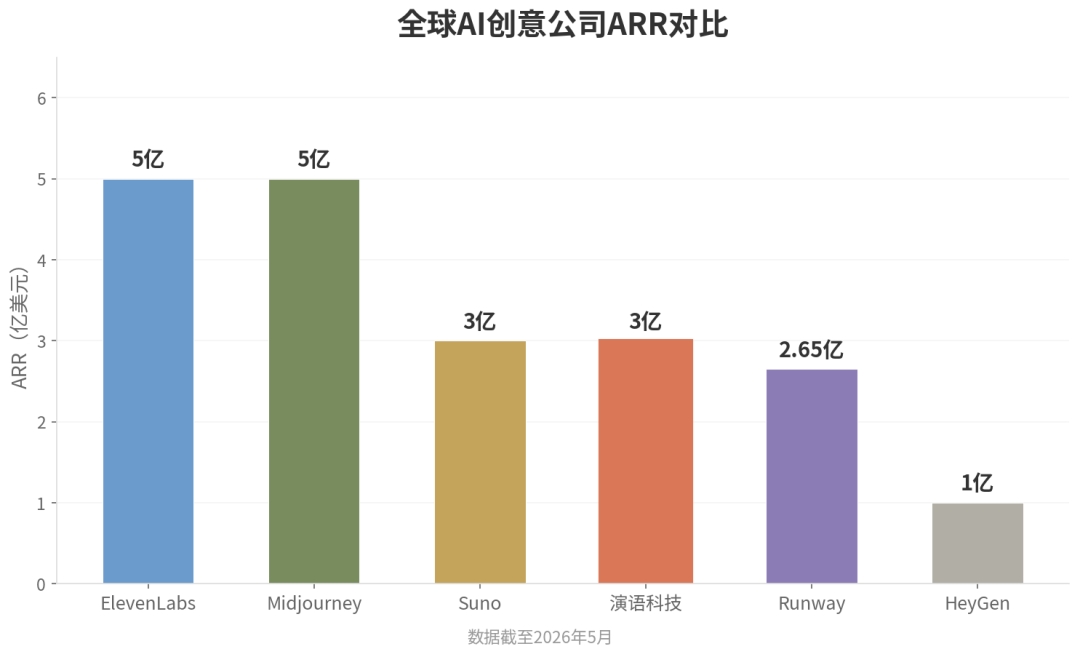
Global AI-Driven Creative Companies' ARR Comparison. Source: Company Disclosures
This comparison is straightforward. From a revenue perspective, Yanyu Technology is already on par with Suno and Runway; from a valuation perspective, it is significantly lower than Suno, Runway, and ElevenLabs. With an ARR of around $300 million, Suno is valued at approximately $5.4 billion, while Yanyu is valued at around $2 billion, a difference of more than two-fold. 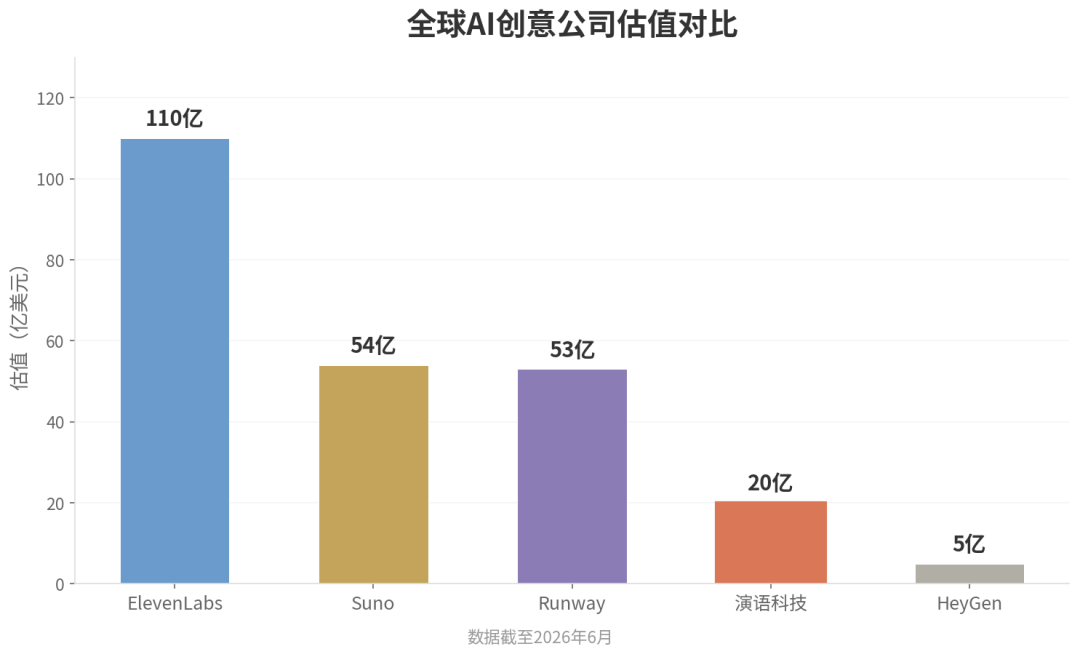
At the Same $300 Million ARR, Yanyu Technology's Valuation is Only 37% of Suno's. Source: Company Disclosures
The gap may stem from three factors:
First, the clarity of market positioning differs. Suno focuses on AI music, Runway on AI video, and ElevenLabs on AI voice, with simple and direct positioning. Yanyu covers images, design, and video simultaneously, offering a broader scope but a more complex narrative.
Second, the degree of globalization differs. ElevenLabs, Suno, and Runway naturally target the global market, with stronger brand recognition. Yanyu Technology's overseas market presence, copyright compliance, and enterprise client capabilities still require further validation.
Third, the competitive moats differ. Vertical companies can more easily establish a strong brand presence—for example, Suno for AI music and Runway for AI video.
Yanyu needs to prove that an image community, design tool, and video platform can be integrated into a long-term creative production system.
Therefore, Yanyu Technology is not simply "cheap" or "expensive."
It serves more as an observational sample: AI-driven creative companies can indeed generate revenue, but whether they can achieve valuations comparable to global leading companies depends on their ability to retain clients, increase average revenue per user, succeed in overseas markets, and avoid being replaced by foundational models.
-
![]()
Insta360’s Post-Lockup Period Begins: Employees Suspected of Selling Shares, Institutions Biding Their Time—Is a Major Storm on the Horizon?
-
![]()
Are Houses Getting 'ID Cards' Now? In the Future, House Decorating, Renting, and Buying Will All Be Possible with a Simple Scan!
-
![]()
Where Should the Senior Citizens in County Towns Go?
-
![]()
【OFweek Weike Cup】Santec Officially Enters for the 2026 Optical Industry Annual Innovation Product Award
-
![]()
Anhui’s Taihu County Establishes a Project with an Impressive Annual Production Capacity of 850 Million Square Meters of Optical Film, Along with Supporting Rollers!
-
![]()
The AI Unicorn Valued at 960 Billion is Raising Funds Again
-
![]()
Unveiling the Strategy: The RMB 11.5 Million Deal of MLOptics
-
![]()
Qingtian Lease Hits 7 Billion Valuation in Six Months, Coexistence of Robot Leasing Bubble and Reality