AI is Quietly Destroying a Trillion-Dollar Industry
 06/30 2026
 547
547
A silent industrial reshuffle is quietly unfolding on a global scale.
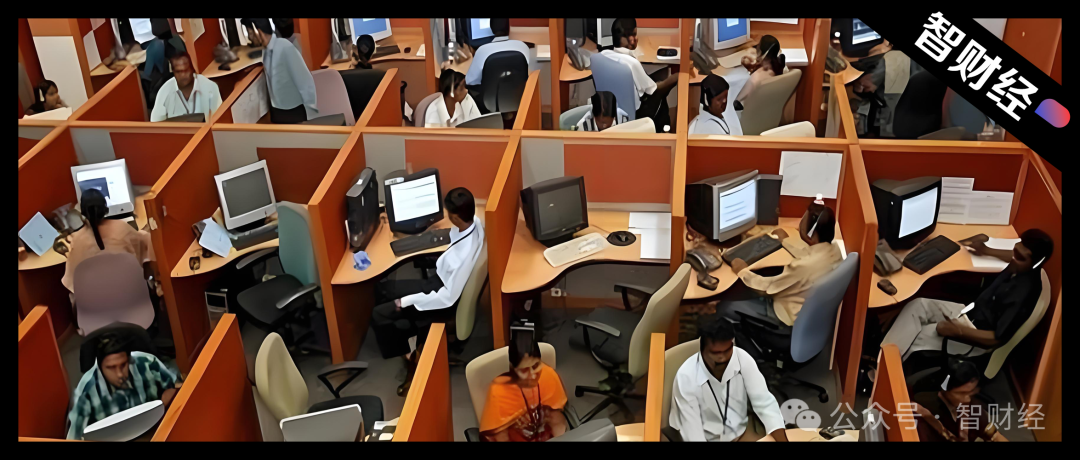
Without industry collapse or public outcry, a massive number of jobs are quietly disappearing, and the trillion-dollar industrial landscape is rapidly being reshaped. The global outsourcing industry, which rose to prominence by leveraging labor cost differentials, supported millions of workers and underpinned the economies of multiple nations. Now, it is being steadily eroded, dismantled, and reshaped by AI.
This silent disruption is far more ruthless than industry competition: AI is no longer just an auxiliary tool but is reshaping the underlying business logic of the outsourcing industry. The three-decade-old global labor division system is rapidly collapsing.
01 Domestic Tech Giants Quietly Overhaul: Token Quotas Replace Outsourced Labor
Attentive professionals have already noticed a transformative shift in China's internet industry labor practices.
Leading IT giants such as Tencent, Alibaba, Ant Group, ByteDance, NetEase, 360, and 58 are quietly phasing out low-end IT outsourcing positions in bulk. The reason this round of replacements is shaking the entire job market lies in the fact that China's IT outsourcing sector is a hundred-billion-yuan industry. According to industry and Ministry of Commerce data, by 2025, China's overall IT and software outsourcing market will exceed 610 billion yuan. Adding in IT operations and maintenance outsourcing, the total industry capacity surpasses a trillion yuan, Annual absorption (chángnián xīnā, meaning "consistently absorbing") millions of grassroots technical, operations, customer service, and data processing professionals. It represents one of the largest "labor reservoirs" in the internet ecosystem. Outsourcing teams that once supported the efficient operation of internet companies and handled vast amounts of basic, repetitive work are now accelerating their exit from the industry.
The core solution these tech giants are using to replace massive outsourced labor is both simple and revolutionary: company-wide AI token quotas.
Currently, leading companies are granting substantial AI token privileges to their full-time employees, with generous base quotas and the ability to request additional tokens for specialized needs. Some business lines have no upper limit. Standardized outsourced tasks such as code writing, data organization, document proofreading, process verification, and basic customer responses can now be efficiently completed by a single individual working with AI.
This is not merely about cost reduction and efficiency improvement but represents a fundamental revolution in internet labor models.
In the past, outsourcing primarily aimed to compress labor costs and offload non-core businesses, relying on a large pool of inexpensive labor to handle basic tasks. However, AI's marginal cost approaches zero—requiring a one-time investment for long-term reuse, with efficiency and accuracy comprehensively surpassing human labor.
When compared to the costs of outsourcing, including salaries, social security, management, and personnel turnover, AI token costs are nearly negligible. This silent personnel overhaul directly signals the end of the low-end IT outsourcing model, rapidly squeezing the survival space of China's trillion-dollar outsourcing sector.
02 Global Epicenter: Asia's Hundred-Billion-Dollar BPO Industry Faces Catastrophic Impact
China's IT outsourcing represents only a localized contraction, while Asia's trillion-dollar BPO (Business Process Outsourcing) sector, which relies on labor cost advantages, is facing a devastating, systemic AI impact.
BPO involves companies outsourcing standardized non-core business processes such as data entry, invoice processing, customer service complaints, document verification, basic legal affairs, and simple development to reduce costs and focus on core operations.
For decades, BPO has been an economic pillar for countries like India and the Philippines and a primary employment channel for their populations. It has also been a mainstream cost-reduction strategy for multinational corporations. However, the rise of generative AI has completely overturned this three-decade-old business model. The Harvard Business Review commented: The outsourcing economic logic built on standardized labor has now completely failed.
As the global dual cores of BPO, India and the Philippines' industry status perfectly encapsulates this industrial crisis.
India commands 55% of the global IT outsourcing market, with nearly 6 million workers contributing 7% of the country's GDP, making it the world's primary "back office." The Philippines holds 15-18% of the global BPO share, with 2 million workers covering customer service, administration, accounting, and technical support. The industry generates annual revenue exceeding 270 billion yuan, accounting for over 8% of the national GDP.
This trillion-dollar industrial powerhouse has now become ground zero for AI replacement.
The most brutal change is the extreme efficiency crush (niǎnyā, meaning "crushing") by AI. According to human resources agency TeamLease Digital: Tasks like contract review and drafting, which previously required a 30-person team, can now be completed by one person working with AI. Basic data entry and verification work that once needed 10 people can now be done by 2-3. AI also halves the time required for insurance claims processing and business audits while significantly reducing error rates.
Programming outsourcing in Bangalore, India, has cooled significantly. After local companies implemented AI-assisted development, industry barriers dropped sharply. Instead of requiring large numbers of junior programmers to log hours, ordinary people can now complete basic development with AI assistance, directly threatening the jobs of 2-3 million grassroots IT outsourcing workers.
Mass layoffs and industry-wide hiring freezes have brought a deep freeze. Oracle laid off 12,000 employees in India this year while ramping up AI investments. Industry leader Tata Consultancy Services cut 12,000 jobs last year, its largest layoff ever. Hiring data is even more glaring: In the first nine months of FY 2025-2026, India's top IT firms added only 17 net employees, compared to thousands of new positions in the same period last year. Outsourcing recruitment has essentially stalled.
Anxiety among frontline workers continues to spread. Filipino customer service representatives note that AI can now handle most routine inquiries independently, sharply reducing the need for human escalation and causing ongoing job contraction. Jobstreet's 2025 Philippines Workplace Happiness Index Report shows that 41% of local workers fear AI will impact their career development, with "technological disruption anxiety" becoming the norm in Asia-Pacific outsourcing.
03 Not Complete Extinction, But Complete Restructuring: The Irreplaceability of Human Labor and Industry Buffering
Most people mistakenly believe AI will completely eliminate BPO jobs. In reality, the industry logic is that AI disrupts rather than destroys, reshapes rather than eradicates.
After ChatGPT's explosion in popularity in 2022, Asia's outsourcing market initially plunged into job loss panic. Four years later, extreme unemployment waves haven't materialized, but the industry has undergone fundamental, subtle qualitative changes.
AI excels at standardized, mechanical repetitive tasks but has glaring weaknesses: lack of empathy, inability to handle complex human scenarios, data security vulnerabilities, and difficulty responding to sudden business changes. These represent the core barriers to human replaceability.
University of the Philippines professor Binhai notes that AI is currently used only for routine back-office tasks like call summaries, script assistance, quality inspection, and basic data organization. It cannot independently complete full customer service or business cycles.
Telework Philippines CEO Baniosa bluntly states that core processes still require human oversight: AI cannot perceive customer emotions, capture communication nuances, or anticipate risks like contract cancellations or complaints. Critical decisions still rely on human empathy and industry experience.
Meanwhile, AI has obvious technical flaws. The Philippine Artificial Intelligence Business Association points out its propensity for errors in data privacy, information security, and complex scenario implementation, necessitating human supervision, review, and error correction.
Therefore, some BPO companies remain stable and continue hiring, while local governments have implemented safety net policies. The Philippines allocated funds to provide skills training for 340,000 BPO workers. India has seen steady growth in rural and government outsourcing demand, as clients still trust human professionals for nuanced interpretation and flexible response.
However, industry buffering is only temporary. Job contraction is an irreversible trend. AI won't eliminate the BPO industry but will completely eliminate (táotài, meaning "eliminate") all low-end, repetitive, non-technically demanding human outsourcing positions.
04 Global Labor Division Reshuffle: Widening Wealth Gap, Outsourcing Enters 3.0 Era
AI's disruption of BPO goes beyond job counts—it's reshaping global industrial divisions and exacerbating global wealth inequality.
For the past three decades, the global division of labor has been fixed: The West exports technology, capital, and core businesses, while Asian countries provide cheap labor for low-end outsourcing, creating stable complementarity.
AI has completely shattered this balance. It doesn't uniformly create or destroy jobs but concentrates high-value positions in tech and capital-rich regions while draining the industrial foundations of labor-intensive nations.
Western companies are using AI to repatriate basic operations, creating high-value roles in AI training, intelligent operations, and advanced data analysis. Meanwhile, outsourcing giants like India and the Philippines continue losing low-end jobs, experiencing industrial hollowing-out. Their human capital growth path has completely failed, further widening the global wealth gap.
Simultaneously, new sectors replacing traditional BPO are quietly emerging—GCC (Global Capability Centers), dubbed the next wave of outsourcing.
Unlike low-end labor outsourcing, GCCs are overseas autonomous operation units of multinational corporations. They abandon simple repetitive work to focus on high-value complex businesses like data analysis, R&D, financial risk control, in-depth customer operations, and innovation projects.
However, this industry dividend is out of reach for most traditional workers. GCCs demand extremely high technical and professional capabilities, requiring skills in data analysis, advanced finance, and intelligent tool adaptation. Industry projections suggest only 10-30% of traditional BPO employees can successfully transition, leaving over 70% facing a dead end.
Most displaced workers will flow into low-threshold fields like gig work, services, and basic manufacturing, ending the era of high-paying, stable outsourcing jobs. There's widespread consensus that Southeast Asian nations must transition to physical and heavy industries to reduce reliance on human outsourcing.
05 Ultimate Revelation: In the AI Era, No Job is Truly Permanent
This global outsourcing industry transformation serves as a wake-up call for all professionals.
Once seen as low-threshold yet stable, BPO and IT outsourcing were considered premium career paths for ordinary people. Many invested years in these fields only to now realize: The most stable standardized jobs are the most vulnerable to AI replacement.
World Economic Forum data shows that 59% of global workers urgently need skills upgrades to adapt to the AI era. AI doesn't eliminate industries but targets those performing mechanical repetition without core competitiveness or the ability to provide emotional value and complex decision-making.
Human labor costs were once an advantage; now, human value is the core competitive barrier.
AI can replace repetitive labor but cannot replicate deep thinking, empathetic service, complex judgment, or innovative integration. Future workplace competition will hinge on personal value that AI cannot replicate.
This silent industry disruption confirms an enduring workplace truth: The era never eliminates industries, only those who cling to outdated models. The only permanent job security lies in continuous iteration and self-evolution.
Disclaimer: This article represents financial commentary only and does not constitute investment advice. All corporate data and regulatory events mentioned are derived from publicly available information and are for reference only, subject to official announcements. Image sources are noted online; please contact us for copyright removal if needed.
-
![]()
Starting at 4999 Yuan! Nubia RedMagic Gaming Tablet 5 Pro Review: Impressive Performance, But Hefty Price Tag
-
![]()
ByteDance Initiates First Major Management Reform
-
![]()
AI is Quietly Destroying a Trillion-Dollar Industry
-
![]()
A Whopping 30 Billion Yuan Investment: Qingdao Kicks Off Another Major Central Enterprise Project
-
![]()
5G Standalone Private Network Policy Breaks the Ice, Creating an Exclusive 'Nervous System' for Physical AI in Industrial Scenarios
-
![]()
Two Investments Totaling 700 Million Yuan! Sunny Optical Sets Its Sights Beyond Lens Supply, Launching a Strategic Move in the XR Optics Arena
-
![]()
Xianyu Initiates Internal Testing of 'Yu Maimai' and 'Yu Maimai': Can AI Revolutionize Secondhand Transactions?
-
![]()
The Dullest 618 in History, with AI Being the Busiest