5G Standalone Private Network Policy Breaks the Ice, Creating an Exclusive 'Nervous System' for Physical AI in Industrial Scenarios
 06/30 2026
 530
530
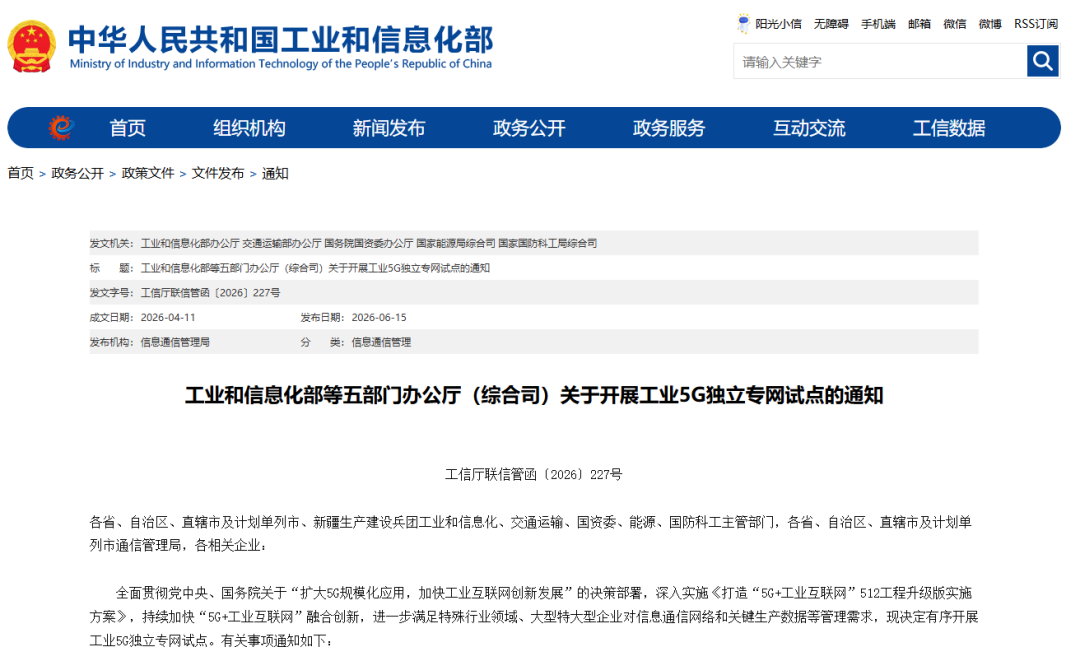
Recently, the General Offices of the Ministry of Industry and Information Technology and four other departments jointly issued the Notice on Conducting Pilot Programs for Industrial 5G Standalone Private Networks. This marks the first systematic policy-level deployment of 5G standalone private networks, further unlocking the benefits of this technology. As 5G commercialization enters its sixth year, its value in empowering the real economy has been fully validated. Meanwhile, the development of artificial intelligence, particularly the advancement of physical AI, is accelerating its penetration into all aspects of industrial production and operations. Against this backdrop, launching pilot programs for industrial 5G standalone private networks is timely.
I. Overseas 5G Standalone Private Networks: Remarkable Results, Established Models
The development of overseas 5G standalone private networks, particularly in industrial powerhouses like Germany, has followed a path from policy-driven to industry-led, and from pilot exploration to continuous expansion. Key characteristics include:
1. Spectrum Liberalization Policies as a Core Driver
Many countries overseas have prioritized the release of dedicated spectrum as a key means to activate the 5G private network market. Germany, as a pioneer, opened the 3.7-3.8GHz band for enterprise applications at minimal cost as early as 2019, significantly lowering the entry barrier for enterprises to build their own networks. Data shows that Germany has issued over 400 private network spectrum licenses. Following suit, more than 20 countries and regions, including the UK, Japan, the US (through CBRS), and France, have introduced similar policies, forming a spectrum liberalization trend centered on 'shared and local licensing.' This approach effectively breaks the traditional telecommunications operators' monopoly on spectrum, stimulating investment and innovation in vertical industries.
2. Vertical Industry Leaders as New Market Forces
Another notable feature of the overseas 5G private network market is the emergence of 'industry-level suppliers' like Siemens. Siemens quickly transitioned from a demander and tester of 5G private networks (e.g., its early collaboration with Qualcomm in Nuremberg in 2019) to a provider of complete solutions. In 2023, Siemens launched a full suite of industrial-grade 5G private network systems designed for harsh industrial environments, natively supporting industrial protocols such as Profibus/Profinet and seamlessly integrating with its own automation software. To date, Siemens' private 5G business covers more than a dozen countries, with plans to enter the US market in summer 2026. Leveraging its strengths in industrial automation and deep understanding of industrial scenarios, Siemens provides end-to-end solutions 'built by industry, for industry.'
3. Application Value Shifting from 'Peripheral Support' to 'Core Production'
Overseas 5G private networks are moving from non-industrial scenarios like ports and stadiums to core industrial production processes such as manufacturing and mining. For example, BMW's global first AI factory in Hungary relies on a 5G private network to support real-time communication among nearly a thousand robots; Nokia's private network deployment for a Canadian gold mine enables remote control of autonomous trucks and drills, significantly enhancing safety and efficiency.
In terms of benefits, 5G private networks deliver efficiency gains ranging from 20% to 90% in manufacturing, warehousing, energy, and other sectors. For instance, warehousing facilities save 55% in labor costs, while oil refineries reduce work-related accidents by 20%. This demonstrates the irreplaceable value of standalone private networks in supporting mobility (AGV/AMR), low-latency control (machine coordination), and massive connectivity.
4. Accelerated Market Consolidation and Differentiation
As the market matures, significant differentiation has emerged among players. Cloud service giants like AWS and Microsoft Azure, constrained by spectrum resources, lower-than-expected market scale, and competition for AI investment resources, have exited or scaled back their 5G private network services by 2025. This indicates that 'generic' solutions lacking industry understanding and deep scenario adaptation struggle to persist, with the market concentrating toward professional suppliers possessing deep industry knowledge, dedicated spectrum resources, or end-to-end customized service capabilities.
II. Domestic 5G Standalone Private Networks: Policy Breakthrough, Poised for Growth
Compared to overseas counterparts, China's early 5G industry applications followed an operator-led 'virtual private network' route, primarily relying on public network UPF sink (UPF sink , UPF sink ), network slicing, and MEC edge computing. This has resulted in the world's largest number of 5G industry virtual private networks.
According to the 2025 Communications Industry Statistical Bulletin, by the end of 2025, China had built 75,000 5G industry virtual private networks, accelerating digitalization in the industrial sector. The number of '5G+Industrial Internet' projects exceeded 23,000, with over 100 million devices connected to key industrial internet platforms. Through these virtual private network explorations, the value of 5G in industry applications has become prominent, laying the foundation for policies on 5G standalone private networks.
The National Industrial and Information Technology Work Conference held in late 2024 explicitly proposed 'promoting the construction of industrial 5G standalone private networks' for the first time, listing it as a key task for 2025. This marks a shift in the authorities' stance from cautious observation to active promotion. In 2022, COMAC obtained China's first 4.9GHz industrial private network frequency license, seen as the 'first shoe dropping' in 5G standalone private network policy liberalization. However, no large-scale open window followed. The issuance of this Notice signifies the 'second shoe finally dropping,' officially initiating the upgrade of China's industrial 5G networking model from 'virtual slicing' to 'standalone physical' networks.
Of course, the implementation of 5G standalone private networks has faced a series of doubts and challenges.
First is concern over spectrum fragmentation risks. Some argue that allocating dedicated frequencies to numerous industrial enterprises may lead to fragmented and inefficient spectrum utilization. Balancing enterprise autonomy with spectrum management efficiency remains a core challenge for regulators.
Second is uncertainty over return on investment. Building a physically isolated standalone private network requires substantial upfront investment (including equipment procurement, integration, and maintenance). For most enterprises, whether there are sufficient and critical production scenarios (e.g., real-time control, AGV scheduling) capable of generating clear and quantifiable ROI remains a key constraint to large-scale deployment. German experience also shows that despite active frequency applications, some enterprises believe their existing production processes do not yet require 5G capabilities, leading to lower-than-expected demand.
Third is the challenge of deep IT/OT/CT integration. Industrial enterprises building standalone private networks are not communications experts. Seamlessly integrating communication networks (CT) with enterprise IT and OT, achieving unified management from network deployment to application operation and maintenance, poses significant technical and managerial challenges. Enterprises need to establish or outsource high-end teams with cross-domain expertise.
Meanwhile, the relationship between standalone private networks and operator-provided virtual private networks needs clarification. The two should be complementary rather than substitutes, requiring exploration of 'standalone + hybrid + virtual' combined models to meet diverse scenario needs.
Of course, the Notice fully considers these challenges and proposes a two-year pilot period to steadily advance the implementation of 5G standalone private networks.
III. The Convergence Engine: Bidirectional Synergy Between 5G Private Networks and Physical AI
The issuance of the Notice also objectively aligns with the technological revolution of physical AI. Physical AI emphasizes intelligent agents capable of perceiving, understanding, and directly interacting with the physical world, including autonomous mobile robots, collaborative robotic arms, embodied intelligent production lines, and autonomous AGVs. Unlike AI confined to cloud training and screen recommendations, physical AI requires real-time manipulation of physical entities, imposing stringent demands on network determinism, reliability, and uplink bandwidth latency. In this process, 5G standalone private networks and physical AI systems form a 'connectivity + intelligence' value multiplier effect. Market research firm SNS Telecom & IT reports that annual spending on 5G standalone private networks will exceed $6.6 billion by 2029, with physical AI being a key driver.
On one hand, 5G standalone private networks build a usable 'neural conduction system' for physical AI. For example, on a final assembly line with dozens of robots, precise time synchronization is required for multi-robot joint movements. High-definition images from visual perception must be transmitted to edge inference nodes at hundreds of megabits per second, with stringent requirements on network jitter for instruction delivery. The physical isolation of standalone private networks enables end-to-end deterministic latency and high-precision clock synchronization, effectively providing wired-grade reliable wireless connectivity for physical AI. This allows cloud-trained large models to be safely and real-time injected into physical execution endpoints, truly unleashing the value of 'industrial brains.'
On the other hand, physical AI creates irreplaceable rigid demand ( rigid demand , rigid demand ) for 5G standalone private networks. As industrial scenarios enter the 'swarm intelligence' era, a workshop may simultaneously house thousands of connected devices, many of which are high-speed roaming autonomous mobile robots. Wi-Fi solutions exhibit significant drawbacks in handover disconnections, uplink capacity, and interference control. The large-scale application of physical AI compels enterprises to upgrade their network infrastructure, making standalone 5G private networks no longer an 'optional choice' but an integral part of production tools, further enhancing their ROI. Thus, physical AI acts as a driver for monetizing the value of 5G private networks.
Conclusion
The issuance of this Notice clearly shows that 5G private networks are no longer merely a communications technology issue but a critical path for implementing national strategies such as building a manufacturing powerhouse, developing the digital economy, and advancing 'AI+.' They address bottlenecks in deep '5G+Industrial Internet' integration and pave the way for physical AI's large-scale entry into the physical world. The high reliability, security, and data sovereignty capabilities conferred by 5G standalone private networks precisely meet physical AI's fundamental need for deterministic connectivity. During policy implementation, the ability to effectively resolve spectrum and cost challenges, cultivate a thriving domestic industrial ecosystem, and achieve deep synergy with AI technologies will determine whether 5G standalone private networks can truly become a 'key variable' driving industrial transformation and upgrading. For all stakeholders in the industrial chain, proactively positioning themselves within the pilot framework, aligning their capabilities with relevant technologies, and promoting the successful piloting of industrial 5G standalone private networks are essential.
-
![]()
ByteDance Initiates First Major Management Reform
-
![]()
AI is Quietly Destroying a Trillion-Dollar Industry
-
![]()
5G Standalone Private Network Policy Breaks the Ice, Creating an Exclusive 'Nervous System' for Physical AI in Industrial Scenarios
-
![]()
Two Investments Totaling 700 Million Yuan! Sunny Optical Sets Its Sights Beyond Lens Supply, Launching a Strategic Move in the XR Optics Arena
-
![]()
Xianyu Initiates Internal Testing of 'Yu Maimai' and 'Yu Maimai': Can AI Revolutionize Secondhand Transactions?
-
![]()
The Dullest 618 in History, with AI Being the Busiest
-
![]()
Shenzhen’s Most Mysterious Robot Startup Secures 1 Billion Yuan in Funding, Targeting a 150 Billion Yuan Market
-
![]()
Why Are Celebrities So Keen on Diving into the AI Realm?