The Dullest 618 in History, with AI Being the Busiest
 06/30 2026
 529
529
Source | Bohu Finance and Economics (bohuFN)
Author | Kaikai
This year's 618 has been dubbed by the industry as the e-commerce promotion with the highest 'AI content.'
Major e-commerce platforms have shifted from price wars to using AI as a new battleground—digital human anchors working 24/7 shifts, AI algorithms guessing what you want, AI assistants helping you compare prices and select products in the chatbox...
Yet, beneath the AI frenzy, the sales data is somewhat awkward.
Data from Xingtu shows that during the 2026 618 shopping festival, the cumulative sales (GMV) of comprehensive e-commerce, instant retail, and community group buying across the entire network reached RMB 934 billion, a 4% year-on-year increase, lower than last year's 20.9% growth rate.
Public opinion outside the event has been surprisingly 'quiet,' with media describing it as the lowest-key and dullest 618 in 16 years.
Major companies have clearly put in tremendous effort to capture shopping entry points—Alibaba has placed its AI assistant front and center in Taobao, Doubao has launched '618 Ask Doubao' in a prime spot on its homepage, and even the usually silent Pinduoduo has quietly launched AI search.
But in the end, no one has created tangible consumer desire. What's missing in the final step of AI shopping?
01 Platforms Go All-In on AI
AI is ubiquitous in this year's 618.
Functions such as AI shopping guides, intelligent recommendations, and intelligent after-sales have been fully implemented. AI shopping guides, which were once minor features, now occupy center stage on major platforms.
Alibaba has fully integrated Qianwen with Taobao, allowing users to complete the entire shopping process through natural language. Additionally, the 'Qianwen AI Shopping Assistant' has been launched within the Taobao app, featuring functions such as AI Q&A, AI try-ons, and AI product recommendations.
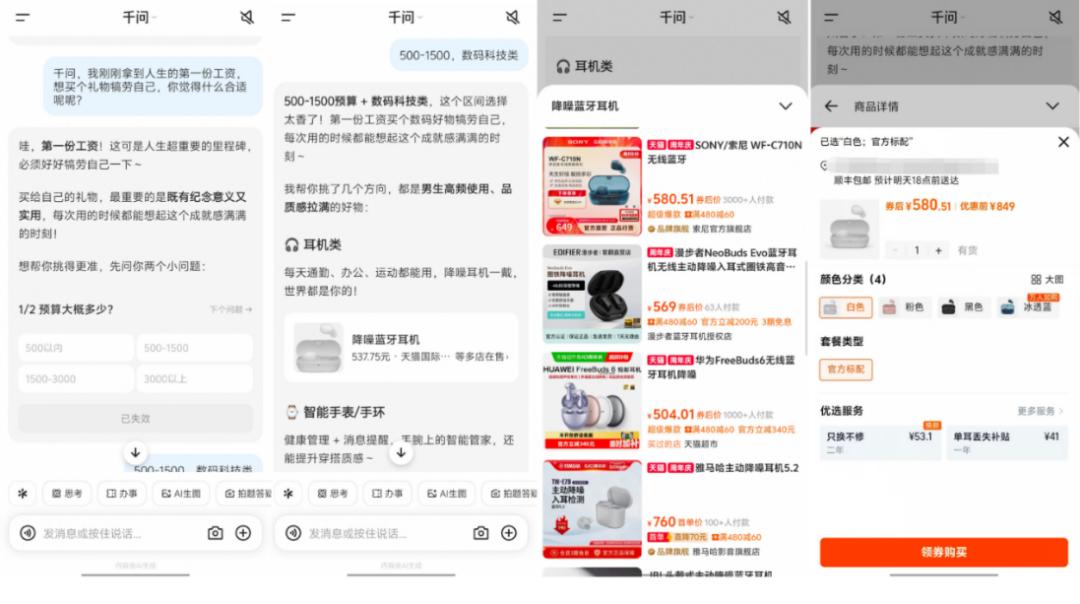
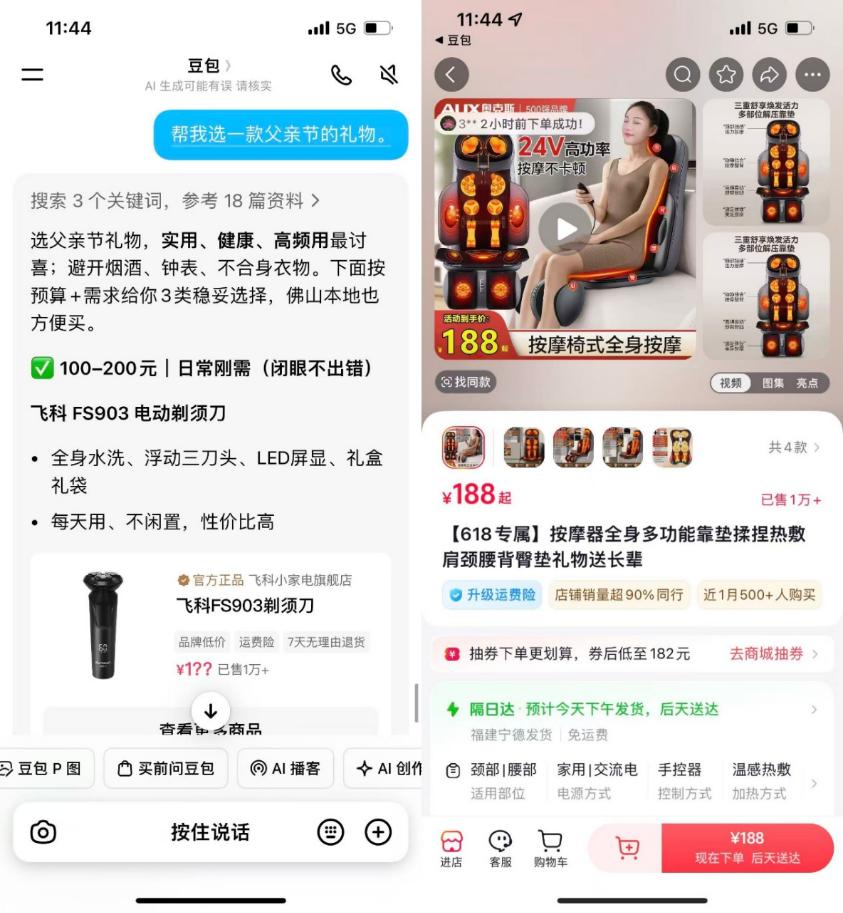
Doubao has also integrated with Douyin e-commerce, allowing users to obtain product recommendations and shopping links through conversations with Doubao. Additionally, the 'Ask Doubao Before Buying' function has been added to the primary navigation bar on Doubao's homepage, providing a smoother user experience.
JD.com also launched its Jingyan AI assistant in March, providing shopping inspiration based on user input. Furthermore, JD.com has introduced functions such as digital human live streaming, AI restocking assistants, and logistics superbrain large models, embedding AI throughout the entire sales service chain.
Even Pinduoduo, which has remained low-key (low-key) on AI topics, quietly launched AI search in May; Kuaishou also introduced an 'AI Shopping Assistant' before 618, offering services such as product recommendations and product comparisons.
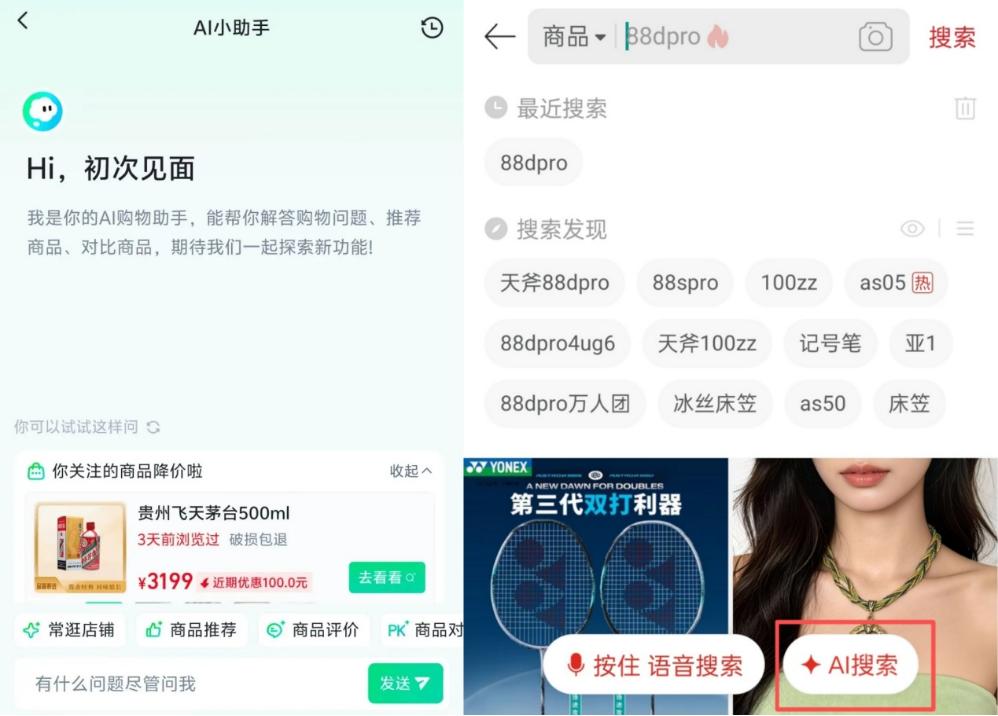
Currently, major platforms' moves in AI e-commerce are largely similar, but upon closer inspection, their goals differ, with strategies tailored to their own ecosystems.
Alibaba and ByteDance focus on competing for 'super entry points.' Alibaba aims to make Qianwen the first stop for consumption; ByteDance is also striving for this goal, reshaping entry points through content and establishing an AI ecosystem closed loop (closed loop).
JD.com focuses on full-scenario AI penetration from marketing to fulfillment; Pinduoduo and Kuaishou hope to use AI to enhance product distribution and supply chain efficiency, with a greater emphasis on improving merchant operations.
The comprehensive intervention of AI has indeed brought some visible changes:
On the consumer side, AI shopping guides can recommend products and calculate discounts, making shopping more worry-free.
According to 36 krypton (36Kr), since April this year, user acceptance of AI shopping recommendations has increased compared to the second half of last year, with the conversion rate for clicking on Doubao product cards exceeding 3%.
On the merchant side, AI has improved efficiency across the entire transaction chain, primarily in live streaming, customer service, and operational decision-making.
JD.com data shows that in the first quarter of 2026, the digital human live streaming rate among JD.com's top merchants reached 80%. Currently, JD.com's digital humans are freely available to all merchants, with costs as low as one-tenth of human live streaming.
Additionally, after Taobao upgraded its AI store assistant Xiaomi and launched the 'AI Fake Image Recognition Model,' the average rate of transferring to human customer service decreased by 45%, and the average success rate of refund prevention exceeded 20%; Douyin disclosed that its Feige intelligent customer service can save approximately 70% in labor costs.
On the platform side, AI functions have become a new hook for e-commerce platforms to attract incremental users.
JD.com data shows that during the 618 promotion, the cumulative number of dialogues with users in the JoyAI app exceeded 3 million, with service volume increasing more than tenfold compared to last year's Double 11; after the Spring Festival red envelope battle, Alibaba stated that nearly 140 million users experienced AI shopping for the first time through Qianwen.
The emergence of AI is forcing platforms to shift from simple price subsidies to deep cultivation (deep cultivation) of operational efficiency, ecological synergy, and user value. Whoever can more efficiently push the right products to the right people has the opportunity to capture a larger share of the existing market.
From this perspective, AI is indeed doing more work, but the question is, are consumers buying it?
02 Consumers 'Love and Fear' AI
Currently, AI shopping guides 'look great' but still fall short in practice.
First, AI is still not smart enough in understanding intent. On social media, many users mention that AI shopping guides do help them skip the process of comparing and selecting products, but not every conversation goes smoothly.
Some users report that they asked the AI shopping guide to recommend a pair of shoes based on their preferences, only to end up with an order for potatoes; another user said they wanted to buy a car cup holder, and the AI shopping guide suggested a cup with a diameter of 3-4 centimeters, a recommendation completely detached from reality.
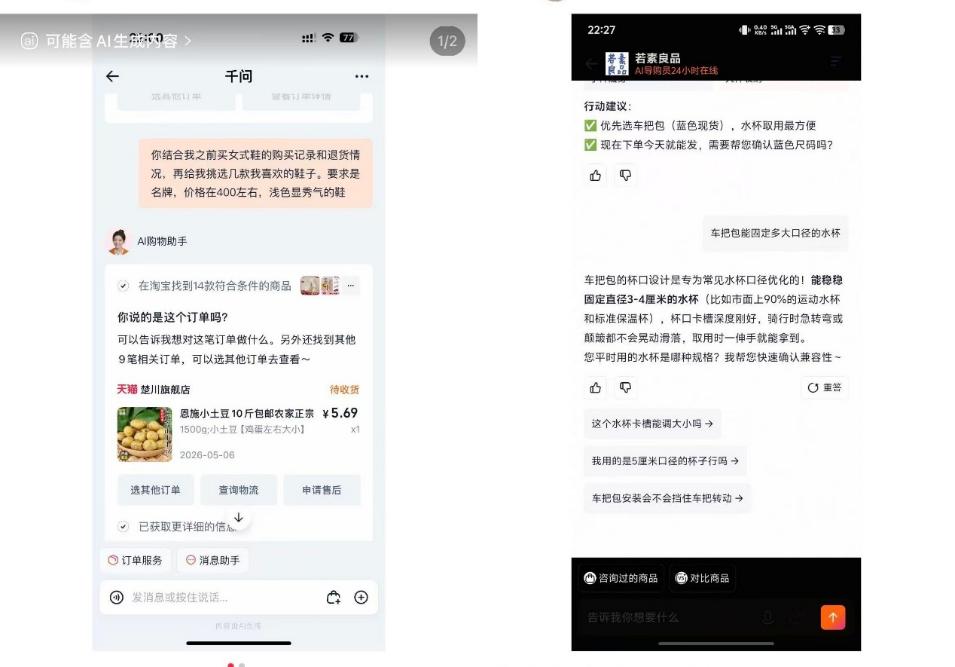
'If you don't have a shopping goal, AI recommendations can solve decision paralysis, but if you already have clear preferences, AI shopping guides become a burden,' one netizen summarized.
Second, 'one-sentence shopping' has not yet reached a very smooth stage.
Some netizens complain that AI shopping guides sometimes cannot even identify out-of-stock products, with several recommended phones being discontinued models; others have encountered coupons provided by AI shopping guides that cannot be used at all when clicked;
Even more frustrating for users is that AI shopping guides are always 'lurking' on product shelves, and they accidentally trigger them without noticing, receiving little useful information, making it less enjoyable than browsing product details themselves.
Synchronizing large language models with vast amounts of e-commerce product data in real-time is a massive engineering challenge. Currently, most AI shopping guides only influence the first step of the shopping journey, but truly delving into the entire process will take some time.
Finally, consumers are most concerned about whether AI-recommended products are truly trustworthy.
We consulted Doubao, Qianwen, and JD.com about 'face creams that alleviate allergies,' and all platforms initially recommended mainstream face cream brands. However, when probed further, the AI shopping guides began recommending brands less familiar to ordinary consumers.
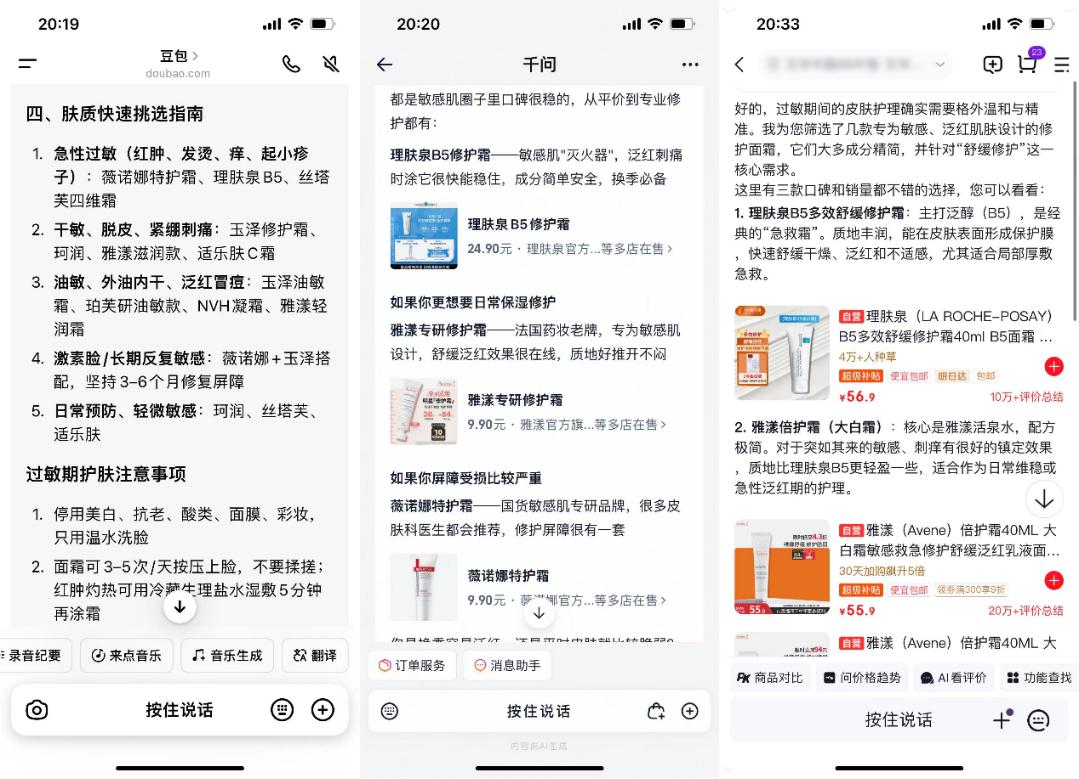
On social media, some consumers also report that they purchased a certain face cream based on AI shopping guide recommendations, only to later discover that the product was heavily advertised on Xiaohongshu. While the quality may not be an issue, they couldn't help but wonder if they had fallen into the algorithm's 'trap.'
All these complaints point to the same question—can AI truly help consumers make better shopping decisions?
On one hand, there is the issue of trust.
AI shopping guides may seem like personal assistants for consumers, but in reality, they are also 'salespeople' for platforms and merchants. The relationship between AI recommendations and commercial advertising is both symbiotic and oppositional, making it difficult for their positions to remain completely consistent.
Consumers are well aware of this, and they naturally question AI recommendations, willing to try them out but hesitant to place orders.
According to a 618 forward-looking (forward-looking) survey by National Business Daily, 65%-70% of users expect AI tools to 'organize information, compare prices, and calculate discounts,' but only 37%-48% expect 'AI to directly give purchase suggestions or place orders automatically.'
On the other hand, what is the essence of shopping?
More users still prefer to search and compare prices themselves before placing orders, rather than relying on AI decisions.
This is not just a matter of trust but also an often-overlooked factor: 'browsing' itself is part of the consumption process. The joy of selecting, comparing, and discovering surprises is something AI shopping guides cannot yet replace.
AI shopping guides turn shopping into a multiple-choice question, but many people miss the pleasure of 'browsing stores.'
03 Merchants Trapped by Algorithms
While consumers are still wait and see ( wait and see , on the fence) about AI shopping guides, merchants are already being swept forward.
AI tools can indeed help merchants improve efficiency, and even in logistics and supply chain links invisible to consumers, AI is quietly working, enabling more efficient delivery of products to consumers through intelligent scheduling and inventory allocation.
From both 'cost reduction' and 'revenue increase' perspectives, AI has delivered impressive results, but for merchants, using AI is easy, but using it well is difficult.
First, AI rules are not transparent.
In the era of search, merchants could obtain traffic through relatively clear rules such as keyword bidding and ranking optimization. However, in the era of AI recommendations, the rules have become a 'black box,' with some merchants even describing AI recommendations as a form of 'metaphysics.'
Some merchants place hopes on GEO (Generative Engine Optimization), but even agents responsible for GEO admit, 'We can only continuously adjust and optimize; we cannot guarantee selection by AI.'
In the past, merchants only needed to focus on keywords, sales volume, return rates, etc., to squeeze into (squeeze into) the top of search pages for traffic; but now, AI shopping guides have narrowed recommendation spots to a few, raising the bar for merchants to obtain recommendations and increasing competition difficulty.
Additionally, AI tools are not always easy to use.
On social media, netizens have started boycott (boycotting) merchants who use AI-generated product images, complaining, 'Seeing AI images gives me no desire to shop at all' and 'Without a single real photo, I have no idea what the product looks like.'

On the other hand, some merchants admit that while AI-generated content is cost-effective, it is highly homogenized, and sometimes the generated content requires revisions, saving little time.
Currently, AI cannot fully replace humans in customer service, copywriting, art design, etc., and merchants prefer to invest AI in areas with clear data feedback, such as data review, competitor monitoring, and product forecasting.
Despite complaints, merchants dare not neglect AI tools. After all, if everyone else is using them and you're not, you risk being left behind.
This 618, AI's foray into the e-commerce world has generated both positive feedback and negative voices.
But one undeniable fact is: AI may have solved many problems, but it has not yet made consumers more eager to buy.
The emergence of AI has not changed the essence of e-commerce. While platform and merchant efficiency has improved, the biggest challenge for the entire e-commerce industry remains where incremental growth will come from.
Amazon across the ocean may provide some reference:
In May this year, Amazon launched its personalized AI shopping assistant, Alexa for Shopping, which can remember user preferences across devices, offer product comparisons, and notify users to place orders once prices reach expected levels.
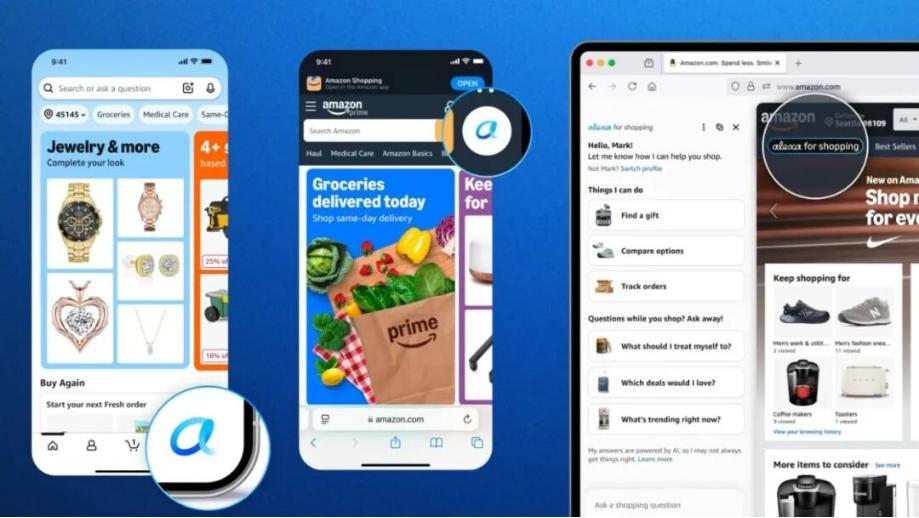
In terms of commercialization, Amazon also directly launched 'prompt advertising,' where semantically matching products appear in conversation answers with a Sponsored label when consumers ask AI questions.
For consumers, AI shopping guides can only truly drive sales by understanding user needs and pain points; for merchants, AI needs to become a placement tool with clear conversion effects. Only when the effects are clear can growth be sustained.
Of course, maintaining a balance between the commercialization and neutrality of AI recommendations remains a challenge. But at least, everyone can first find an answer more suitable for their own ecosystem.
Now, AI is beginning to further integrate into the shopping ecosystem, but of course, it cannot yet replace the emotionally driven parts of consumer decision-making—impulse, trust, ritual, and the joy of browsing.
AI has just started on this path, and from 'using' to 'using well,' it still needs time to evolve.
The copyright of the article's cover image and accompanying pictures belongs to the copyright owners. If the copyright holders believe that their works are not suitable for public browsing or should not be used free of charge, please contact us promptly, and our platform will make corrections immediately.
-
![]()
ByteDance Initiates First Major Management Reform
-
![]()
AI is Quietly Destroying a Trillion-Dollar Industry
-
![]()
5G Standalone Private Network Policy Breaks the Ice, Creating an Exclusive 'Nervous System' for Physical AI in Industrial Scenarios
-
![]()
Two Investments Totaling 700 Million Yuan! Sunny Optical Sets Its Sights Beyond Lens Supply, Launching a Strategic Move in the XR Optics Arena
-
![]()
Xianyu Initiates Internal Testing of 'Yu Maimai' and 'Yu Maimai': Can AI Revolutionize Secondhand Transactions?
-
![]()
The Dullest 618 in History, with AI Being the Busiest
-
![]()
Shenzhen’s Most Mysterious Robot Startup Secures 1 Billion Yuan in Funding, Targeting a 150 Billion Yuan Market
-
![]()
Why Are Celebrities So Keen on Diving into the AI Realm?