Agent: The 'Hard Requirement' for Entering Core Enterprise Systems for the First Time
 07/08 2026
 433
433
This set of standards does not directly make Agents smarter, eliminate model hallucinations, or replace the need for businesses to restructure their workflows. After all, whether a vehicle can run smoothly depends on whether model capabilities, industry data, software engineering, corporate governance, and organizational changes can keep pace. However, at least one critical prerequisite has been addressed: enabling Agents to transition from 'trial-ready' to 'governance-ready.'
From today's perspective, the true value of these standards lies not in ending all 'information silos' but in providing businesses with a reason to begin restructuring their systems.
Author | Dou Dou
Editor | Pi Ye
Produced by | Industry Insight
While technology service providers compete on model capabilities and Agent demonstrations, what truly determines whether Agents can enter the core systems of finance, manufacturing, and government sectors?
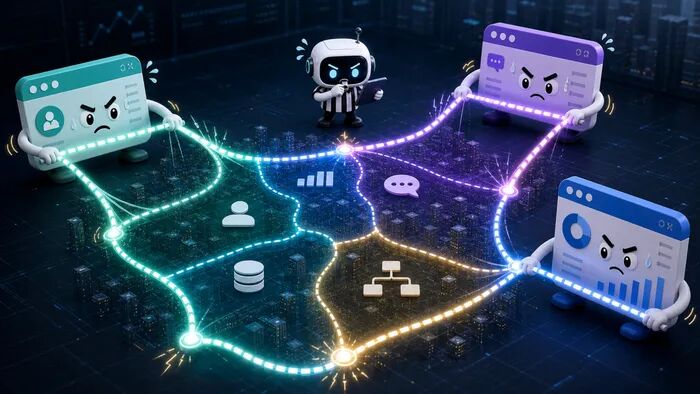
In early 2026, a well-known domestic cross-border e-commerce company introduced a set of 'AI Procurement Agents' and 'AI Warehousing Agents' developed by different vendors. During a promotional stocking period, the procurement Agent failed to correctly interpret a non-standard inventory alert sent by the warehousing Agent, blindly placing orders for millions of dollars' worth of redundant goods from overseas suppliers. Due to inconsistent Agent interfaces between the two vendors and a lack of unified identity authentication and complete behavioral audit trails, the company could not even determine where the semantic misunderstanding had occurred.
This is not an isolated incident. It has been a common occurrence during the wave of large model implementations over the past year. Behind these phenomena, a deeper reality is emerging: the biggest bottleneck for AI technology in enterprise adoption is shifting from 'whether models are smart enough' to 'collaboration and accountability tracing between Agents.'
Notably, the stalemate in Agent implementation saw a new turning point in June just passed.
On June 26, the State Administration for Market Regulation approved the release of seven national standards in the 'Artificial Intelligence Agent Interconnection' series (hereinafter referred to as the 'Standards'), marking China's first national standard system for Agent interconnection.

What these Standards fill is a previously long-missing foundational order: enabling Agents to mutually recognize, collaborate, invoke, and hand over tasks. It is this order that, for the first time, qualifies Agents to enter core enterprise systems.
The 'information silos' of Agents are now facing the possibility of being eliminated.
I. Agent Entry into Core Enterprise Systems: 'Disorder' as the Top Challenge
Over the past year, China has not lacked Agents.
Data shows that as of 2025, over 500,000 developers have created more than 2 million Agents on ByteDance's Coze platform, covering over 30 industries including finance, healthcare, and education. New Agents continue to be added by the thousands daily in stores on Alibaba Cloud BaiLian, Baidu, Tencent Yuanqi, and Zhipu Qingyan.
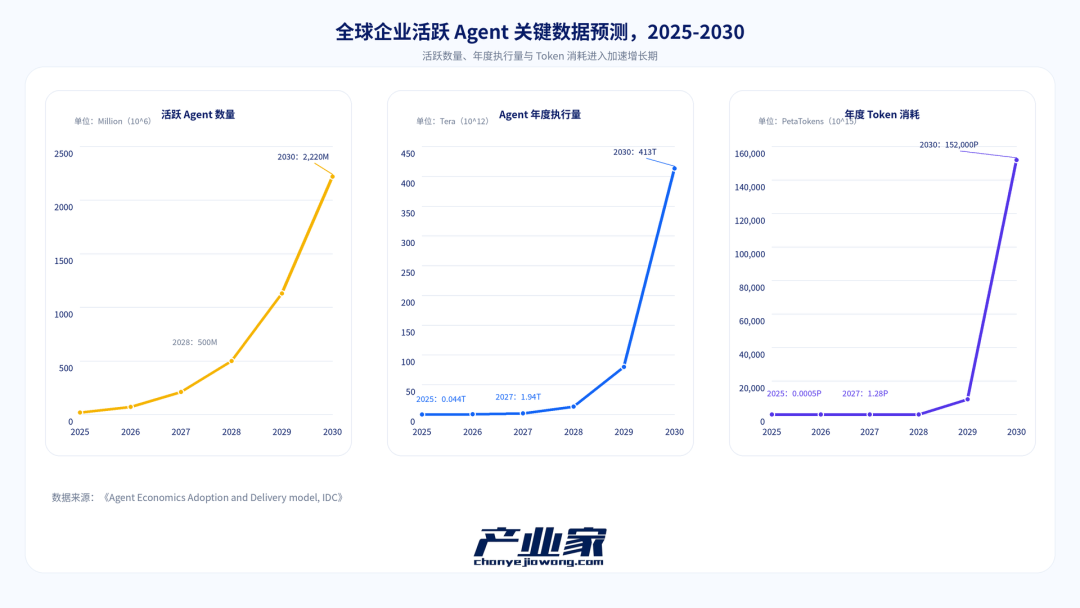
Third-party agency estimates put the 2025 Chinese AI Agent market size at approximately 18.2 billion yuan, with nearly 80% growth year-on-year. IDC paints an even larger long-term picture, stating that by 2030, 2.2 billion AI Agents will flood into various industries worldwide as new digital labor forces.
It is evident that the supply side of Agents is already bustling.
However, shifting the lens to industrial implementation reveals a less optimistic picture.
Gartner once predicted in a report that by the end of 2026, 40% of enterprise applications will have built-in Agents. At the same time, Gartner also made another judgment: by the end of 2027, over 40% of Agent projects will be canceled due to cost overruns, unclear value, and insufficient risk control.
This judgment is already reflected in the implementation process in specific industries, with the financial sector providing a clear example of this dilemma.
According to the 'China Financial Agent Development Research Report,' about 96% of financial Agents remain in the exploratory phase of PoC, platform construction, and trial operation, with only 4% truly entering business operations, mostly concentrated in non-core scenarios.
Where does the problem lie?
At the press conference, Zhu Meina, Deputy Director of the Standards Technology Department, summarized it as three issues: inconsistent interfaces and protocols among Agents from different vendors, creating 'Agent silos' as ecological barriers; a lack of unified identity authentication and traceability mechanisms for Agents, posing risks of identity spoofing and data leakage in cross-domain interactions as trust crises; and the absence of universal interaction and description specifications, leading to high costs of redundant construction and integration adaptation for enterprises as innovation costs.
Behind these three types of issues lies the same fact: today's Agents are mostly standalone, isolated, and speaking different languages.
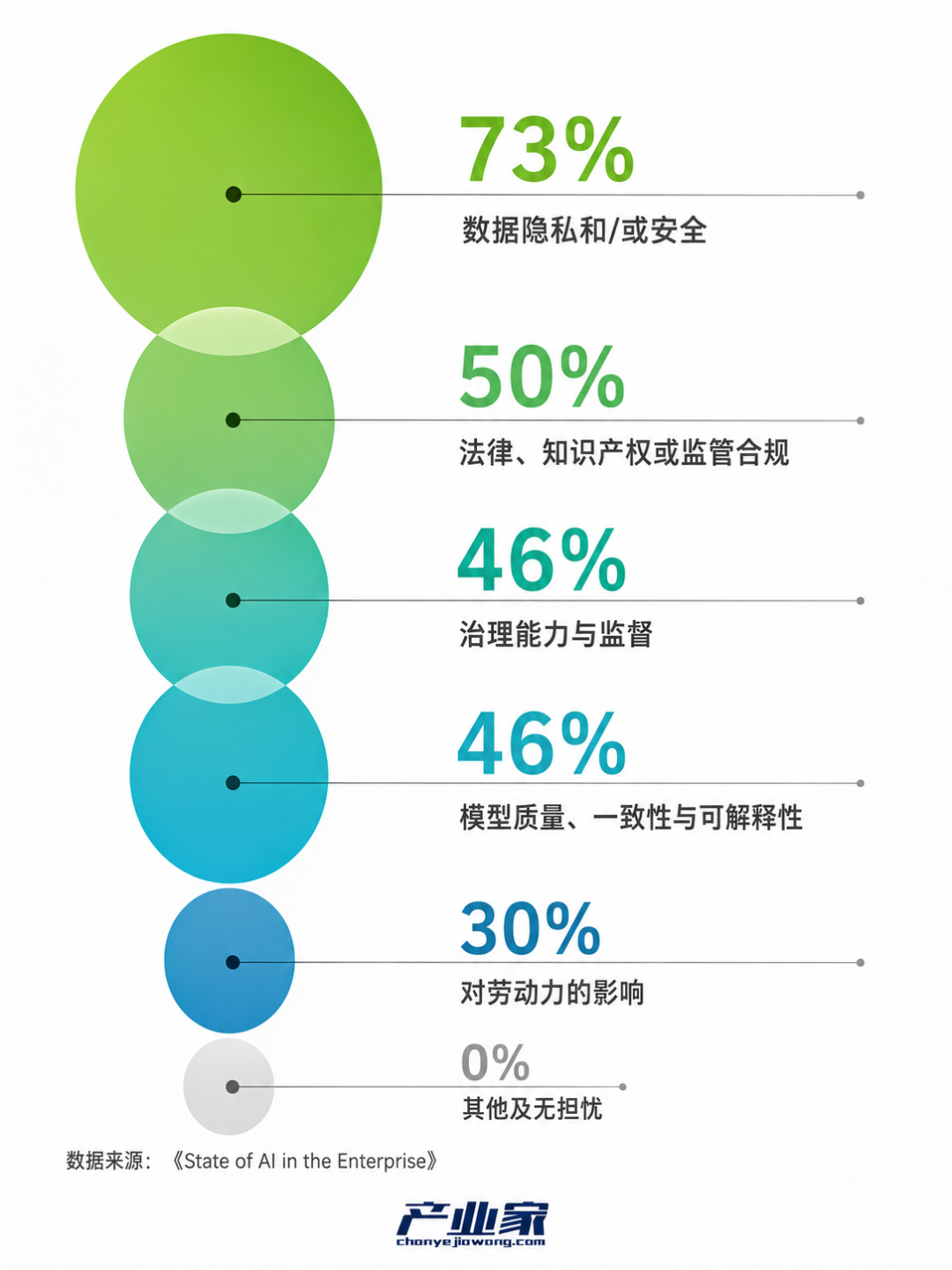
Deloitte's 2026 'State of AI in the Enterprise' survey of 3,235 IT and business leaders across 24 countries indirectly confirms this point.
Data shows that only 21% of organizations have mature Agentic AI governance models, while about 80% lack mature governance capabilities, including Agent decision boundaries, real-time monitoring, behavioral anomaly alerts, and complete audit trails.
This also explains why Agent demos are often impressive but often 'acclaimed but not adopted' in actual implementation.
For core processes in government, manufacturing, and finance, the requirements for Agents are entirely different from 'building a Copilot.' If a chat assistant gives a wrong answer, it can simply be refreshed and tried again. However, for an Agent handling funds, production lines, or approvals, enterprises truly need another set of capabilities: verifiable identity, traceable behavior, accountable results, and sufficiently stable interfaces.
Agents that cannot meet these requirements can at best remain in peripheral scenarios, handling tasks like customer service, assistance, and peripheral automation, and are unlikely to truly enter core enterprise systems.
In other words, over the past year, the industry has solved the problem of 'whether Agents exist'; what truly hinders industrialization is 'whether there is order among Agents.'
As enterprise demand for Agents continues to rise, the urgency of this issue becomes increasingly apparent.
Data shows that under optimistic scenarios, Agentic AI could contribute about 30%—over $450 billion—to enterprise application software revenue by 2035.
Under this trend, Agents need not just more applications and scenarios but also a protocol system capable of supporting interconnection. Only by filling this infrastructure gap can Agents evolve from standalone tools to systematic collaboration and truly meet the next phase of industrial implementation demands.
II. Agents Need an 'Interaction System'
The industry has long been aware of the issue of Agent interconnection.
Previously, de facto Agent interconnection protocols had already taken shape globally, and not just one. For example, in November 2024, Anthropic introduced MCP, primarily addressing how Agents invoke external tools and data, dubbed 'the USB-C of AI'; in April 2025, Google open-sourced A2A, focusing on collaboration among multiple Agents, compared to 'the HTTP of Agents.'
However, 'being able to connect' has never meant 'being brave enough to use.'
Whether MCP or A2A, even if they become more widespread in the future, they primarily solve the issue of 'how to connect technically.' As open-source protocols driven by commercial companies and formed from the bottom up, such protocols excel at connect through interfaces (Note: ' connect through ' is translated as 'connecting' to convey the idea of enabling communication) but struggle to cover another set of harder issues: Who endorses the identity of this Agent? If cross-vendor collaboration goes wrong, who is responsible? How should compliance risks be handled when data flows into an overseas tool?
Therefore, what the industry needs is not just another communication protocol but a foundational order for identity, collaboration, and governance.
The seven national standards in the 'Artificial Intelligence Agent Interconnection' series provide an answer.

So, what exactly do these seven standards fill?
Specifically, they establish a closed-loop chain from identity identification, capability description, supply-demand discovery, to collaborative interaction and tool invocation.
At the press conference, officials provided a more understandable 'plain language' version: 'Who are you' (identity codes and identity management), 'What can you do' (capability description), 'How to find you' (Agent discovery), 'How to work together' (collaborative interaction), and 'How to invoke tools' (tool invocation).
It is evident that these five questions precisely cover the entire process of two Agents going from strangers to collaborators. Before this, these links either lacked standards or relied on each vendor's proprietary protocols, requiring enterprises to rewrite adaptation code for each integration. After unification, according to officials, enterprises can reuse standard components, reduce custom development, and shorten product time-to-market.
More notably, these seven standards are not mandatory national standards but are released as 'National Standardization Guidance Technical Documents' (GB/Z). According to Zhu Meina, Deputy Director of the Standards Technology Department, this is an 'agile standardization' arrangement for the industry's cultivation phase. In other words, Agent technology routes are still evolving rapidly, and locking them down too early would stifle innovation. Instead, more compatible guidance documents are used to build consensus and leave room for trial and error.
However, within this 'non-mandatory' arrangement, one official stance is very clear: subsequent efforts will timely (Note: ' timely ' is translated as 'timely' to convey the idea of acting at the right moment) promote the conversion of identity code-related standards into mandatory national standards and accelerate the development of standards for Agent auditing and Agent transactions.
This move reveals the true intent of the entire standard system.
Breaking down the five links, identity is the only part explicitly earmarked for 'conversion to mandatory' standards. In other words, the state first incorporates the most sensitive 'identity and governance layer' into standardized orbits while leaving 'how to collaborate' and 'how to invoke tools'—application-layer capabilities—more to market competition and ecological evolution. On the one hand, this gives Agents a 'compliance credential' for entering core systems, enabling them to have foundational order for the first time; on the other hand, it leaves sufficient elastic development space for the industrial ecosystem.
Currently, at the implementation level, officials have provided a clear path: start with a pilot in Haidian District, Beijing, where local frontier industries will validate and apply the standards first, then export replicable solutions nationwide.
III. Agent Productivity Acceleration Is on the Way
The establishment of a new order brings new industrial narratives.
From an industrial perspective, Agent implementation will go through three stages: toolization, processification, and systematization.
The significance of these Standards lies in paving the way for the third stage.
In the past, when enterprises purchased an Agent, they were essentially buying a standalone application. Whether this Agent could integrate with existing systems, collaborate with Agents from other vendors, or be audited and held accountable often depended on project-based adaptations. This is why many AI projects demonstrate quickly but implement slowly later; the closer they get to core businesses, the higher the degree of customization and implementation costs.
After standardization, Agents can transition from 'project delivery' to 'product delivery.'
This has a significant impact on the industry. On the one hand, standards will reduce integration costs for enterprises deploying Agents; on the other hand, they will also lower migration costs when enterprises switch suppliers. After the underlying interaction rules are unified, vendors can still compete on model capabilities, scenario understanding, and industry know-how, but they can no longer rely solely on closed ecosystems to lock in customers.
Following this logic, the industrial landscape will also be reshaped.
First are cloud vendors. In the formulation of these Standards, Volcano Engine under ByteDance, as well as Xiaomi, Kuaishou, Lenovo, and other Haidian-based companies, were deeply involved. As Agents need to mutually discover and invoke each other according to unified protocols, whoever controls the 'hub' of registration and discovery and possesses underlying computing power and platform capabilities will have the opportunity to become an infrastructure provider in the Agent era and even evolve further toward an 'Agent Operating System.'
Next are vendors like DingTalk and Feishu, which guard office entry points. The emergence of standards will drive them to upgrade from 'workbenches' to 'Agent stores' and Agent scheduling platforms.
The most profoundly rewritten may be industry ISVs. In the past, many industry software vendors earned money through integration hours, project deliveries, and custom development. However, as identity, discovery, collaboration, and invocation rules for Agents gradually unify, players relying solely on adaptation and integration may be squeezed out; companies that can precipitate (Note: ' precipitate ' is translated as 'encapsulate' to convey the idea of distilling expertise into reusable components) industry know-how into reusable, pluggable Agent components will instead see new opportunities. Established vendors like Kingdee and Yonyou are already breaking down scenarios like finance, recruitment, and business travel into individual Agent components, signaling the evolution of industrial software toward Agentization.
Of course, standards do not directly make Agents smarter, eliminate model hallucinations, or replace the need for businesses to restructure their workflows. After all, whether a vehicle can run smoothly depends on whether model capabilities, industry data, software engineering, corporate governance, and organizational changes can keep pace.
However, at least one critical prerequisite has been addressed: enabling Agents to transition from 'trial-ready' to 'governance-ready.'
From today's perspective, the true value of these Standards lies not in ending all 'information silos' but in providing businesses with a reason to begin restructuring their systems.
If large models have given enterprises their first glimpse of AI's general capabilities, then Agent interconnection standards address another, more fundamental issue: how to safely, stably, and cost-effectively embed these capabilities into industrial systems.
-
![]()
OFILM Reports Colossal 460 Million Yuan Loss: Founder Quietly Shifts Focus to Optical Modules!
-
![]()
Yutong Optics and Zeiss Forge Partnership to Develop Quality Measurement System and Launch "Optical Communication Joint Measurement Class"
-
![]()
AutoNavi Revises Splash Screen Ads with Precision Amid Controversy
-
![]()
Unlicensed Vehicle Disputes: AutoNavi Ensnared in the Aggregation Model
-
![]()
Agent: The 'Hard Requirement' for Entering Core Enterprise Systems for the First Time
-
![]()
Global Auto Market Outlook: Sales Decline in China, US, and Europe, Chinese Exports Approach 10 Million
-
![]()
AI Pioneer Breaks Free from the 'Doldrums'
-
![]()
Valuation Exceeds $26 Billion! Three Chinese "Gold Medalists" Shake Up the AI Industry