Has Doubao Started Charging? Does ByteDance Face Commercialization Pressure?
 07/14 2026
 338
338
 This article is the 1055th original work by DeepAtom.
"
Strategic Monetization or Forced Damage Control?
Yang Xiaoxian 丨 Author
DeepAtom Studio 丨 Editor
On June 24, 2026, Doubao officially launched a professional subscription service, offering three plans priced at 68 RMB, 200 RMB, and 500 RMB. Public opinion quickly split into two factions.
On one side, angry users declared, 'The era of free services is over,' and 'This is even more expensive than ChatGPT.' On the other side, industry observers remarked with nuance, 'ByteDance is finally starting to keep accounts.'
Both voices point to the same core question: Does ByteDance face commercialization pressure? Is Doubao's charging a strategic monetization move or a forced damage control effort?
A False News Story That Needs Correction
In May, a rumor spread wildly on social media: 'ByteDance quietly canceled 30% of its AI projects. By 2025, AI inference costs will exceed 8 billion RMB, 2.3 times the revenue growth, and the company's cash flow won't last until 2027.'
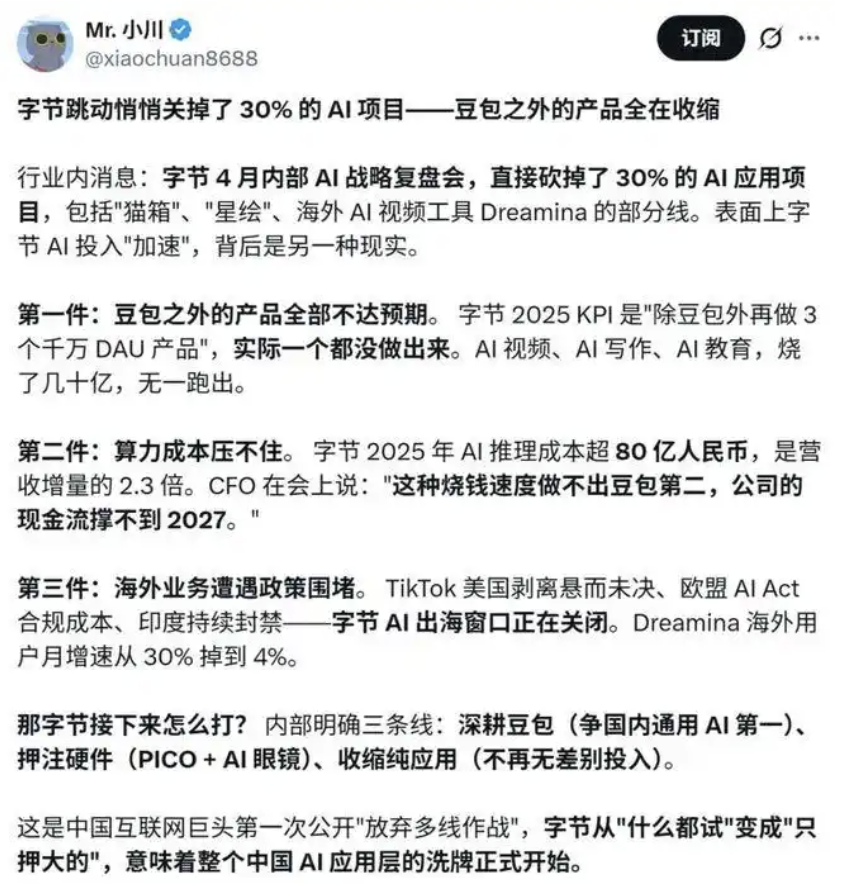
ByteDance employees dismissed it as 'too fake' and 'obviously false.' Data from Zheshang Securities shows ByteDance invested over 80 billion RMB in AI in 2024; the South China Morning Post reported its 2026 AI infrastructure budget exceeds 200 billion RMB. An industry analogy clarifies the situation: A billionaire planning a 20 million RMB renovation sees an 80 RMB utility bill and declares, 'We can't make it to next year!'—absurd to the point of not needing a calculator.
The debunking holds up. ByteDance's revenue scale, cash reserves, and core business fundamentals are all public. The 'cash flow crisis' conclusion doesn't stand. The claim of 'canceling 30% of projects' was also factually incorrect—products like 'Meng' and 'Dreamina' were not cut but are key focus areas for ByteDance.
The false news was debunked. But if we stop here, we miss the real issue.
The rumor had many flaws, but the resonance it sparked in the industry is genuine. YouMind founder Yubo's judgment amid this controversy carries more weight than the rumor itself: Using an internet mindset to develop AI products is a dead end—AI products lack economies of scale. Yubo's background lends credibility to this statement. He joined Alibaba in 2008, worked there for 15 years, led the development of Ant Design and Yuque, joined ByteDance as Feishu's product VP in 2023, and left a year later to found an AI company. In a June 2026 interview with Huxiu, he summarized his two-year journey as 'dispelling the illusion of the internet.' For someone who reached P10 at Alibaba and became Feishu's product VP at ByteDance before starting his own AI venture, this statement carries more weight than any analyst report. It highlights that Doubao's current dilemmas—from 'the more free users, the greater the losses' to 'paid willingness being locked by free habits' and 'advertising models not working for AI'—all stem from the initial approach of 'using an internet mindset for AI.'
False News Is Debunked, But Real Pressures Remain
China Entrepreneur magazine published an in-depth report on June 26, 'ByteDance AI Faces Sweet Troubles' (Huxiu published related analysis on June 29). The title itself provides the answer—both 'sweet' and 'troubles' exist.
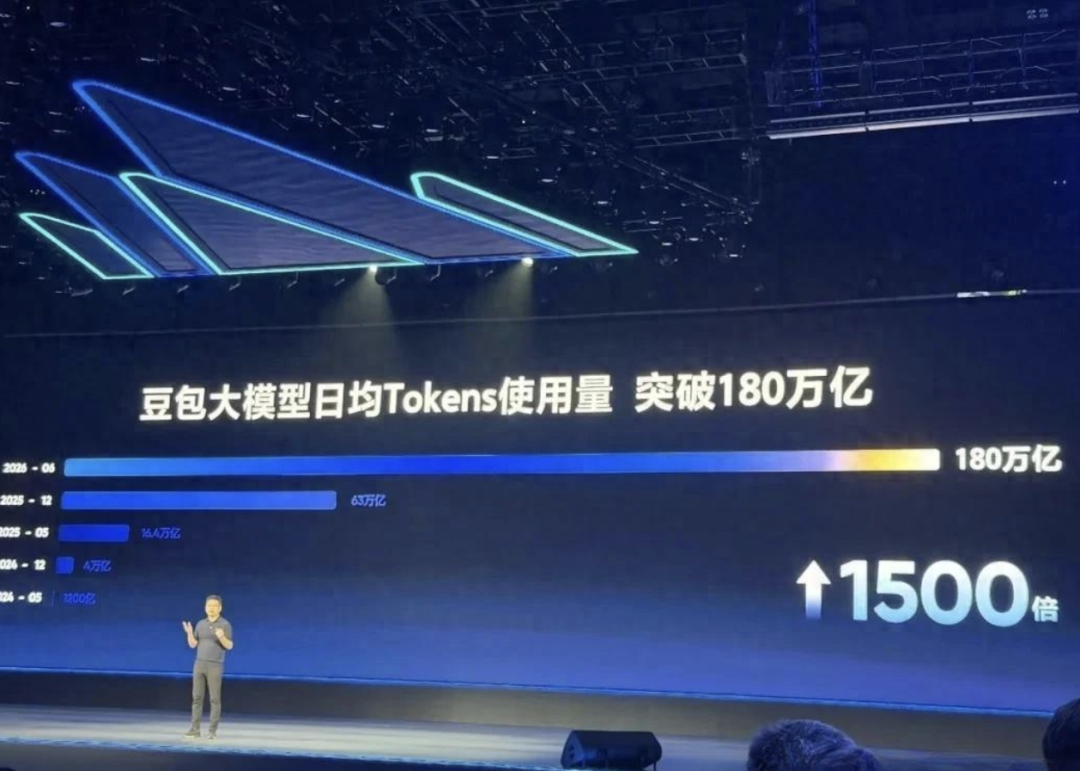
The report disclosed two key metrics: Doubao has over 200 million daily active users but generates less than 1 million RMB in daily revenue; its large model's daily token calls exceed 180 trillion, a more than 10x increase in one year. An AI infrastructure founder told China Entrepreneur: If Doubao maintains this user growth, its computing power consumption could deplete ByteDance's resources.
Volcano Engine president Tan Dai tried to downplay this anxiety in interviews, stating, 'From Volcano Engine's perspective, we haven't evaluated computing costs; we focus on B2B business.' But in the same interview, he admitted, 'The reported Seedance revenue figures are wrong and overstated. I'm under pressure—finance keeps asking if I'm hiding numbers.'

Even revenue from core star products is being verified by finance. This may not be a 'cash flow crisis,' but it certainly qualifies as commercialization anxiety.
More concerning is the shift in ByteDance's overall financial trends. Bloomberg reported ByteDance's 2025 profit at approximately 50 billion USD, a figure denied by ByteDance insiders. The Financial Times reported its 2025 capital expenditures at around 150 billion RMB; the South China Morning Post reported its 2026 AI infrastructure budget exceeds 200 billion RMB—equivalent to 60% of its 2025 profit. Douyin's annual advertising revenue is about 400 billion RMB, which sounds substantial, but AI burns nearly 200 billion RMB annually. After deducting TikTok's overseas investments and operational costs across business lines, profits are severely squeezed.
Meanwhile, multiple growth engines are slowing simultaneously: Douyin's monthly active users reached 1.009 billion, a mere 14.43% YoY increase, essentially capping growth; Douyin E-commerce's GMV growth slowed from 320% in 2022 to around 30% in 2025 and is expected to decline further in 2026. Revenue growth is flattening while cost curves remain steeply upward—the concern now is not 'if something will happen' but 'how long it can hold out.'
Why Is Doubao Charging Now?
These figures all point to the same reality: ByteDance's investments are accelerating while revenue growth is decelerating. But this is the group's overall ledger and doesn't directly explain why Doubao is charging. To understand this, we must refocus on Doubao itself.
First, revenue. According to LatePost, as of H1 2026, Doubao generated less than 1 million RMB in daily revenue, primarily from e-commerce commissions—revenue sharing from user purchases within Doubao. In other words, before the paid subscription launched on June 24, Doubao's C-end commercialization was nearly zero. With 345 million monthly active users generating less than 1 million RMB daily, each user contributes under 0.003 RMB per day.
Now, costs. According to data disclosed at the Volcano Engine FORCE Conference, Doubao's large model exceeds 180 trillion daily token calls. Huxiu's 'ByteDance Starts Keeping Accounts' cited CSDN's cost breakdown: Comprehensive costs for 1 million tokens of general dialogue are about 4 RMB, translating to 720 million RMB in daily costs for 180 trillion tokens. Guolian Securities and Minsheng Securities provide more conservative estimates—even using the cheapest model, daily costs range from 130 to 240 million RMB. Taking the midpoint, this amounts to tens of billions annually.
The massive gap between revenue and costs is the most direct reason for Doubao's charging. But that's not the whole story.
A bigger issue is user structure. QuestMobile data shows that in Q1 2026, new AI app users skewed toward 'lower-tier cities + silver-haired' demographics. Huxiu's analysis of Doubao's charging cited Citigroup research: Among Doubao's 345 million monthly active users, students and elderly groups dominate, with usage concentrated in daily chat, information search, and life consulting, averaging under one hour of daily use. Meanwhile, professionals with high-frequency productivity needs—workers, developers, and creators—generally find Doubao's capabilities insufficient and prefer ChatGPT, Claude, or domestic alternatives like Kimi.
Citigroup's survey of 1,800 respondents revealed a more specific dilemma: 45% were willing to pay for advanced AI features, but the acceptable monthly price averaged just 48.3 RMB. Doubao's standard plan starts at 68 RMB, about 20 RMB higher than this psychological threshold.
This creates a lose-lose situation: Users most willing to pay find Doubao inadequate, while its most loyal users don't need paid features. In short, 'low-end users don't need it, high-end users don't want it.'
This mismatch between user structure and business model is not new to ByteDance. In 2020, online education was one of ByteDance's largest advertisers. Seeing the sector's scale through advertising data, ByteDance launched Dali Education, hiring 10,000 people in four months and operating over 20 internal projects. After China's 'Double Reduction' policy in 2021, Dali Education laid off staff with 'N+2 compensation and yellow gift boxes.' ByteDance saw the market's scale through advertising but underestimated the barriers to entry.
The AI sector is repeating a similar logic but with the opposite problem. Education's barriers lay in policy and operations—ByteDance had traffic and capital but couldn't adapt quickly enough. AI's barriers lie in technology and product development. ByteDance's large model capabilities are strong, but its commercial DNA—free acquisition and ad monetization—doesn't work for AI. Beijing University of Posts and Telecommunications professor Wang Xiaojie told Huxiu bluntly: 'AI advertising lacks suitable entry points; a misstep could be seen as poisoning.' Users don't want pop-up ads when asking AI to write reports or create PPTs.
Across the industry, companies that have commercialized AI successfully have taken different paths. According to TMTPost's deep dive, Anthropic's enterprise adoption rate reached 34.4% in April 2026, surpassing OpenAI for the first time, with annual recurring revenue (ARR) soaring to 45 billion USD, over 80% from enterprise services. OpenAI has 900 million weekly active users but a paid conversion rate under 6%, spending 1.6–2.25 USD to generate 1 USD in revenue. Sam Altman admitted its 200 USD/month Pro subscription remains unprofitable.
Domestic differentiation is starker. According to The Paper, Alibaba's QianWen integrates with Alibaba Cloud and e-commerce ecosystems, while Tencent's Yuanbao leverages WeChat's social and payment infrastructure—neither relies on direct C-end charging. Only Kimi has succeeded in C-end subscriptions by 'simplifying features and screening users,' reaching 200 million USD in ARR by April.
Baidu's ERNIE Bot took a notable path worth examining separately. According to Caijing, Baidu launched a 59.9 RMB/month professional version of ERNIE Bot in November 2023, just eight months after its debut, becoming China's first C-end charging large model. This timing was crucial. Domestic large models were then in a 'free quota, parameter size, and user growth' frenzy, with burning cash for growth as the dominant narrative. Baidu went against the grain, erecting a paywall early on. Haiwainet summarized this decision as 'first-mover premium': Baidu distinguished between AI enthusiasts and genuine users—if a user had sustained demand for AI, not just curiosity, they'd likely pay.
In hindsight, this logic proved prescient. In AI's early days, when computing costs were extreme and business models uncertain, free acquisition meant every new user increased losses. Baidu used pricing to filter out casual users, retaining those with genuine needs willing to pay for productivity tools. This acted as a barrier against inefficient computing use and locked in high-value users early. In February 2025, facing pressure from DeepSeek's free strategy, Baidu announced ERNIE Bot would go fully free starting April 1 and refund existing subscribers. This refund didn't negate the initial pricing rationale but marked a strategic shift after achieving its goals.
This contrast is key to understanding Doubao's charging. Baidu's pricing was a proactive strategic choice during the product's early, industry-frenzied phase, clearly defining its user base. Doubao's charging is a reactive response to reaching user scale limits and cost pressures—it started calculating only when forced to. While both involve C-end charging, their underlying logics differ entirely: Baidu screened users before serving them; Doubao offered free services before attempting to monetize. This explains why Baidu's 59.9 RMB pricing seemed expensive then but looks restrained now, while Doubao's 68 RMB pricing feels reasonable objectively but faces psychological barriers from users accustomed to three years of free service.
DeepSeek's API pricing adds a final note to this comparison. According to The Paper in June, DeepSeek V4-Pro announced permanent 75% discounts, charging just 6 RMB per million tokens for output and as low as 0.025 RMB for cache-hit inputs. In contrast, Volcano Engine's Doubao 2.1 Pro charges 30 RMB per million tokens for output and 1.2 RMB for cache hits—a 5–60x cost gap for equivalent tasks. DeepSeek's previously disclosed inference cost profit margins reached 545% (for V3/R1), but its technical efficiency carried over to V4-Pro, indicating this pricing reflects genuine cost advantages, not subsidies. For Doubao users, the choice is stark: Pay 68 RMB/month for Doubao or spend less to access DeepSeek APIs for other applications. With near-zero migration costs, this price gap is hard to bridge with 'ecosystem' or 'brand.'
Against this landscape, Doubao's position is clear. It lacks Anthropic's strong enterprise focus, Alibaba's and Tencent's super-ecosystems, or Kimi's precise product-market fit. With 345 million monthly actives averaging under one hour of daily use, paywall willingness clustered under 50 RMB, and power users deeming it inadequate, Doubao's charging seems less like a validated business model and more like a necessary experiment to test one.
Spending money freely, but failing to make the accounts add up
Back to the core question: Does ByteDance face pressure to monetize?
My assessment is that while it hasn't reached a 'cash flow crisis,' growth anxiety is real.
ByteDance remains one of China's most profitable internet companies. Its cash reserves are sufficient to support AI investments for many years to come, and there is no risk of 'not surviving until 2027.'
However, 'having money' and 'having a viable business model' are two different things. Doubao generates less than a million yuan in daily revenue, while its daily computing costs run into the tens or even hundreds of millions. Volcano Engine's ToB business is indeed growing—MaaS Token has captured 49.5% market share, and market rumors suggest Seedance's monthly revenue exceeds 1 billion yuan. However, Tan Dai himself has acknowledged that this figure is inflated, and the growth of B-end business is far from keeping pace with the soaring inference costs on the C-end.
The real issue is that every unit of growth comes at a cost, and the cost is growing faster than the growth itself.
ByteDance's commercial DNA has long been built on the 'traffic tax'—concentrating massive user attention and charging advertisers who need it. This model was unstoppable in the mobile internet era. But in the AI era, the core costs have shifted to electricity and depreciation of GPU clusters, causing the marginal cost of products to rise instead of fall. The internet mantra of 'more users → lower costs' has been replaced by 'more users → more losses.' ByteDance's entire business model needs to be restructured.
Charging for Doubao is the first step in this restructuring.
The paywall is up. What comes next?
The article began by asking: Is Doubao's monetization a strategic move or a desperate attempt to stop the bleeding?
The correct answer likely lies somewhere in between. Calling it strategic, ByteDance is indeed taking proactive steps—the professional office task mode now integrates Doubao 2.1 Pro, Seedance 2.5 is set to launch, and Volcano Engine's MaaS business is surging on the B-end. Calling it desperate, Doubao's daily revenue is less than a million yuan while its daily costs reach tens or hundreds of millions, and this gap won't narrow on its own.
But the truly important judgment may lie at another level. Multiple media outlets have cited insiders stating that Doubao will not make paid user penetration a core KPI in 2026. This detail speaks louder than the pricing scheme itself: ByteDance does not expect to eliminate its losses overnight through subscriptions. What it aims to do is conduct a cautious commercial trial—to test whether Chinese users are willing to pay for an AI assistant, how much they're willing to pay, and whether they'll renew their subscriptions.
The outcome of this trial matters beyond just Doubao. It tests whether ByteDance can find a new path beyond the old model of 'trading traffic for ads.' With user growth plateauing and ad revenue growth slowing, and with AI's cost logic being the opposite of mobile internet's—Doubao's monetization is ByteDance's first answer to this question. The score will be determined by the renewal rate.
-
![]()
Breaking the Monopoly! Trillion-Parameter Large Model Adopts Domestic Chips, Marking a Key Step Towards 'De-NVIDIA-ization' in AI Computing Power
-
![]()
Performance Drops Sharply, Seres Alerts 280,000 Shareholders
-
Behind the AI Boom: US Rakes in $314 Billion, South Korea $223 Billion, While China Lags at $26 Billion?
-
![]()
Volkswagen's 'Drastic Measures' to Cut Half of Its Models: Will China's Three Joint Ventures Be Affected?
-
![]()
It's already crowded in car manufacturing, yet Chunnan insists on joining in.
-
Confirmed: Fossil Fuel Vehicle Ban! Hainan Unveils New '15th Five-Year Plan', Weakening Passenger Vehicle Sector and Initiating Petroleum Asset Depreciation
-
![]()
Research on the Underlying Industrial Logic of the Booming Sales of Chinese Action Camera Brands in Japan and the Decline of GoPro: The UGC+AIGC Creation Wave Reshapes the Market Landscape
-
![]()
Half-Year In-App Purchases Reach 105 Billion: The Most Lavish Starting Point and the Most Challenging Second Half