Why Are JieYue and Honor Still Persisting After Doubao Phone Crashed into a Wall Half a Year Ago?
 07/15 2026
 394
394
The One Paying for the 'World's First' AI Agent Phone May Not Be the User
Author: Yixiu
Editor: Xiaobai
Cover Image: AI Generated
Produced by: Qiangdiao Next
On the evening of July 13, JieYue launched its AI terminal brand STEPX, the agent-native operating system Step AOS, and the personal agent JieYue Amoo, with its first phone, STEPX Neo, making its debut at the same time.
Four days later, at the World Artificial Intelligence Conference, agent phones will face their first direct clash.
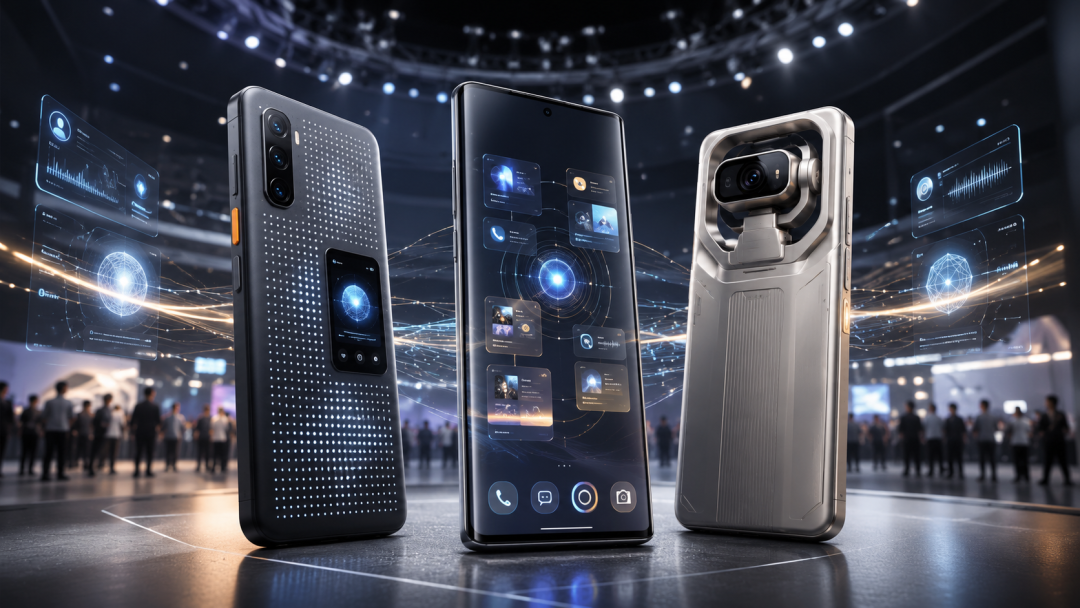
Nubia will showcase a mass-produced flagship model it claims is the 'world's first AI agent phone,' widely seen as the second-generation Doubao phone. Honor also confirmed that its Robot Phone will be unveiled at the WAIC special forum on July 18 and open for on-site experience.
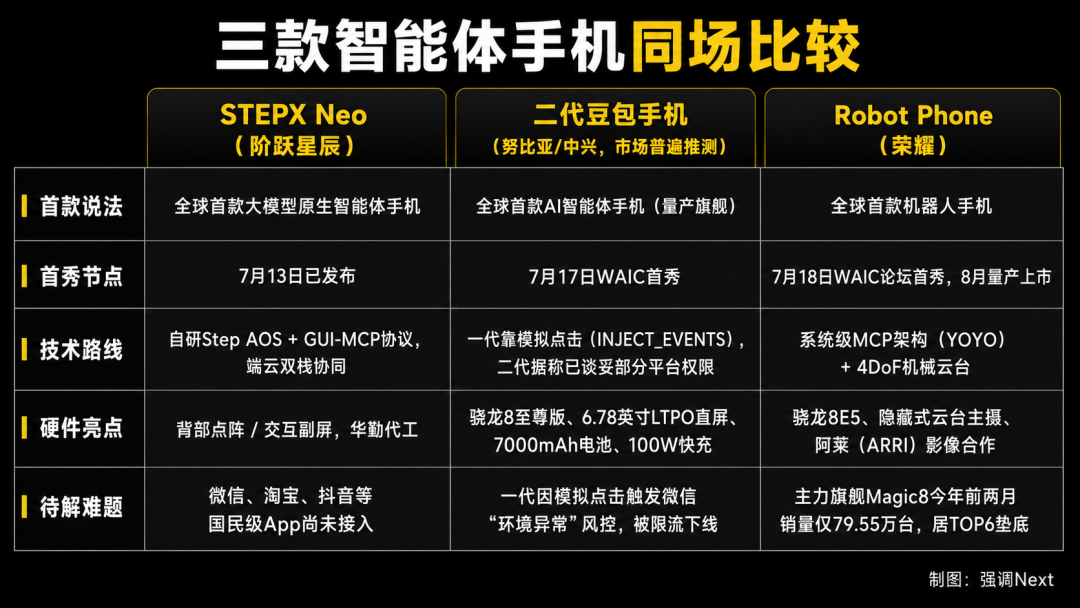
With JieYue's STEPX Neo, three phones, all claiming to be the 'world's first' agent phones, will be showcased together. JieYue emphasizes its native agent operating system, Nubia highlights mass production and cross-app execution, while Honor combines agents with a four-degree-of-freedom mechanical gimbal.
The emergence of three 'world's firsts' in a short period indicates that there is no universally recognized standard in this race. Anyone can redefine 'first' precisely because no one has truly succeeded yet.
01. The Surge of AI-Native Apps, Yet Phone Makers' AI Falls Short
QuestMobile's '2026 Mid-Year AI Application Market Insights Report' released yesterday explains the underlying logic behind these companies' Layout (strategic Layout can be translated as 'strategic moves' or 'strategic Layout ' but 'moves' is more natural in English) in agent phones.
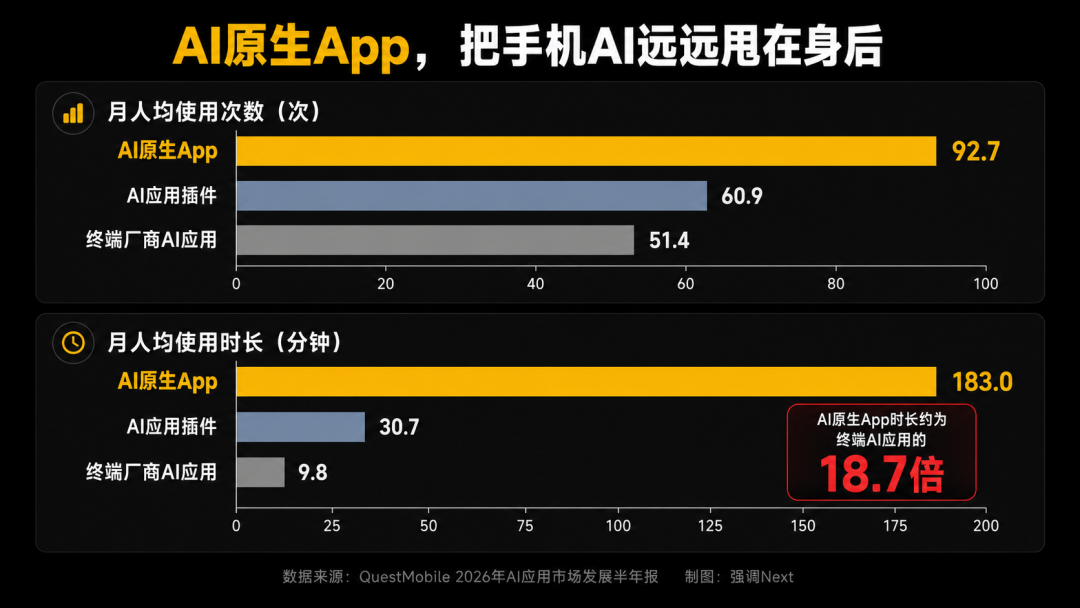
As of June, domestic AI-native apps had 499 million monthly active users, up 85.4% year-on-year, with users spending an average of 183 minutes per month, up 40%. AI apps have crossed the 'novelty' threshold and become a daily necessity. However, the same report shows that the largest volume actually comes from system assistants pre-installed by phone makers, with 755 million monthly active users, 256 million more than AI-native apps.

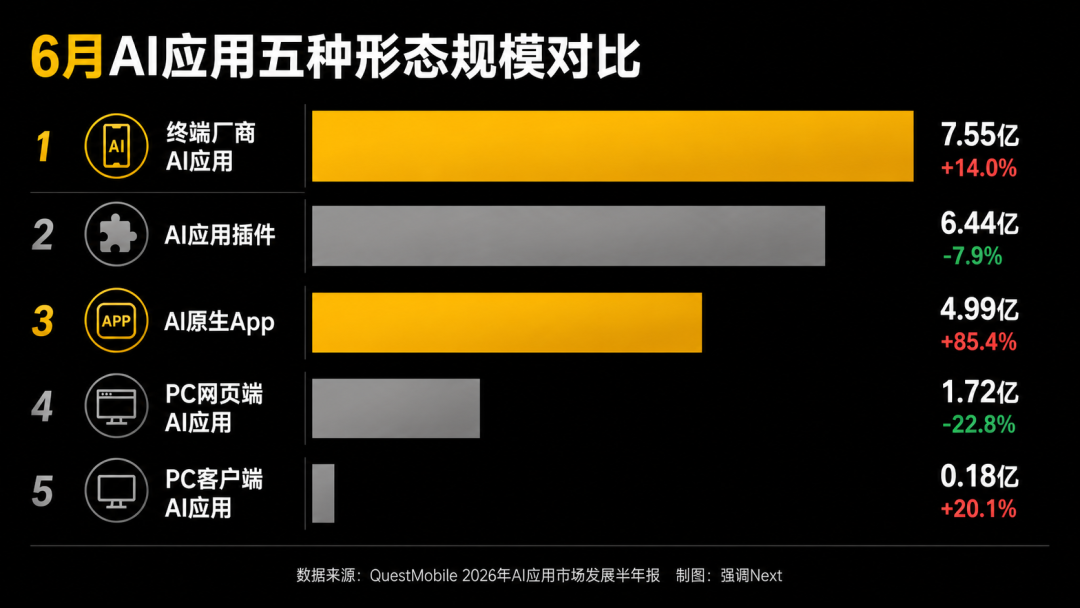
However, in terms of monthly usage per person, AI-native apps are used 92.7 times on average, while system assistants are only used 51.4 times, nearly half as much, with a staggering 18.7-fold difference in duration. Phone makers have won in volume through hardware pre-installation but are lagging in depth of use.
This contradiction is even more glaring at the brand level. QuestMobile data shows that OPPO's Xiao Bu ranks first with 165 million monthly active users, but the most frequent users are actually Xiaomi's Super Xiaoi (29 times per person per month). Apple's Siri ranks last, with only 3.8 times per person per month, less than one-twentieth of the average for AI-native apps.
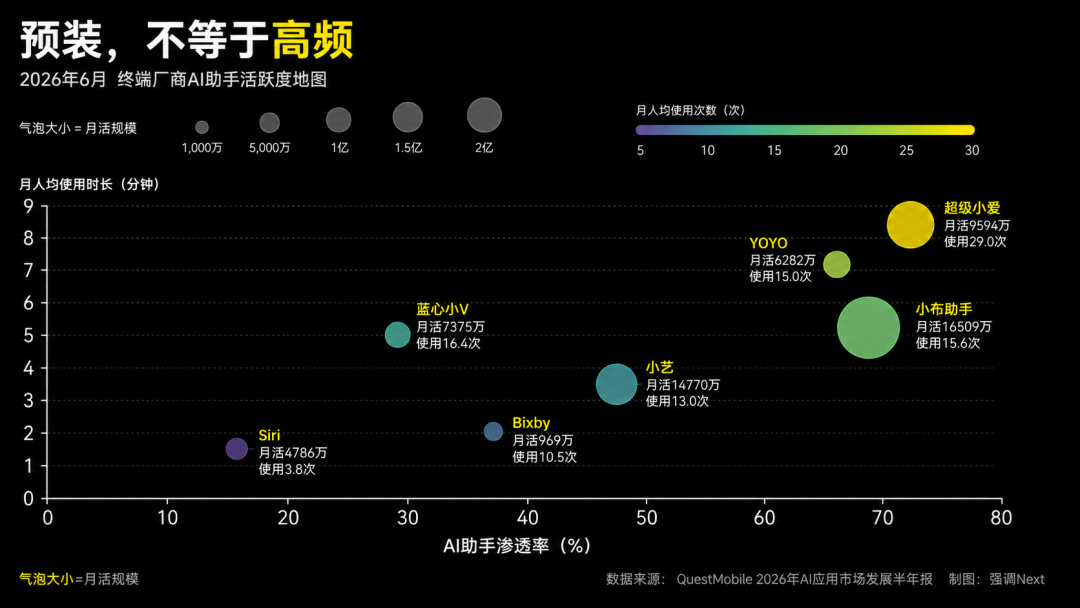
This exposes an awkward truth: phone makers have pre-installed more and more AI features, yet users have not changed their usage habits.
Summarization, translation, photo editing, and search seem to cover everything, but they are just scattered tools within the system. Users still need to remember these AI features and actively call them up. No matter how powerful the model is, if the entry point fails, the capability is hard to translate into usage frequency.
Yin Qi, Chairman of JieYue, put it more bluntly: agents residing in others' operating systems are forever just 'guests.' Only by rebuilding a house for agents can they become 'natives.'
But this sounds more like a judgment aimed at the industry and capital markets rather than a verified conclusion.
The core change in all three prototypes is elevating AI assistants to a system-level control center, not just pre-installed AI tools. However, phone makers and model makers differ in their starting points and forms. Whether this path can succeed depends not on technology but more on commercial interests and user habits.
Although STEPX Neo has passed the National Standard L3 Test for 'Artificial Intelligence Terminal Intelligence Grading,' the certificate proves its capability ceiling, not whether users are willing to entrust it with complex cross-app operations—a question none of the three companies have answered yet.
02. The Battle Over Paths Behind the Three 'Firsts'
The core issue lies in how agents invoke third-party apps.
JieYue follows a protocol-based approach. Its GUI-MCP protocol adopts a layered dual-stack architecture, keeping raw screenshots local and only transmitting semantic summaries to the cloud. The open-source GUI proprietary model has 4 billion parameters and can reportedly recognize and operate over 200 apps. Initial ecosystem partners include Alipay, Meituan, Didi, Gaode, JD.com, Baidu, WPS, CapCut, Ctrip, Tongcheng, Weibo, and others.
However, the market's most concerned apps—WeChat, Taobao, and Douyin—are not on the list.
Nubia takes the most aggressive path. The first-generation Doubao phone (engineering model Nubia M153, launched in December 2025 at 3,499 yuan) relied on system-level 'INJECT_EVENTS' simulated touch permissions and the wake word 'Doubao Doubao,' responding to almost any user command. It sold out quickly after launch, with second-hand prices once exceeding 10,000 yuan.
But consequences followed. This high-frequency automated clicking was soon identified by WeChat as abnormal operation, triggering 'environment anomaly' alerts and restricting some accounts from logging in. WeChat, Taobao, and other platforms subsequently blocked relevant permissions.
Tencent later publicly opposed uploading user screen recordings to the cloud via automated plugins. According to reports, the second-generation model has negotiated permission openings for high-frequency scenarios like social, office, and travel with some leading internet companies, but the extent of these openings will only be clear on July 17.
Honor chooses the most 'rule-abiding' path. Its YOYO agent, based on a system-level MCP architecture, covers over 3,000 scenarios. While secure, it is limited by whether third-party developers voluntarily adapt their interfaces. If commands are too complex or span multiple unadapted apps, YOYO may ' Strike ' (malfunction).
This 'first judge capability boundaries, then issue commands' interaction logic partly explains why Honor's flagship Magic8 received lackluster market feedback. According to data disclosed by tech bloggers earlier, as of Week 8 this year, Magic8 series sales stood at only 795,500 units, ranking last among flagship models from the TOP 6 phone brands.
03. Who Has the Authority to Click 'Confirm' for Users?
The essence of the three paths lies in whether agents need App approval to act on behalf of users.
The simulated click logic is that if users can operate something, agents should in principle (principally) be able to as well, without waiting for any platform to open interfaces. This is the most aggressive and fastest path but also the most challenging. IDC predicts that China's AI phone shipments will reach 147 million units in 2026, accounting for over half, but over 90% will merely overlay AI auxiliary functions without truly touching the underlying paradigm of human-computer interaction. The Doubao phone is among the few daring to take a step forward, only to be the first to hit the boundaries of super Apps.
The MCP protocol logic is the opposite: let Apps decide how far to open up. Both JieYue's GUI-MCP and Honor's system-level MCP follow this path, prioritizing security and control but inherently slower. App makers have no obligation to adapt immediately; the completeness of user experience depends on ecosystem partners' willingness, not technical limits.
The problem is that both paths ultimately face the same dilemma: super platforms like WeChat, Taobao, and Douyin are unlikely to cede their transaction and account systems. This is a question of traffic allocation rights and advertising revenue ownership. While it involves security on the surface, it goes deeper to core business models.
Thus, what agent phones are truly competing for is the authority to choose services on behalf of users.
Alibaba breaks down Taobao and Gaode into callable atomic skills, offering limited openness under its own rules. Tencent's restrained posture of 'light connection, heavy backend' essentially refuses to yield the power to define rules. None of the three internet giants are willing to budge first, making this the toughest nut to crack in this melee.
Without support from these leading platforms, agent phones will inevitably seem somewhat redundant.
04. Phones Are Not Products but Negotiation Chips
QuestMobile's half-year report shows clear commercialization signals from AI-native apps, not agent phones.
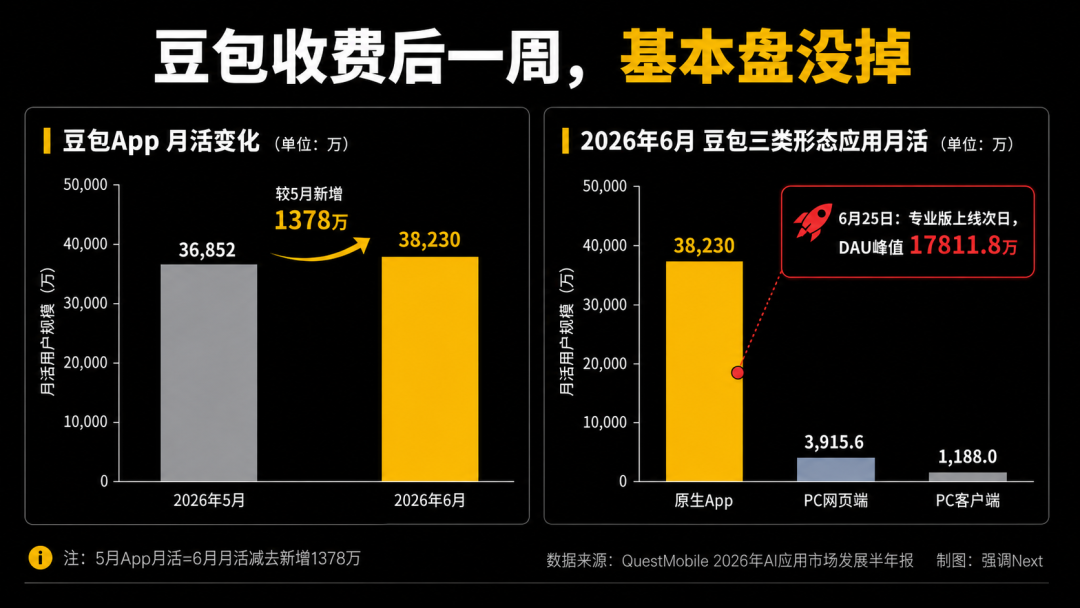
In June, Doubao's three application formats maintained robust activity, with the App version gaining 13.78 million new users from May. After launching a paid professional version on June 24, daily active users surged to over 178 million the next day, hitting a monthly peak. The paid model did not hurt the user base; the 'inclusive + premium' approach has proven viable.

Meanwhile, Qianwen reached 167 million monthly active users, up 5,792.9% year-on-year, and DeepSeek hit 130 million. Among the first tier formed by these three, the proportion of heavy users spending over 10 minutes per session is rising. Doubao leads at 27.5%, DeepSeek at 30.0%, and Kimi at 26.1%, all up at least 2 percentage points from last year.
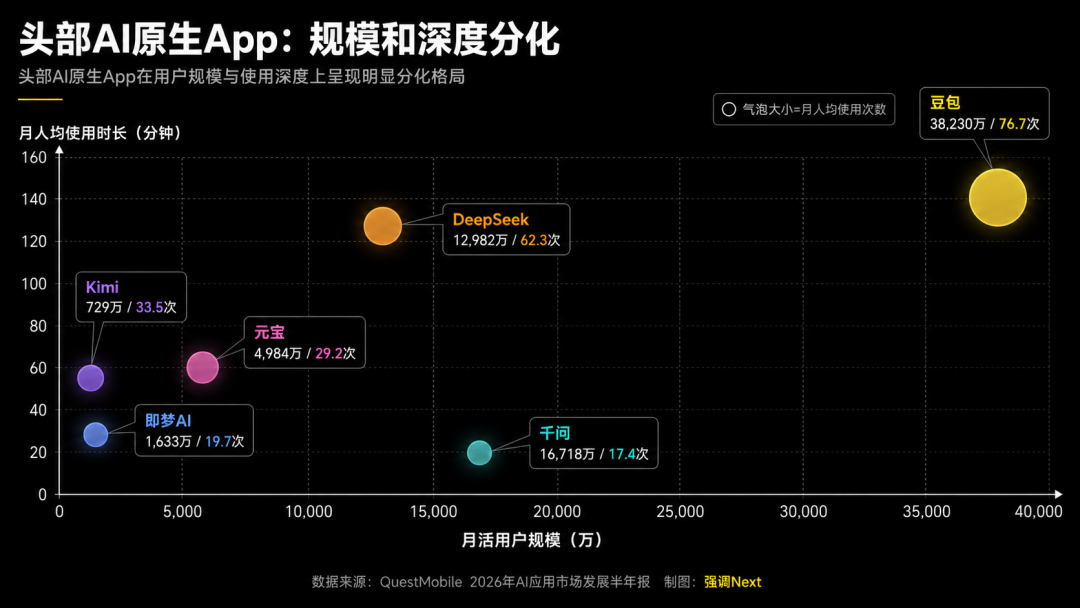
In contrast, all three agent phones remain in the prototype validation stage.
As of July 14, STEPX Neo has not announced its specs, price, or launch date. JieYue stated it will not monetize through hardware margins or pre-installed ads and has no fixed shipment targets. Nubia's mass-produced flagship has not revealed its price or launch date. Honor's Robot Phone only confirmed a Q3 launch, likely around August. At this stage, agent phones seem more like declarations of industrial status than proven consumer electronics businesses.
What truly determines who laughs last is the industrial alliances formed beneath the surface.
In January, JieYue completed a B+ round financing exceeding 5 billion yuan, with Huaqin Technology among the industrial investors. In May, the company raised nearly $2.5 billion in a new round, attracting core consumer electronics supply chain players like Huaqin, Longcheer, OmniVision, and ZTE, as well as Hong Kong Investment Management Corporation, dubbed the 'Hong Kong version of Temasek.' The company simultaneously completed share reform and removed its red-chip structure, leading media to speculate an imminent Hong Kong IPO.
Notably, Step series models from Jieyue have been pre-installed on approximately 60% of leading mobile phone brands through collaborations with manufacturers such as OPPO, Honor, and ZTE, with installations surpassing 42 million units and serving nearly 20 million users daily. Therefore, the number of units sold for the STEPX Neo prototype itself is not crucial; what matters is whether it can provide Jieyue with a tangible device as leverage when negotiating interfaces, permissions, and revenue-sharing rules with mobile phone manufacturers and App platforms.
Following closely behind is OpenAI. According to reports, its first AI Agent smartphone is expected to enter mass production as early as the first half of 2027. This arms race for AI agent terminals has never been merely a ranking competition among domestic players.
This scenario bears a striking resemblance to Google's strategy in 2007 when it partnered with HTC, Motorola, Qualcomm, and carriers to establish the Open Handset Alliance, promoting Android through real devices.
However, AI agent smartphones face greater resistance. Android helped mobile phone manufacturers reduce system development costs, benefiting nearly all participants. Once AI agents truly integrate into the system, they may alter the mobile phone manufacturers' own system entry points and bypass the pages, ads, and recommendation chains that super Apps rely on for survival. No one can be certain they will be a pure beneficiary.
Therefore, for Jieyue and ByteDance, the short-term goal may not be the number of units sold. What they need is a tangible device to prove that their models can truly integrate into the operating system. Armed with this leverage, they can then renegotiate permissions, interfaces, and revenue-sharing rules with mobile phone manufacturers and App platforms. The smartphone is the most visible prop in this game theory (game/competition), but the real negotiating table is not at the product launch event.
· Data Sources and Notes: QuestMobile's "Insight Report on AI Application Market Development in the First Half of 2026," official releases and public reports from Jieyue Stars (Jieyue Xingchen), Honor, and ZTE/Nubia.
- END -
-
Standing at a Distance, Behind Xiaomi's Phone Slowdown and Layoffs", "Xiaomi Phone, Declining Sales, Offline Stores, Product Strategy, Comprehensive Ecosystem of People, Vehicles, and Homes", "Accordi
-
![]()
Phoenix Optics Forecasts a Nearly 70% Drop in First-Half Net Profit, Yet Optical Business Profit Shows Growth!
-
![]()
A Staggering 50.16% Reduction in Losses Projected! COST's Interim Report Signals a Pivotal Moment
-
![]()
Nearly 19% of National Total! Guangdong Boasts 164 Registered Large Models as New AI Personification Regulations Take Effect
-
![]()
BYD’s Baosha, Sought After by Australians, Makes a Triumphant Return to China
-
【Focus】Analysis of Downstream Demand Sectors and Key Enterprise Development for Acrylic OCA Optical Adhesives in China by 2026
-
![]()
Big News! OpenAI Poaches Apple's Hardware Team
-
Hot Topic | DeepSeek and Zhipu Cross into Chipmaking, Domestic AI Firms Vie for Computing Autonomy