SPEC Cloud IaaS Performance Results Released, Domestic C86 Processor Breaks Records
 02/12 2026
 693
693

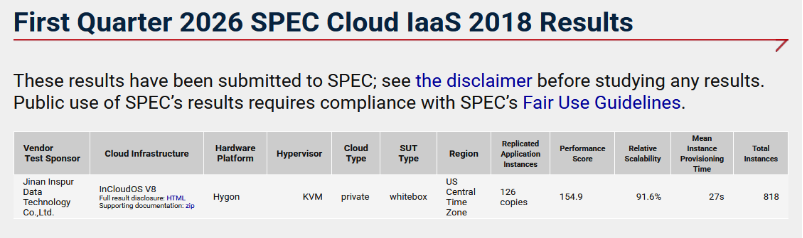
Recently, the international authoritative organization SPEC released the test results of SPEC Cloud IaaS 2018. Servers based on the Hygon C86 architecture processor achieved the highest publicly measured performance among domestic vendors in the Inspur Cloud InCloud OS environment.
In cloud computing core benchmark tests long dominated by international vendors, this result signifies that domestic general-purpose processors have entered a stage where their performance in IaaS core workload scenarios can be benchmarked against international mainstream platforms.
01
Cloud Computing Competition Shifts from 'Availability' to 'Efficiency'
Over the past decade, the competitive landscape of cloud computing infrastructure has undergone significant changes.
Initially, the core metrics were stability and ecosystem compatibility. However, as virtualization density and multi-tenant scale continue to increase, the key measures of cloud platform capabilities have shifted to resource scheduling efficiency and unit compute power output.
SPEC Cloud IaaS 2018 is designed around the needs of this stage. The test simulates enterprise cloud environments with continuous mixed workloads, focusing on evaluating:
Elastic scalability efficiency for large-scale instance concurrent scheduling Storage I/O latency Long-term stable operation capabilities
Therefore, this benchmark is closer to real cloud operation scenarios rather than traditional single-machine performance tests.
In this test, the platform achieved:
91.6% scalability efficiency 27-second instance readiness 4.073ms read latency / 2.183ms write latency
In cloud platform operations, scalability efficiency directly impacts resource oversubscription potential, instance readiness time relates to business elasticity capabilities, and millisecond-level I/O latency determines the stable throughput capabilities of database and microservice systems.
Overall, these metrics have entered a performance range capable of supporting large-scale production environments. For cloud service providers, such metrics directly correspond to unit rack capacity and resource utilization, serving as core variables in operational cost models.
02
Multi-Core Architecture Begins to Align with Real Cloud Workload Models
Cloud computing demands from CPUs are not about single-core performance but rather concurrent density and scheduling overhead control capabilities. As the scale of virtual machines and containers expands, processors need to maintain high context-switching frequencies and memory access pressures over extended periods, imposing higher requirements on cache coherence, interconnect bandwidth, and scheduling strategies.
Public information shows that the Hygon C86 4G processor participating in the test supports 64 cores and 128 threads, with concurrent scheduling optimizations tailored for cloud and data center scenarios. The test results reflect that in high-density instance environments, its multi-core parallelism and I/O response efficiency can support large-scale resource pool operations.
Industry experts point out that CPU competition in the cloud computing era is shifting from 'peak compute power' to 'stable throughput capabilities,' namely performance retention under prolonged multi-tenant workloads. This is why SPEC Cloud benchmarks hold more reference value compared to traditional SPEC CPU tests.
03
From Compatibility Validation to Operational-Level Validation
Previous breakthroughs in domestic server processors primarily focused on compatibility and deployment feasibility, while cloud vendors are truly concerned about migration costs and long-term operational efficiency.
The C86 architecture is compatible with the x86 software ecosystem, supporting the migration of existing applications; meanwhile, the processor incorporates built-in security mechanisms and Chinese cryptographic acceleration modules, catering to government and critical industry cloud environments. In cloud platforms, such capabilities directly impact virtualization security isolation and compliant data deployment.
This test was completed through collaboration between the processor and Inspur Cloud InCloud OS, involving multi-layer optimizations across hardware, firmware, virtualization, and resource management. This reflects that cloud infrastructure capability assessments are evolving from single-chip metrics to validation of hardware-software system collaboration (collaborative) capabilities.
Once processor performance, cloud operating system scheduling, and application ecosystems form a stable combination, the competitive dimension of domestic cloud infrastructure will gradually shift from availability validation to efficiency and cost model competition. This also means that the role of domestic CPUs in the data center market is evolving from a supplementary solution to a foundational compute power option.
-
![]()
The World's First Trillionaire Emerges: Is SpaceX's $2 Trillion Valuation Justified?
-
Volkswagen to Implement 19,000 Job Cuts in Germany This Year
-
![]()
Tremble, Humans: AI Continues to Accelerate at Breakneck Speed
-
![]()
A Strategic Vision: Taking a Leaf Out of Apple’s Book in China’s Operation-Intensive Auto Market
-
![]()
Yu Chengdong Declares, ‘Only First Place Exists in My Lexicon.’ Is This Bold Claim or a Promise of Excellence?
-
![]()
Agent OS is Here! HarmonyOS 7 Unveiled, Huawei Redefines OS
-
![]()
Agent OS is Here! Huawei Unveils HarmonyOS 7, Redefining Operating Systems
-
DingTalk’s Evolution and the Dilemma Facing Alibaba